

Refinery RCM is reliability centered maintenance applied to the pumps, compressors, heaters, exchangers, and safety devices that keep a refinery running. When you run it inside a CMMS, each RCM decision becomes a scheduled task with a clear reason, a record, and live data that shows whether it works. That pairing is what digital maintenance for refining really means.
Most refineries already have both tools. The trouble is that they rarely connect. RCM studies sit in spreadsheets, while the CMMS runs on OEM intervals and old habits. This guide shows you how to join them, with a criticality matrix, the CRUDE Reliability Framework, a 7-step rollout, and the KPIs that prove it is working.
Key Takeaways
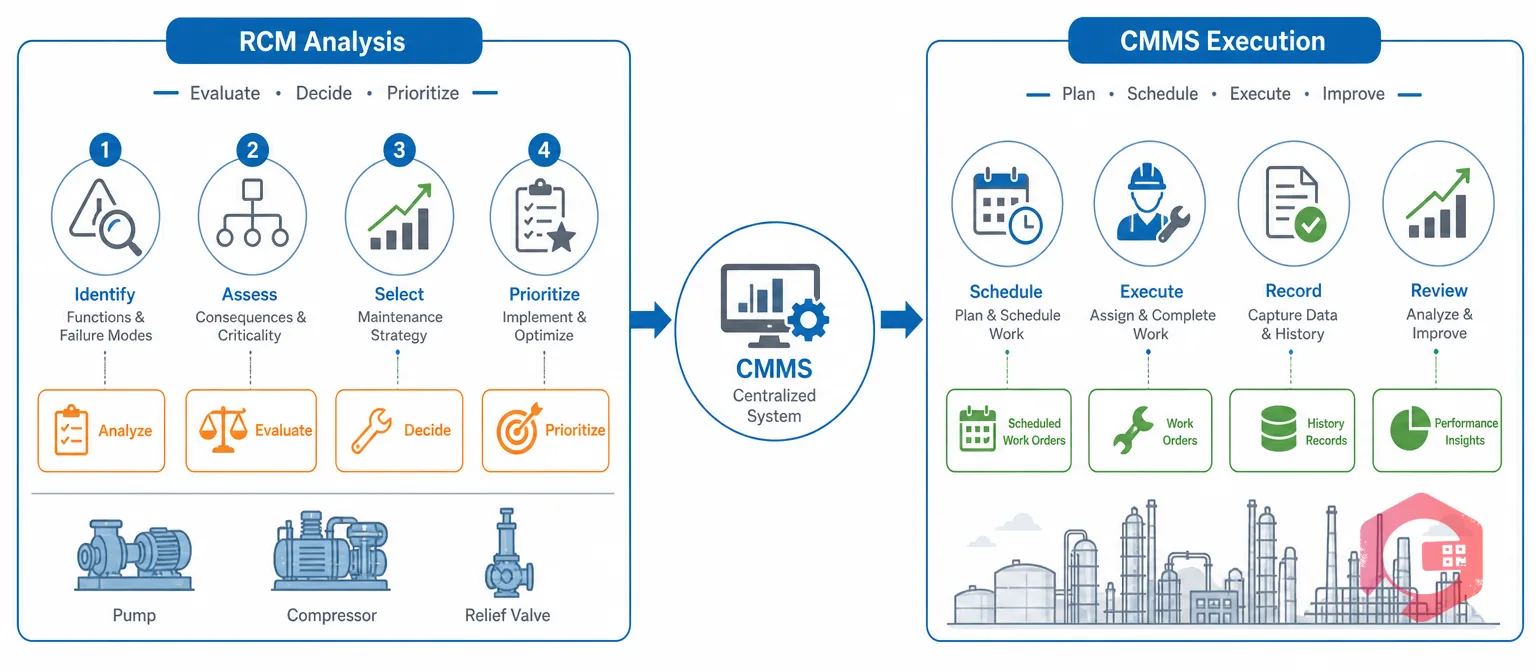
Refinery RCM is a method for choosing maintenance tasks based on how refinery assets fail. It also weighs what each failure costs in safety, environment, and margin. It asks what each asset must do, how it can fail, and what happens when it does. Then it picks the task that deals with each failure mode at the lowest total risk and cost.
Classic reliability centered maintenance follows the SAE JA1011 standard, which sets seven questions any true RCM process must answer. In a refinery, those answers also have to fit the rules and practices that already govern the plant.
RCM, RBI, and API 691 are not rivals. In most refineries, RBI covers static equipment, RCM covers rotating and electrical equipment plus instruments, and the CMMS is where all of their tasks meet. A refinery RCM program works best when it shares one asset register and one failure code list with these other programs.
Refineries need digital maintenance because RCM only pays off when its decisions reach the field and its results come back as data. Paper studies break that loop. A refinery can spend months on RCM workshops and still run the same PM plan two years later.
The stakes are high. A single trip on a main air blower or a recycle compressor can shut down a whole unit, flare product, and cost large sums in lost margin each day. Process safety incidents investigated by the US Chemical Safety Board have often pointed to gaps in maintenance and mechanical integrity.
A Computerized Maintenance Management System (CMMS) fixes these gaps by holding the asset register, task library, failure codes, and work history in one place. That shift from static study to live program is the heart of digital maintenance in refining.
CMMS and RCM work together through five connected data layers. When these layers link, every task in the system can be traced back to a failure mode and a risk decision.
Each asset sits in a clear tree: site, unit, system, equipment, and maintainable item. Using the ISO 14224 structure makes it easy to compare a crude unit pump with the same pump type in a hydrotreater.
Technicians pick a failure mode, a cause, and an action when they close a job. These codes should match the failure modes in your RCM worksheets, so field data maps straight back to the analysis.
Every PM, inspection, and condition check stores the failure mode it protects against. A planner can open any task and see why it exists and who approved it.
Vibration, temperature, pressure, and oil analysis readings flow into the asset record. When a value drifts past its limit, the system can raise a work order on its own.
A new interval or task goes live only after MOC review. The system keeps the version history, the approver, and the effective date.
Many refiners run these layers in EAM software that spans several units or sites. The result is two-way traceability: start from a task and reach the risk rationale, or start from a failure and find the task that should have caught it.
Want a quick baseline before your first review? Run your history through the free failure rate calculator to see which refinery assets fail most often.
A refinery RCM criticality matrix links each key asset to its main failure mode, its consequence, and the strategy that fits. The sample below shows how a reliability team might fill one in, plus the CMMS record each decision creates.
| Asset | Unit | Dominant Failure Mode | Consequence | Criticality | Chosen Strategy | CMMS Record |
|---|---|---|---|---|---|---|
| Main air blower | FCC | Bearing or seal degradation | Unit shutdown, large margin loss | A | Online vibration and oil analysis | Condition alarm with auto work order |
| Recycle gas compressor | Reformer | Valve or rod packing wear | Unit rate cut, hydrogen loss | A | Valve temperature trending, planned valve swaps | Condition task plus runtime PM |
| Crude charge pump | Crude unit | Mechanical seal leak | Fire risk, hydrocarbon release | A | Seal pot checks, vibration route | Weekly route with readings |
| Fired heater tubes | Coker | Coking and creep damage | Tube rupture, fire | A | Tube skin thermocouples, IR scans, RBI plan | Inspection task linked to RBI |
| Pressure relief valves | All units | Fails to open at set pressure | Overpressure, PSM finding | A | Bench test at risk-based intervals | Statutory PM with test results |
| Feed/effluent exchanger | Hydrotreater | Fouling | Throughput loss, more fuel use | B | Approach temperature trending, clean on condition | Meter-based trigger |
| Fin-fan cooler motor | Utilities | Bearing failure | Minor capacity loss, spare fans exist | C | Run to failure with stocked spares | Corrective work order only |
The last row is a valid RCM outcome. Refinery RCM does not mean more maintenance everywhere. It means the right task on each asset, with the reason written down and stored where planners can find it.
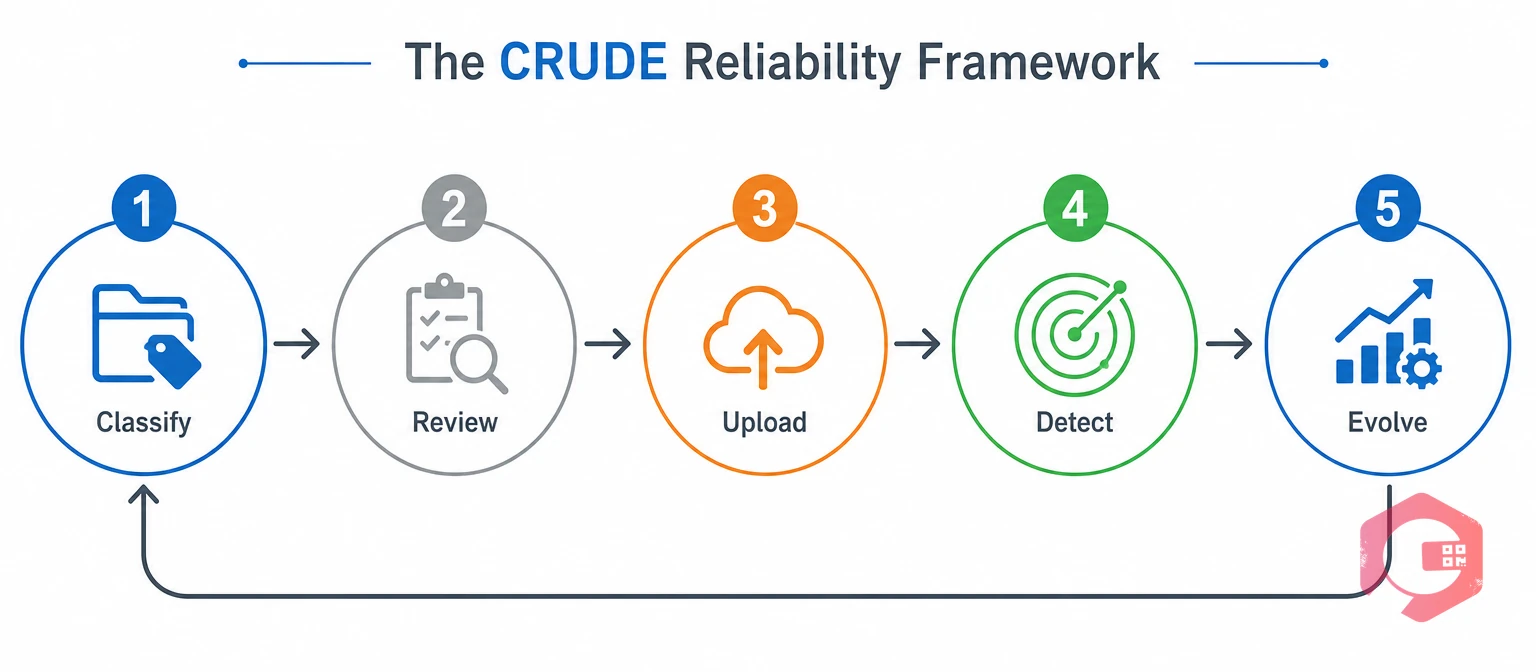
The CRUDE Reliability Framework is a five-stage loop for running refinery RCM inside a CMMS. Each stage has a clear owner and leaves a record, so the program holds up under PSM audits and turnaround reviews.
The CRUDE Reliability Framework:
Most refinery RCM programs stall between Review and Upload. The study is done, but nobody has time to turn hundreds of decisions into system tasks. Treat Upload as its own work package with a deadline, an owner, and an MOC record.
Detect turns RCM from a once-every-few-years study into a daily habit. Condition monitoring software pulls readings from sensors, historians, or operator rounds into each asset, and raises a work order when a value crosses its limit.
Maintenance teams using Cryotos have reported up to 30% reduction in unplanned downtime and 25% faster repair turnaround once condition triggers and work orders run in one system. CRUDE works because it treats RCM as a living program, not a report.
Condition monitoring is the most common task type that comes out of refinery RCM, because many failure modes give a warning before they happen. Research by Nowlan and Heap found that most component failures are not tied to age, so fixed-interval overhauls often miss them.
Condition monitoring is the regular measurement of an asset's health to spot signs of failure early. In a refinery, the right method depends on the failure mode, not on what tools the team happens to own.
Vibration readings catch imbalance, misalignment, looseness, and bearing wear on rotating equipment. Critical machines like main air blowers often have online probes, while spared pumps sit on a monthly walk-around route.
Lube oil samples show wear metals, water, and breakdown of the oil itself. A rising iron or copper count can warn of bearing or gear damage weeks before vibration changes.
Infrared scans find hot spots in switchgear, motor control centers, and fired heater tubes. Many refineries scan electrical rooms each year and heater tubes far more often.
Refineries already collect huge amounts of process data. Exchanger approach temperatures, pump discharge pressures, and compressor valve temperatures can all act as condition signals when you link them to the right asset.
When condition data lives on the asset record next to the RCM decision, the team can see whether each task is catching failures in time. That feedback is what keeps a refinery RCM program sharp year after year.
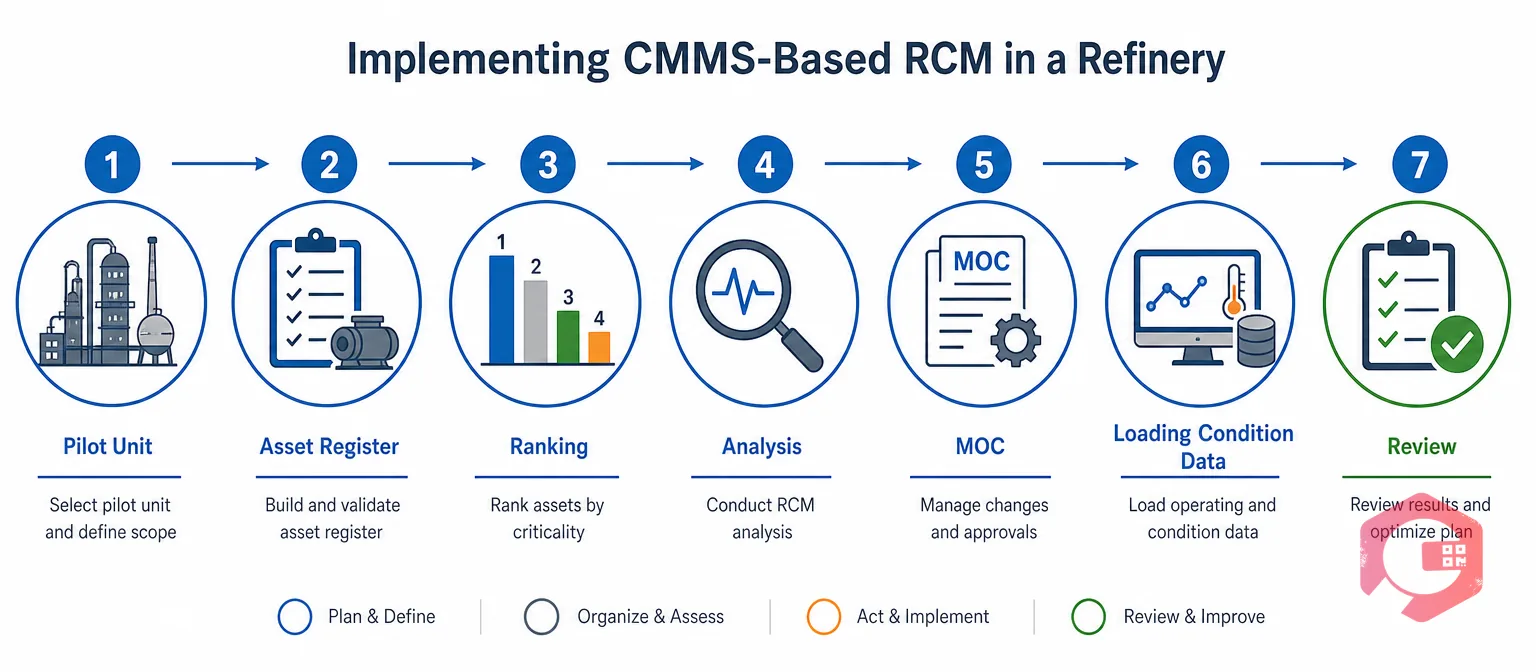
You can implement CMMS-based RCM in a refinery in seven steps. Start with one unit, prove the method, and then scale across the site.
Choose a unit with known bad actors, decent records, and strong support from operations. An FCC, a crude unit, or a hydrotreater often makes a good first choice. Avoid starting a pilot right before a turnaround, when the team has no time to spare.
Confirm every asset in the pilot unit has the right tag, location, class, and parent. Remove duplicates, fill gaps, and align the structure with ISO 14224.
Score each asset for safety, environmental, production, and repair impact. Focus full RCM effort on the A-ranked assets and use a lighter review for the rest.
Work through functions, failure modes, effects, and task choices with a small cross-functional team. Record each decision in a format that maps straight to CMMS task fields, so loading is quick later. Most teams use failure mode and effects analysis (FMEA) as the core tool for this step.
Raise one MOC for the pilot package. Once approved, load the tasks, checklists, and limits, and let work order management handle assignment, sign-off, and records.
Link key readings from your historian or operator rounds to each asset. Make failure codes mandatory before any corrective work order can close.
Track the KPIs below for two or three quarters. Share results with operations and site leadership, then repeat the method on the next unit with the templates you already built.
Each new unit gets faster because the codes, templates, and approval path already exist.
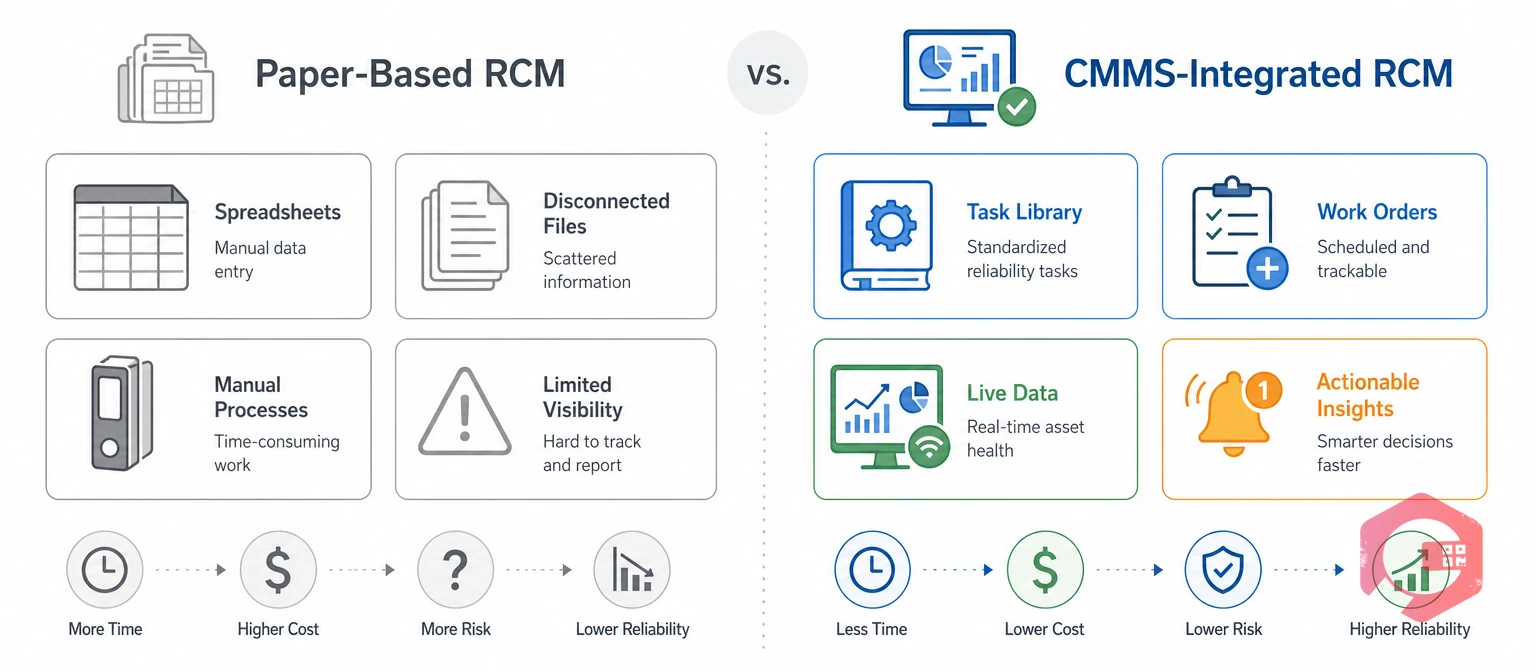
CMMS-integrated RCM keeps decisions live, while paper-based RCM tends to fade once the workshops end. The table below compares the two on the points that matter most in a refinery.
| Factor | Paper-Based RCM | CMMS-Integrated RCM |
|---|---|---|
| Where decisions live | Spreadsheets and consultant reports | Task library linked to each failure mode |
| Path to the field | Manual re-entry, often skipped | Approved tasks go live as scheduled work orders |
| MOC link | Handled separately, easy to miss | Built into the task approval workflow |
| Failure data | Free-text notes, hard to analyze | ISO 14224-style codes that map to the worksheet |
| Condition data | Kept in separate tools or not at all | Readings on the asset record with alarm limits |
| Turnaround planning | Scope copied from the last event | Scope based on condition and failure history |
| Audit response | Rationale rebuilt from old files | Rationale, approvals, and history in one place |
The pattern is the same in most refineries. The analysis is rarely the weak point; the handoff into daily work is. Integration fixes the handoff.
Turnarounds are where refinery RCM delivers its biggest savings, because they hold the largest block of planned work and cost. A typical oil refinery runs each major unit for several years between turnarounds, so every item on the scope list matters.
A turnaround is a planned unit shutdown for inspection and repairs that cannot be done online. It often includes upgrades and catalyst changes too. Scope growth is the main reason turnarounds run over time and budget.
When each scope item links to a failure mode and its history, the planning team can defend what stays and drop what does not. Refiners using oil and gas CMMS software can pull this view by unit in minutes rather than weeks.
Say a hydrotreater scope lists every pump for a full overhaul, just like the last event. RCM review shows that four of the six pumps have spares, steady vibration, and no seal failures in five years.
Every item you remove with evidence frees time and budget for the work that truly protects the unit.
The most common mistakes in refinery RCM programs come from treating RCM as a project instead of a process. Operations that successfully sustain RCM avoid a short list of traps.
A hidden failure is a failure that operators cannot see until a second event occurs. A stuck relief valve is the classic refinery example, because nobody knows it will not open until pressure rises. Most facilities see quick gains just by fixing the first three items on this list and testing hidden failures on a set schedule.
The right KPIs show whether refinery RCM is cutting risk and cost without adding new gaps. Track a short list and review it at every RCM cycle.
Task traceability rate is the share of active tasks linked to a documented failure mode. It shows auditors and managers that your maintenance plan rests on risk, not habit. Watch these numbers between reviews, not just at review time, so trends surface early.
RBI, based on API 580 and 581, sets inspection plans for static equipment such as vessels, piping, and exchangers. RCM covers rotating, electrical, and instrument assets by choosing tasks for each failure mode. Most refineries run both and store their tasks in the same CMMS.
No, OSHA PSM does not require RCM by name. It does require written mechanical integrity procedures, inspections, testing, and records for covered equipment. RCM is one of the clearest ways to show that your tasks and intervals are based on documented risk.
A focused pilot on one unit usually takes three to six months, including analysis, MOC, and task loading. The analysis often takes only a few weeks. Cleaning the asset register and loading tasks take the rest, so plan for them early.
A CMMS does not replace the RCM team's judgment, but it holds everything the team needs and produces. It stores the asset hierarchy, failure codes, task library, condition data, and approvals. That makes each review faster and every decision easy to trace.
Start with assets whose failure can cause a fire, a release, or a unit shutdown. Common first picks are main air blowers, recycle compressors, charge pumps, and relief systems. Lower-risk assets with spares can use a lighter review or run to failure.
Digital maintenance gives planners failure history and condition data for every scope item. That evidence helps them cut habit-based work, defer overhauls on healthy assets, and add tasks that protect against real failure modes. The result is a tighter scope that is easier to defend.
Refinery RCM delivers when every decision becomes a scheduled, traceable task backed by real failure and condition data. Schedule a free demo to see how Cryotos links your asset hierarchy, RCM task library, condition alerts, and work orders in one maintenance platform.



Cryotos AI predicts failures, automates work orders, and simplifies maintenance—before problems slow you down.



