

A reopened work order is one of the most candid signals in a maintenance operation. When a work order that was marked complete is reopened — because the fault recurred, the repair failed, or the asset could not be returned to full service — the system is recording something that verbal reporting routinely conceals: the repair did not work the first time. According to SMRP maintenance benchmarking data, world-class maintenance organisations target a reopened work order rate below 2%. Facilities running above 8% are effectively running a rework programme alongside their normal maintenance operation — paying twice for repairs that should have been closed once, correctly, the first time.
Key Takeaways
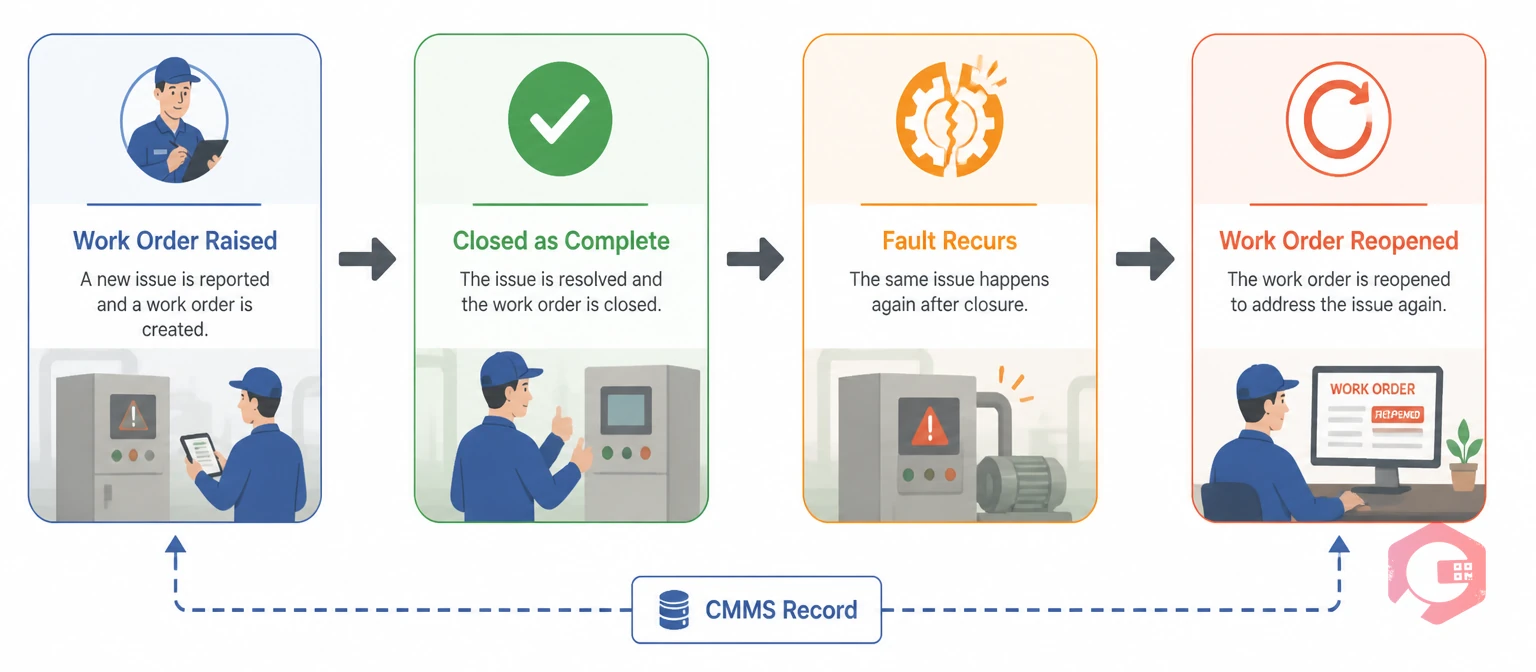
A reopened work order is a corrective or preventive maintenance work order that was closed as complete and then reopened — either because the fault it was intended to address recurred within a defined period, because an inspection identified that the repair was incomplete, or because the asset could not sustain the performance standard required after the work was done. In a CMMS, this appears as a work order that transitions from a closed status back to an open or in-progress status, or as a new work order linked to a recently closed one on the same asset for the same failure mode.
It is important to distinguish reopened work orders from naturally recurring failures. A bearing that is replaced correctly and fails again 18 months later on a high-cycle machine is not a reopened work order scenario — it is a wear cycle operating within its expected lifespan. A bearing replaced on Friday that fails again by Monday is a reopened work order scenario — something about the original repair was incomplete, incorrect, or insufficient to restore the asset to reliable service. The distinction is temporal proximity and causal connection: a reopened work order is one where the failure recurs within a timeframe and from a cause that is directly attributable to the quality of the previous repair.
Most CMMS platforms support reopening work orders explicitly — a status transition from closed to active with a required reason code. The most analytically useful practice is to require technicians or supervisors to classify the reopening as one of a defined set of reason types: incomplete repair, wrong diagnosis, incorrect parts, repair procedure not followed, or quality inspection failure. Each reason type points to a different root cause and a different preventive action. Without this classification, the CMMS records that a work order was reopened but not why — which means the data can surface the problem but not diagnose it.
The reopened work order rate is calculated as the percentage of closed work orders that are subsequently reopened within a defined window — typically 30 days for corrective work orders. This metric sits alongside first-time fix rate (the inverse: the percentage of work orders closed correctly on the first attempt) as one of the clearest indicators of maintenance execution quality in a CMMS-equipped operation.
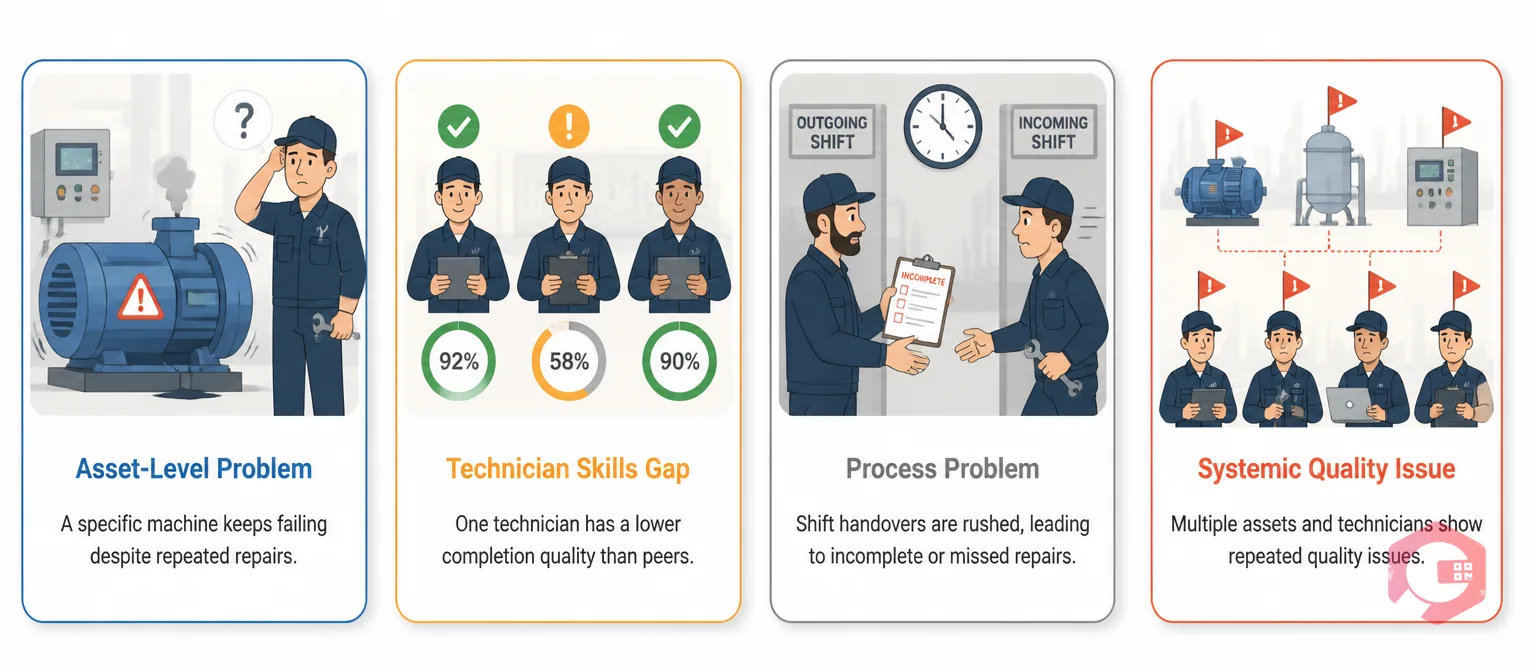
The reopened rate is a composite diagnostic — it does not identify a single problem, but it reliably points to the category of problem that is present. Understanding what different reopened rate patterns reveal is the first step toward using the metric productively.
A high reopened rate concentrated on specific assets almost always indicates an asset-level problem: a failure mode that is misunderstood, a repair procedure that is incorrect for the operating conditions, or a specification mismatch between the replacement parts and the actual service environment. When the same asset generates a disproportionate share of reopened work orders, the correct response is not to retrain the technician but to investigate whether the current repair approach is actually the right one for that specific failure mode on that specific asset in its current operating context.
A high reopened rate concentrated on specific technicians almost always indicates a training or skills gap — or a supervision gap where a technician is consistently signing off work that has not been fully completed. The data distinction is important: if one technician generates 40% of all reopened work orders despite handling 20% of the workload, the problem is specific to that individual's execution or reporting, not to the work type or asset class.
A high reopened rate concentrated on specific work types — emergency reactive repairs, particular PM task categories, or work done during shift handovers — indicates a process problem. Emergency repairs done under time pressure tend to have higher reopened rates because diagnostic rigour is compressed and parts may be substituted rather than correctly specified. PM work done at shift handover may be signed off incomplete because the incoming technician assumed the outgoing one finished what they started.
A generally elevated reopened rate across all assets, technicians, and work types — without a clear concentration pattern — typically indicates a systemic problem: time pressure culture, inadequate job information at dispatch, parts availability issues that force improvised repairs, or a work order closure culture that values throughput over quality. This pattern is the hardest to address because it does not have a single focal point — it requires a programme-level intervention rather than a targeted fix.
According to Plant Engineering benchmarking research, the average industrial facility has a reopened work order rate of 6–10%. World-class facilities target below 2%. The gap between these numbers is not primarily a skills gap — it is a process and data visibility gap. Facilities that track reopened rates by pattern type and review them monthly consistently improve to the 2–4% range within 12–18 months, regardless of starting point.
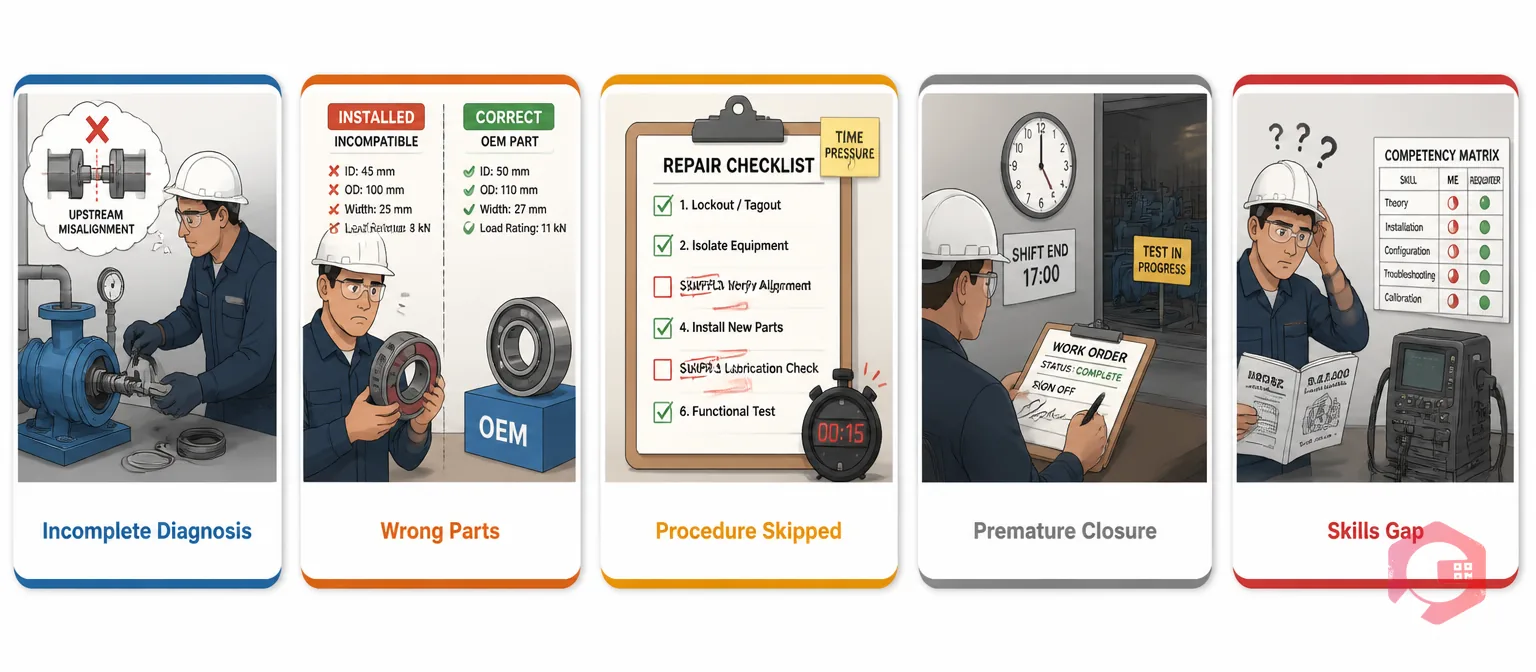
Reopened work orders do not have a single cause. They are produced by five distinct failure modes in the maintenance execution process, each of which generates a recognisable pattern and requires a specific intervention. Identifying which root cause is dominant in your operation before attempting to reduce the reopened rate is essential — the wrong intervention makes no difference and sometimes makes things worse.
The first root cause is incomplete diagnosis. The technician identified and repaired the most visible symptom of a failure but did not identify the underlying cause. The most common example is replacing a component that failed as a consequence of an upstream condition — a pump seal replaced without identifying the misalignment that caused the excessive shaft deflection that destroyed the seal. The seal replacement closes the immediate work order; the misalignment reopens it within weeks. The diagnostic question for this root cause is: does the reopened work order involve the same component as the original, or a different component in the same subsystem? If the latter, incomplete diagnosis is likely. The fix is a structured troubleshooting protocol that requires technicians to confirm root cause before closing — built into the work order checklist as a required field rather than left to individual judgment. Using the Cryotos root cause analysis workflow linked directly to the work order closure process ensures this step is never skipped under time pressure.
The second root cause is incorrect or incompatible parts. The right component category was used but with the wrong specification — wrong material grade for the operating temperature, wrong clearance for the shaft diameter, wrong viscosity for the lubrication requirement. This is particularly common when OEM parts are substituted with non-OEM equivalents without a technical equivalence check. The diagnostic question is: does the reopened work order occur within the expected service life of the replacement part? If a bearing rated for 5,000 hours of service is failing within 200 hours, the part specification is wrong for the application. The fix is linking work order templates to verified parts lists with approved substitution matrices in the CMMS — so technicians always have access to the correct specification and documented alternatives. Cryotos's spare parts inventory software supports this through parts linkage at the work order template level, ensuring the correct part number and specification are visible at dispatch.
The third root cause is repair procedure not followed. The correct procedure exists but was not followed — because it was not available at the point of work, because time pressure led the technician to skip steps, or because the technician substituted their own method based on experience. This is the root cause that maintenance checklists are specifically designed to prevent. A checklist that cannot be bypassed and that requires confirmation of each step before the next one is visible converts a discretionary procedure into an enforced sequence. Cryotos's maintenance checklists are embedded directly in the work order mobile workflow — technicians cannot mark the job complete without completing the required checklist steps — which addresses this root cause structurally rather than through supervision alone.
The fourth root cause is time pressure and premature closure. The technician or supervisor closes the work order before the repair is fully verified — because of shift end, production pressure to return the asset, or accumulated job backlog. The asset may appear functional at the point of closure but has not been run under load conditions sufficient to confirm the repair held. This root cause is the most common driver of the shift-handover concentration pattern: repairs started at the end of one shift and handed over to another are disproportionately likely to be closed prematurely. The fix involves two elements: a work order closure protocol that requires a defined verification step before closure is permitted (for example, a minimum run time confirmation for rotating equipment), and a CMMS culture that makes premature closure visible to supervisors rather than invisible.
The fifth root cause is a skills or knowledge gap. The technician genuinely did not have the competency to perform the repair correctly — either because the task was outside their skill classification, because they had not received adequate training for this specific asset type, or because they were working on equipment with which they had limited experience. This root cause is identifiable when the reopened rate is concentrated on a specific technician or technician cohort, regardless of asset type. The fix is targeted skills development — matched to the specific competency gap identified from the reopened work order data — not generic refresher training. Using the work order management system to track technician assignment by competency tag, and routing complex repairs to appropriately qualified technicians, prevents skill mismatches before they generate reopened work orders.
The reopened work order rate formula is: Reopened Rate (%) = (Work Orders Reopened Within 30 Days ÷ Total Work Orders Closed in the Same Period) × 100.
For example: in a given month, 340 work orders are closed. Of those, 24 are reopened within 30 days. Reopened rate = (24 ÷ 340) × 100 = 7.1%.
The 30-day window is the standard for corrective work orders. For preventive maintenance work orders, a reopened event within 14 days of a PM completion — a fault occurring on an asset that was just serviced — is a signal that the PM did not restore the asset to the required condition, and should be tracked as a PM quality event rather than a standard reopened work order.
Benchmark your reopened rate against three reference points. The first is your own historical trend: plot the rate monthly and look for direction of travel rather than absolute position. A team at 9% that has moved from 14% over six months is making meaningful progress. A team at 6% that has been stable for two years has reached a plateau that requires fresh diagnostic work to break through.
The second reference point is the industry benchmark: 2% or below is world-class, 3–5% is good performance, 6–10% is average, and above 10% signals a systemic quality problem. The average industrial facility sits at 6–10%, which means that for most teams, significant improvement is achievable without fundamental organisational change — it requires process improvement and better data visibility.
The third reference point is segmentation within your own data. Calculate the reopened rate separately for emergency reactive work orders, standard corrective work orders, and PM-related work orders. Calculate it separately for each major asset class, each shift, and each technician cohort. These segmented rates tell you far more than the overall average — because a 7% overall rate might hide a 1% rate on planned work and a 22% rate on emergency repairs, which is a completely different problem from a uniformly distributed 7%.
Your BI Dashboard in Cryotos should be configured to show reopened rate as a standing metric alongside PM compliance, MTTR, and work order backlog — reviewed in the monthly maintenance quality meeting. The MTTR calculator provides the execution time baseline that allows you to distinguish between slow-but-correct repairs and fast-but-wrong ones.
The nominal cost of a reopened work order appears to be the cost of the second repair. The true cost is significantly higher, and understanding its full composition changes the priority calculation for reducing the reopened rate.
The direct cost components of a reopened work order include: the labour cost of the second repair (at least equal to the first, often higher if the failure has progressed during the interval between repairs), the parts cost of the second repair (frequently at emergency procurement pricing if the original parts budget was not anticipated to need replacement again), and the administrative cost of managing the reopened event — creating the new or reopened work order, sourcing the technician, and updating the asset history.
The indirect costs are typically larger. The most significant is extended asset downtime: the asset was returned to service, failed again, and is now out of service for a second period. For production-critical assets, the downtime cost of the second failure event can dwarf the repair cost. According to Reliabilityweb research on maintenance cost drivers, the average industrial facility's emergency repair cost is 3–5 times higher than an equivalent planned repair — and a reopened work order frequently involves emergency-level response for what should have been a completed job.
There is also a less quantified cost: the erosion of trust between the maintenance function and production operations. When a production team observes that a recently completed repair has failed again, their confidence in maintenance competence is reduced. Over time, this erosion of trust generates operational friction — production teams hold back equipment access, pad handover requirements, or escalate maintenance issues over the maintenance team's head rather than working through the normal process. Quantifying this cost is difficult, but experienced maintenance managers recognise its operational significance.
The total cost of a reopened work order, including direct and indirect components, is typically 2–3 times the cost of the original repair. For a corrective work order that cost $800 in labour and parts, the fully-loaded cost of a reopened event — including the second repair, the additional downtime, and the emergency premium — is $1,600–$2,400. At a reopened rate of 8% on a facility closing 300 work orders per month at an average cost of $600 per work order, the monthly cost of reopened events is 24 events × $600 additional cost = $14,400 per month — $172,800 per year in avoidable rework cost.

Reducing the reopened rate requires addressing the dominant root cause for your specific operation rather than applying generic improvement measures. The following actions address each root cause directly and produce the fastest and most durable improvements.
For incomplete diagnosis, the most effective intervention is building a structured cause confirmation step into the work order closure checklist. The technician must identify and record not just the failed component but the failure cause before closure is permitted. This takes less than two minutes for a standard repair and dramatically reduces the rate at which symptom-level fixes are signed off as complete. Over time, the accumulated cause confirmation records build the failure pattern data that surfaces systemic diagnosis problems.
For incorrect or incompatible parts, the intervention is verifying parts specifications against the work order template before the technician leaves the workshop. When the correct part number and approved substitution options are attached to the work order template in the CMMS, the technician either uses the right part or flags the discrepancy — rather than improvising a substitution that may be mechanically incompatible with the operating conditions.
For procedure not followed, the intervention is mandatory digital checklists with enforced completion sequences. A checklist that can be bypassed will be bypassed. A checklist that is structurally required by the CMMS work order workflow, with each step confirming completion before the next becomes visible, becomes the de facto procedure compliance mechanism. Calibration, torque, alignment, and run-test steps that are most commonly skipped under time pressure should be checklist items with required sign-off fields.
For premature closure, the intervention is a minimum verification period requirement for asset classes where run-time confirmation is needed. For rotating equipment, a 15–30 minute monitored run under load as a required closure step prevents the pattern of assets being returned to service before the repair has been stress-tested. The CMMS captures the time of the verification confirmation and flags work orders where this step was skipped.
For skills and knowledge gaps, the intervention is routing work orders by competency tag and building targeted training from the reopened rate data by technician. Work order management systems that support technician skill tagging allow supervisors to route complex repairs to qualified technicians automatically — preventing skill mismatches before they generate reopened events.
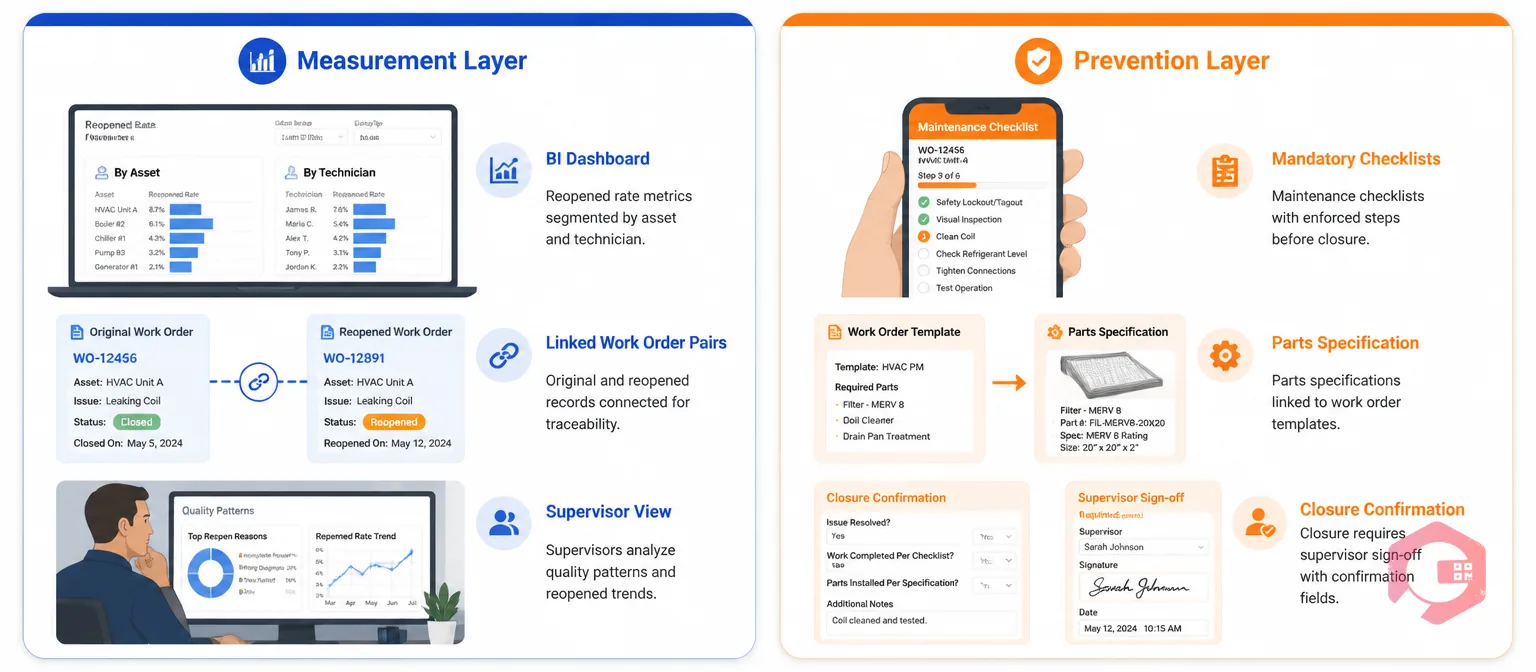
Cryotos CMMS addresses reopened work orders at both the measurement and prevention layers — making the rate visible in real time and building the workflow controls that reduce it structurally.
At the measurement layer, Cryotos tracks reopened work order rate as a standard metric in the BI Dashboard, segmented by asset, technician, work order type, and shift. When a work order is reopened, the system automatically links it to the original closed work order — creating a paired record that makes the pattern immediately visible. Supervisors can see at a glance which assets are generating disproportionate reopened events, which technicians are involved, and what reason codes are most common. This visibility is the prerequisite for any improvement effort: you cannot systematically reduce what you cannot currently see.
At the prevention layer, Cryotos deploys three structural controls. First, mandatory maintenance checklists embedded in the work order mobile workflow ensure that required diagnostic, repair, and verification steps cannot be bypassed under time pressure. Second, parts linkage at the work order template level ensures technicians have access to the correct specification and approved substitutions before leaving the workshop. Third, work order closure confirmation fields can be configured to require cause code entry, run-test confirmation, and supervisor sign-off for designated asset classes — making premature closure structurally harder rather than relying on technician discipline alone.
Over time, the linked work order history in Cryotos builds an asset-level quality record that reveals chronic reopened patterns long before they become obvious from individual work order reviews. An asset that has had four work orders opened and closed on the same failure mode within six months will surface as a quality alert in the BI Dashboard — prompting a reliability investigation before the fifth occurrence. This is the transition from reactive quality management (responding to reopened events after they occur) to proactive quality management (identifying the conditions that produce them before they repeat).
The reopened work order rate is one of the most honest metrics available to a maintenance manager. It is hard to manipulate, directly tied to maintenance execution quality, and financially significant enough that systematic improvement delivers measurable ROI within months. Cryotos gives maintenance teams the measurement infrastructure to track it accurately and the workflow controls to reduce it structurally. Schedule a free demo to see how Cryotos surfaces reopened work order patterns across your asset portfolio and builds the quality controls that reduce them.
A reopened work order is a maintenance work order that was marked complete and subsequently reopened — either because the fault recurred within a defined period (typically 30 days for corrective work orders), because an inspection found the repair was incomplete, or because the asset failed to sustain the required performance standard after the work was done. It is distinct from a naturally recurring failure: a reopened work order is specifically one where the failure recurs within a timeframe and from a cause attributable to the quality of the previous repair, not to normal wear progression.
World-class maintenance organisations target a reopened work order rate below 2%. Good performance is 3–5%. The average industrial facility operates at 6–10%. Above 10% signals a systemic quality problem requiring a structured improvement programme rather than individual intervention. The most useful benchmark is your own historical trend: a team improving from 12% to 6% over 12 months is making more meaningful progress than one sitting at 4% with no improvement trajectory. Segment the rate by work order type, asset class, and technician to identify where the rate is being driven before attempting to reduce it.
The five root causes are incomplete diagnosis (symptom fixed without identifying the underlying cause), incorrect or incompatible parts (wrong specification for the operating conditions), repair procedure not followed (steps skipped under time pressure or through individual habit), premature closure (work order signed off before the repair was adequately verified), and skills or knowledge gaps (technician lacked the competency for the specific repair type). Most elevated reopened rates are dominated by one or two of these causes, identifiable from the pattern of which assets, technicians, and work types are generating the highest reopened rates.
First-time fix rate (FTFR) and reopened work order rate measure the same quality dimension from opposite directions. First-time fix rate is the percentage of work orders closed correctly on the first attempt — the higher the better. Reopened work order rate is the percentage of closed work orders subsequently reopened — the lower the better. They are mathematical complements: a 7% reopened rate implies approximately a 93% first-time fix rate, assuming no work order is reopened more than once. Both metrics are useful, but reopened rate is often more actionable because it surfaces in the CMMS as a distinct event with a linked history, rather than requiring a separate calculation from closure data.
A CMMS reduces reopened work orders through both measurement and prevention. On the measurement side, it tracks reopened rate by asset, technician, work type, and reason code — surfacing the concentration patterns that identify the dominant root cause. On the prevention side, mandatory digital checklists enforce required repair and verification steps, parts linkage ensures correct specifications are available at dispatch, and work order closure configuration can require cause code entry and run-test confirmation before the job is marked complete. Together, these structural controls address the process failures that generate most reopened work orders without relying on individual discipline alone.




Cryotos AI predicts failures, automates work orders, and simplifies maintenance—before problems slow you down.



