
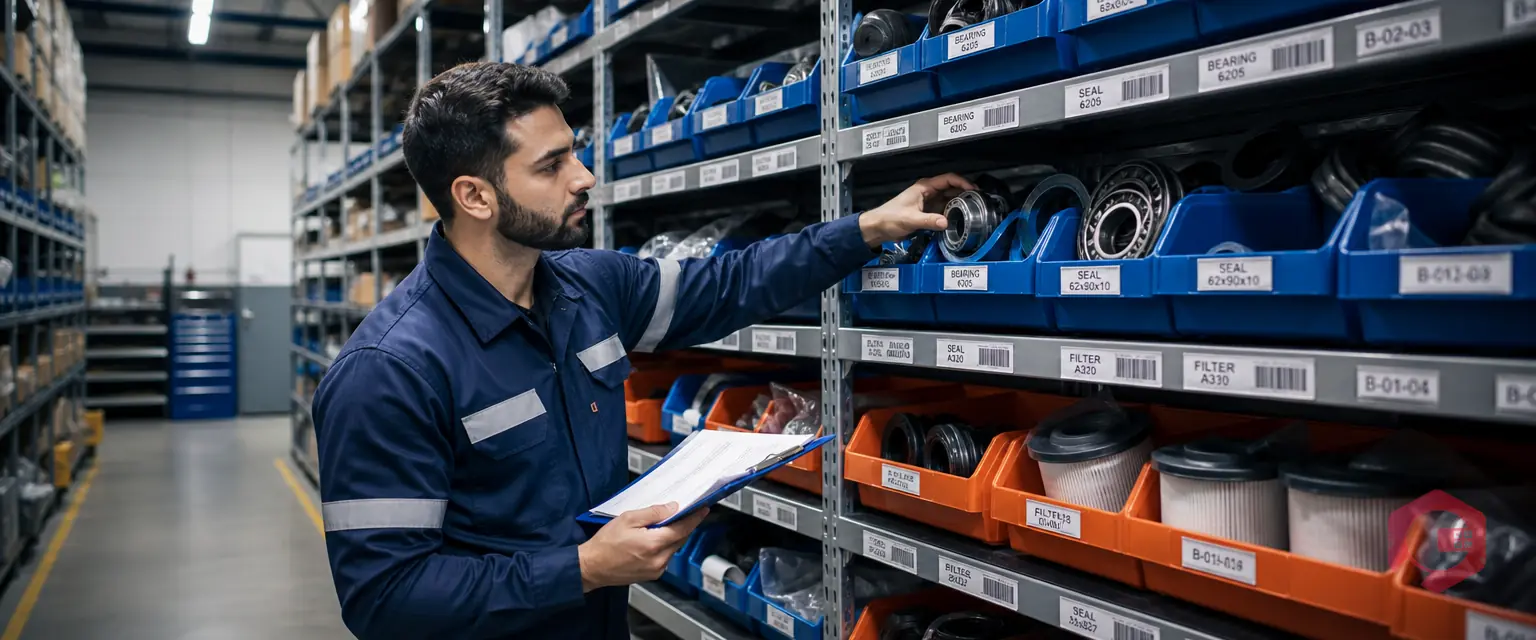
Reorder point, min-max, and two-bin are the three most common inventory replenishment models used to decide when a spare part gets reordered and how much to order. Each one answers the timing-and-quantity question differently, and the right choice depends on the part's cost, criticality, and how predictable its usage is. Most maintenance and MRO storerooms don't need to pick just one — they run all three side by side, matched to the part instead of forced onto every SKU equally.
Key Takeaways
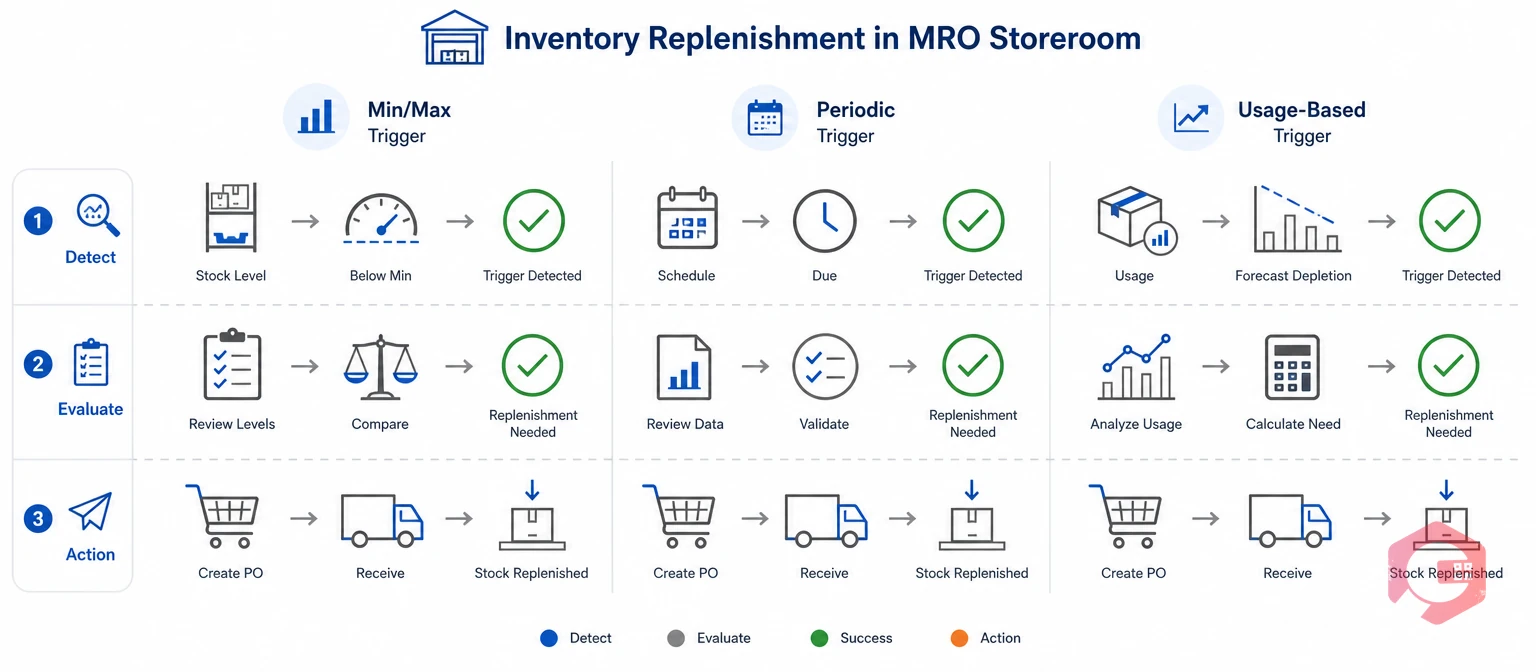
Inventory replenishment is the set of rules that decide when a stocked spare part gets reordered and how much of it to buy. In a maintenance, repair, and operations (MRO) environment, those rules cover bearings, seals, filters, sensors, gaskets, and every other component a technician might need mid-repair.
Order too late, and a technician stands in front of a stopped machine waiting on a part that should already be on the shelf. Order too early or too much, and capital sits depreciating in a storeroom that could hold something more critical. Most facilities that track this closely find both failure modes happening in the same storeroom at the same time — some SKUs stocked out, others gathering dust.
MRO inventory behaves differently from retail or manufacturing inventory in one important way: demand is driven by asset failure and maintenance schedules, not customer orders. A bearing might sit untouched for six months, then get consumed twice in the same week when two similar machines fail close together. That irregular demand pattern is exactly why one single replenishment rule rarely covers an entire storeroom well.
A Computerized Maintenance Management System gives inventory teams a place to configure, monitor, and automate these rules per part rather than relying on a clerk's memory or a stack of reorder cards. This matters more as ISO 55000-aligned asset management practices push maintenance organizations to treat spare parts availability as a measurable input to reliability, not an afterthought.
Broader inventory management theory offers dozens of replenishment models, but MRO storerooms consistently narrow the field down to three that cover almost every part on the shelf. Reorder Point, Min-Max, and Two-Bin differ mainly in how much calculation happens before a reorder fires, and how much of that calculation a system can automate versus a person doing it by hand.
Reorder point is a fixed stock quantity that triggers a purchase order the moment on-hand inventory drops to that level. Once the count hits the threshold, the system — or a person watching a shelf — fires off a replenishment order for a set quantity, typically calculated to cover the lead time until the new stock arrives.
The standard formula multiplies average daily usage by supplier lead time, then adds a safety stock buffer:
Reorder point suits parts with steady, predictable consumption and a supplier with a stable, known lead time. A facility replacing the same seal on a fixed PM schedule, for example, can calculate a reliable threshold and trust it. Reorder point becomes unreliable the moment usage swings unpredictably or a vendor's lead time shifts without warning, which is exactly why relying on it for every SKU in a large storeroom eventually breaks down.
Most facilities that stick with Reorder Point long-term also review it on a fixed schedule rather than setting it once at part creation and forgetting about it. A quarterly review catches the slow drift in usage rates and vendor performance before it turns into a surprise stockout on the floor.
Min-Max inventory is a replenishment model that sets two numbers per part: a minimum that triggers reordering and a maximum that caps how much stock is ever held. When on-hand quantity falls to or below the minimum, the system orders enough to bring the count back up to the maximum — not a fixed order quantity, but a variable one recalculated against the ceiling every time.
The order quantity is simply the maximum minus current on-hand stock at the moment the minimum is triggered. If a part's max is 100 units and stock has fallen to a min of 20, the system orders 80 units — not a static number pulled from a prior calculation.
Min-Max suits parts with more variable demand or multiple acceptable suppliers, since the order quantity adjusts to actual consumption rather than a fixed figure. It also works well for parts where carrying too much stock carries a real cost, since the maximum acts as a hard ceiling on capital tied up in that SKU. Most facilities apply Min-Max to mid-value parts where neither a rigid threshold nor a bin-based system quite fits.
Two-Bin, also called Kanban-style replenishment, is a system that uses two physical bins holding the same part so that an empty bin itself becomes the reorder signal. When the first bin runs out, it gets pulled for replenishment while the second, already-full bin goes into use. No calculation and no system trigger is required to notice a shortage — the empty bin is the alert.
Two-Bin is built for high-volume, low-cost, high-turnover consumables where the administrative cost of calculating a precise reorder point would exceed the value of the part itself. Fasteners, o-rings, and shop-floor gaskets are the classic candidates. Most facilities running lean maintenance principles lean on Two-Bin heavily here, since it removes tracking overhead entirely for parts that don't need precision.
Bin size is the only real decision left to make, and it's usually set to cover expected usage across one full replenishment cycle plus a small cushion — enough that the second bin never runs dry before the first bin's refill arrives, but not so large that the part sits idle for months at a time.
Cryotos's spare parts inventory software lets teams pair a QR or barcode label with each bin, so scanning an empty bin's label logs a replenishment request instantly — no spreadsheet, no delay between a bin going empty and a purchase requisition being raised.
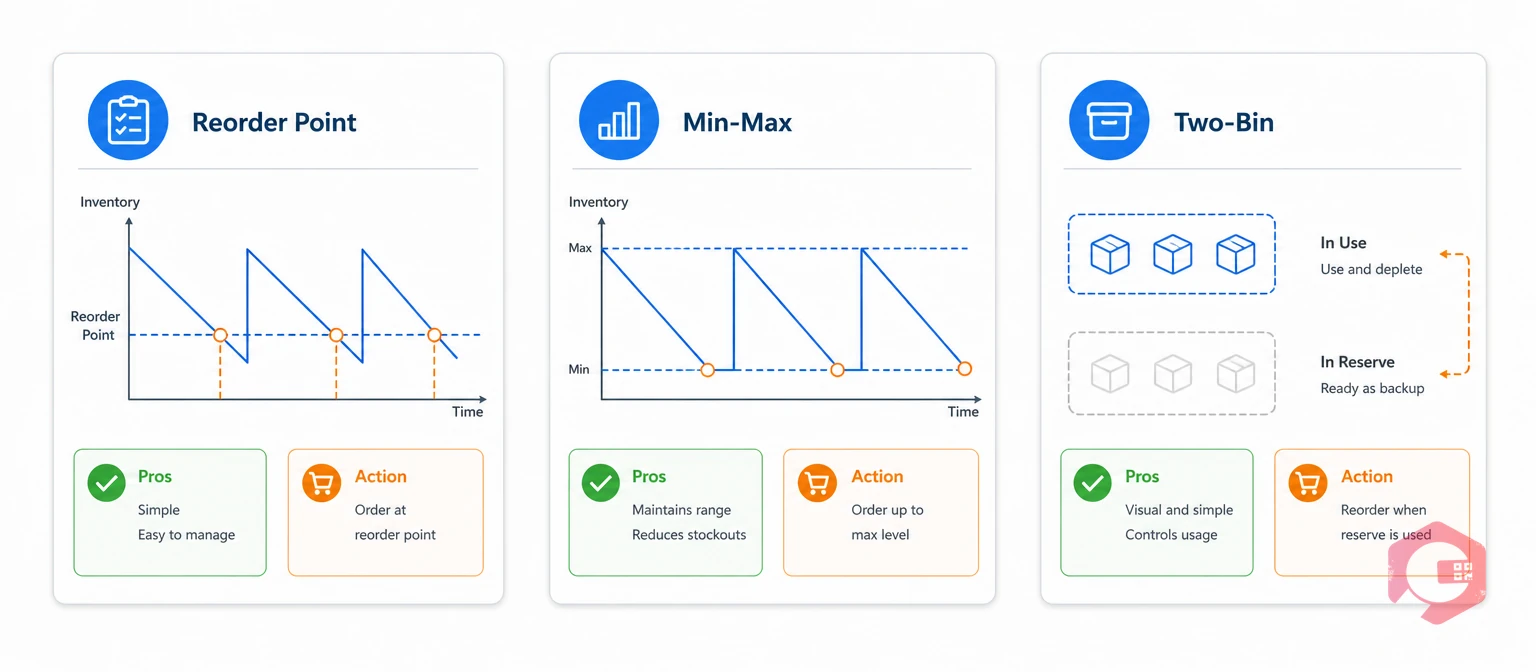
The table below lines up all three replenishment models against the factors that matter most when picking one for a given part.
| Model | Best For | Complexity | Stockout Risk |
|---|---|---|---|
| Reorder Point (ROP) | Steady-demand, critical spares with known lead time | Low-Medium | Low, if lead time is stable |
| Min-Max | Parts with variable demand, multiple suppliers | Medium | Low-Medium |
| Two-Bin (Kanban) | High-volume, low-cost consumables (fasteners, filters, gaskets) | Low | Very Low, but can overstock |
None of the three models is objectively better — each wins on a different combination of part cost, demand pattern, and administrative tolerance.
The numbers below show why the same storeroom ends up running all three models at once, using three parts from a typical plant.
A facility uses 2 bearings a week (about 0.3/day) with a 14-day supplier lead time and wants a 5-day safety stock buffer. The reorder point is (0.3 × 14) + (0.3 × 5) = roughly 6 units. When the shelf count hits 6, the system fires a purchase order for a fixed quantity sized to cover the next few replenishment cycles.
The same plant stocks a sensor used on three different asset types, so weekly usage swings between 1 and 8 units depending on which line is running. A minimum of 5 and a maximum of 40 lets the system absorb that swing — when stock drops to 5, it orders enough to bring the count back to 40, whatever that gap happens to be that week.
For a $0.40 gasket used dozens of times a week, calculating a precise reorder point costs more in administrative time than the part itself is worth. Two identical bins, each holding a two-week supply, remove the calculation entirely — an empty bin is the only signal anyone needs.
Safety stock sizing matters most for the Reorder Point example above, and it should scale with both lead time uncertainty and how disruptive a stockout would be. The safety stock concept exists specifically to absorb the gap between what a formula predicts and what actually happens on the floor when a shipment runs late or usage spikes unexpectedly.
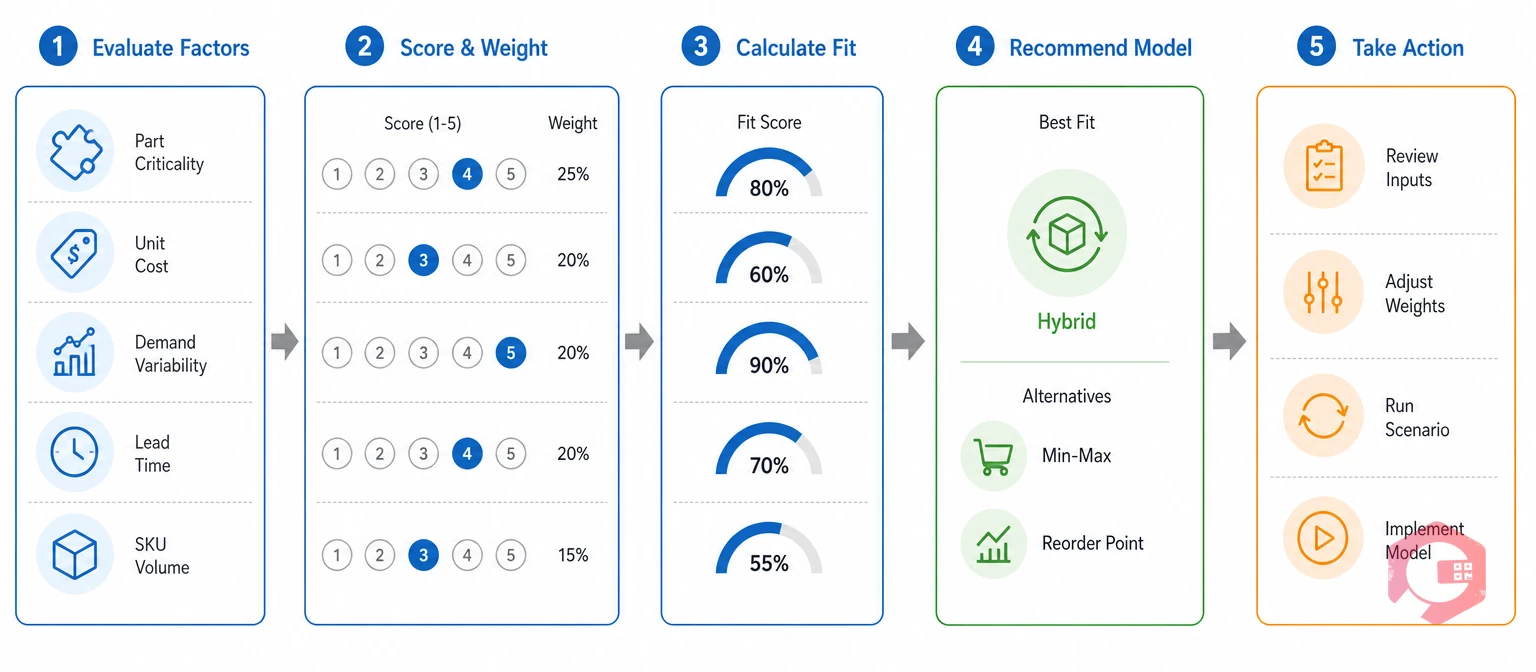
No single replenishment model fits every part in a storeroom, so picking one comes down to five measurable factors.
The Five-Factor Replenishment Fit Framework:
Many mature maintenance operations run all three models side by side — Two-Bin for the shelves of high-turnover consumables, Reorder Point for standard stocked spares, and Min-Max for expensive, variable-demand critical parts. Working through a MRO inventory checklist part by part is a practical way to sort a storeroom into these three buckets the first time.
Unit cost also drives how much attention a part deserves in the first place. Tracking maintenance costs against replenishment model by SKU class shows quickly which parts are quietly overstocked and which are running dangerously lean.
Facilities that already run ABC classification — sorting parts by annual consumption value into Class A, B, and C — can map each class straight onto a default model instead of evaluating every SKU individually. Class A parts typically default to Reorder Point or Min-Max, Class C parts default to Two-Bin, and Class B parts get evaluated case by case using the five factors above.
Picking the wrong replenishment model shows up as one of two costs: carrying cost from overstocking, or downtime cost from stocking out. Both are measurable, and both compound quietly if nobody's tracking them by part.
Every unit sitting on a shelf ties up capital, takes up storeroom space, and in some cases depreciates or expires before it's ever used. A Min-Max ceiling set too high, or a Two-Bin size set larger than actual weekly usage requires, both create the same problem: cash the business could deploy elsewhere is instead parked on a shelf. Classic economic order quantity theory exists specifically to balance this carrying cost against ordering cost, and the same logic applies directly to sizing a Min-Max ceiling or a Two-Bin's bin size.
A missing part turns a routine repair into extended downtime the moment a technician has to wait on a rush order. Facilities that link replenishment data to work order history consistently find that a handful of repeat stockouts on the same few SKUs account for a disproportionate share of total downtime hours. Fixing the model on those specific parts, rather than adjusting every threshold in the storeroom, typically delivers the fastest return.
Getting the model right the first time avoids both costs simultaneously — the goal isn't to hold the least inventory possible, it's to hold the right inventory for each part's actual risk profile.
A Computerized Maintenance Management System should support all three replenishment models natively, since forcing every part through one rule almost always means overstocking some SKUs and stocking out on others.
Teams set a reorder point per part, per storeroom, or per location. The moment recorded on-hand quantity crosses the threshold — whether from work order parts consumption, a manual count, or a cycle count — the system fires an alert and can auto-generate a purchase requisition, removing the need for a clerk to manually track stock levels.
Every part record supports independent minimum and maximum stock levels. When stock hits the minimum, the platform calculates the exact order-up-to quantity against the configured maximum and routes it for approval, or auto-issues the purchase order depending on the workflow the organization has set.
For bin-based consumables, each bin carries a scannable label that logs a replenishment request the moment it's scanned empty. Cryotos also tracks the same part across multiple storerooms, trucks, and sites through warehouse management tools, so a surplus at one site can offset a shortage at another before a new purchase order is even raised. Maintenance teams using Cryotos have reported up to 30% reduction in unplanned downtime and 25% faster repair turnaround, much of it tied directly to fewer parts-related delays. Managers see consolidated stock positions across the entire network in one dashboard, rather than calling around to five different sites to find out who has a spare part sitting unused.
Regardless of which model triggers the reorder, the platform's inventory management tools convert the signal into a purchase requisition pre-populated with part number, quantity, preferred vendor, and last purchase price — cutting the time from "stock is low" to "PO is in the vendor's inbox."
Cryotos analyzes historical consumption from work orders and PM schedules to recommend reorder points, min-max levels, and safety stock, so thresholds reflect actual usage patterns rather than a one-time guess made when the part was first added to inventory. This matters most for parts on Min-Max, where the maximum ceiling should track real demand trends rather than sit static for years.
Vendor lead times are stored against each part and factored directly into reorder point and safety stock calculations. When a vendor's average lead time shifts, the platform flags parts whose reorder points may now be miscalibrated, catching the drift before it turns into a stockout on the shop floor.
Dashboards show parts trending toward a stockout before it happens, replenishment cycle time by vendor, and carrying cost by replenishment model. That evidence lets an inventory manager decide whether a part should move from Two-Bin to Min-Max as its usage pattern changes, or the other way around, instead of guessing based on gut feel.
Most storerooms lose money not from picking the wrong model outright, but from applying one model to every part without exception.
Reorder point triggers a fixed order quantity once stock hits a single threshold, while Min-Max triggers a variable order quantity calculated against a maximum ceiling. Min-Max gives more flexibility for parts with inconsistent demand, while Reorder Point works well when usage and lead time are both predictable. Many facilities start every new part on Reorder Point by default, then move it to Min-Max once a few months of consumption data reveal how variable its actual demand is.
Two-Bin is a physical, visual implementation of Kanban principles applied to spare parts inventory. Both use a simple signal — an empty bin or an empty card slot — to trigger replenishment without any calculation or system lookup required.
Yes, and most mature MRO operations do exactly that. A single storeroom commonly runs Two-Bin for high-turnover consumables, Reorder Point for standard stocked spares, and Min-Max for expensive, variable-demand critical parts, all managed from the same inventory management system.
Multiply the part's average daily usage by the supplier's lead time in days, then add a safety stock buffer sized to the part's criticality and demand variability. Facilities with unstable lead times should size that safety stock buffer larger than facilities with predictable, contracted delivery windows.
Reorder Point carries the highest stockout risk if a vendor's lead time increases without the threshold being recalculated, since the buffer built into the original calculation no longer covers the actual delay. Two-Bin carries the lowest stockout risk by design, though it can lead to overstocking if bin sizes are set larger than actual usage requires. Min-Max sits in between, since its flexible order-up-to quantity absorbs demand swings but still depends on the minimum being set correctly in the first place.
A Computerized Maintenance Management System analyzes historical consumption from work orders and PM schedules to recommend reorder points, min-max levels, and safety stock so thresholds reflect actual usage patterns rather than a one-time guess made when the part was first added to inventory.
Running an ABC analysis first makes the model choice far easier, since it sorts every part by value and usage frequency before anyone has to decide between Reorder Point, Min-Max, and Two-Bin. Class A parts usually justify Reorder Point or Min-Max precision, while Class C parts are strong Two-Bin candidates by default.
Most facilities review thresholds quarterly at minimum, and immediately after any known change in vendor lead time or a shift in production volume. A reorder point calculated two years ago on since-changed usage data is often the real reason behind a stockout that looks, on the surface, like a supplier problem.
Reorder Point, Min-Max, and Two-Bin aren't competing systems — they're three tools suited to different parts of the same storeroom, and the organizations that get the most value are the ones that match the model to the part instead of forcing every SKU through one rule. Getting there doesn't require ripping out an existing inventory process; it usually starts with sorting the current SKU list into rough criticality and cost tiers, then testing each replenishment model against a handful of representative parts before rolling it out storeroom-wide. Schedule a free demo to see how Cryotos brings all three replenishment models into a single, configurable inventory module for your maintenance team.


Cryotos AI predicts failures, automates work orders, and simplifies maintenance—before problems slow you down.



