

Retail facilities teams use CMMS software to manage store HVAC, lighting, and electrical maintenance by centralizing work orders, automating preventive maintenance schedules, and tracking compliance across every system — across one store or hundreds of locations. Without a CMMS, these three critical systems are managed reactively: the air conditioning fails mid-summer, the lighting circuit trips during peak hours, or an electrical panel inspection gets missed until an auditor finds it. According to a Plant Engineering maintenance benchmarking study, facilities relying on reactive-only maintenance spend three to five times more per repair event than those running structured preventive programs. In retail, that cost multiplier lands directly on operating margin.
This guide covers how a CMMS changes the way retail facilities teams handle each of their three highest-maintenance systems — and how it ties them together into a single, auditable maintenance program.

Retail facilities maintenance operates under constraints that industrial maintenance teams rarely face. A factory can shut down a production line for scheduled maintenance. A retail store cannot close its HVAC during a Saturday in August or take down the lighting circuit at 2pm on a weekday. Maintenance has to happen around the business — early morning, overnight, or in planned micro-windows between opening and peak traffic hours.
The asset portfolio is also different. A typical retail store — anywhere from 5,000 to 50,000 square feet — runs multiple HVAC units serving different zones, lighting circuits across hundreds of fixtures, a mix of single-phase and three-phase electrical loads, refrigeration systems, and customer-facing equipment like escalators and automatic doors. Each system has its own inspection cycle, its own compliance requirements, and its own failure consequences. A failed HVAC unit in a food and beverage aisle affects product safety. A tripped lighting circuit in a fitting room affects sales. An overloaded electrical panel is a safety and insurance liability.
Multi-site retail adds another layer of complexity. A retail brand running 50 or 500 stores needs to manage maintenance consistency across all of them — same PM intervals, same inspection checklists, same compliance documentation — without a centralised visibility tool making that practically impossible. A retail facility management software platform gives area managers and regional directors a live view of maintenance status across every site, not just the ones they visited this week.
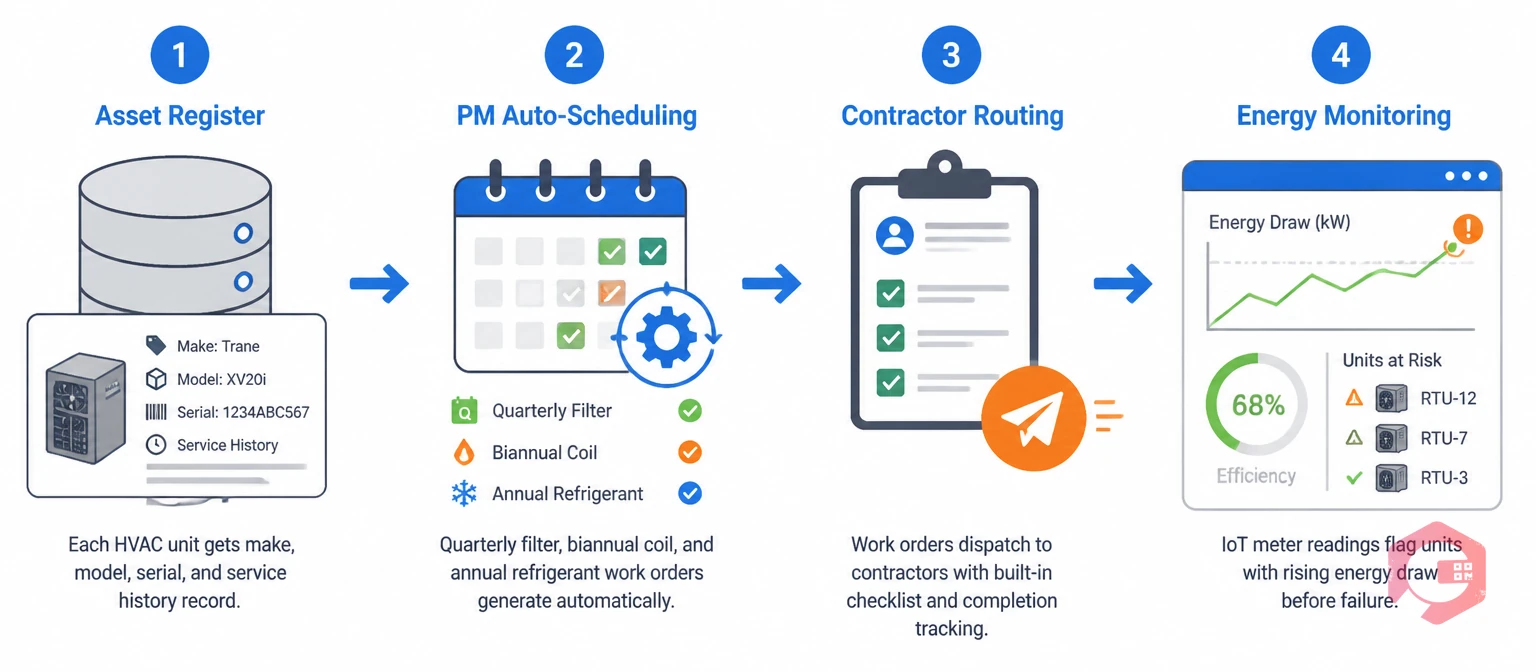
HVAC is the single largest maintenance cost category in most retail facilities budgets. A 20,000 square foot department store typically runs 4 to 8 rooftop units, split systems for specialty zones, and dedicated units for stockrooms and server rooms. Each unit needs quarterly filter changes, biannual coil cleaning, annual refrigerant checks, and belt and motor inspections on a defined cycle. Without a system, these tasks run on whoever remembers to call the HVAC contractor — which means they run late, or not at all, until a unit fails.
A CMMS changes this by building the PM schedule directly into the system. Every HVAC unit gets its own asset record in Cryotos — make, model, serial number, installation date, service history, warranty status, and attached documentation including OEM service manuals and refrigerant charge records. Preventive maintenance work orders generate automatically at the right interval, pre-assigned to the technician or contractor responsible, with the checklist built in.
For retail HVAC specifically, three CMMS workflows deliver the most value. First, filter replacement tracking: filter change intervals vary by unit location and store traffic density. A unit above a food court runs a tighter filter cycle than one in a back-of-house storeroom. A CMMS lets you configure different PM intervals per asset rather than applying a blanket calendar schedule. Second, contractor coordination: most retail chains use third-party HVAC contractors rather than in-house technicians. Cryotos's work order management routes work orders directly to contractors, tracks completion status, and captures service reports against the asset record — no more chasing contractors for paperwork. Third, energy performance monitoring: HVAC units running past their service interval consume more energy. A CMMS that connects to your IoT meter reading feed can flag units where energy draw has increased between service cycles, signalling a maintenance need before the unit shows visible performance degradation.
Retail facilities teams using Cryotos report a 30% reduction in downtime and 25% faster repair times — HVAC failures are where those numbers show up most visibly in a retail environment, especially during summer peak trading periods.

Retail lighting maintenance is underestimated as a maintenance discipline. Lighting directly affects sales — research from the Retail Industry Leaders Association consistently shows that well-maintained, correctly aimed lighting increases product visibility and dwell time in targeted sections. A dimmed or failed fixture in a jewellery display or wine section doesn't just look neglected — it costs sales.
The maintenance scope is wider than most store managers realise. A typical 15,000 square foot retail store has 200 to 400 individual fixtures across ceiling grids, display cases, perimeter tracks, exterior signage, emergency lighting, and car park canopies. Each fixture type has a different service life, a different failure mode, and in some cases a different regulatory inspection requirement. Emergency lighting in particular carries compliance obligations — most jurisdictions require monthly functional tests and annual full-duration discharge tests, with records kept for inspection.
A CMMS manages retail lighting maintenance across three dimensions. First, planned replacement cycles: LED retrofit programs work best when managed through a CMMS that tracks each fixture's installation date and calculates replacement windows based on rated hours and actual operating hours per day. Second, fault response: when a fixture fails, a staff member can raise a corrective work order via QR code scan or the mobile app in under a minute — no paper log, no forgotten fault. The work request routes to the right technician automatically and appears on the maintenance dashboard. Third, compliance scheduling: emergency lighting test work orders generate on a monthly and annual cycle without a planner having to remember. Test results record against each asset, and the compliance history is audit-ready at any point.
Grouping fixtures by zone or circuit in the CMMS asset hierarchy also helps with bulk replacement decisions. If 15 of 20 fixtures in a particular ceiling grid have exceeded 80% of their rated hours, the CMMS flags the zone for a group replacement rather than handling individual failures one at a time — saving contractor call-out costs and reducing disruption to the trading floor.
Electrical maintenance in retail stores operates at the intersection of safety, compliance, and operational reliability. A retail store's electrical infrastructure includes main switchboards, distribution boards, sub-panels, emergency power systems, RCDs (residual current devices), surge protection equipment, and the wiring and circuits connecting all customer-facing and back-of-house loads. Any of these failing creates either a safety event, a trading disruption, or a compliance gap — often all three.
Electrical compliance in retail is non-negotiable. In most jurisdictions, retail premises require periodic fixed electrical installation inspections — typically every 3 to 5 years for commercial premises, with RCD testing on an annual or more frequent cycle depending on local codes. OSHA electrical safety standards for general industry apply to retail environments in the US, covering panel labelling, equipment guarding, and lockout/tagout procedures for any maintenance that involves de-energising equipment. The paper trail for all of this matters — not having it during an insurance claim or regulatory audit is a significant liability.
A CMMS turns electrical compliance from a scramble into a system. Inspection due dates for every panel, RCD, and switchboard live in the asset register. Work orders for compliance inspections generate automatically ahead of due dates — giving enough lead time to book a qualified electrician, not chasing one on the morning the inspection is due. Every test result, certificate, and inspection report attaches to the relevant asset record in Cryotos's document management module, creating a complete, searchable compliance history per asset.
Fault response matters too. When a distribution board trips or a circuit develops an intermittent fault, the corrective work order captures exactly what happened, what was found, what was done, and what parts were used. That history tells the next electrician — or the insurance assessor — exactly what the panel's maintenance record looks like. Without it, every fault response starts from zero.
Most retail facilities teams understand the theory of preventive maintenance. The practical shift from reactive to preventive is where CMMS software makes the real difference — turning scheduled intent into automated execution. The comparison below shows what that difference looks like across the three core retail systems.
| System | Reactive Approach | CMMS-Driven Preventive Approach | Business Impact |
|---|---|---|---|
| HVAC | Call contractor when unit fails or complaint raised | Auto-generated quarterly filter, coil, and refrigerant work orders per unit | 30–40% lower HVAC repair costs; fewer peak-season failures |
| Lighting | Replace fixtures when staff notice failure | Scheduled group replacements by zone; monthly emergency lighting tests | Consistent trading floor presentation; zero compliance gaps |
| Electrical | Inspect panels when due date noticed or fault occurs | Auto-scheduled RCD tests, panel inspections, and certificate renewals | Audit-ready compliance records; reduced insurance and safety risk |
The real operational shift happens when HVAC, lighting, and electrical maintenance are managed inside a single CMMS rather than across three separate contractor relationships, two spreadsheets, and a paper compliance folder. A unified system lets a retail facilities manager answer questions that are impossible to answer otherwise: What is my total open maintenance backlog across all three systems right now? Which of my 30 stores has the worst HVAC PM compliance this quarter? How many electrical inspections are coming due in the next 60 days across the portfolio?
Cryotos gives retail facilities teams the tools to run this unified program without needing a large in-house maintenance team. The platform's preventive maintenance software handles the scheduling automatically — facilities managers set the intervals once and the system generates, assigns, and tracks work orders from there. The mobile app lets contractors and technicians receive, complete, and close work orders on site without calling back to a coordinator. WhatsApp notifications via Cryotos WhatsApp integration keep store managers informed when a work order is raised, assigned, or completed — without requiring them to log into a system.
Multi-store visibility is where the platform earns its keep for retail chains. The BI Dashboard surfaces maintenance KPIs across every location — HVAC uptime by store, open corrective work orders by system, PM compliance rate, and overdue inspection count — giving regional facilities managers the data they need to prioritise visits, escalate non-performing contractors, and report to leadership on maintenance program health across the network.
For a retail chain running a significant number of stores, centralised asset tracking also means knowing the age, service history, and replacement horizon for every HVAC unit, every lighting system, and every electrical panel across the portfolio. Capital planning stops being guesswork and starts being data-driven: the CMMS tells you which HVAC units are approaching end of service life, which stores have the highest reactive maintenance ratio, and where preventive maintenance investment will deliver the strongest return in reduced emergency call-outs.
The facility inspection checklist gives retail facilities teams a ready-made starting point for structuring store-level maintenance checks across HVAC, lighting, and electrical — a practical template that maps directly to CMMS work order checklists in Cryotos.
Retail facilities teams that move from reactive to planned maintenance with Cryotos consistently report fewer peak-season HVAC emergencies, cleaner compliance records, and a measurable reduction in contractor call-out costs. If your store maintenance is still running on emails and contractor callbacks, Cryotos CMMS gives you the platform to change that — one asset register, one PM schedule, one compliance history across every system in every store. Book a demo at cryotos.com to see how retail facilities teams are using Cryotos to run tighter, cheaper, more auditable maintenance programs.
A CMMS (Computerized Maintenance Management System) is software that centralises asset records, work orders, preventive maintenance schedules, and compliance documentation in one platform. For retail facilities teams, it replaces spreadsheets, email chains, and contractor callbacks with a structured system that automatically generates maintenance work orders, routes them to the right technician or contractor, and tracks completion against every asset in the store — including HVAC units, lighting fixtures, and electrical panels.
Most commercial HVAC units in retail environments require quarterly filter replacement, biannual coil cleaning, and an annual comprehensive service covering refrigerant levels, belts, motors, and controls. Units in high-traffic areas or those handling specialty zones like food and beverage sections may require tighter filter intervals. A CMMS lets you configure different PM schedules per asset rather than applying a blanket interval across all units — so each unit gets the service it needs based on its actual operating conditions.
Retail stores typically require periodic fixed electrical installation condition reports (every 3 to 5 years in most jurisdictions), annual or more frequent RCD testing, regular switchboard and distribution board visual inspections, and documented testing of emergency lighting systems on a monthly and annual cycle. Specific intervals vary by jurisdiction and local building codes. All test records should be stored against the relevant asset in a CMMS to maintain an audit-ready compliance history.
Yes — multi-site management is one of the primary use cases for retail CMMS software. Cryotos supports unlimited sites under a single account, with role-based access controls that give store-level staff visibility into their location's assets and work orders while giving area managers and regional directors a cross-portfolio view of maintenance performance, PM compliance, and open corrective work orders across the entire store network.
A CMMS creates a complete, time-stamped maintenance record for every asset — including inspection certificates, test results, contractor service reports, and compliance documentation — stored directly against the asset record. When an auditor, insurer, or building inspector requests evidence of HVAC servicing, electrical inspection, or emergency lighting testing, the records are retrievable from a single screen in seconds rather than assembled from filing cabinets and email threads. This is particularly valuable for retailers operating across multiple stores where compliance records would otherwise be scattered across different locations and responsible parties.


Cryotos AI predicts failures, automates work orders, and simplifies maintenance—before problems slow you down.



