Risk based maintenance is a strategy that prioritizes maintenance tasks and resources based on the probability and consequence of asset failure — not simply how important an asset appears on paper. Traditional criticality ranking tells you which assets matter most. Risk-based prioritization tells you which assets are most likely to fail, when, and what the real cost of that failure will be. That difference determines where your maintenance budget has the greatest impact. A CMMS that surfaces risk scores automatically moves maintenance teams from instinct-driven scheduling to evidence-based decisions.
Key Takeaways
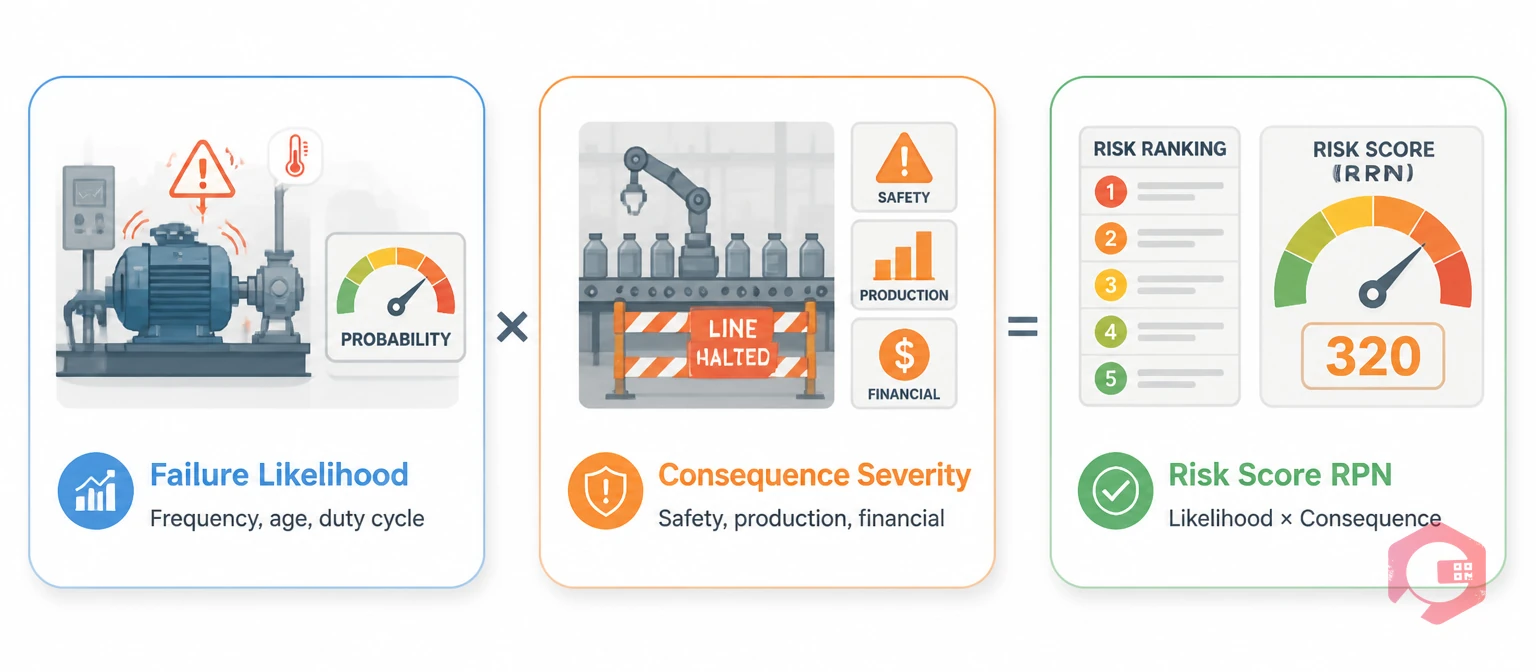
Risk based maintenance (RBM) is a maintenance planning methodology that uses quantified risk assessments to rank assets and allocate maintenance resources. The core formula is simple: Risk = Likelihood of Failure × Consequence of Failure. Assets with high scores on both dimensions receive the most frequent, intensive maintenance; assets with low risk scores are maintained less aggressively — or shifted to a run-to-failure strategy.
The approach is formally recognized in standards including the ISO 31000 risk management standard and the API 580 Risk-Based Inspection standard, which define how to assess, quantify, and respond to asset risk across industries from oil and gas to pharmaceuticals.
RBM differs from conventional scheduled maintenance in a critical way. Scheduled maintenance assigns PM intervals based on time or usage thresholds — the calendar, not the machine, decides when maintenance happens. RBM assigns intervals based on current failure risk, which means an asset that has been operating in unusual conditions gets more attention sooner, while a stable low-risk asset gets serviced later. Cryotos asset tracking gives maintenance planners the usage data, fault history, and condition signals they need to calculate these scores accurately.
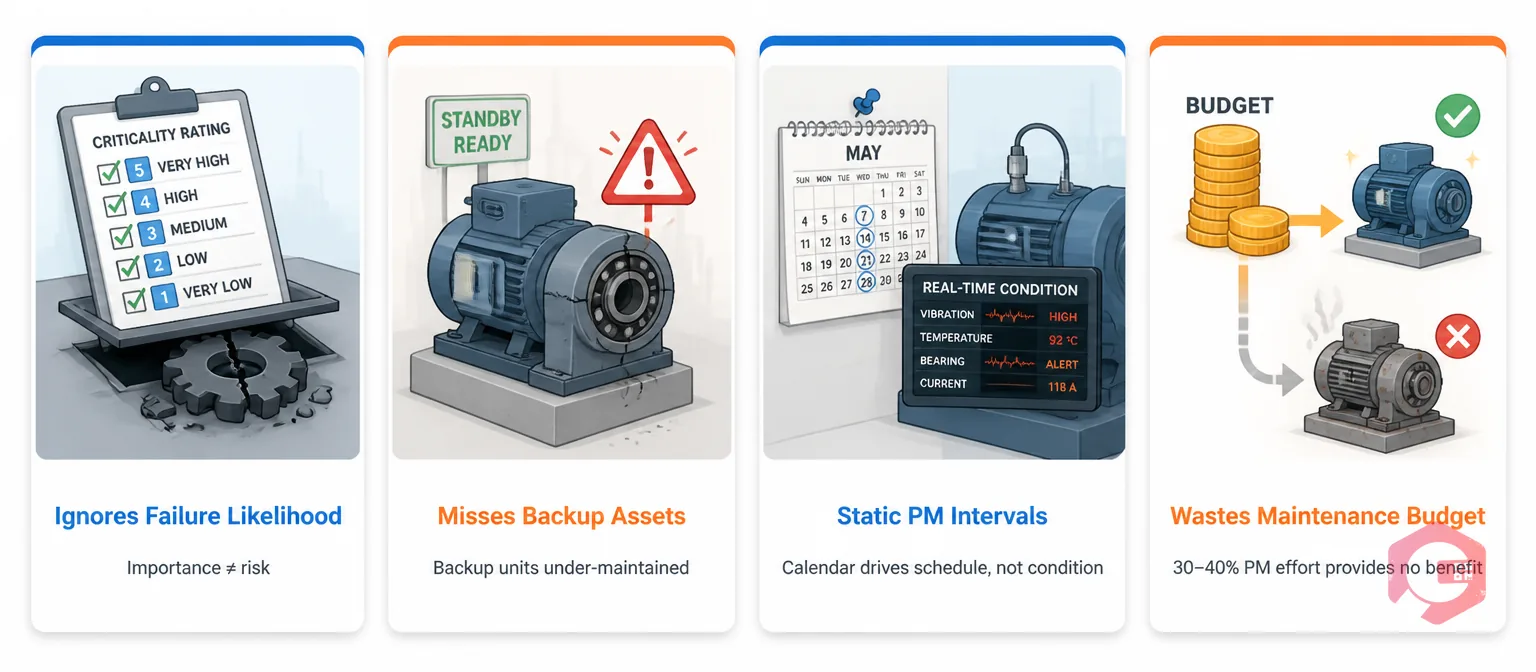
Criticality ranking has been the backbone of maintenance prioritization for decades. The logic is intuitive: identify your most important assets, give them the most care. But criticality ranking has a fundamental flaw — it conflates importance with risk.
Consider a primary production conveyor and a backup conveyor. The primary unit is classified as highly critical because it runs 24/7 and any failure stops the line. The backup unit is classified as low criticality because it rarely runs. Traditional maintenance scheduling gives the primary conveyor heavy PM attention and the backup conveyor minimal service.
But what if the backup conveyor has a seized bearing that's been degrading for six months? When the primary fails — and it will — the backup won't start. Now you have a double failure and an extended shutdown that no criticality ranking predicted, because criticality alone never accounted for the backup's probability of failure.
This is the core problem. Criticality measures the consequence side of the risk equation only. It ignores the likelihood of failure entirely. Assets that are moderately critical but have high failure rates and short mean time between failures (MTBF) are systematically under-maintained in criticality-only systems. Meanwhile, well-engineered, highly redundant "critical" assets often receive far more maintenance than their actual failure probability justifies.
Risk-based prioritization replaces subjective category labels with a numeric score derived from two dimensions.
Likelihood of failure is estimated from failure history, condition monitoring data, manufacturer recommendations, age, duty cycle, and environmental factors. A compressor that has failed twice in 18 months and is operating at 110% of its rated load has a high likelihood score. A pump that has run flawlessly for three years within normal parameters has a low one.
Consequence of failure covers multiple impact categories:
Each category is scored on a defined scale (typically 1–5 or 1–10), then multiplied to produce a Risk Priority Number (RPN). Assets are ranked by RPN, and maintenance intervals, inspection frequencies, and spare parts stocking levels are set accordingly.
Use Cryotos's failure rate calculator to establish baseline failure rates for each asset before building your risk scoring model.
A risk priority matrix maps likelihood and consequence on two axes and places assets into risk bands. Here is a simplified example with five assets from a food processing facility:
| Asset | Likelihood (1–5) | Consequence (1–5) | Risk Score (L×C) | Priority Action |
|---|---|---|---|---|
| Backup cooling pump | 4 | 5 | 20 — High | Weekly inspection + condition monitoring |
| Primary packaging line motor | 2 | 5 | 10 — Medium | Monthly PM per manufacturer schedule |
| Refrigeration compressor | 3 | 4 | 12 — Medium | Vibration analysis quarterly |
| Auxiliary air handler | 2 | 2 | 4 — Low | Run-to-failure with annual visual check |
| CIP wash pump | 4 | 3 | 12 — Medium | Bi-monthly seal and coupling inspection |
Notice that the backup cooling pump — which a criticality-only system might label "low criticality" — surfaces as the highest-priority asset once failure likelihood is factored in. This is exactly the kind of insight that criticality labels miss.
Understanding where these two frameworks diverge helps maintenance managers decide how to integrate both — or when to replace one with the other. See the reliability-centered maintenance glossary for context on how RCM relates to risk-based approaches.
| Dimension | Criticality Ranking | Risk-Based Maintenance |
|---|---|---|
| Primary question | How important is this asset? | How likely is this asset to fail, and what happens if it does? |
| Input data | Asset function, production dependency | Failure history, condition data, consequence modelling |
| Output | Category label (A/B/C or 1/2/3) | Numeric risk score updated dynamically |
| Handles redundancy | Poorly — backup assets are usually under-ranked | Yes — likelihood score factors in actual failure rates regardless of backup status |
| Maintenance intervals | Fixed to criticality tier — rarely updated | Dynamic — updated when failure probability or consequence changes |
| Resource allocation | May over-maintain stable critical assets | Directs budget to highest actual risk regardless of criticality label |
| Standards alignment | Internal process, no formal standard | Aligned with ISO 31000, API 580/581, IEC 60812 |
The practical takeaway: criticality tells you what to protect; risk-based maintenance tells you where to act first.
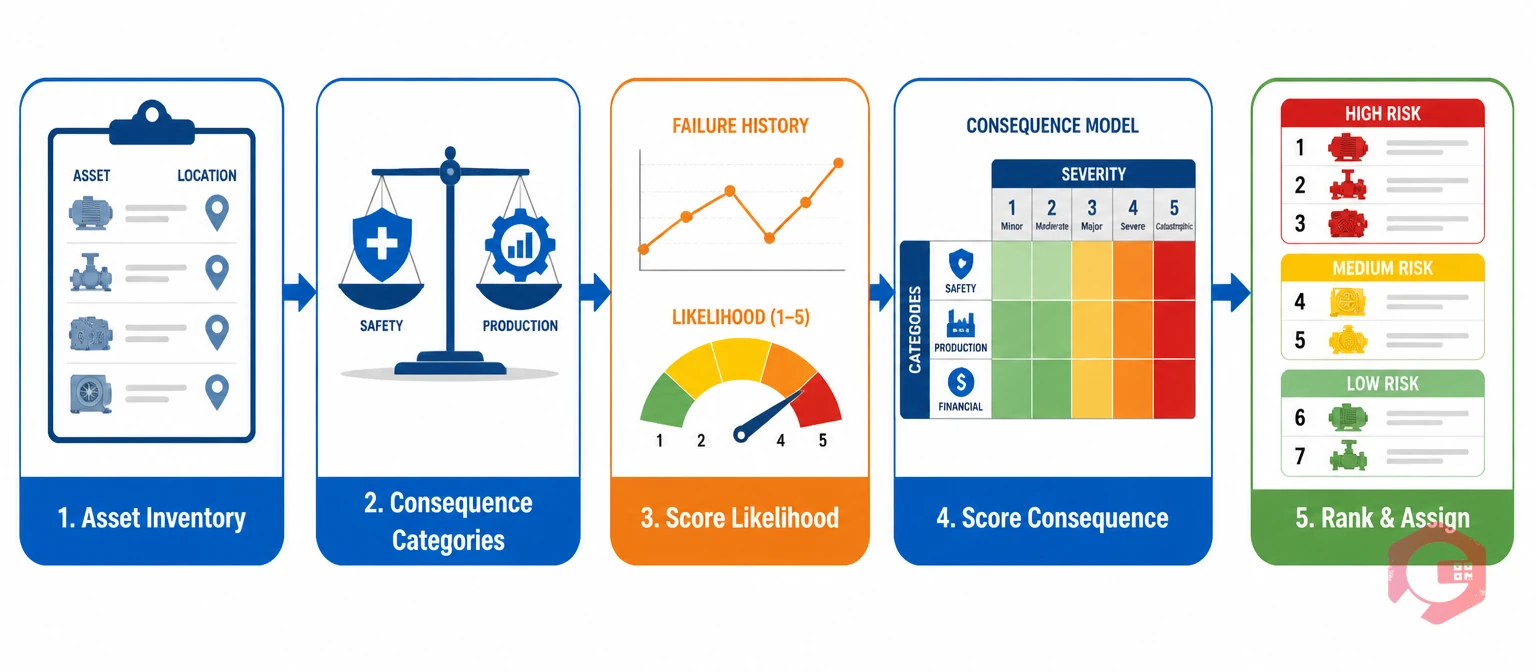
Moving from criticality-only to risk-based asset prioritization is a structured process, not an overnight switch. These five steps will get your team there without disrupting current maintenance schedules.
Use Cryotos preventive maintenance software to create and track PM schedules for each risk tier, with automated reminders, checklists, and completion tracking built into every work order.
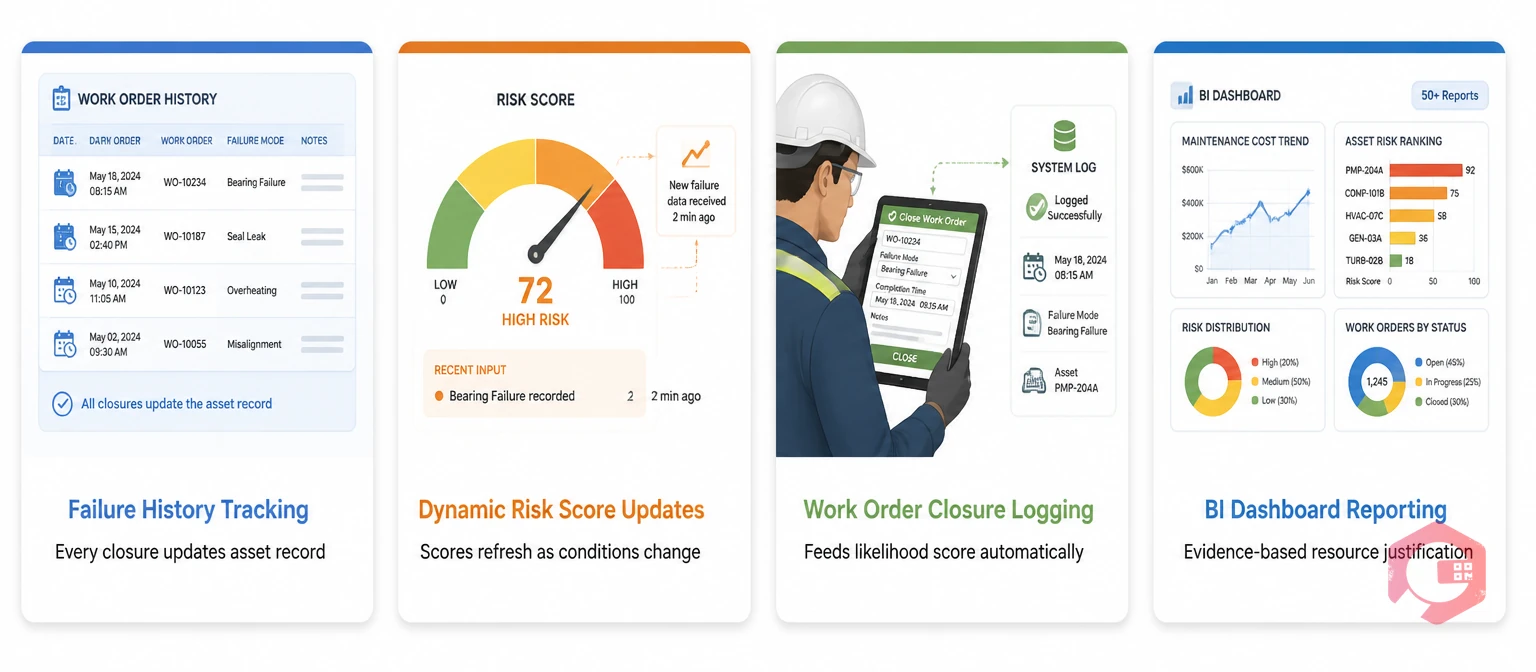
Risk-based maintenance generates powerful insights when done well — but it creates a significant data management challenge. Every asset needs a failure history, condition readings, maintenance cost records, and a risk score that's updated as conditions change. Without software, this breaks down at around 50 assets. Beyond that, spreadsheets become unmanageable and risk scores go stale.
A purpose-built downtime tracking system gives you the failure frequency and mean time between failure data that feeds directly into your likelihood scores. Every work order closed in Cryotos timestamps the failure, captures the failure mode, and updates the asset's maintenance history — the exact inputs your risk model needs to stay accurate.
Cryotos also surfaces this data through a BI dashboard with 50+ configurable reports, so maintenance managers can see asset risk trends, identify which assets are driving the most corrective spend, and justify resource allocation to leadership with evidence rather than intuition. The result is a risk-based maintenance framework that is not a one-time exercise but a continuously improving system that gets smarter with every work order closed.
Criticality measures how important an asset is to operations — it answers "how bad would it be if this asset failed?" Risk measures both the likelihood of failure and its consequences — it answers "how likely is this asset to fail, and how bad would it be?" An asset can be highly critical but low-risk (robust design, redundancy, low failure history), or low-criticality but high-risk (aging equipment, frequent failures, no backup). Risk-based maintenance uses both dimensions; criticality ranking uses only one.
Risk-based maintenance is most widely adopted in oil and gas, petrochemical, power generation, and pharmaceutical manufacturing — industries where asset failure has major safety or regulatory consequences. It is also gaining adoption in food and beverage, heavy manufacturing, and water utilities. The API 580 and API 581 standards specifically govern risk-based inspection in the oil and gas sector. Any industry that cannot afford unplanned downtime benefits from the approach.
No — risk-based maintenance determines which assets need preventive maintenance and at what frequency, but the actual maintenance tasks are still preventive or condition-based activities. RBM is a prioritization framework, not a replacement for maintenance execution. High-risk assets typically receive more frequent and more sophisticated PM tasks; low-risk assets may be shifted to run-to-failure or a minimal inspection schedule. The result is a smarter PM program, not the absence of one.
Risk scores should be reviewed at least annually for the full asset register, and updated immediately when a significant event occurs — a failure, a near-miss, a process change, or a change in production load. In practice, a CMMS that captures failure and maintenance data continuously makes dynamic updating straightforward: as failure frequency increases, the system flags the asset for risk score review without waiting for the annual cycle.
You need four things: an asset list with function and location data, failure history (even two to three years of work order records is enough), consequence definitions for your facility, and a scoring methodology (likelihood × consequence matrix). You do not need condition monitoring sensors or IoT data to start — those improve accuracy over time but are not prerequisites. Many facilities run a successful first risk assessment using only their existing CMMS work order history and a one-page scoring rubric.
Ready to move from criticality labels to dynamic, evidence-based asset prioritization? Schedule a free demo to see how Cryotos automates risk scoring, tracks asset failure history, and keeps your maintenance strategy aligned with actual operational risk.




Cryotos AI predicts failures, automates work orders, and simplifies maintenance—before problems slow you down.