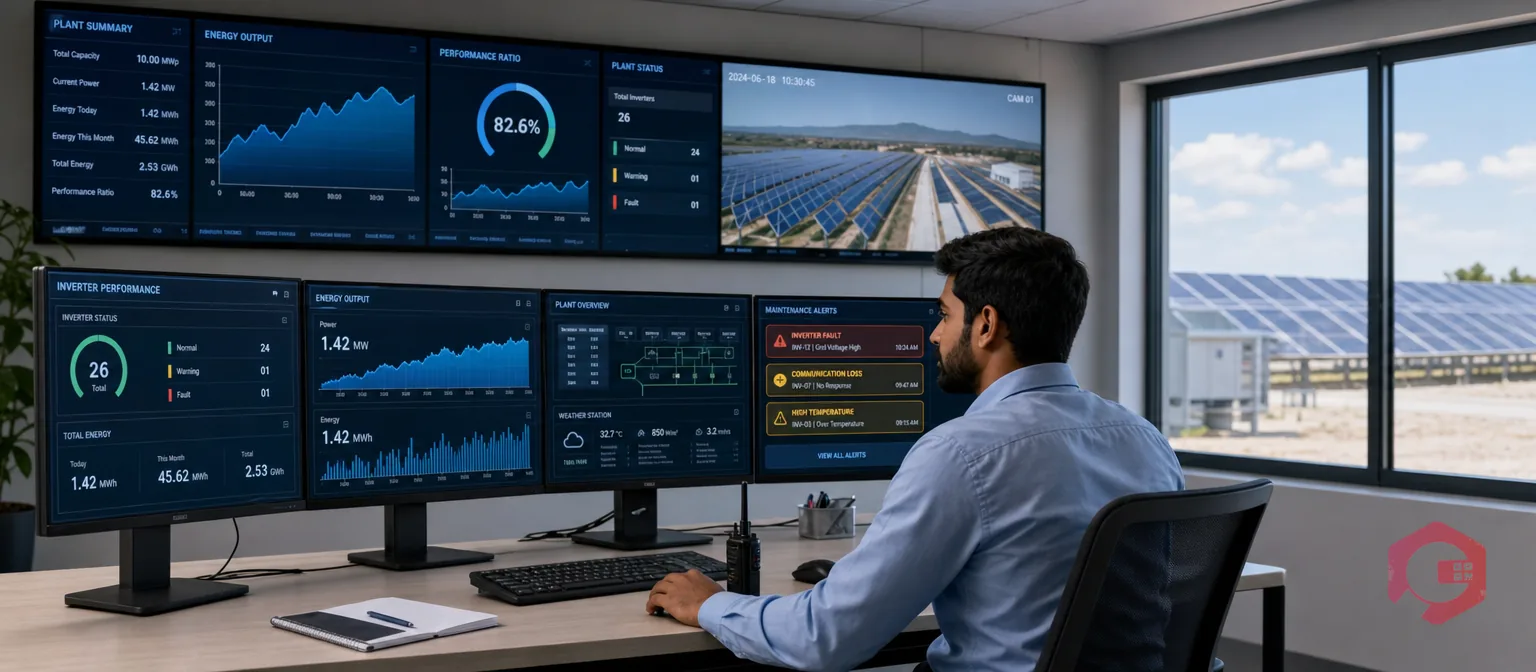
SCADA-CMMS integration for solar performance connects your supervisory control and data acquisition system directly to your computerized maintenance management system — creating a unified platform where real-time equipment alerts automatically trigger work orders, assign technicians, and log asset history without manual intervention. According to the International Energy Agency, unplanned downtime in utility-scale solar plants accounts for up to 5% of annual energy losses — losses that a connected SCADA-CMMS workflow can cut by more than half.
What Is SCADA-CMMS Integration in Solar Plants?
SCADA-CMMS integration in solar plants is the automated connection between a SCADA system and a CMMS. When both systems share data, a SCADA alarm no longer sits in a control room dashboard waiting for someone to notice — it immediately becomes a structured work order inside the CMMS, with priority, assignee, and asset context already populated.
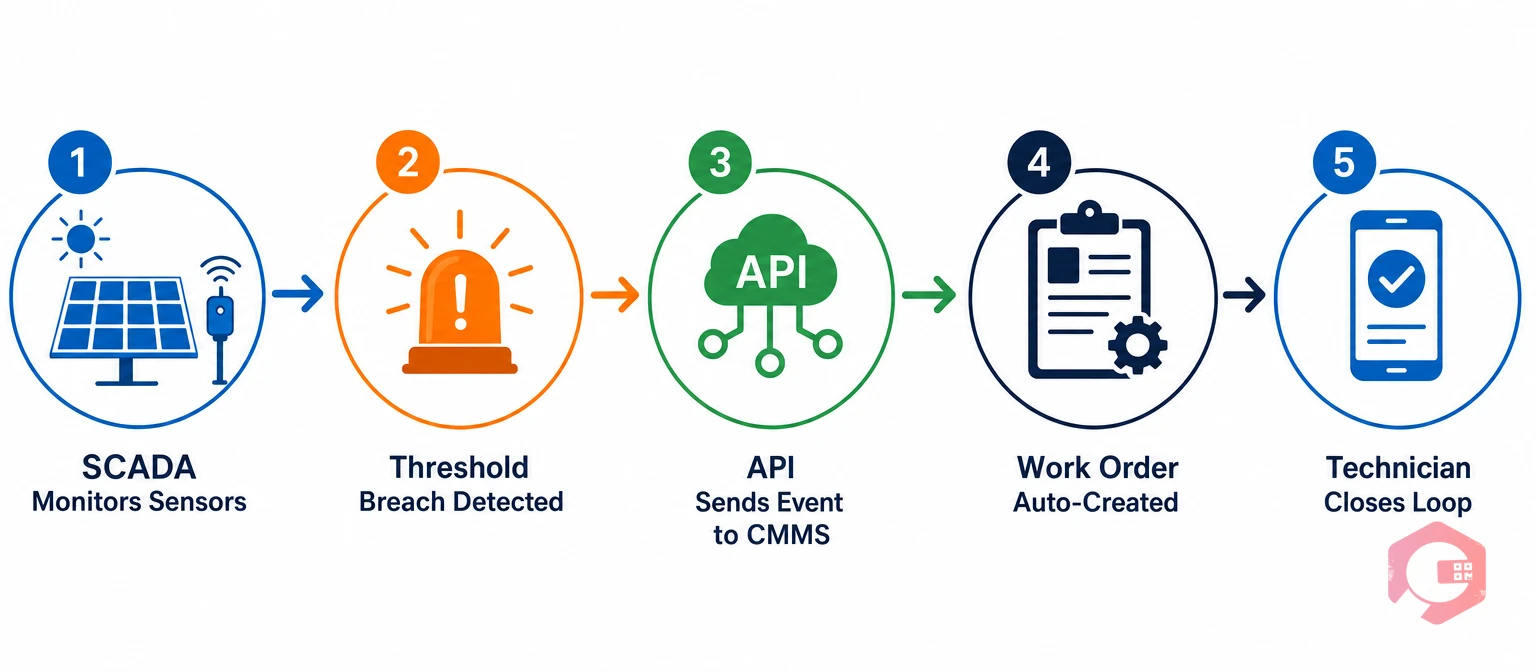
How SCADA and CMMS Work Together
SCADA monitors and signals: Sensors feed live performance data — string-level current, inverter output, clipping events, temperature anomalies — into the SCADA platform continuously.
Threshold breach triggers an event: When a value crosses a pre-defined alarm threshold (e.g. inverter output drops 15% below expected yield), SCADA generates a fault event.
CMMS receives the event via API or middleware: The CMMS ingests the SCADA event in real time through a REST API, MQTT broker, or OPC-UA middleware layer.
A work order is auto-created: The CMMS maps the event type to a pre-configured maintenance task template, creates a work order, assigns it to the correct technician, and links it to the affected asset’s history.
Technician closes the loop: The field technician completes the work order on a mobile device, capturing findings, parts used, and resolution time.
Key Benefits of Integrating SCADA with CMMS for Solar Performance
Real-Time Fault Detection and Automated Work Orders: A string under-performance event detected by SCADA at 6:00 AM automatically creates a priority work order before the operations team starts their shift. Field technicians receive the alert on their mobile devices with full context — asset ID, fault description, GPS coordinates, and last maintenance record — enabling first-time-fix rates that typically improve by 25–35% after integration.
Predictive Maintenance Driven by SCADA Data: SCADA systems collect time-series performance data that, when fed into CMMS analytics, reveal degradation trends before they become failures. McKinsey estimates predictive maintenance in energy assets reduces maintenance costs by 10–25% and increases equipment uptime by 10–20%.
Inverter and Panel Health Monitoring: Track inverter MTBF against OEM benchmarks, automate warranty-triggered work orders, and schedule panel cleaning based on irradiance vs. output deviation data rather than fixed weekly cycles.
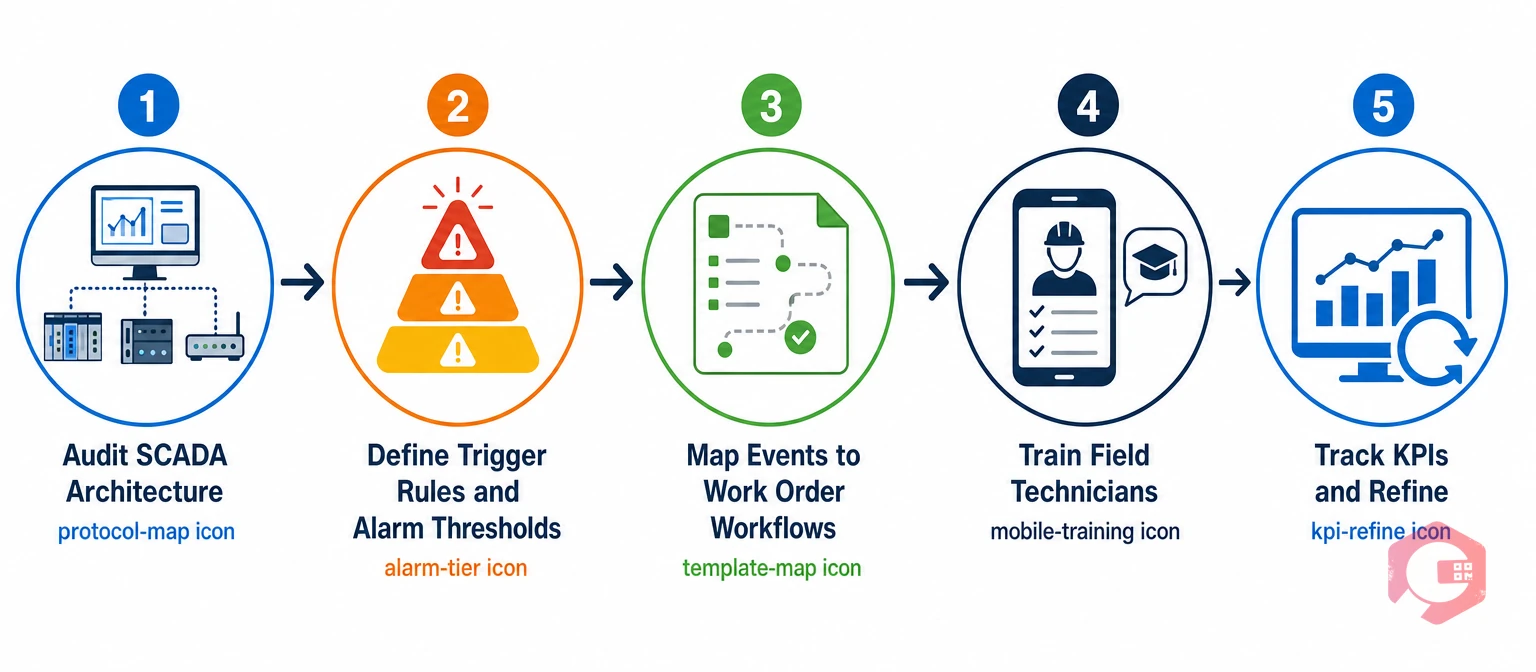
How to Implement SCADA-CMMS Integration: Step-by-Step
Audit Your Current SCADA Architecture: Document every data source your SCADA system monitors and identify communication protocols in use — OPC-UA, Modbus TCP, DNP3, or MQTT.
Define Trigger Rules and Alarm Thresholds: Not every SCADA alarm should create a work order. Tier 1 (immediate P1): total inverter failure, grid disconnect. Tier 2 (same-day P2): string output deviation >10%. Tier 3 (planned P3): gradual performance ratio decline.
Map SCADA Events to CMMS Work Order Workflows: Create work order templates for each alarm tier pre-populated with asset ID, fault description, diagnostic steps, required tools, and responsible technician team.
Train Field Technicians on the Integrated Platform: Cover receiving work orders on mobile, logging diagnostic findings against SCADA fault codes, recording parts for inventory management, and marking resolution with photos and notes.
Track KPIs and Refine Over Time: Key metrics: MTTR from SCADA alarm to technician dispatch, first-time-fix rate, work order completion rate versus alarms generated, and performance ratio improvement at plant level.
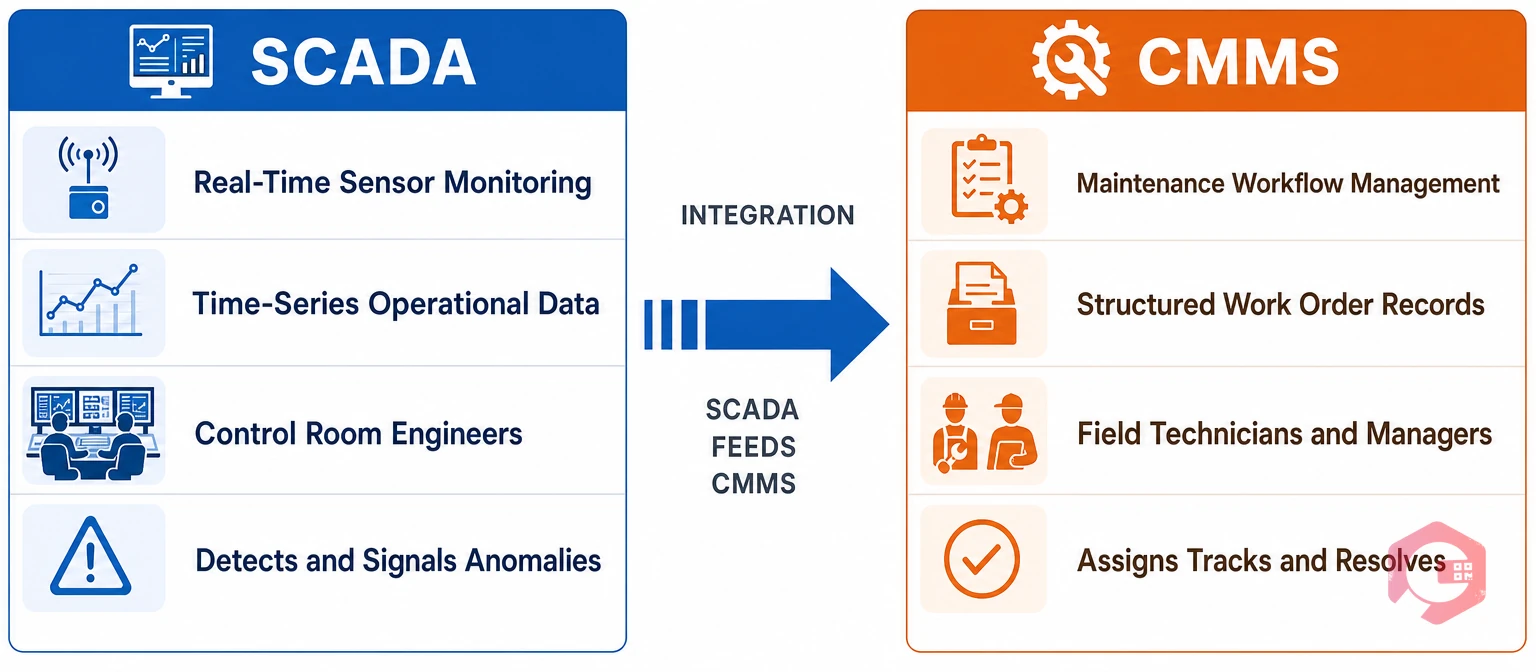
SCADA vs. CMMS: Understanding the Distinction
SCADA and CMMS serve distinct but complementary roles. SCADA provides real-time sensor monitoring, time-series operational data, and detects and signals anomalies. CMMS manages maintenance workflow management, structured work order records, and assigns, tracks, and resolves the maintenance response. In isolation, SCADA tells you something is wrong and CMMS tells you what was fixed. Integrated, they create a closed-loop system where detection, response, and learning happen automatically.
How Cryotos CMMS Powers SCADA Integration for Solar Plants
Cryotos CMMS connects to your existing SCADA infrastructure through standard APIs and transforms alarms into structured, actionable work orders within seconds. Automated work order creation, mobile-first field execution, predictive maintenance scheduling, spare parts and inventory integration, and a performance analytics dashboard are all built in. Solar EPC contractors and IPPs using Cryotos CMMS have reported a 40% reduction in mean time to respond after enabling SCADA integration. Book a free demo today and see how Cryotos transforms solar maintenance from reactive to performance-driven.
Frequently Asked Questions
What SCADA protocols does a CMMS need to support for solar integration?
The most common SCADA communication protocols in solar plants are OPC-UA, Modbus TCP, DNP3, and MQTT. A CMMS designed for solar integration should support REST API connections and either native protocol adapters or compatibility with middleware platforms like OSIsoft PI, Ignition, or AWS IoT Greengrass.
How long does it take to integrate SCADA with a CMMS at a solar plant?
A basic integration — covering inverter fault alarms, work order auto-creation, and mobile technician dispatch — typically takes 4–8 weeks for a utility-scale solar plant. More complex integrations involving predictive analytics or multi-site aggregation can take 3–6 months.
Can SCADA-CMMS integration work across multiple solar sites?
Yes. Most modern CMMS platforms support multi-site architectures where a central CMMS instance ingests SCADA data from multiple plants, each with their own asset hierarchy and alarm rules. This allows maintenance planning, technician scheduling, and performance benchmarking across all sites from a single dashboard.