
Tracking SHE KPIs in a CMMS means configuring your Computerized Maintenance Management System to automatically capture, calculate, and report Safety, Health, and Environment key performance indicators from the same work orders, inspection records, and incident logs your maintenance team already creates. When SHE KPIs live inside a Computerized Maintenance Management System, they stop being a monthly spreadsheet exercise and become real-time signals that show whether your facility is getting safer or accumulating hidden risk. According to occupational safety and health standards, organizations that measure leading safety indicators proactively reduce incident rates significantly compared to those relying on lagging metrics alone. This guide explains which SHE KPIs matter, how to distinguish leading from lagging indicators, and exactly how to configure your CMMS to track them without adding manual reporting burden.
Key Takeaways
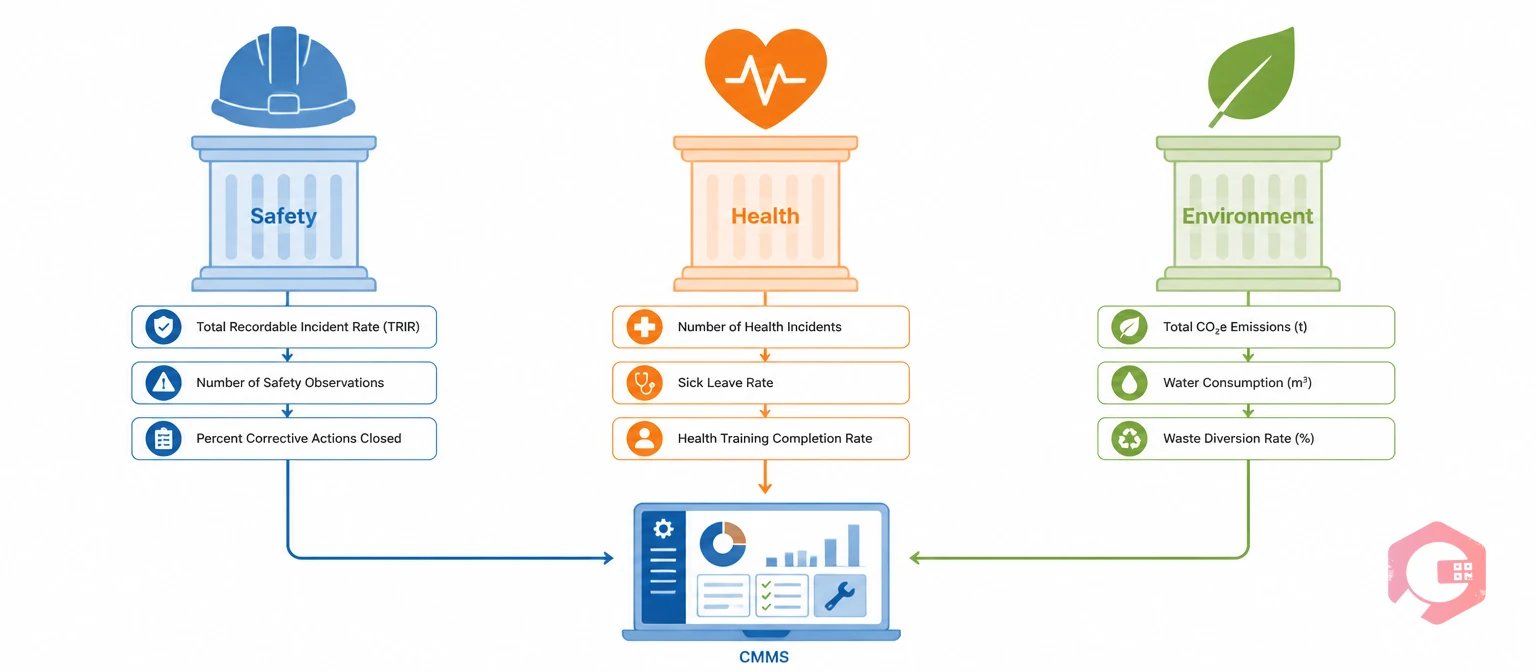
SHE KPIs are quantifiable metrics used to measure an organization's performance across the three pillars of Safety, Health, and Environment — giving maintenance managers and HSE officers a data-driven view of risk, compliance, and operational hazard exposure. The abbreviation SHE (sometimes written as HSE or EHS) groups three disciplines that are tightly connected in any industrial operation: safety governs how equipment and processes are controlled to prevent injuries, health covers how worker exposure and wellbeing are managed, and environment tracks how waste, emissions, and hazardous materials are handled and disposed of.
Maintenance departments are both a major generator and a major consumer of SHE data. Every work order, inspection, near-miss report, permit, and chemical handling record feeds directly into SHE performance. When that data is captured in a CMMS, it becomes the foundation for KPIs that answer real operational questions: Are we completing safety inspections on time? Are near-misses being reported and closed? Are our environmental checks generating corrective actions?
The business case for tracking SHE KPIs is direct. The OSHA recordkeeping requirements mandate that organizations with 10 or more employees document work-related injuries and illnesses — and regulators compare your TRIR and LTIR figures against industry benchmarks during inspections. Beyond compliance, facilities that track and act on leading SHE KPIs consistently report lower incident rates, lower insurance premiums, and higher workforce retention than those that only review lagging statistics after events occur.
A lagging SHE KPI is a metric counted only after an incident has already occurred. Tracking only lagging KPIs leaves maintenance teams reacting to events instead of preventing them.

Leading SHE KPIs measure inputs and behaviors that predict future safety performance, while lagging SHE KPIs measure outputs — events that have already occurred — and confirm whether past performance was adequate. Most facilities track lagging KPIs because they are easy to count, but leading indicators are where the real prevention value lives. A CMMS is uniquely positioned to track both, since work orders, checklists, and permits generate the raw data for leading metrics automatically, while incident records produce the lagging figures.
| Type | What It Measures | Examples | CMMS Data Source |
|---|---|---|---|
| Leading KPI | Behaviors and conditions before an incident occurs | PM compliance rate, near-miss reporting rate, safety inspection completion | Work order completion data, checklist sign-offs, open corrective actions |
| Lagging KPI | Outcomes after an incident or violation has already happened | TRIR, LTIR, Days Away from Work, environmental spill count | Incident records, regulatory reports, corrective work orders triggered by events |
The practical implication for CMMS configuration is significant. Leading KPIs need the system to track task completion rates, overdue inspection counts, and near-miss closure times — all of which come from the work order and checklist modules. Lagging KPIs need a structured incident logging workflow that captures injury type, severity, body part, root cause, and whether a corrective action was opened and closed. Most CMMS platforms support both if configured correctly at setup.
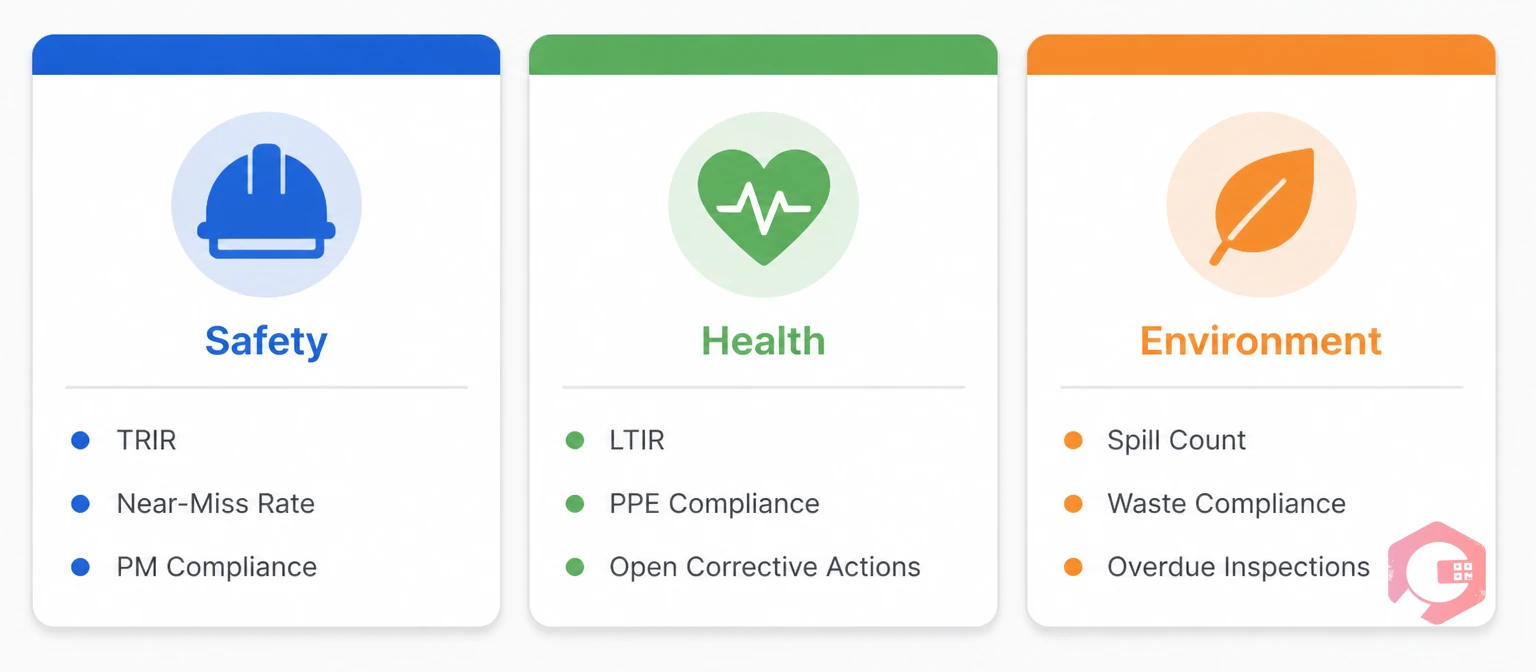
The most effective SHE KPI programs track a balanced mix of leading and lagging indicators across all three pillars. The framework below identifies the ten KPIs that deliver the highest value in a CMMS environment, organized by pillar.
The SHE Performance Triangle is a structured KPI selection framework that ensures Safety, Health, and Environment metrics are tracked in balanced proportion — preventing the common failure of over-indexing on safety incident counts while neglecting occupational health exposure and environmental compliance data. Each side of the triangle carries equal weight in a mature SHE program:
TRIR is the most universally reported safety lagging indicator, calculated as the number of OSHA-recordable incidents per 100 full-time employees annually. It gives regulators and insurers a comparable benchmark across facilities and industries.
Maintenance teams using Cryotos have reported up to 30% reduction in unplanned downtime and 25% faster repair turnaround — outcomes made possible by the same work order and checklist discipline that drives accurate SHE KPI tracking. Use the regulatory compliance checklist to map your mandatory inspection requirements before configuring your first CMMS report.

SHE KPI tracking in a CMMS only works if the system is configured to capture the right data fields before work orders are created, not after. Most CMMS implementations that fail at SHE reporting do so because incident categories, failure codes, and inspection outcomes were not standardized at setup. Follow these steps to build a clean, audit-ready SHE KPI data foundation.
Create a standardized taxonomy of incident types in your CMMS — at minimum: near-miss, first-aid case, recordable injury, lost-time injury, environmental release, and health exposure event. Every work order triggered by an incident must be tagged with one of these types before it can be closed. Without this taxonomy, you cannot produce a TRIR or LTIR report from CMMS data because the system has no way to distinguish a safety-related closure from a routine repair.
Map every mandatory SHE inspection to a recurring work order in the CMMS — safety audits, environmental monitoring rounds, PPE checks, hazmat storage inspections, and permit-to-work pre-job reviews. Assign each one a target frequency, responsible technician, and digital checklist with mandatory sign-off fields. The system then tracks completion automatically and flags overdue inspections in real time. Integrate your permit-to-work software directly into work orders for high-risk tasks, so that safety authorization is a non-skippable step in every relevant job.
SHE KPIs improve fastest when safety observations are collected at the point of maintenance work, not separately in a safety management system. Add mandatory SHE check fields to every maintenance work order for assets in hazardous areas: PPE worn (yes/no), hazard identified (yes/no with description), near-miss occurred (yes/no). This generates near-miss data and PPE compliance data as a by-product of normal maintenance operations — no separate safety data entry required. Use digital maintenance checklists to enforce these fields at every job closure.
Once incident categories and inspection work orders are configured, set up a dedicated SHE KPI dashboard in your CMMS reporting module. Pull the following views: PM compliance rate by department, open near-miss corrective actions by age, overdue inspection count by asset area, and quarterly TRIR trend by rolling 12-month period. Most facilities that achieve real-time SHE visibility run a single dashboard with all three SHE pillars visible side by side — rather than three separate reports that no one reads in combination. Schedule the dashboard report for automatic email delivery to HSE officers and plant managers on a weekly cycle.
Configure alert triggers for KPIs that indicate immediate risk: if PM compliance drops below 85%, send an alert to the maintenance manager; if any near-miss corrective action stays open longer than 7 days, escalate to the HSE officer; if an environmental inspection is more than 48 hours overdue, notify the compliance team. These thresholds turn a passive reporting dashboard into an active safety management system.
Cryotos CMMS automates SHE KPI tracking by generating the underlying data — incident records, inspection completions, checklist sign-offs, and corrective action closures — through the same digital workflows that maintenance teams use for every job, eliminating the need for a separate safety data entry process. Most operations that struggle with SHE reporting are maintaining two parallel systems: a maintenance CMMS and a paper-based or spreadsheet safety tracking system. Cryotos eliminates this duplication by making safety data capture a built-in output of maintenance workflow, not an additional administrative task.
Every Cryotos work order can include mandatory SHE fields — incident type, hazard observation, PPE status, near-miss flag — that technicians complete directly on their mobile device before the job is closed. This means near-miss data, PPE non-compliance observations, and environmental incidents are captured at the point of work, time-stamped, and immediately visible in the maintenance KPI dashboard. No manual transfer to a safety register is required.
Cryotos calculates PM compliance rate automatically from the ratio of completed versus scheduled preventive maintenance work orders, broken down by department, asset class, or individual asset. This gives HSE teams a real-time leading indicator — the single metric most predictive of equipment-related incidents — without any manual KPI calculation. When compliance drops below a configured threshold, the system generates an alert and queues the overdue tasks for the next available technician slot.
When a technician logs a near-miss or incident in Cryotos, the platform automatically creates a corrective action work order linked to the triggering event, assigns it to the responsible person, sets a due date based on severity, and tracks it to closure. This gives maintenance and HSE managers a live count of open corrective actions by age and type — one of the most operationally useful SHE KPIs because unresolved corrective actions are a direct measure of systemic risk accumulation.
Cryotos generates scheduled SHE reports covering PM compliance, near-miss counts, open corrective actions, overdue inspections, and recordable incident trends — all calculated from live CMMS data and delivered by email on a schedule set by the HSE officer or plant manager. This eliminates the manual monthly safety report compilation that most HSE teams spend hours on, replacing it with a real-time dashboard and automated distribution.

Most facilities that track SHE KPIs still struggle to act on them. The problem is rarely the data — it is how the data is collected, categorized, and presented. These are the most common failure points that prevent SHE KPIs from driving real improvement.
SHE stands for Safety, Health, and Environment — the same three disciplines covered by HSE (Health, Safety, Environment) and EHS (Environment, Health, Safety). The order of the words changes by region and industry convention, but the scope is identical. In a CMMS context, SHE KPIs measure how well safety incidents are prevented, how worker health exposure is managed, and how environmental compliance obligations are met — all using data generated by maintenance work orders, inspections, and incident logs rather than a separate safety management system.
TRIR is calculated as (Number of OSHA-recordable incidents × 200,000) divided by total hours worked. In a CMMS, you derive this by counting every work order tagged as a recordable incident type over the calculation period, then dividing by the total labor hours logged in work orders over the same period, multiplied by 200,000. For this to work accurately, every incident must be logged to the correct incident type at work order creation, and labor hours must be recorded consistently in every work order closure — not estimated after the fact.
Lagging KPIs measure outcomes that have already occurred — injury rates, lost-time incidents, environmental spills. Leading KPIs measure behaviors and conditions before incidents happen — PM compliance rate, near-miss reporting frequency, safety inspection completion. Both matter, but most organizations over-invest in lagging KPIs because they are easier to count. If you can only configure a handful of KPIs in your CMMS first, prioritize PM compliance rate, near-miss reporting rate, and overdue inspection count — these three leading indicators provide the earliest and most actionable warning signals of accumulating safety risk.
Yes, but only if the CMMS is configured correctly at setup. A CMMS like Cryotos can automatically calculate PM compliance rate, inspection completion rate, open corrective action count, and overdue inspection count entirely from work order data — no manual entry required. Lagging KPIs like TRIR and LTIR require incident records to be logged using standardized incident types when work orders are created for safety-related events. Once the taxonomy is set and technicians are trained, the data flows automatically into every SHE KPI report without any additional safety team data entry burden.
Leading SHE KPIs — PM compliance, open corrective actions, overdue inspections — should be reviewed weekly by maintenance managers and HSE officers, ideally through a live dashboard that updates in real time. Lagging KPIs — TRIR, LTIR, environmental incident count — should be reviewed monthly and trended quarterly against industry benchmarks and internal targets. Plant directors and senior leadership typically review a monthly SHE summary. Cryotos supports scheduled automated report delivery so the right data reaches each audience at the right frequency without anyone having to pull it manually.
A CMMS that tracks SHE KPIs effectively closes the gap between maintenance operations and safety management — turning work orders, inspections, and incident records into a real-time picture of your facility's true safety posture. Schedule a free demo to see how Cryotos configures SHE KPI dashboards, automates near-miss corrective action workflows, and delivers automated compliance reports to your HSE team every week.



Cryotos AI predicts failures, automates work orders, and simplifies maintenance—before problems slow you down.



