

In facility management, the shift handover is the highest-risk communication event in the operational day. Every open fault, every deferred repair, every isolated piece of equipment, every safety flag from the previous shift must transfer accurately to the incoming team — or the consequences compound. A technician who doesn't know that a pump was temporarily bypassed because of a seal failure isn't negligent; they're uninformed. When that information only exists in a verbal briefing that lasted four minutes at the end of a busy shift, the failure mode is structural, not human. Research published in the AHRQ Patient Safety Network — drawn from high-reliability operations including aviation and process industries — consistently identifies verbal handovers as a primary source of information loss, with critical details omitted in up to 40% of shift transitions in operational environments.
A CMMS shift handover log replaces the verbal briefing with a structured, timestamped, acknowledged record — one that carries every open work order, every equipment status note, and every deferred task from outgoing shift to incoming shift, with full context intact. This guide covers what that log must capture, how the workflow runs, and why accountability starts at the handover record.
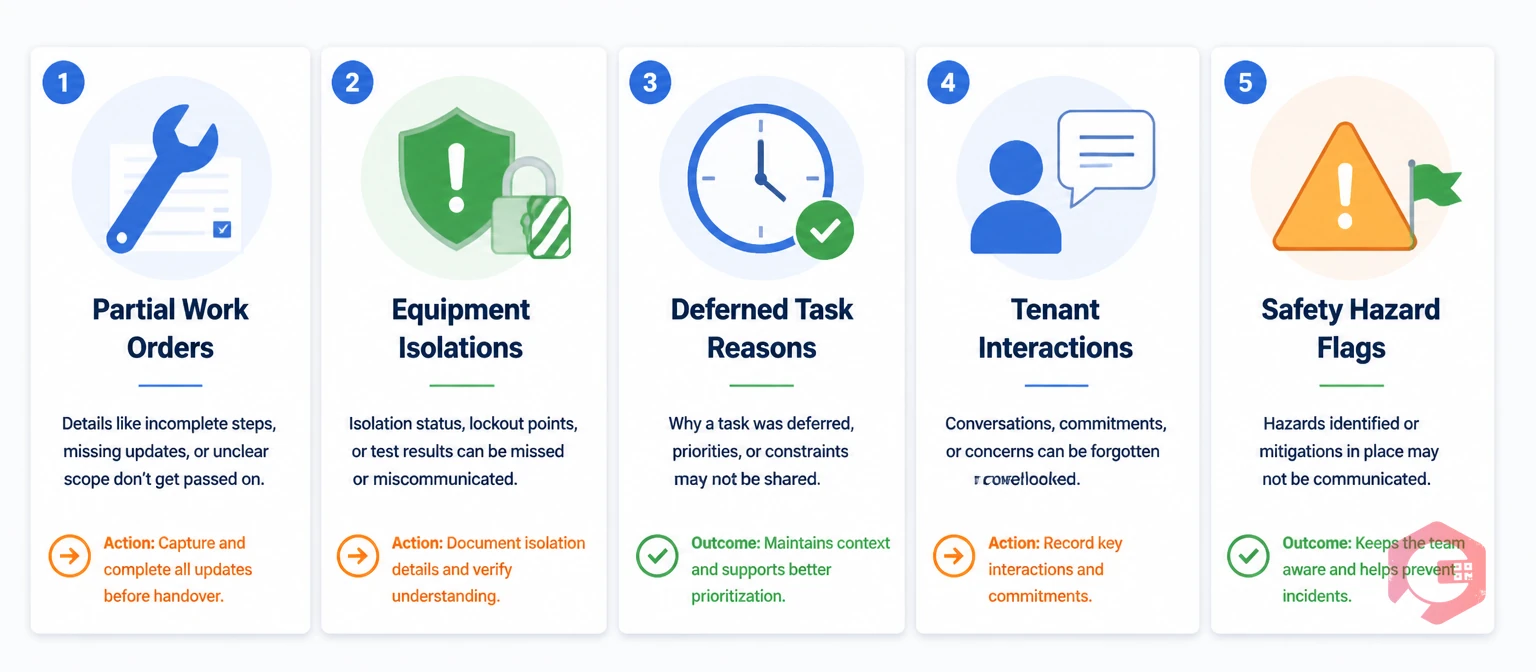
Verbal shift briefings fail not because technicians are careless but because the format is structurally unreliable for the volume and complexity of information that needs to transfer. A briefing at the end of a 12-hour shift, between a tired outgoing team and an incoming team still getting oriented, compresses hours of operational context into a few minutes of speech that neither party can verify, reference, or search.
Five categories of information consistently fail to transfer accurately in verbal-only handovers in FM operations:
When any of these five categories is missed, the cost appears in a different part of the operation hours later. A missed isolation becomes an electrical incident. A deferred task without a reason becomes duplicate work when the incoming team attempts it and discovers the prerequisite hasn't been met. A missed complaint becomes an escalation when the tenant follows up and finds nobody knows what they're talking about. None of these are foreseeable from the handover itself — they appear downstream, disconnected from their cause, and are routinely attributed to operational failure rather than the handover communication breakdown that caused them.
A CMMS shift handover log is not a free-text note field. It's a structured record that forces the outgoing team to document specific categories of operational state before sign-off is permitted. The structure is what makes the record usable — and what makes omissions visible rather than invisible.
Every work order that was active during the outgoing shift and is not fully closed must appear in the handover log with its current status, the work completed so far, the next required action, any parts or resources awaited, and an estimated completion time. This is the difference between handing over a task and handing over an understanding of a task. The work order management software module generates the open work order list automatically at shift-end — the outgoing technician adds status notes and next-action instructions rather than building the list from memory.
For work orders that have been raised but not yet started — typically maintenance requests that came in during the final hour of the shift — the handover log carries them forward as pending items for the incoming team, with the request context and any priority flags already attached. Nothing falls through the cracks because no item can be omitted from the carry-over list without an explicit close or deferral action.
Any equipment that is isolated, bypassed, operating in a degraded mode, or subject to a temporary control measure must be documented with the isolation type, the reason, the asset identifier, the time of isolation, and the condition for reinstatement. This record is not optional — it is a safety requirement. A CMMS asset management module links isolation records directly to the asset profile, meaning the incoming technician who opens the asset record sees the isolation status before they interact with the equipment — regardless of whether anyone remembered to mention it in the briefing.
Tasks deferred from the outgoing shift carry a reason code — parts awaited, contractor scheduled, occupant clearance required, management approval pending — so the incoming team knows not just that a task is deferred but why, and what condition would allow it to proceed. Escalations that were raised but not resolved during the outgoing shift carry their escalation status and the last action taken. Safety flags — hazards identified, incidents reported, areas restricted — carry the flag type, location, and required action, and they remain visible in the handover log until explicitly cleared by an authorised user.
The gap between what a verbal handover transfers and what a CMMS shift log captures is not a matter of degree — it's structural. Every weakness in the verbal model is a design characteristic of how spoken information behaves under operational pressure:
The comparison isn't a case against verbal communication in operations — briefings have a place in building team cohesion and handling nuance. It's a case against verbal communication as the sole or primary mechanism for transferring operational state between shifts. The CMMS log is the reliable record; the verbal briefing becomes a supplement to it, not a replacement for it.
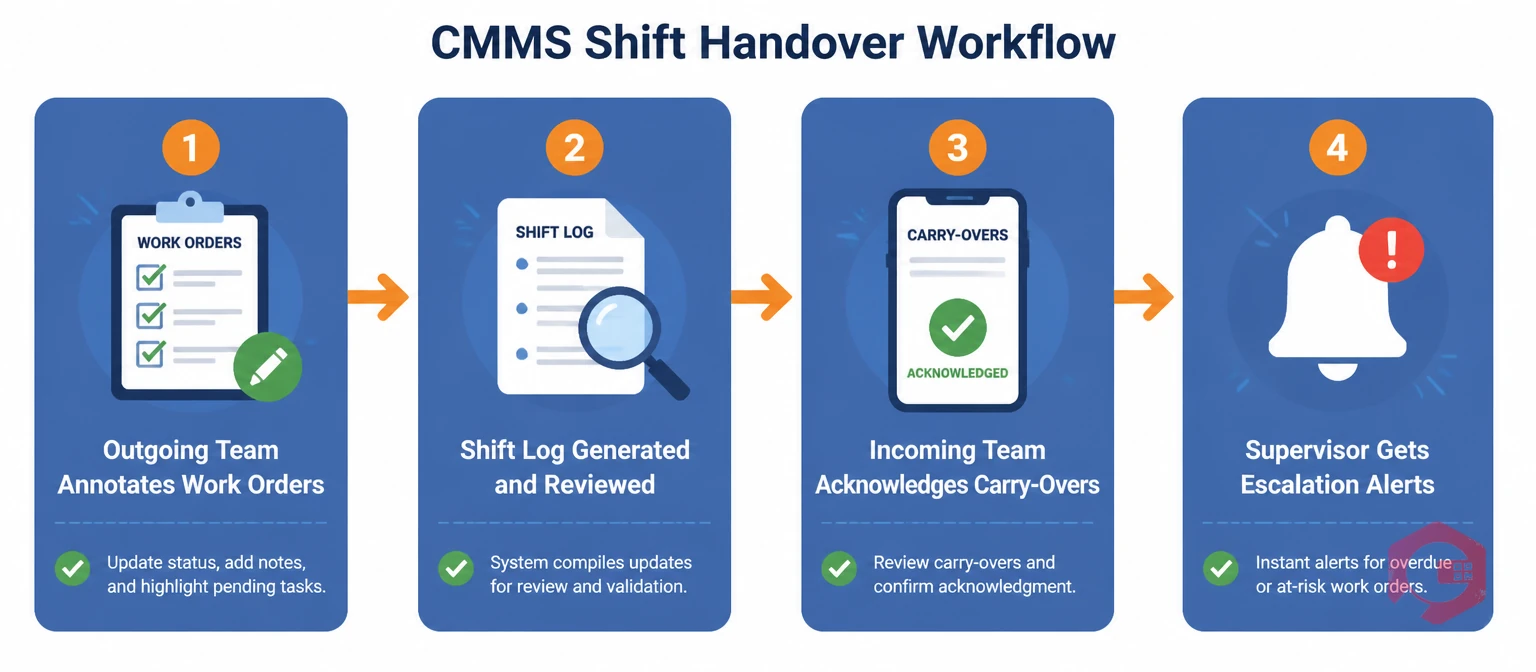
A well-configured CMMS shift handover workflow has four steps. Each step is enforced by the system — the next step cannot begin until the previous one is completed, creating a chain of documented actions that constitutes the formal handover record.
As the shift approaches its end, each technician on the outgoing team reviews their assigned work orders and takes one of three actions: closes the work order with a completion record, annotates it with current status and next-action instructions for the carry-over, or defers it with a reason code. This step is not optional — any work order without a close, annotation, or deferral blocks the technician's shift sign-off. The system prompts the review; the technician provides the context. Nothing is assumed to be finished unless it is explicitly closed.
Once all open work orders are actioned, the CMMS compiles the shift log automatically — a consolidated record of every work order closed, every carry-over with its annotation, every deferral with its reason, every active equipment isolation, and every safety flag that remains open. The outgoing shift supervisor reviews the compiled log, confirms it is complete and accurate, adds any shift-level observations not captured in individual work orders (equipment running abnormally, an unresolved tenant complaint, a staffing gap on the next shift), and signs off. The BI Dashboard surfaces the shift log for supervisor review without requiring navigation through multiple modules — the handover record is a single-screen review at the end of every shift.
The shift log is available to the incoming team the moment the outgoing supervisor signs off — before the incoming team sets foot on the floor. Incoming technicians review their carry-over assignments on mobile, see the status annotations and next-action instructions from their outgoing counterparts, and acknowledge receipt. The workflow automation software requires acknowledgement before a carry-over work order can be reassigned or rescheduled — ensuring the incoming technician has read the context, not just received the task. This acknowledgement timestamp is part of the permanent handover record.
For work orders carrying a high or critical priority flag, the CMMS sends an automatic notification to the FM supervisor or duty manager at the point of handover — not at the point of failure. This means the supervisor knows, before the incoming shift begins active operations, that a high-priority item is being carried over, who has acknowledged it, and what the expected resolution timeline is. If an acknowledged carry-over is not actioned within its SLA window during the incoming shift, a second escalation fires — creating a documented chase trail that makes missed high-priority items visible in real time rather than at the next morning's operations review.
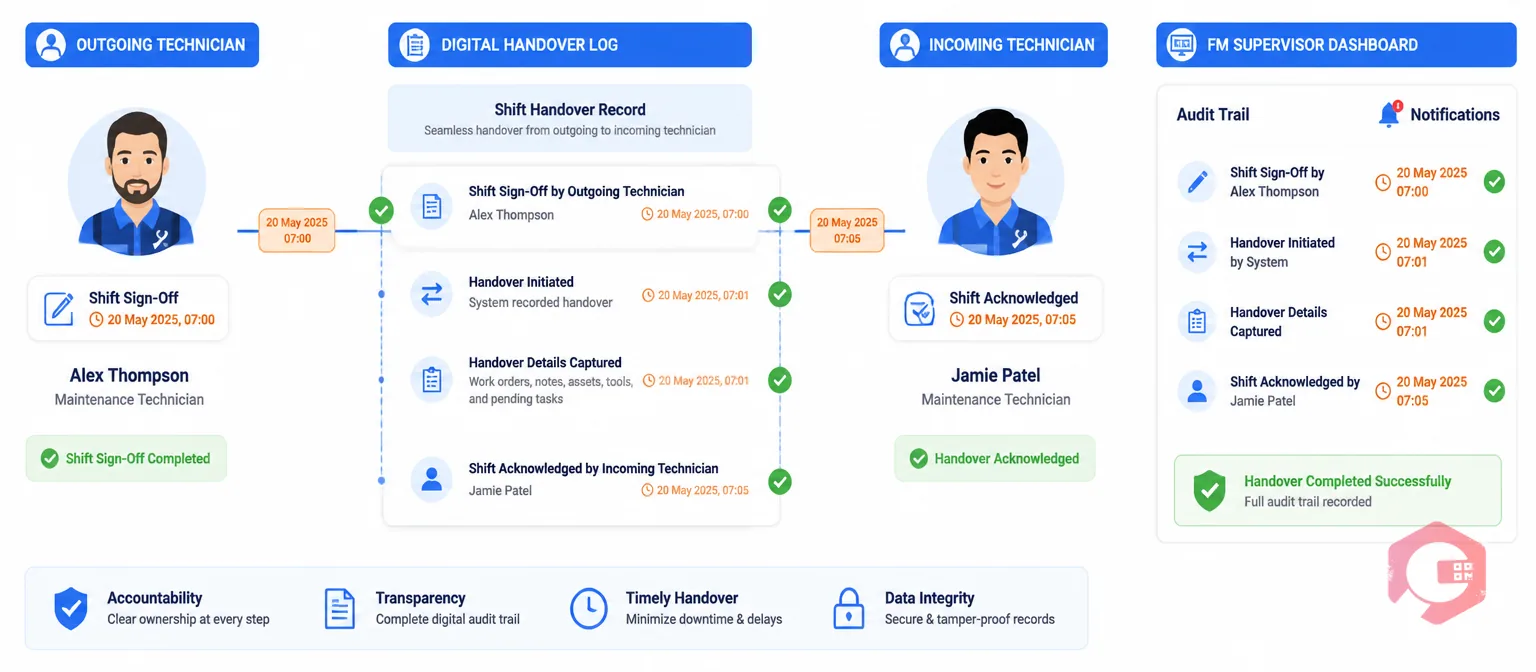
The most operationally important feature of a CMMS shift handover log is not the information it captures — it is the accountability structure it creates. In a verbal handover model, when something goes wrong after a shift change, the question "was this handed over?" has no reliable answer. Both parties may have different recollections, and neither is provably correct. In a CMMS handover model, the answer is always retrievable: the outgoing technician either annotated the work order or they didn't; the incoming technician either acknowledged the carry-over or they didn't; the supervisor either reviewed and signed off the log or they didn't. Every action has a timestamp and a named user.
This accountability structure changes the behaviour of the handover before anything goes wrong. When technicians know that their outgoing annotations are timestamped and associated with their name, the quality of those annotations improves. When incoming technicians know that acknowledgement is recorded, they read the context rather than dismissing it. When supervisors know their sign-off is in the permanent record, they review the log rather than rubber-stamping it. The Report Builder makes this accountability history retrievable for any shift, any team, and any time period — whether for internal performance review, a regulatory inspection, or an incident investigation.
According to UK Health and Safety Executive guidance on human factors in operations, documented shift handover procedures with acknowledged sign-off requirements are among the most effective structural controls for reducing information-loss incidents in facilities with continuous operations. The CMMS shift log is the operational implementation of that guidance.
Cryotos CMMS builds shift handover logging directly into the operational workflow — it is not a separate module or an add-on form. Every work order raised, updated, or closed during a shift contributes to the shift log automatically. The outgoing team's task at shift-end is to add annotations and context, not to reconstruct the shift's activity from memory.
The mobile app gives field technicians a shift-end checklist that walks through each open item assigned to them — prompting for status, next action, and any safety notes before sign-off is available. For multi-person shifts, each technician completes their own portion of the handover log independently, and the supervisor sees a consolidated view across all team members before the shift-level sign-off. No item can be omitted; any work order without a final status note generates a prompt before the sign-off is permitted.
For FM teams managing multiple sites or operating 24-hour schedules with no physical overlap between shifts, Cryotos provides the same structured handover record without requiring anyone to be present at the same time. The incoming team at Site B can review the outgoing log from Site A on mobile before the first task of their shift, with full context for every item they're inheriting — regardless of the distance between sites or the time between shifts. The notification builder pushes the shift handover summary to supervisors via WhatsApp or email at the moment of sign-off, keeping the duty manager informed without requiring them to log into the system to check. Teams using Cryotos report a 30% reduction in unplanned downtime, with improved shift continuity a consistently cited factor in reduced reactive work volumes after implementation.
A complete FM shift handover log should include: all open work orders with current status, work completed so far, and next action required; all active equipment isolations with the asset, reason, and reinstatement condition; deferred tasks with the reason for deferral and the prerequisite for proceeding; safety flags and hazard observations that remain unresolved; any escalations raised during the shift and their current status; and a shift-level summary from the outgoing supervisor covering anything not captured in individual work orders — abnormal equipment behaviour, staffing observations, or upcoming activities the incoming team needs to prepare for. In a CMMS, most of this is auto-generated from the work order and asset record data; the outgoing team's contribution is the contextual annotation layer, not the data gathering.
CMMS prevents tasks from falling through the cracks by making omission impossible at sign-off. Every work order that is open at shift-end must be explicitly actioned — closed, carried over with annotation, or deferred with a reason — before the outgoing technician can sign off. There is no mechanism for a task to silently disappear between shifts. Additionally, carry-over acknowledgement by the incoming team creates a second checkpoint — if a carry-over is not acknowledged within a defined window of the incoming shift starting, an automated alert fires to the supervisor. The combination of mandatory outgoing annotation and mandatory incoming acknowledgement eliminates the silent hand-off that characterises verbal-only systems.
Yes — and multi-site operations are one of the highest-value use cases for CMMS shift handover logs. In a multi-site operation, shifts rarely overlap physically between sites, and the FM manager or duty supervisor may be responsible for multiple locations simultaneously. A CMMS shift log gives the duty manager a consolidated view of handover status across all sites from a single dashboard — showing which sites have completed their outgoing sign-off, which incoming teams have acknowledged their carry-overs, and which high-priority items are active at any location. Without a CMMS, multi-site handover coordination requires phone calls, emails, and manual status updates that introduce exactly the information gaps the handover process is designed to prevent.
Retention requirements for shift handover records vary by sector and jurisdiction. For general commercial facility management, best practice is a minimum of 12 months — long enough to support any investigation of an incident that may take weeks or months to surface after the event. For regulated environments (healthcare, food production, industrial facilities), retention may be mandated at 3–5 years by sector-specific regulations. CMMS records are stored digitally and retrievable by date, site, team, or individual, making long-term retention practically simple. The constraint in a CMMS environment is not storage but rather ensuring the handover records are complete and accurate from day one — because a searchable but incomplete record is only marginally more useful than no record at all.
Verbal shift handovers are a structural liability in facility management operations — not because people communicate poorly, but because spoken information under end-of-shift pressure cannot reliably carry the volume, specificity, and accountability that the handover moment requires. A CMMS shift handover log doesn't replace human communication; it creates the documented foundation that makes human communication at handover valuable rather than load-bearing.
For FM teams ready to move from verbal-and-hope handovers to a structured, accountable, searchable record of every shift transition, Cryotos CMMS gives you the workflow enforcement, mobile capture, and supervisor visibility to make every handover count. Book a free demo today and see what your shift handovers look like when nothing can fall through the cracks.




Cryotos AI predicts failures, automates work orders, and simplifies maintenance—before problems slow you down.



