

Spare parts inventory management for maintenance is the process of tracking, storing, and replenishing the components and materials a facility needs to keep equipment running — ensuring the right part is available at the right time, without tying up excess capital in slow-moving stock. Studies show that nearly 42% of unplanned equipment downtime is caused by unavailable spare parts, making inventory control one of the highest-impact disciplines in facility operations. This guide covers the classification methods, reorder strategies, common pitfalls, and software tools maintenance teams use to bring spare parts costs under control in 2026.

Spare parts inventory management is a structured approach to controlling the stock of physical components — motors, belts, filters, sensors, valves, and thousands of other items — that a maintenance team needs to repair and service facility assets. Unlike retail inventory, spare parts stock often sits idle for months or years before a failure triggers demand, which makes forecasting and classification uniquely challenging.
Not all spare parts carry equal importance. Understanding these three categories is the foundation of any effective inventory strategy:
A clearly documented classification system — ideally stored inside a CMMS — ensures your team makes purchase decisions based on risk and criticality, not guesswork.
Poor spare parts management creates a double-sided financial problem: stockouts drive emergency downtime costs, while overstock drives carrying costs that quietly drain your maintenance budget.
The goal of spare parts inventory management is to find the optimal balance point — enough stock to prevent downtime, lean enough to keep capital productive.
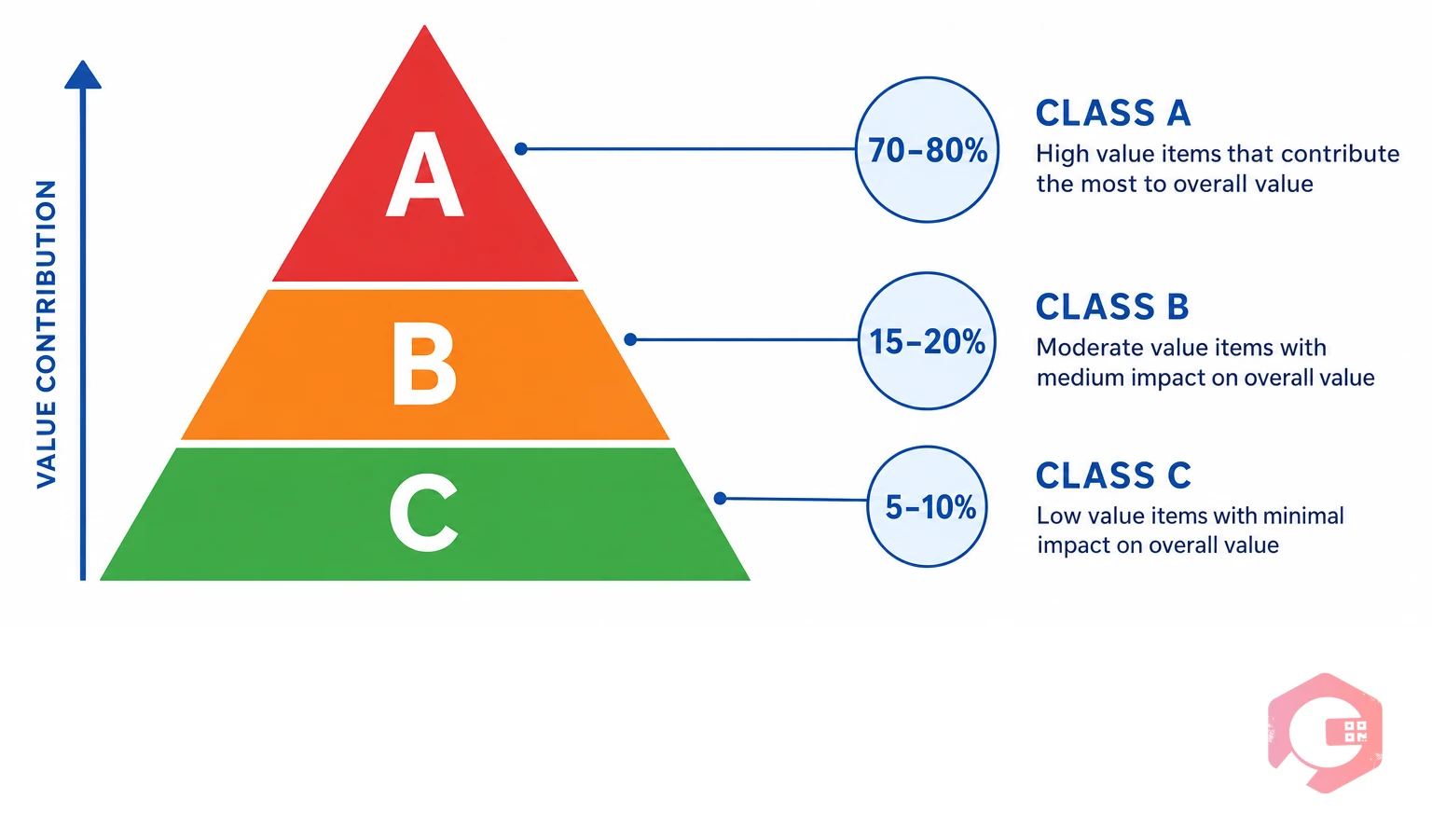
ABC analysis is the most widely used classification method in MRO inventory management. It segments parts by their consumption value — annual usage quantity multiplied by unit cost — so you can direct the most control effort toward the items with the most financial impact.
A CMMS like Cryotos can automate this classification by pulling live consumption data from linked work orders, flagging parts whose class has shifted since the last review cycle.
The reorder point (ROP) tells your system when to trigger a purchase order before stock runs out. The formula is straightforward:
Reorder Point = (Average Daily Usage × Lead Time in Days) + Safety Stock
Safety stock acts as a buffer against demand spikes and supplier delays. A common approach sets safety stock at 1.5× the average lead time demand for Class A parts and 1× for Class B. Class C consumables are typically managed with a fixed minimum quantity rule.
Physical inventory accuracy is the foundation of reliable reorder calculations. Rather than a disruptive annual full count, high-performing maintenance teams use cycle counting — counting a rotating subset of parts each week. Reliable Plant research suggests facilities using cycle counting achieve 95%+ inventory accuracy versus 75–85% for annual-count-only operations.
Lead time variability is one of the top causes of unexpected stockouts. Maintain an updated lead time record for each critical part, and set your ROP based on the worst-case lead time (not average) for Class A items. Build preferred-vendor agreements for your top-spend parts to reduce both lead time and emergency procurement premiums.
Linking parts consumption to specific assets — not just to work orders in aggregate — reveals which equipment drives the most parts spend. This data helps prioritize capital replacement decisions: if a single aging chiller accounts for 30% of your parts budget, the business case for replacement often writes itself.
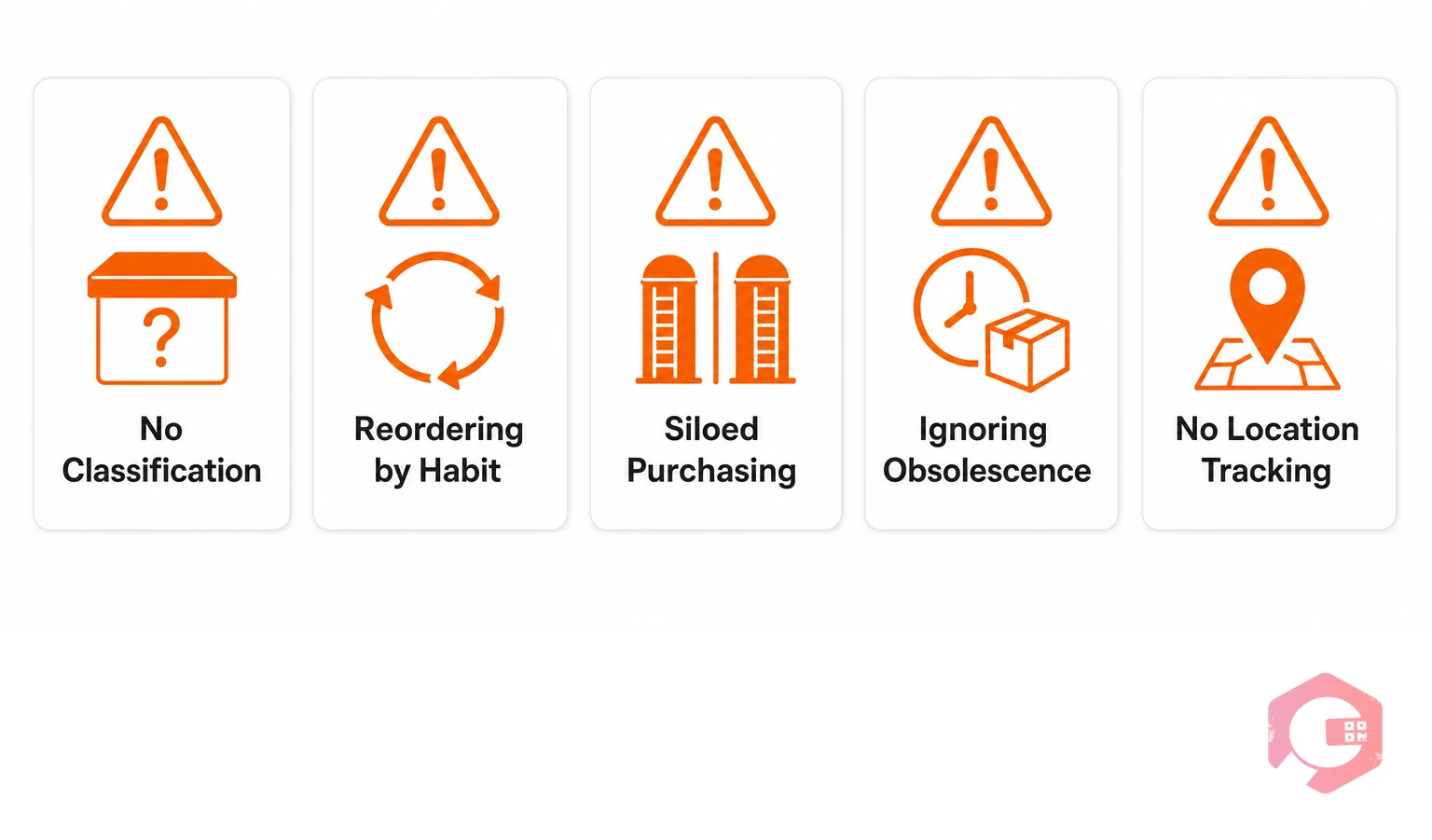
A computerised maintenance management system (CMMS) connects your parts inventory directly to your maintenance workflows — so every work order automatically records parts consumed, and your reorder alerts fire before stock reaches zero rather than after.
According to Gartner research on asset management, facilities using a CMMS for inventory control report an average 18% reduction in MRO spend within the first year of adoption.

Use this checklist to audit your current spare parts program and identify the highest-impact improvements:
For MRO spare parts, a turnover ratio of 2–4 times per year is considered healthy for most facilities. Consumables should turn faster (6–12×), while insurance spares may turn less than once per year by design. Tracking turnover by part class — rather than across the whole inventory — gives a more actionable picture.
Start with a criticality assessment tied to your asset register. Ask three questions for each part: What asset does it support? What is the consequence of that asset failing (safety, production loss, compliance)? What is the lead time to source this part in an emergency? Parts that support high-consequence assets with long lead times are your critical spares and should always be held in stock.
MRO (Maintenance, Repair, and Operations) inventory is a broader category that includes all materials used to support operations — not just parts for equipment repair, but also cleaning supplies, personal protective equipment, and office materials. Spare parts inventory is a subset of MRO focused specifically on components used to repair or replace equipment. In practice, the terms are often used interchangeably in maintenance contexts.
A CMMS centralises your parts catalog, automates reorder alerts, links consumption to specific work orders and assets, and provides real-time stock visibility across locations. This eliminates the manual spreadsheet tracking that leads to stockouts and duplicate purchasing, and gives maintenance managers the consumption data they need to optimise reorder levels over time.
If your maintenance team is still managing spare parts through spreadsheets or tribal knowledge, the gap between your current parts costs and what they could be is likely significant. Cryotos CMMS gives facility maintenance teams a complete spare parts management system — from automated reorder alerts to mobile parts consumption tracking — built into the same platform you use for work orders and asset management. Book a free demo today and see how your team can reduce MRO spend while eliminating parts-related downtime.


Cryotos AI predicts failures, automates work orders, and simplifies maintenance—before problems slow you down.



