

Stock level visibility in spare parts management means knowing — in real time — exactly what parts you have, where they are stored, and how much is left. Without it, maintenance teams waste hours searching storerooms, ordering duplicate stock, or waiting on emergency deliveries while equipment sits idle. According to a McKinsey report on operations resilience, unplanned equipment downtime costs industrial companies an average of $50 billion annually — and parts unavailability is one of the top three root causes.
This guide covers why stock visibility breaks down in spare parts warehouses, the exact causes behind inventory blind spots, a practical framework for classifying and stocking parts, and a step-by-step approach to fixing visibility gaps — including how a CMMS connects every piece together.
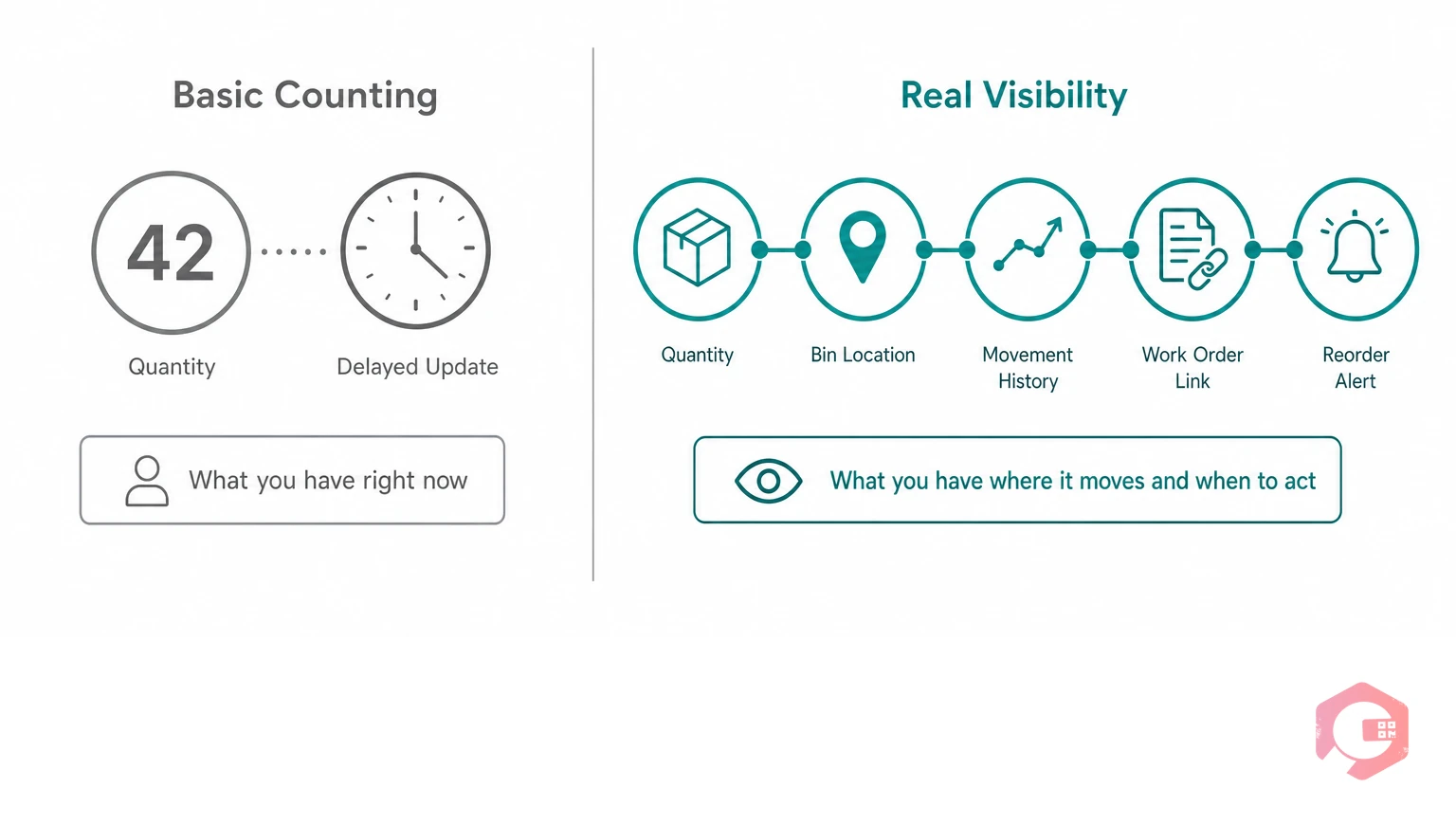
Stock level visibility is the ability to see the current quantity, location, and movement history of every spare part in your storeroom — without having to physically walk the shelves or call someone. It goes beyond a simple headcount. True visibility means knowing which bin a bearing is stored in, whether it's below the minimum threshold, when it was last used, and which work order consumed it.
The difference between basic inventory counting and real visibility is this: counting tells you what you have right now; visibility tells you what you have, where it is, how it moves, and when you need to act. For maintenance teams, that distinction is the gap between a job that gets done on time and a repair that stretches into an unplanned production halt.
In warehouse management terms, spare parts occupy a unique position. Unlike raw materials or finished goods, spare parts don't follow predictable demand patterns. A seal might sit untouched for 18 months and then be needed three times in a week. That unpredictability makes real-time visibility even more critical — you can't rely on historical sales data the way a retail warehouse manager can.

When maintenance teams can't see what they have, three expensive problems follow almost immediately.
A technician identifies a failed pump seal. They check the storeroom log — it shows 4 units in stock. But when they go to pull the part, the shelf is empty. Someone issued those seals three weeks ago and never updated the record. The repair waits. The production line stops. According to Plant Engineering, parts-related delays account for up to 30% of total maintenance downtime in industrial facilities.
This is the most direct cost of poor visibility: a part exists somewhere in your system but can't be found or confirmed available at the moment it's needed. The repair window closes. Emergency purchasing kicks in. Lead times stretch from hours to days.
The natural response to “we keep running out of parts” is to order more and hold bigger buffers. But without visibility into actual consumption patterns, teams over-order. Spare parts then sit on shelves for months or years, tying up capital. The Gartner Supply Chain research group estimates that holding costs for slow-moving MRO inventory typically run 20–30% of the item's value per year when you account for storage, handling, insurance, and obsolescence risk.
Ghost inventory is stock that exists on paper but not on the shelf — or the reverse, physical stock that nobody recorded. It builds up through unlogged issues, returns that don't get booked back in, and parts cannibalized from one machine to fix another. Over time, ghost inventory erodes trust in the system entirely. Technicians stop checking the software and default to walking the shelves — which defeats the purpose of having a system at all.

Poor visibility rarely has a single cause. It's usually the result of several compounding problems in how parts are tracked and stored.
Many maintenance storerooms still run on paper logs, whiteboard counts, or spreadsheets updated once a week. Every transaction that happens between updates is invisible to anyone not standing in the room. A technician pulls a part at 2 PM on a Thursday; by Friday morning, the log still shows it as available. Manual systems are always behind — and in fast-moving operations, “behind” means wrong.
Storing parts without a defined address system — aisle, rack, shelf, bin — means every search is a physical expedition. When you have hundreds of part numbers across a large storeroom, finding a specific item without location data can take 20 minutes. That time adds up fast when it happens multiple times a day across a team of technicians. Cryotos's inventory management module supports full warehouse structure mapping down to the bin level, giving every part a fixed digital address.
Larger facilities often have satellite storerooms near different production zones. Without a centralized system, each room operates as an island. A part that's stocked in Building C gets ordered again for Building A because nobody checked across locations. Consolidated inventory visibility across all storerooms eliminates this duplication and reduces total stock holding costs.
Most teams know they need reorder points, but many set them once and never revisit them. Parts consumption changes seasonally, after equipment upgrades, or when production volumes shift. Without automated alerts tied to current thresholds, the first sign that you've run out is the moment a technician needs the part. Automated stock alerts in Cryotos trigger notifications the moment any part falls to its minimum threshold — before the stockout, not after.
Not all spare parts carry the same risk if they run out. A practical classification framework helps you decide how much stock to hold and how tightly to monitor each category. The most useful approach combines two dimensions: criticality and movement speed.
Applying this framework to your parts list gives you a tiered visibility strategy. You invest your tightest monitoring in the top-left quadrant (critical + fast-moving) and accept looser controls at the bottom right. This is how maintenance teams get more value from their inventory system without trying to track everything with equal intensity.
For teams managing MRO inventory, this classification approach also connects directly to budget planning — you can size your carrying cost targets by quadrant rather than applying a blanket percentage to the whole inventory.
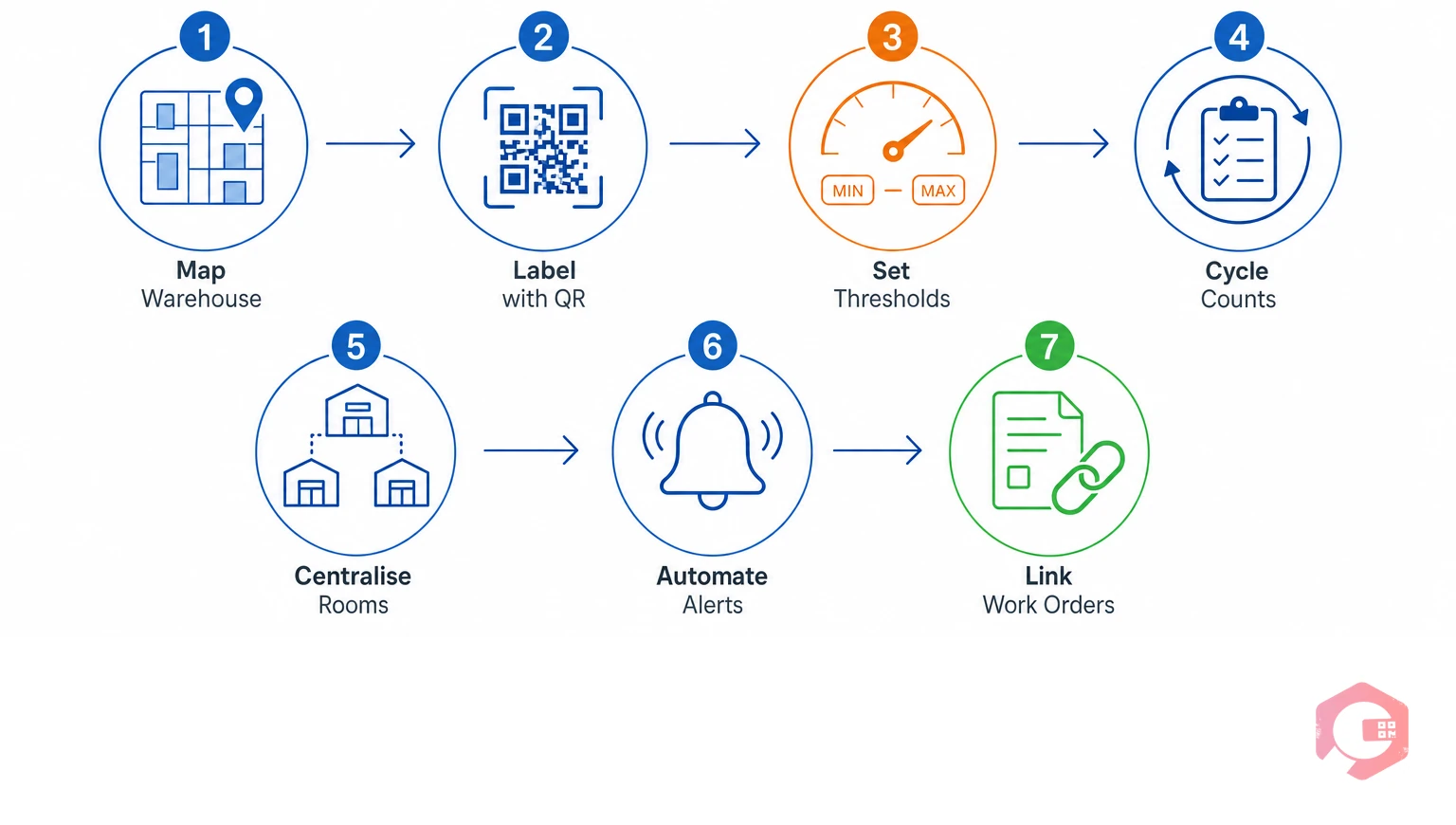
Improving visibility isn't a single project — it's a set of layered changes to how you store, label, track, and review parts. Here are seven steps that work in sequence.
Teams that follow this sequence typically see measurable results within the first quarter: fewer emergency purchases, faster technician response times, and more accurate stock records. A manufacturer in the food processing sector that implemented structured location mapping and automated alerts through Cryotos reduced emergency procurement spend by 28% in the first six months.
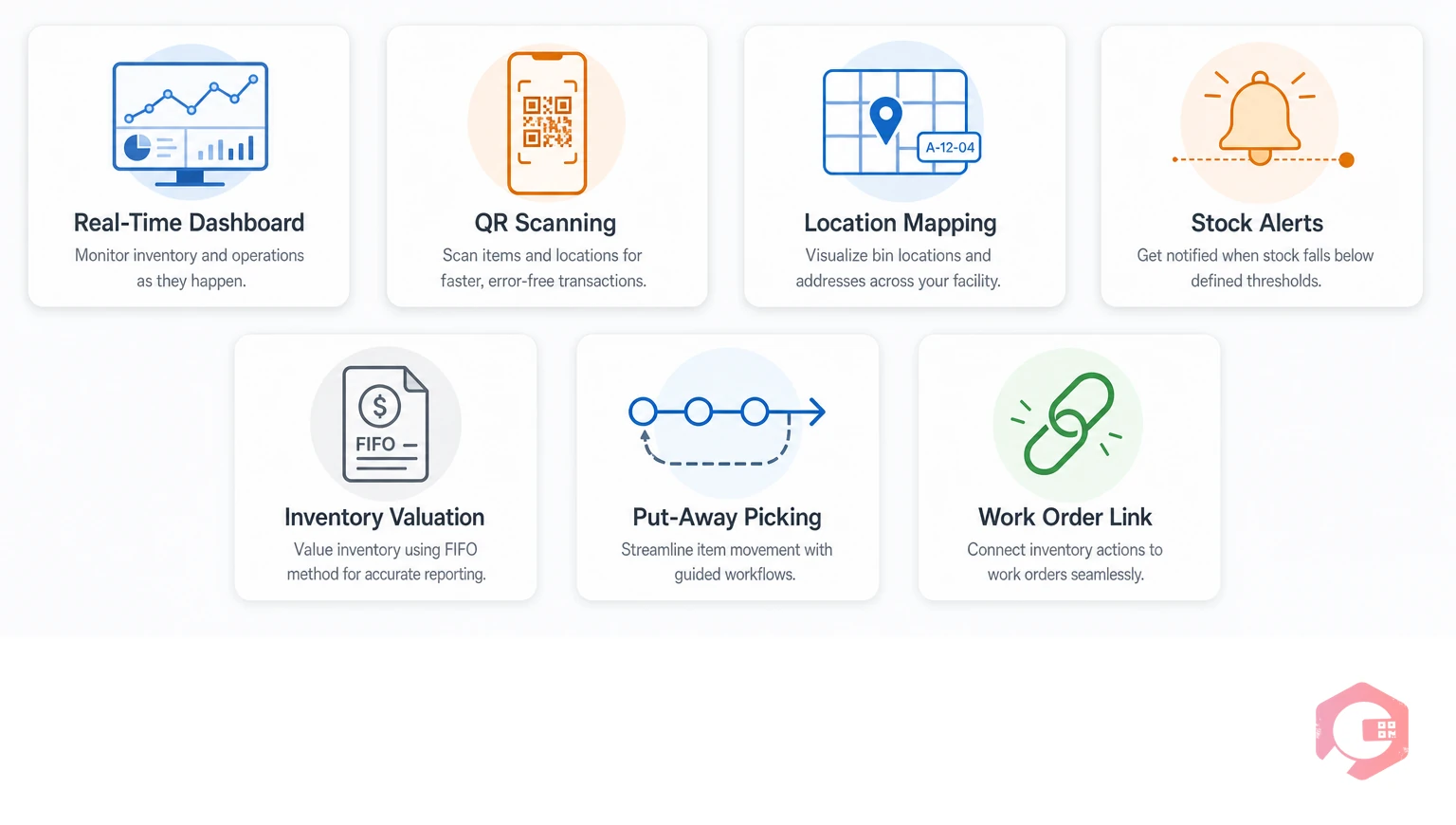
A maintenance management platform closes the gap between your physical storeroom and the digital record of what's in it. Here's how the core capabilities translate to real visibility gains:
The result is an inventory system that doesn't just tell you what's on the shelf but connects that information to the maintenance work that drives consumption. That connection is what transforms stock data from a number in a spreadsheet into an operational tool that prevents downtime.
According to ISO 55000 asset management standards, effective spare parts management is a core component of physical asset lifecycle management — and visibility is explicitly identified as a prerequisite for optimal inventory performance.
Safety stock is a buffer held above the minimum stock level to absorb unexpected demand spikes or supply delays. The minimum stock level is the trigger point for reordering — when you hit it, you place a purchase order. Safety stock sits below the minimum and above zero, acting as your last line of defense before a stockout. In practice, many teams set their minimum level to include the safety stock buffer, but they're technically distinct values in inventory planning.
Critical and fast-moving parts should be cycle-counted monthly or even weekly for high-velocity items. Slow-moving parts can be counted quarterly. A full physical count of the entire storeroom once per year is the minimum standard for facilities under any kind of regulatory compliance requirement. The goal of frequent cycle counts isn't to count everything — it's to catch discrepancies before they compound into major record inaccuracies.
For most maintenance operations, yes. A warehouse management system (WMS) is designed for high-volume goods movement in distribution centers. A CMMS with strong inventory features — location mapping, barcode scanning, put-away/picking workflows, and real-time alerts — covers everything a maintenance storeroom needs. Unless you're running a very large multi-site operation with complex logistics requirements, a CMMS provides better value because it connects inventory directly to work orders, assets, and maintenance schedules.
Ghost inventory builds up through four main causes: unlogged parts issues (technician takes a part without recording it), unbooked returns (part comes back to the shelf but isn't entered back into the system), ad hoc cannibalization (part removed from one asset to fix another without a work order), and receiving errors (parts counted incorrectly during goods receipt). Fixing ghost inventory starts with enforcing QR code scanning for every transaction — no exceptions — and linking every issue to a work order.
Poor stock level visibility is a solvable problem — but it requires more than good intentions. It takes structured location mapping, consistent scanning discipline, automated alert thresholds, and a system that connects storeroom data to the work orders that drive consumption. Cryotos CMMS brings all of these together in one platform, giving maintenance teams real-time visibility into every spare part — what it is, where it is, and when to reorder — without manual tracking or storeroom expeditions. If your team is still dealing with stockouts, ghost inventory, or emergency purchases, it's worth seeing what connected inventory management looks like in practice.


Cryotos AI predicts failures, automates work orders, and simplifies maintenance—before problems slow you down.



