

Facility management operations consume more time, budget, and energy than they should - not because the work is inherently complex, but because most teams are still managing it reactively. According to a JLL Facility Management survey, reactive maintenance costs up to three times more per work order than planned maintenance. If your team is constantly firefighting instead of following a plan, this guide gives you a practical framework to fix that.
Streamlining facility management operations means replacing ad-hoc processes with structured, repeatable workflows - covering work orders, inspections, vendor coordination, and asset tracking - so your team spends less time reacting and more time preventing problems.
Streamlining isn't about cutting corners or reducing headcount. It's about eliminating the friction that slows your team down - duplicate data entry, unclear task ownership, paper-based inspection logs, and missed maintenance windows. When operations are streamlined, your technicians know exactly what needs doing, when, and where. Your managers have real-time visibility. And your budget doesn't haemorrhage on emergency repairs that could have been prevented.
Reactive operations are driven by failure - something breaks, someone calls it in, a technician is dispatched. Proactive operations are driven by schedules, data, and standards. The goal of streamlining is to shift your team's time ratio from reactive to proactive. A well-run facility aims for 70-80% planned work and 20-30% reactive response, according to IFMA research.

Before you can streamline, you need to know what's slowing you down. These five bottlenecks appear consistently across facility types and sizes:

Every request - whether it's a broken HVAC, a lighting fault, or a cleaning escalation - should flow into a single work order management system. This gives you one source of truth for task status, technician assignment, and completion history. Teams using digital work order systems report up to 28% faster resolution times compared to manual processes, according to Plant Engineering's benchmark report.
Preventive maintenance is the single highest-value investment a facility team can make. Schedule routine checks for HVAC, plumbing, electrical systems, elevators, and fire safety equipment at fixed intervals. Use usage-based triggers (operating hours, cycle counts) for equipment that doesn't fail on a calendar pattern. A good PM schedule should cover at least 70% of your maintenance workload.
Paper checklists for facility inspections create three problems: they're slow to complete, impossible to analyse, and easy to lose. Digital inspection forms - completed on a mobile device - create an instant audit trail, flag non-conformances automatically, and push follow-up work orders without any manual handoff. This is especially critical for health and safety compliance, where OSHA inspection data shows documentation gaps are among the most common citation triggers.
When technicians know the exact location, condition, and service history of every asset, they stop wasting time searching for equipment or repeating work that was already done. Asset management software with QR code scanning or GPS tracking gives your team instant access to service records, warranties, and maintenance history - right from the floor.
Vendor management is where many facility operations lose hours every week. Create standardised onboarding checklists, service level agreements, and work completion sign-off processes for every contractor. When vendor workflows are documented and enforced digitally, disputes decrease and accountability increases.
You can't improve what you don't measure. Key metrics to track include mean time to repair (MTTR), planned maintenance compliance rate, work order backlog, and cost per work order. Review these weekly - not monthly - so you can course-correct quickly. According to McKinsey's Operations research, facilities that track operational KPIs weekly reduce unplanned downtime by up to 20%.
Facility technicians aren't at a desk. They're on the floor, across buildings, or in the field. Tools that only work on desktop create unnecessary delays. Mobile-first CMMS platforms - where technicians receive assignments, update work order status, complete checklists, and raise new issues - all from a phone - cut the feedback loop from hours to minutes.
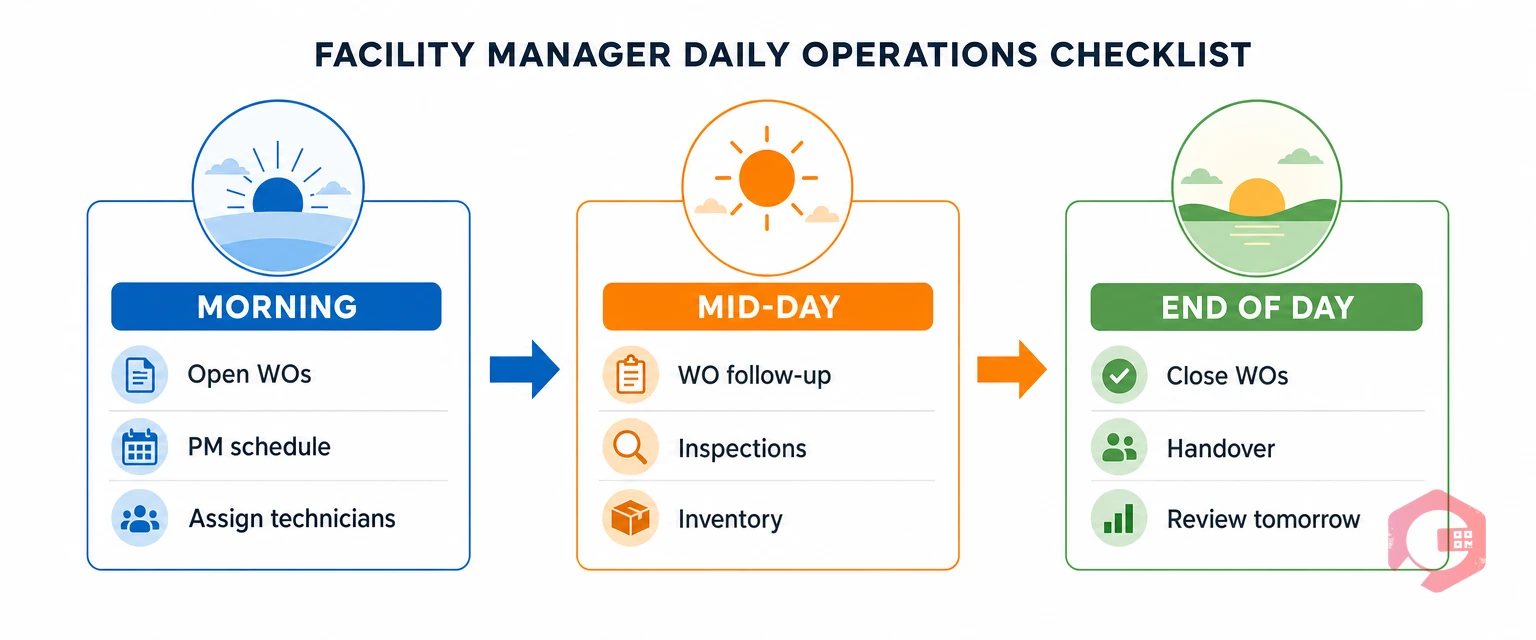
Use this framework to structure your team's day and ensure nothing slips through:

Cryotos CMMS is built for exactly this use case. Work orders can be raised via QR code scan, voice command, or photo - and are automatically routed to the right technician based on location and skill. Preventive maintenance schedules run on calendar or usage-based triggers with automated alerts. Inspections are completed digitally on mobile with instant audit trail generation. Asset tracking uses GPS, NFC, and BEACON technology so your team always has real-time visibility.
Teams using Cryotos report a 30% reduction in equipment downtime and 25% faster repair times. If you want to see how it maps to your facility's specific workflows, book a demo with the Cryotos team.
Facility management operations streamlining refers to replacing manual, fragmented, or reactive processes with structured, digital workflows that improve efficiency, reduce costs, and give managers real-time visibility into every task, asset, and inspection across their facility.
Most facility teams see measurable improvements within 60-90 days of implementing a digital operations system - particularly in work order resolution time, PM compliance rates, and technician productivity. Full ROI typically appears within six to twelve months.
A CMMS (Computerised Maintenance Management System) focuses specifically on maintenance workflows - work orders, PM scheduling, asset tracking, and downtime management. Facility management software is broader and may include space management, lease tracking, and occupancy planning. For operational teams, a CMMS is usually the higher-value investment.
Yes. Even a team of 3-5 technicians benefits from digital work order management and PM scheduling. The productivity gains are proportionally higher for smaller teams because manual processes consume a larger share of their available time.
Streamlining facility management operations isn't a one-time project - it's a shift from reactive firefighting to proactive, data-driven management. Start with work order centralisation and a preventive maintenance schedule, then layer in digital inspections, asset tracking, and mobile tools as your team adapts. Track your KPIs weekly, and the improvements compound over time. The facilities that run most efficiently aren't the ones with the biggest budgets - they're the ones with the best systems.


Cryotos AI predicts failures, automates work orders, and simplifies maintenance—before problems slow you down.



