How to Reduce Facility Operating Costs with CMMS (Complete Guide)

Article Written by:

Created On:

April 27, 2026

How to Reduce Facility Operating Costs with CMMS (Complete Guide)

Why Facility Operating Costs Keep Rising

Most facility managers are fighting costs on multiple fronts at once — aging infrastructure, tighter compliance requirements, rising energy prices, and shrinking maintenance teams. The core problem isn’t that costs are inevitable; it’s that they’re invisible until they become emergencies.

The Hidden Cost Drivers Most Managers Overlook

The biggest cost leaks in facility management rarely show up as a single line on a report. They accumulate through:

  • Unplanned downtime — equipment failures that halt operations at the worst possible time
  • Overstocked or understocked spare parts — either tying up capital or causing delays
  • Manual work order processes — technicians spending more time on paperwork than on repairs
  • Deferred maintenance — small issues ignored until they become expensive failures
  • Compliance gaps — missed inspections that result in fines or failed audits

A CMMS targets each of these problems at the source — not with band-aid fixes, but systematic controls.


What Is CMMS and How Does It Cut Costs?

A Computerized Maintenance Management System (CMMS) is software that centralizes all maintenance operations — scheduling, work orders, asset data, inventory, and compliance records — into one platform. Rather than relying on spreadsheets, phone calls, and tribal knowledge, facility teams use a CMMS to automate, track, and optimize every maintenance activity.

The cost savings come from replacing reactive, guesswork-driven maintenance with data-backed decisions. When you know what assets you have, when they were last serviced, and what parts are in stock, you stop wasting money on surprises.


6 Proven Ways CMMS Reduces Facility Operating Costs

1. Preventive Maintenance Cuts Emergency Repair Costs

Reactive maintenance — fixing things after they break — is the most expensive way to manage a facility. Emergency callouts, expedited parts, and production stoppages add up fast. CMMS enables preventive maintenance (PM) scheduling, automatically triggering service tasks based on time intervals, meter readings, or usage thresholds.

Organizations that shift from reactive to preventive maintenance typically reduce maintenance costs by 12–18% within the first year. With Cryotos CMMS, PM schedules are auto-generated, assigned to the right technician, and tracked to completion — with zero manual follow-up.


2. Automated Work Orders Reduce Labor Waste

Without a CMMS, maintenance requests get lost in emails, WhatsApp messages, or verbal conversations. Technicians travel to jobs without the right tools or information. Time is wasted on coordination, not repairs.

A CMMS automates work order creation, assignment, and tracking. Technicians receive job details — asset location, fault history, required parts, priority — on their mobile devices before they leave the workshop. This reduces average job completion time and eliminates duplicate or missed work orders. Less wasted labor time directly translates to lower labor cost per job.


3. Asset Lifecycle Tracking Delays Replacement Costs

Replacing assets too early wastes capital. Replacing them too late leads to costly failures. CMMS gives you complete visibility into each asset’s maintenance history, total cost of ownership, and predicted remaining useful life.

With this data, facility managers can make evidence-based decisions: repair vs. replace, extend warranty coverage, or plan capital expenditure accurately. Organizations using CMMS for asset lifecycle management report extending average asset lifespan by 15–25% — deferring significant replacement costs year over year.


4. Inventory & Spare Parts Optimization Eliminates Overstocking

Spare parts inventory is a silent cost killer. Overstock ties up working capital in parts that sit unused for months. Understock causes emergency purchases at premium prices and delays that extend equipment downtime.

CMMS tracks parts consumption in real time, links inventory to specific assets and PM schedules, and generates reorder alerts at optimal thresholds. The result: facilities typically reduce spare parts carrying costs by 10–20% while improving parts availability when it matters most.


5. Energy Management Monitoring Lowers Utility Bills

Energy is often the single largest operating cost for facilities — accounting for 30% or more of total operating expenses in commercial buildings. Poor maintenance is a major contributor: dirty HVAC filters, failing seals, misaligned equipment, and aging lighting all consume excess energy.

CMMS helps reduce energy costs by ensuring energy-consuming assets are maintained on schedule. When HVAC units, compressors, boilers, and lighting systems are serviced regularly, they operate at peak efficiency. Some CMMS platforms also integrate with IoT sensors to detect energy anomalies in real time — flagging overconsumption before it becomes a monthly bill shock.


6. Compliance & Audit Trails Avoid Penalty Costs

Regulatory compliance in facility management carries real financial risk. Missed safety inspections, expired certifications, and incomplete maintenance records can result in fines, insurance premium increases, or operational shutdowns.

A CMMS automatically logs every maintenance activity with timestamps, technician signatures, and attached photos — creating an audit-ready compliance trail at all times. Scheduled compliance tasks (fire safety checks, elevator inspections, electrical testing) are triggered automatically, so nothing is missed. Avoiding even one compliance penalty can justify the annual cost of a CMMS subscription.
 

How to Calculate Your CMMS ROI

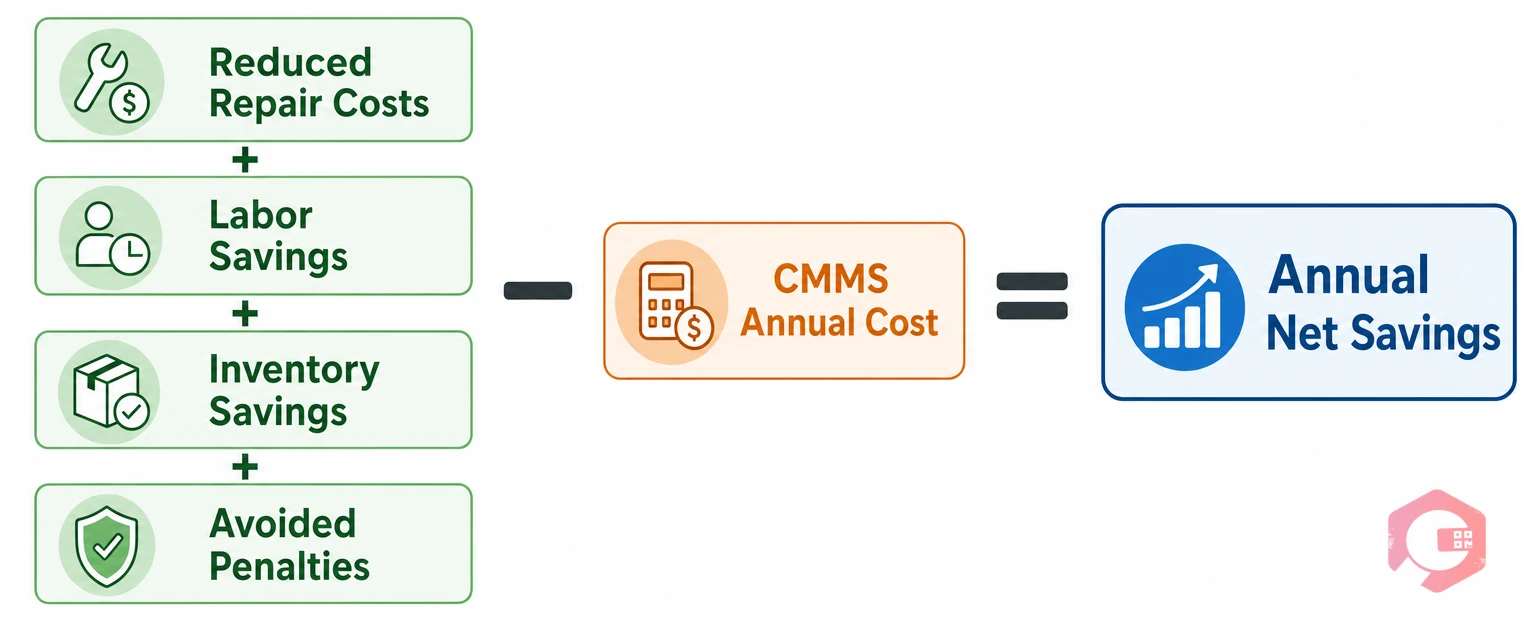
Before committing to a CMMS, it helps to estimate your potential savings. A simple ROI formula:

Annual Savings = (Reduced Repair Costs + Labor Savings + Inventory Savings + Avoided Penalties) − CMMS Annual Cost

As a benchmark: a facility spending ₹50 lakhs per year on maintenance can realistically target a 15–20% cost reduction in year one — saving ₹7.5–10 lakhs. Most CMMS implementations pay for themselves within 6–12 months.

The key is to baseline your current costs (emergency repairs, overtime labor, parts wastage, compliance fines) before go-live, then measure the same metrics 6 months post-implementation.


How Cryotos CMMS Helps Facility Teams Cut Costs

Cryotos CMMS is purpose-built for facility management teams that need to do more with less. With Cryotos, you get:

  • Automated PM scheduling — set it once, run it forever
  • Mobile-first work orders — technicians get everything on their phones
  • Real-time asset tracking — full maintenance history at your fingertips
  • Smart inventory management — auto-reorder alerts and usage analytics
  • Compliance dashboards — never miss an inspection or certification deadline
  • Custom reports & cost analytics — see exactly where your money is going

Facility teams using Cryotos have reported up to 30% reduction in maintenance costs within the first year of implementation. Whether you manage a single building or a multi-site portfolio, Cryotos scales with your operations.

👉 Book a free demo and see how much your facility could save.


Frequently Asked Questions

How long does it take to see cost savings with a CMMS?

Most facilities see measurable cost reductions within 3–6 months of go-live — particularly in reduced emergency repair spending and labor efficiency gains. Full ROI is typically achieved within 6–12 months.

What is the average cost reduction with CMMS for facility management?

Industry benchmarks suggest CMMS can reduce overall maintenance costs by 12–25% depending on the starting baseline. Facilities with high reactive maintenance ratios see the largest initial savings.

Can a CMMS help reduce energy costs in a facility?

Yes. By ensuring HVAC, lighting, and mechanical systems are maintained on schedule, CMMS helps equipment run at peak efficiency — directly reducing energy consumption. IoT-integrated CMMS platforms provide real-time energy anomaly detection for even greater savings.


Conclusion

Reducing facility operating costs isn’t about cutting corners — it’s about eliminating waste, preventing failures before they happen, and making data-driven decisions. A CMMS gives facility managers exactly the visibility and automation they need to achieve all three.

From preventive maintenance and work order efficiency to inventory control and compliance — the savings add up quickly. If your facility is still managing maintenance reactively, every month without a CMMS is money left on the table.

Ready to cut your facility operating costs? Get a free Cryotos CMMS demo today →

Want to Try Cryotos CMMS Today? Lets Connect!
Thank you! Your submission has been received!
Oops! Something went wrong while submitting the form.
Related Post

How to Reduce Facility Operating Costs with CMMS (Complete Guide)

Calendar
Duration:
7 min read
person
calendar today
Published on
April 27, 2026
Featured Image

Why Facility Operating Costs Keep Rising

Most facility managers are fighting costs on multiple fronts at once — aging infrastructure, tighter compliance requirements, rising energy prices, and shrinking maintenance teams. The core problem isn’t that costs are inevitable; it’s that they’re invisible until they become emergencies.

The Hidden Cost Drivers Most Managers Overlook

The biggest cost leaks in facility management rarely show up as a single line on a report. They accumulate through:

  • Unplanned downtime — equipment failures that halt operations at the worst possible time
  • Overstocked or understocked spare parts — either tying up capital or causing delays
  • Manual work order processes — technicians spending more time on paperwork than on repairs
  • Deferred maintenance — small issues ignored until they become expensive failures
  • Compliance gaps — missed inspections that result in fines or failed audits

A CMMS targets each of these problems at the source — not with band-aid fixes, but systematic controls.


What Is CMMS and How Does It Cut Costs?

A Computerized Maintenance Management System (CMMS) is software that centralizes all maintenance operations — scheduling, work orders, asset data, inventory, and compliance records — into one platform. Rather than relying on spreadsheets, phone calls, and tribal knowledge, facility teams use a CMMS to automate, track, and optimize every maintenance activity.

The cost savings come from replacing reactive, guesswork-driven maintenance with data-backed decisions. When you know what assets you have, when they were last serviced, and what parts are in stock, you stop wasting money on surprises.


6 Proven Ways CMMS Reduces Facility Operating Costs

1. Preventive Maintenance Cuts Emergency Repair Costs

Reactive maintenance — fixing things after they break — is the most expensive way to manage a facility. Emergency callouts, expedited parts, and production stoppages add up fast. CMMS enables preventive maintenance (PM) scheduling, automatically triggering service tasks based on time intervals, meter readings, or usage thresholds.

Organizations that shift from reactive to preventive maintenance typically reduce maintenance costs by 12–18% within the first year. With Cryotos CMMS, PM schedules are auto-generated, assigned to the right technician, and tracked to completion — with zero manual follow-up.


2. Automated Work Orders Reduce Labor Waste

Without a CMMS, maintenance requests get lost in emails, WhatsApp messages, or verbal conversations. Technicians travel to jobs without the right tools or information. Time is wasted on coordination, not repairs.

A CMMS automates work order creation, assignment, and tracking. Technicians receive job details — asset location, fault history, required parts, priority — on their mobile devices before they leave the workshop. This reduces average job completion time and eliminates duplicate or missed work orders. Less wasted labor time directly translates to lower labor cost per job.


3. Asset Lifecycle Tracking Delays Replacement Costs

Replacing assets too early wastes capital. Replacing them too late leads to costly failures. CMMS gives you complete visibility into each asset’s maintenance history, total cost of ownership, and predicted remaining useful life.

With this data, facility managers can make evidence-based decisions: repair vs. replace, extend warranty coverage, or plan capital expenditure accurately. Organizations using CMMS for asset lifecycle management report extending average asset lifespan by 15–25% — deferring significant replacement costs year over year.


4. Inventory & Spare Parts Optimization Eliminates Overstocking

Spare parts inventory is a silent cost killer. Overstock ties up working capital in parts that sit unused for months. Understock causes emergency purchases at premium prices and delays that extend equipment downtime.

CMMS tracks parts consumption in real time, links inventory to specific assets and PM schedules, and generates reorder alerts at optimal thresholds. The result: facilities typically reduce spare parts carrying costs by 10–20% while improving parts availability when it matters most.


5. Energy Management Monitoring Lowers Utility Bills

Energy is often the single largest operating cost for facilities — accounting for 30% or more of total operating expenses in commercial buildings. Poor maintenance is a major contributor: dirty HVAC filters, failing seals, misaligned equipment, and aging lighting all consume excess energy.

CMMS helps reduce energy costs by ensuring energy-consuming assets are maintained on schedule. When HVAC units, compressors, boilers, and lighting systems are serviced regularly, they operate at peak efficiency. Some CMMS platforms also integrate with IoT sensors to detect energy anomalies in real time — flagging overconsumption before it becomes a monthly bill shock.


6. Compliance & Audit Trails Avoid Penalty Costs

Regulatory compliance in facility management carries real financial risk. Missed safety inspections, expired certifications, and incomplete maintenance records can result in fines, insurance premium increases, or operational shutdowns.

A CMMS automatically logs every maintenance activity with timestamps, technician signatures, and attached photos — creating an audit-ready compliance trail at all times. Scheduled compliance tasks (fire safety checks, elevator inspections, electrical testing) are triggered automatically, so nothing is missed. Avoiding even one compliance penalty can justify the annual cost of a CMMS subscription.


How to Calculate Your CMMS ROI

Before committing to a CMMS, it helps to estimate your potential savings. A simple ROI formula:

Annual Savings = (Reduced Repair Costs + Labor Savings + Inventory Savings + Avoided Penalties) − CMMS Annual Cost

As a benchmark: a facility spending ₹50 lakhs per year on maintenance can realistically target a 15–20% cost reduction in year one — saving ₹7.5–10 lakhs. Most CMMS implementations pay for themselves within 6–12 months.

The key is to baseline your current costs (emergency repairs, overtime labor, parts wastage, compliance fines) before go-live, then measure the same metrics 6 months post-implementation.


How Cryotos CMMS Helps Facility Teams Cut Costs

Cryotos CMMS is purpose-built for facility management teams that need to do more with less. With Cryotos, you get:

  • Automated PM scheduling — set it once, run it forever
  • Mobile-first work orders — technicians get everything on their phones
  • Real-time asset tracking — full maintenance history at your fingertips
  • Smart inventory management — auto-reorder alerts and usage analytics
  • Compliance dashboards — never miss an inspection or certification deadline
  • Custom reports & cost analytics — see exactly where your money is going

Facility teams using Cryotos have reported up to 30% reduction in maintenance costs within the first year of implementation. Whether you manage a single building or a multi-site portfolio, Cryotos scales with your operations.

👉 Book a free demo and see how much your facility could save.


Frequently Asked Questions

How long does it take to see cost savings with a CMMS?

Most facilities see measurable cost reductions within 3–6 months of go-live — particularly in reduced emergency repair spending and labor efficiency gains. Full ROI is typically achieved within 6–12 months.

What is the average cost reduction with CMMS for facility management?

Industry benchmarks suggest CMMS can reduce overall maintenance costs by 12–25% depending on the starting baseline. Facilities with high reactive maintenance ratios see the largest initial savings.

Can a CMMS help reduce energy costs in a facility?

Yes. By ensuring HVAC, lighting, and mechanical systems are maintained on schedule, CMMS helps equipment run at peak efficiency — directly reducing energy consumption. IoT-integrated CMMS platforms provide real-time energy anomaly detection for even greater savings.


Conclusion

Reducing facility operating costs isn’t about cutting corners — it’s about eliminating waste, preventing failures before they happen, and making data-driven decisions. A CMMS gives facility managers exactly the visibility and automation they need to achieve all three.

From preventive maintenance and work order efficiency to inventory control and compliance — the savings add up quickly. If your facility is still managing maintenance reactively, every month without a CMMS is money left on the table.

Ready to cut your facility operating costs? Get a free Cryotos CMMS demo today →

Let AI Take Control of Your Maintenance

Cryotos AI predicts failures, automates work orders, and simplifies maintenance—before problems slow you down.

Try AI-Powered CMMS
🡢