

Turning maintenance technicians into continuous improvement champions means giving them structured time, the right digital tools, and visible recognition to surface operational improvements directly from the shop floor. A McKinsey analysis of lean manufacturing transformations found that organisations where frontline workers actively contributed improvement ideas achieved 2× the productivity gains of those where CI was manager-led only. The reason is simple: technicians see problems that managers never encounter.
They feel the friction of a badly organised parts store, the inefficiency of a checklist that doesn't match the actual machine sequence, and the frustration of being dispatched without the right information. That daily lived experience is the richest source of improvement ideas in any CMMS-supported maintenance operation — and most of it never gets captured. This guide gives you a proven framework to change that.
Key Takeaways

Before you can build a technician CI culture, you need to understand exactly what kills it. Three barriers show up in every maintenance team, regardless of industry or size.
When most of a technician's shift is consumed by urgent corrective repairs, there is no cognitive or physical space left to think about improvement. Kaizen requires focused attention — a resource that reactive maintenance operations drain completely. The American Society for Quality identifies dedicated time allocation as the single most critical enabler of frontline CI participation. Teams that shift even 10% of technician capacity toward preventive and improvement activities see measurable increases in idea submission rates within the first 90 days.
Technicians who submitted an idea that was ignored — or worse, dismissed with a reason that felt dismissive — stop trying. This is the psychological safety problem. It's not that maintenance workers lack ideas; it's that experience has taught them ideas don't lead anywhere. CI cultures collapse when the feedback loop between submission and outcome is invisible or delayed. If a technician doesn't know what happened to their last suggestion, they won't submit another one. Rebuilding that trust requires visible action on ideas, even small ones, at a predictable cadence.
Most maintenance teams rely on verbal communication for improvement ideas — a technician mentions something to a supervisor, the supervisor intends to pass it on, and the idea evaporates somewhere in the handover. Without a formal capture mechanism, the institutional knowledge that technicians accumulate over years of hands-on work disappears when they walk off the floor. A structured system — whether a digital work order tied to an improvement log, a mobile-first form, or a physical idea board — is the minimum viable infrastructure for technician CI.

This framework is designed to be deployed incrementally. You don't need to implement all five steps at once. Start with Step 1, demonstrate one quick win, and build from there.
Give technicians a dedicated, low-friction channel for improvement ideas. The best systems take under 60 seconds to use and are accessible from the same device technicians already carry on the floor. A mobile improvement log integrated into your CMMS works well because it ties the idea directly to an asset, a work order, or a location — giving the idea context that a standalone suggestion box can't provide. Physical idea boards work too, but they require someone to digitise submissions for tracking. The format matters less than the commitment: every idea submitted gets a logged response within 72 hours.
Dedicate a standing 10-minute slot in the weekly team meeting specifically to reviewing submitted ideas and updating the team on ideas in progress. This is the most important signal you can send about whether CI is real or performative. When technicians see their suggestions discussed — by name, with an update on status — participation rates increase dramatically. The meeting agenda should cover three items: ideas submitted this week (name the contributor), ideas approved and assigned, and one completed improvement celebrated. Nothing else. Keep it tight, keep it regular, and never cancel it.
The fastest way to build CI participation is to implement a simple idea quickly. A two-hour fix that a technician suggested builds more CI momentum than a three-month capital project. The Society for Maintenance and Reliability Professionals recommends that CI programmes prioritise ideas that can be implemented within one week of submission, at least in the early stages of a programme. Early wins create social proof — other technicians see that ideas lead to action, and submission rates increase organically.
A visible board — physical or digital — showing submitted, in-progress, and completed improvements closes the feedback loop for every contributor. It also creates accountability for the management team: ideas that have sat in "in progress" status for six weeks become visible problems that drive action. Use your BI dashboard to display CI metrics alongside operational KPIs. When technicians see improvement data next to downtime tracking data, the connection between their ideas and operational outcomes becomes concrete.
Recognition is the cheapest and most powerful CI accelerator. Calling out a specific technician for a specific improvement — in a team meeting, on a communication board, or via a WhatsApp notification to the wider team — costs nothing and drives behaviour. The key is specificity: "Arjun identified a lubrication sequence error on CNC-04 that was causing a 40-minute delay three times a week" is more powerful than "the team did a great job this month." Specific recognition teaches other technicians exactly what kind of contribution is valued, which shapes future submissions.
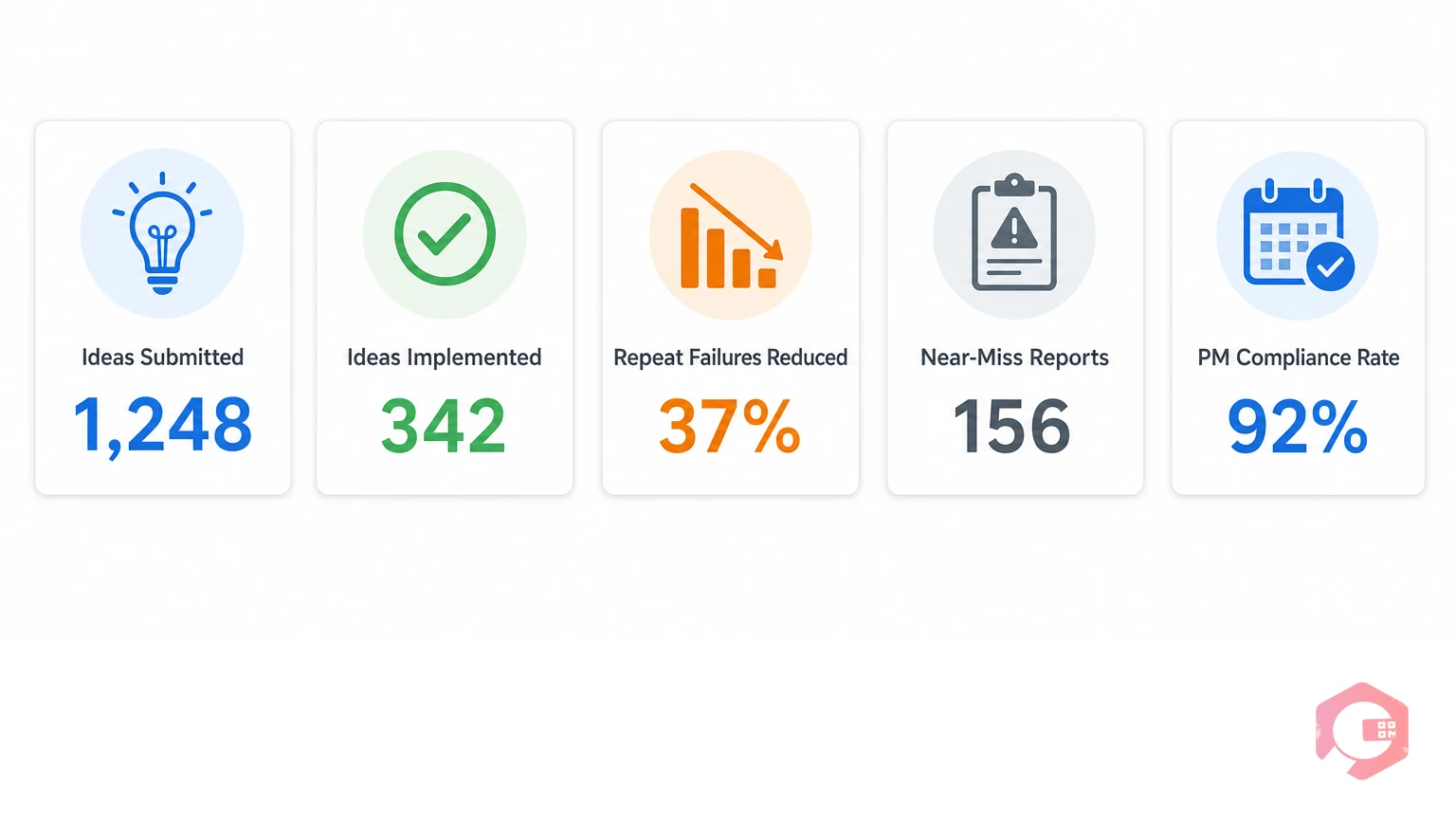
You can't improve what you don't measure. These five KPIs tell you whether your technician CI programme is building real momentum or stalling.
This is your leading indicator. World-class lean facilities target 1–2 implemented improvements per employee per month. For teams new to structured CI, a starting target of 1 idea per technician per quarter is realistic and achievable. Track this by individual and by team — individual tracking surfaces your most engaged contributors; team tracking identifies where peer dynamics are suppressing participation.
Implementation rate tells you whether your review and approval process is actually converting submissions into action. A rate below 30% usually signals one of two problems: either the idea-capture system is collecting low-quality submissions (fix with better prompts and coaching), or the approval process is too slow (fix with a clear implementation SLA). A rate above 70% can mean you're cherry-picking easy wins and not tackling meaningful problems — balance matters.
A declining repeat failure rate is the clearest operational signal that CI ideas are addressing root causes rather than symptoms. Monitor this on your preventive maintenance software dashboard. When technicians see that their improvement suggestions are reducing the frequency of breakdowns they've spent years firefighting, the intrinsic motivation to participate in CI increases significantly.
Near-miss reporting rate is a proxy for psychological safety. Technicians who feel safe enough to report near-misses without fear of blame are the same technicians who submit improvement ideas. A rising near-miss report rate — provided it's not driven by a specific safety incident — indicates that your CI culture is building the trust infrastructure it needs. Link near-miss data to your 5 Whys root cause workflow so every report generates a structured follow-up.
Technicians who feel ownership of the maintenance programme complete PM tasks at higher rates than those who experience maintenance as something done to them rather than with them. Track PM compliance by technician alongside CI participation — you'll typically find a positive correlation. Technicians who submit CI ideas about PM checklists (suggesting sequence changes, removing redundant steps, adding missing checks) tend to be your highest PM compliance performers.
Week 1: Audit your current idea-capture infrastructure. If you don't have a formal system, set one up — a CMMS improvement log or a structured mobile form. Communicate to your team that every submission will receive a written response within 72 hours.
Week 2: Hold your first CI huddle. Review any ideas submitted in Week 1. If none came in, share one problem you observed yourself and demonstrate the submission process live. Make it easy, make it visible, make it safe.
Week 3: Implement one idea. It doesn't need to be complex. A relabelled parts bin, a revised checklist order, a new tool shadow board — anything that a technician suggested and that you can complete within the week. Announce the implementation and name the contributor.
Week 4: Measure and report. Share your Week 1–4 metrics with the team: ideas submitted, ideas implemented, any operational improvement linked to an implemented idea. Ask the team what would make the process easier. Adjust based on what you hear.
Cryotos supports technician-led continuous improvement across every stage of the workflow. The mobile app gives technicians a frictionless improvement log accessible from the same interface they use for work order management — no separate system, no separate login, no barrier between observing a problem and capturing it. The 5-Why RCA module is built into every corrective work order, turning each breakdown into a structured improvement opportunity. Idea-to-action tracking is visible to the whole team, so the feedback loop that sustains participation stays closed. And the BI dashboard surfaces repeat failures by asset, giving technicians the data evidence they need to make a compelling case for changes they know are necessary.
The result is a CI programme that doesn't depend on manager initiative or periodic kaizen events — it runs continuously, driven by the people who understand the equipment best. Schedule a free demo to see how Cryotos turns every technician into an active contributor to operational improvement.
Start with psychological safety by establishing a no-blame policy and demonstrating that idea submission is anonymous if needed. Then give technicians a low-friction capture system — one that takes under 60 seconds to use and is accessible from the shop floor. Act on at least one submitted idea within the first two weeks. The fastest path to sustained engagement is demonstrating that ideas lead to visible, credited changes.
World-class lean facilities target 1–2 implemented improvements per employee per month. For teams new to structured CI, starting with 1 idea per technician per quarter is realistic. Submission targets should increase gradually as participation normalises — pushing high targets too early signals quantity over quality and produces low-value submissions.
The evidence consistently points to past rejection and invisible feedback loops as the primary barrier — not lack of ideas. Technicians who previously submitted suggestions and received no visible response stop participating. The fix is process transparency: every idea gets a logged response, and the status of every submission is publicly visible to the team.
Track five leading and lagging indicators: ideas submitted per technician per month (leading), idea implementation rate (leading), repeat failure rate by asset (lagging), near-miss report frequency (leading proxy for psychological safety), and PM compliance rate (lagging proxy for ownership). Review all five monthly and share results with the full team — transparency drives accountability on both sides.
A modern CMMS eliminates the three main barriers to technician CI participation: it provides a formal capture system (no more verbal suggestions lost at handover), it creates a visible tracking system (closing the feedback loop that sustains participation), and it surfaces the operational data — repeat failures, downtime patterns, PM compliance — that gives technicians the evidence base to make compelling improvement cases.



Cryotos AI predicts failures, automates work orders, and simplifies maintenance—before problems slow you down.



