
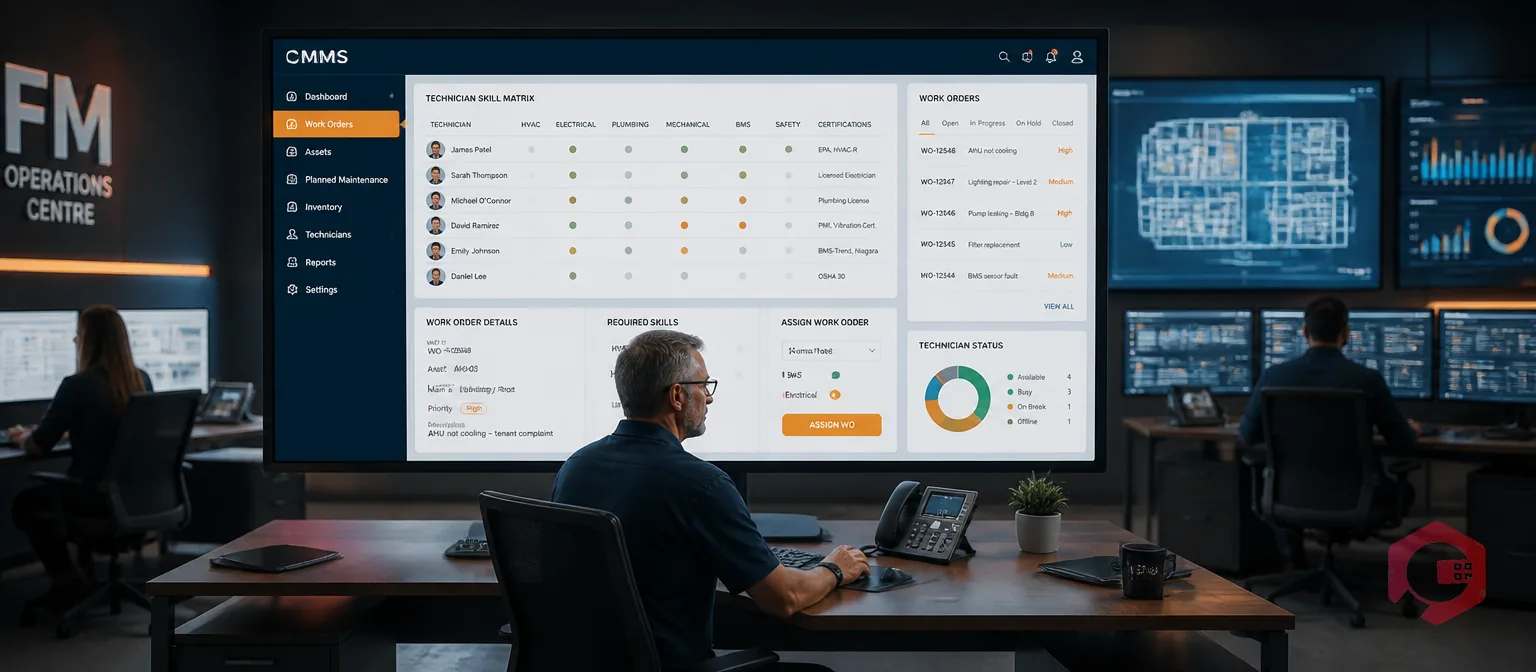
Every time a facility manager assigns a work order to a technician without checking whether that technician has the right skills for the job, the assignment is a guess. Some guesses work out — the technician figures it out, the job gets done, the work order closes. Others don't: the technician arrives at the fault, realises it's outside their competence, and either attempts the repair anyway or waits for a qualified colleague, wasting travel time, delaying resolution, and in regulated work categories — electrical, gas, confined space, asbestos — potentially creating a compliance breach. According to UK Health and Safety Executive guidance, competence is a legal requirement for many categories of maintenance work, not a preference — and "competence" means documented, verified skill, not assumed capability.
A CMMS technician skill matrix makes every assignment deliberate. This guide covers how to build the matrix, what it stores, how the CMMS uses it at the moment of assignment, and how certification tracking keeps the data accurate over time.
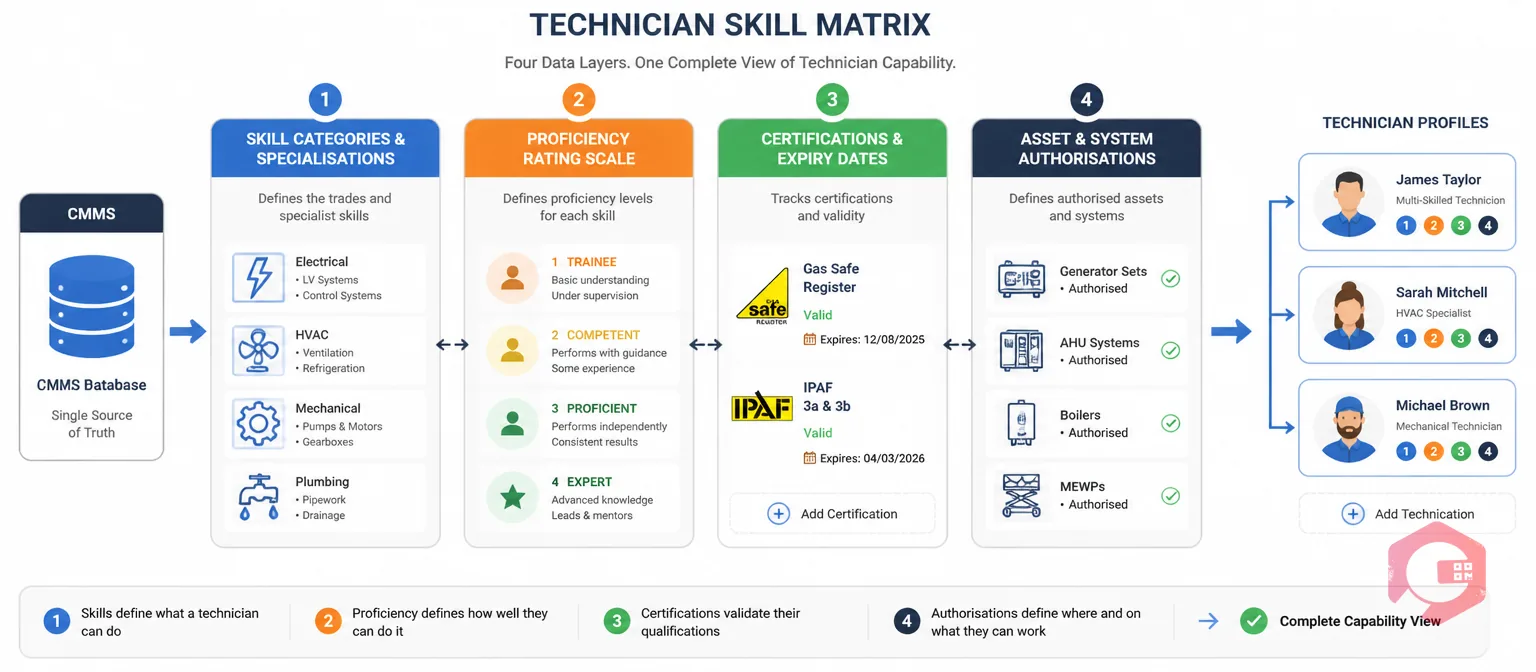
A technician skill matrix in a CMMS (computerized maintenance management system) is a structured data record that maps every technician's verified skills, proficiency levels, and relevant certifications to the job types and asset categories in the maintenance work order system. It is the data layer that enables skill-based assignment — the ability to filter available technicians by what they are qualified and capable of doing, at the moment a work order is being created or dispatched.
HR training records track what training a technician has attended. A CMMS skill matrix tracks what a technician is currently qualified to do. The difference is operational. An HR record may show that a technician attended an electrical safety course three years ago. The CMMS skill matrix shows that the same technician holds a current 18th Edition IET Wiring Regulations certification, valid until a specific date, rated as proficient on low-voltage electrical fault diagnosis and panel work. The first record answers "what has this person learned?" The second answers "what can this person do, right now, on this job?"
For facility managers assigning work orders in real time, only the second answer is useful.
A well-configured CMMS skill matrix stores four data layers for each technician:
Mis-assignment — sending a technician to a job they are not qualified or equipped to complete — generates costs across multiple dimensions, most of which don't appear in the work order record that triggered the assignment.
The direct cost of a mis-assignment is the wasted travel time and the delay to resolution. The indirect costs are larger. When a mis-assigned technician attempts a repair beyond their competence, the first-fix failure rate climbs — the fault may be temporarily resolved but return within days, requiring a second work order and a second visit. First-fix failure rates above 10% in a maintenance operation are frequently traceable to skill-assignment mismatches rather than diagnostic difficulty or parts availability.
SLA breaches follow. A work order that requires a qualified electrician, dispatched to a general maintenance technician, will miss its resolution SLA — not because the technician was slow, but because the assignment was wrong from the start. In multi-tenant facilities, that SLA breach has financial consequences through penalty clauses and reputational consequences through client satisfaction scores.
The regulatory dimension is the most serious. Categories of maintenance work in most jurisdictions require the work to be performed by a certified or licensed individual — not simply a trained one. Electrical work to BS 7671 in the UK, gas work under Gas Safe registration, asbestos-related work under Control of Asbestos Regulations, confined space entry under the Confined Spaces Regulations — in each case, work performed by an uncertified individual is not just operationally risky but legally non-compliant. A CMMS skill matrix with certification tracking prevents uncertified assignment from occurring rather than discovering it after the fact.
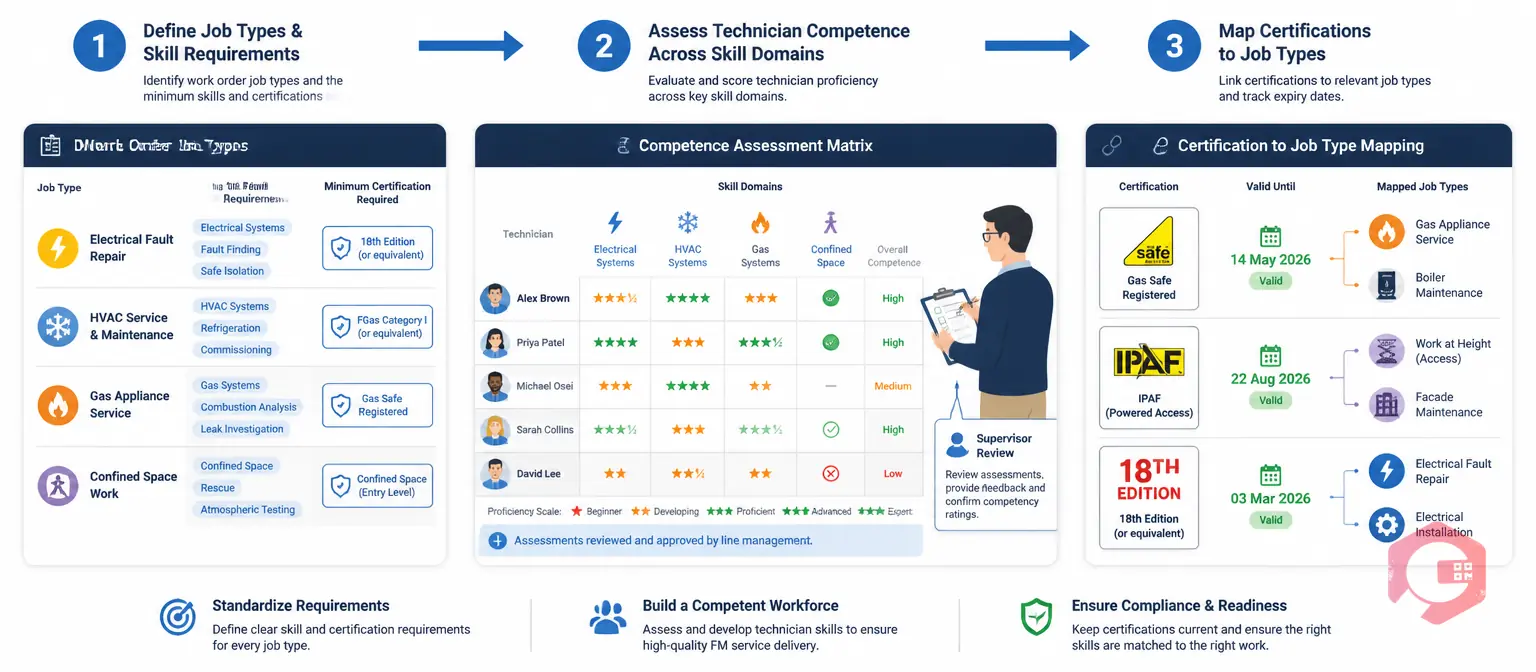
Building the skill matrix is a three-step process. The order matters: defining job requirements before rating technicians ensures the matrix reflects operational needs rather than self-reported capability.
Start from the work order side, not the technician side. List every category of job type that appears in your maintenance work order system — electrical fault diagnosis, HVAC service, plumbing repair, BMS calibration, lift maintenance coordination, civil defect rectification, fire system testing, generator PM, and so on. For each job type, define the minimum skill level required to perform the work independently, and identify any certifications that are legally or contractually mandated.
This exercise often surfaces job types that have been assigned generically — "maintenance technician" — when they actually require a specific certification to be performed compliantly. Building the skill requirement against the job type first means that when a work order of that type is created, the CMMS filter for eligible technicians already excludes anyone who does not meet the minimum requirement.
With the job type skill requirements defined, conduct a competence assessment for each technician against the relevant skill categories. This is not a self-assessment — it requires a structured review against observable criteria: direct observation of task performance, review of previous work order records, assessment by a senior technician or supervisor. Ratings should reflect current capability, not historical training attendance.
The output is a completed skill matrix — each technician rated against each relevant skill domain, with proficiency levels assigned and supporting evidence documented. This matrix is entered into the CMMS technician records module, making it queryable at assignment time rather than stored in a spreadsheet on the FM manager's desktop.
For each job type that carries a regulatory certification requirement, map the specific certification(s) required to the job type in the CMMS. When a work order of that type is created, the system filters eligible technicians to those who hold the required certification and whose certification is currently valid — not expired. Certification expiry tracking is not a separate HR function in a CMMS; it is built into the assignment filter. A Gas Safe registration that expired last month does not appear as a qualification for a gas work assignment. The system enforces currency automatically, without the FM manager having to remember to check.
Use the following structure as a template for configuring job type skill requirements in your CMMS. These are representative examples covering the most common FM maintenance categories — adapt to your specific facility type, asset mix, and jurisdictional certification requirements:
| Job Type | Required Skill Domain | Certification Required | Minimum Proficiency |
|---|---|---|---|
| Electrical fault diagnosis | Low-voltage electrical systems | 18th Edition IET / ECS Card | Proficient (independent sign-off) |
| Gas appliance service | Gas systems — commercial | Gas Safe Registration (relevant category) | Proficient (registered and current) |
| HVAC preventive maintenance | Refrigeration and air handling | F-Gas Category I (for refrigerant work) | Competent (supervised acceptable for non-refrigerant tasks) |
| Working at height | Access equipment operation | IPAF / PASMA (equipment type dependent) | Proficient (certificated and current) |
| Confined space entry | Confined space operations | Confined Space Entry Certificate | Proficient (current, with rescue cover confirmed) |
| BMS fault and calibration | Building automation systems | Manufacturer or platform certification | Expert (system-specific authorisation required) |
| Plumbing and drainage repair | Plumbing systems | City & Guilds / NVQ Level 2+ or equivalent | Competent |
| Asbestos-containing material work | Asbestos awareness / licensed removal | P402 / UKATA Asbestos Awareness (non-licensable); Licensed contractor for notifiable work | Awareness minimum; Licensed for disturbance work |
This table structure, built into the CMMS as job type requirements, becomes the filter that governs every assignment. A work order categorised as "gas appliance service" will only surface technicians with a current Gas Safe registration as eligible assignees — no manual checking required.
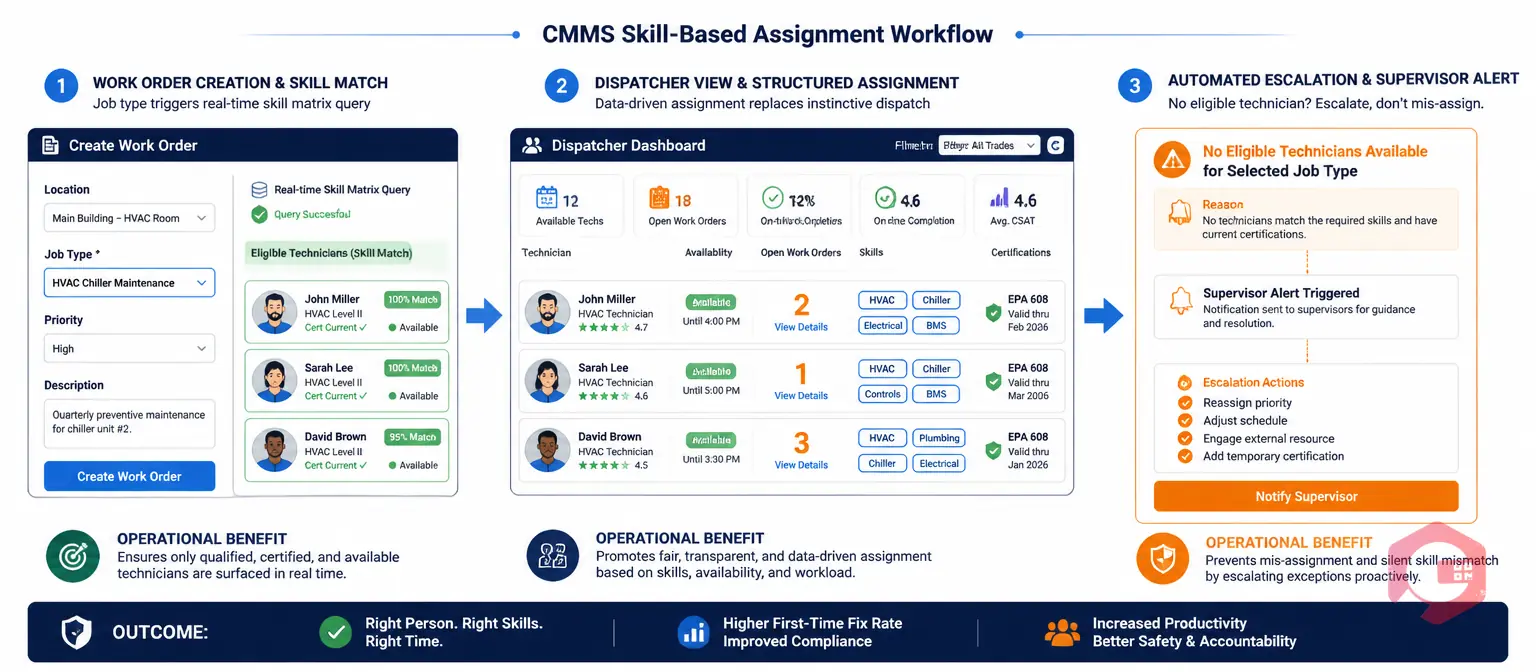
The skill matrix's operational value is realised at the moment of assignment, not at the moment of matrix creation. When a work order is raised and categorised — electrical fault in Zone 7, HVAC service on AHU-3, confined space entry for drain inspection — the CMMS queries the skill matrix in real time and returns a filtered list of eligible technicians: those who hold the required skill at the required proficiency level, with any mandatory certifications current and valid.
From the filtered list, the FM manager or dispatcher selects the assignee based on availability and workload, which the CMMS also surfaces — current open work orders per technician, scheduled leave, shift roster. The skill filter handles compliance; the workload view handles capacity. The assignment decision becomes structured and defensible rather than instinctive and unverifiable.
For facilities running automated dispatch — where work orders below a certain complexity threshold are assigned without human intervention — the CMMS skill matrix is the logic engine that determines which technician receives the auto-assigned work order. Without the matrix, automated dispatch is round-robin by availability. With the matrix, it is skill-matched by requirement. The work order management software module applies skill-based routing at the point of assignment, whether the assignment is manual or automated.
When no eligible technician is available — all qualified technicians are on leave, on shift, or at capacity — the CMMS escalates the work order for supervisor action rather than assigning it to the next available person regardless of skill. This prevents the silent mis-assignment that occurs when a dispatcher assigns "whoever is free" because the system shows no eligible options and the manual workaround is to ignore the filter.
A skill matrix is only as accurate as its most recent update. Certifications expire. Skills can be suspended. New certifications are acquired. A matrix that was accurate at implementation drifts over 12 months without a systematic update mechanism — and a drifted matrix is more dangerous than no matrix at all, because it creates false confidence in assignment decisions that are actually uninformed.
CMMS certification expiry tracking prevents drift through automated alerts. When a certification in the matrix is within a configurable window of expiry — typically 60 or 90 days before the expiry date — the system generates an alert to the technician, their supervisor, and the FM manager, prompting renewal before the certification lapses. When a certification expires and is not renewed, the CMMS automatically removes that certification from the technician's active skill profile — they no longer appear as eligible for job types that require it, until the renewed certification is recorded.
The preventive maintenance software scheduling logic applies to certification renewals exactly as it applies to equipment PM intervals — a scheduled alert, a required action before expiry, and an automatic consequence if the deadline is missed. According to ACAS guidance on workforce capability management, maintaining auditable records of employee certifications and their currency is a core employer responsibility — the CMMS certification tracker is the operational system that makes this responsibility manageable at scale.
The Report Builder generates certification currency reports on demand — showing which technicians have certifications expiring in the next 30, 60, or 90 days, which have already lapsed, and which job types are at risk of having no eligible assignees if renewals are not actioned. FM managers who review this report monthly prevent the scenario where a certification lapses mid-job-type and creates an assignment gap at the worst possible moment.
Cryotos CMMS builds technician skill profiles directly into the workforce management layer — not as a separate HR module but as the data source that governs work order assignment in real time. Each technician record carries their skill categories, proficiency ratings, and certifications with expiry dates. When a work order is created and its job type is selected, the system queries the skill profiles and surfaces eligible assignees — filtering by skill match, certification currency, and current availability in a single view.
The mobile app gives technicians visibility into their own skill profile and certification status — they can see their upcoming expiry dates, their current proficiency ratings, and any skills flagged for reassessment. This transparency reduces the administrative load on FM managers and gives technicians ownership of their own certification renewal timelines.
For multi-trade FM teams where technicians hold multiple certifications across different domains, the Cryotos skill matrix handles complex assignment scenarios — a technician who is both HVAC-qualified and electrically certified can be surfaced for jobs that require either or both skills, without the FM manager having to maintain separate lists. The BI Dashboard shows team skill coverage at a glance — which skill domains are well-covered, which have single points of failure, and which certification categories need renewal priority. Teams using Cryotos report a 30% reduction in unplanned downtime, with improved first-fix rates cited as a consistent outcome of skill-matched assignment replacing availability-only dispatch.
For FM teams managing multi-site operations, Cryotos provides cross-site skill visibility — the FM manager can identify whether a specialist skill needed at Site A is available from a technician currently scheduled at Site B, and reassign accordingly, without making phone calls or checking separate records. The skill matrix is the shared data layer that makes multi-site coordination precise rather than approximate.
The skill matrix should cover every trade domain that appears in your work order system: electrical (LV fault diagnosis, metering, panel work), mechanical (pumps, motors, drives, compressors), HVAC (air handling, refrigeration, controls), plumbing and drainage, civil and fabric (plastering, tiling, carpentry, glazing), BMS and controls, fire and life safety systems, and any specialist equipment types specific to your facility. For each domain, include the certifications that are legally required for work in that domain in your jurisdiction. Start with the job types you assign most frequently — those are where a poorly configured matrix has the highest daily impact.
Yes — automated skill-based routing is one of the highest-value configurations in a CMMS. Work orders below a defined complexity threshold (routine PM, reactive faults with clear job-type classification) can be auto-assigned to the highest-rated available technician who meets the skill requirement, without FM manager involvement. High-complexity or high-priority work orders surface the skill-filtered list for human review rather than auto-assigning. The auto-assignment logic is configured once per job type and applies to every work order of that type thereafter, reducing dispatcher workload significantly while ensuring skill compliance on every assignment.
First-fix failure — a job that requires a return visit because it was not resolved on the first attendance — is frequently caused by sending a technician who lacks either the skill to diagnose the fault correctly or the qualification to perform the specific repair required. The skill matrix reduces first-fix failure by ensuring the first technician sent to the job is qualified to complete it. For complex fault categories where diagnostic skill is as important as repair skill, proficiency ratings within the matrix allow FM managers to route diagnostically complex jobs to Expert-rated technicians rather than Competent-rated ones — matching the job's complexity to the technician's capability level rather than just their trade category.
Certification data should be updated continuously — as soon as a renewal is completed or a new certification is acquired, it should be entered in the CMMS to maintain assignment eligibility. Proficiency ratings should be reviewed at minimum annually as part of the technician performance review cycle, or following any work quality incident that calls a proficiency rating into question. The skill domain inventory — the list of job types and their requirements — should be reviewed whenever new asset types are introduced to the facility, new regulatory requirements come into force, or the scope of FM services changes. A CMMS skill matrix that was accurate 18 months ago but has not been reviewed since is likely out of step with the current operation in at least one meaningful way.
Every assignment decision in a maintenance operation is a question: does this technician have what it takes to complete this job correctly, on the first visit, in compliance with all applicable requirements? Without a skill matrix, that question is answered by instinct and memory. With a CMMS skill matrix, it is answered by data — skill ratings, certification records, and expiry dates that are queryable at the moment of assignment and updated automatically as the team's qualifications change.
For facility managers ready to move from availability-based assignment to skill-based assignment, Cryotos CMMS gives you the technician skill profiles, certification tracking, and real-time assignment filtering to make every work order go to the right person. Book a free demo today and see what your assignment process looks like when it's backed by verified skill data.




Cryotos AI predicts failures, automates work orders, and simplifies maintenance—before problems slow you down.



