

Test and measurement equipment for preventive maintenance is any instrument or tool used to assess an asset's condition, record readings, and detect early signs of failure before they cause downtime. A well-structured preventive maintenance (PM) program doesn't run on schedules alone — it runs on data. The right measurement tools give your team objective evidence of how equipment is behaving, so every PM task is grounded in fact, not guesswork.
According to a Reliabilityweb study, poor maintenance practices cost manufacturers an estimated $50 billion annually in lost production. Having the right test equipment — and a system to manage the data it produces — is one of the most direct ways to reverse that number.
This guide covers every major category of PM test and measurement equipment, how to choose the right tools for your assets, and how a preventive maintenance software solution ties measurement data into your maintenance workflow.
Preventive maintenance without measurement is little more than a calendar exercise. You replace filters on schedule, lubricate bearings on a fixed cycle, and hope the asset holds out in between. The problem is that assets don't fail on a schedule — they fail based on load, environment, usage patterns, and hidden wear that no calendar can predict.
Test and measurement tools close that gap. They give your technicians the ability to see what's actually happening inside a piece of equipment rather than inferring it from time elapsed.
When maintenance teams skip measurement steps, they introduce a category of risk that's easy to underestimate. An unchecked motor may run another three weeks after a scheduled service and then fail catastrophically mid-shift. Equipment failures that could have been caught with a $400 vibration meter sometimes result in $40,000 in total downtime costs. The investment in test equipment almost always pays for itself within the first prevented failure event.
When you record actual measurement readings — motor temperature, vibration amplitude, insulation resistance, bearing noise — you build a baseline for every critical asset. Deviations from that baseline become early warning signals. A bearing that normally vibrates at 2.5 mm/s that starts reading 4.1 mm/s isn't failing yet, but it's telling you something has changed. That's your window to plan a repair before it becomes an emergency.
This is the foundation of condition monitoring — using measurement data to track asset health continuously rather than reactively.

Maintenance measurement tools span a wide range of technologies. Each category targets a different failure mode, and a complete PM program typically draws from several of them.
Electrical test equipment is the backbone of any PM program that covers motors, drives, switchgear, or electrical panels. The most common tools include digital multimeters, clamp meters, megohmeters (insulation resistance testers), power quality analysers, and earth ground testers. According to NEMA standards, motor insulation resistance should be tested at least annually on critical assets.
Vibration is one of the earliest and most reliable indicators of mechanical degradation. Handheld vibration meters, vibration analysers with FFT, and wireless vibration sensors allow teams to detect bearing wear weeks or months before failure. ISO 10816-3 provides the standard severity zones for vibration on industrial machines.
Infrared thermography detects heat anomalies on electrical panels, motors, bearings, and steam systems. NFPA 70B recommends annual thermographic inspections on electrical distribution systems.
Ultrasonic instruments detect high-frequency sound waves inaudible to the human ear — used for compressed air and gas leak detection, bearing condition monitoring, and electrical arcing detection. The U.S. Department of Energy estimates a typical industrial facility loses 25–30% of compressed air through undetected leaks.
Oil analysis provides a direct window into what's happening inside gearboxes, hydraulic systems, and engines. Portable viscosity testers, particle counters, moisture analysers, and lab sample kits all help detect abnormal wear before it causes failure.
Temperature and humidity loggers, pressure gauges, flow meters, and gas detectors help spot conditions that accelerate degradation before they leave visible marks on the equipment.
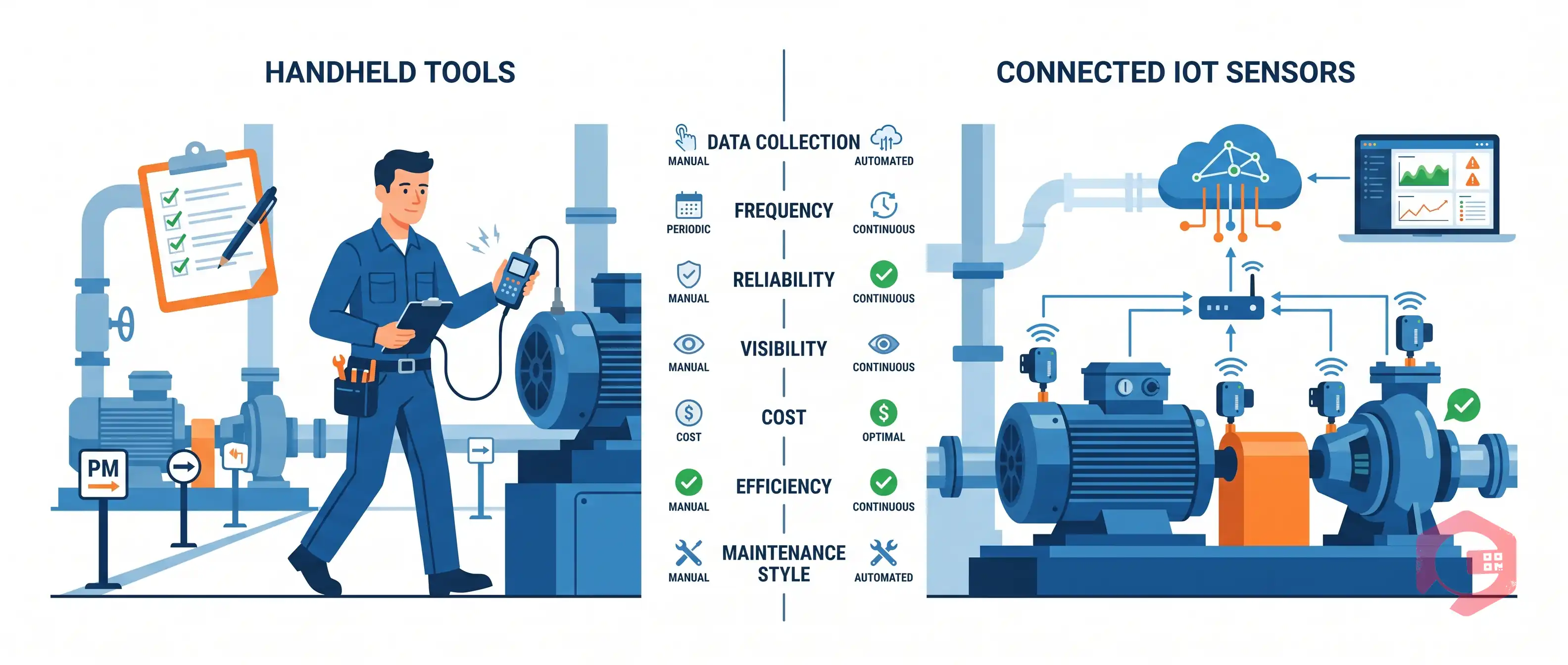
One of the most important decisions when building your measurement toolkit is whether to use handheld instruments carried on PM rounds, or permanent connected sensors that transmit data automatically.
Asset criticality is medium or lower, you have a well-structured PM programme, and budget is a constraint. A good-quality handheld vibration meter costs $300–$1,500 versus $200–$800 per IoT sensor node plus subscription costs.
The asset is safety-critical or production-critical, failure can develop rapidly, or you want to feed data into CMMS automatically. IoT sensors connected to your IoT meter reading system can automatically log readings and trigger work orders when thresholds are crossed.
Start with your asset register and rank each asset by criticality: Tier 1 critical assets justify full measurement coverage; Tier 2 important assets need targeted measurement covering the most likely failure modes; Tier 3 non-critical assets are best served by time-based PM without detailed measurement.
A maintenance management software platform transforms individual measurements into a managed, auditable programme. Cryotos CMMS lets you build measurement fields directly into maintenance checklists, tracks your test equipment as assets with calibration schedules and expiration reminders, and automatically generates corrective work orders when recorded measurements exceed defined thresholds.
It depends on your asset mix. For rotating machinery-heavy facilities, a vibration meter is often the highest-value starting point. For electrical-heavy facilities, a megohmmeter and thermal camera cover the most critical failure modes.
Most test and measurement instruments require calibration at least annually. Instruments in demanding environments may need checks every six months or quarterly. Your CMMS should flag upcoming calibration due dates automatically.
Yes — Cryotos allows you to embed measurement fields directly into PM checklists. Readings are stored against the asset's maintenance history, enabling trend analysis. When connected to IoT sensors, a CMMS can receive readings automatically and trigger corrective work orders when values exceed set thresholds.
Preventive maintenance equipment is used during scheduled, time-based maintenance tasks. Predictive maintenance equipment is used for continuous condition monitoring to predict when failure will occur. In practice, many facilities use the same instruments for both.
If you're building or upgrading a preventive maintenance programme and want to make sure your measurement data is captured, tracked, and acted on consistently, Cryotos CMMS gives your team the tools to close the loop. Book a demo and see how Cryotos can bring structure to your test and measurement programme.



Cryotos AI predicts failures, automates work orders, and simplifies maintenance—before problems slow you down.



