
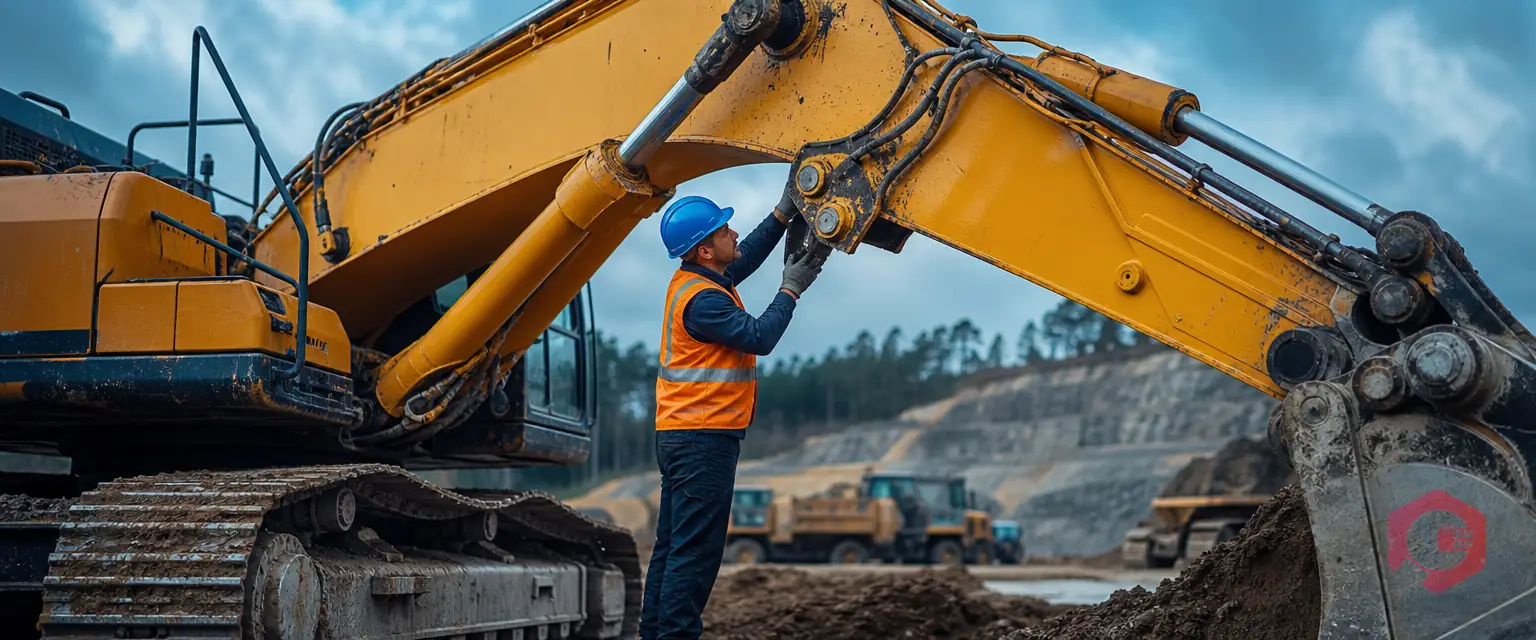
Preventive maintenance matters more for heavy equipment than light assets because heavy machines cost more to replace, cause pricier downtime, fail in more complex ways, and carry stricter safety rules. A missed service on an excavator can cost six figures in downtime and repairs. A missed dusting on a printer costs nothing. That gap in consequences is why a mature maintenance program treats the two asset classes differently instead of running one schedule for everything on the books.
Key Takeaways
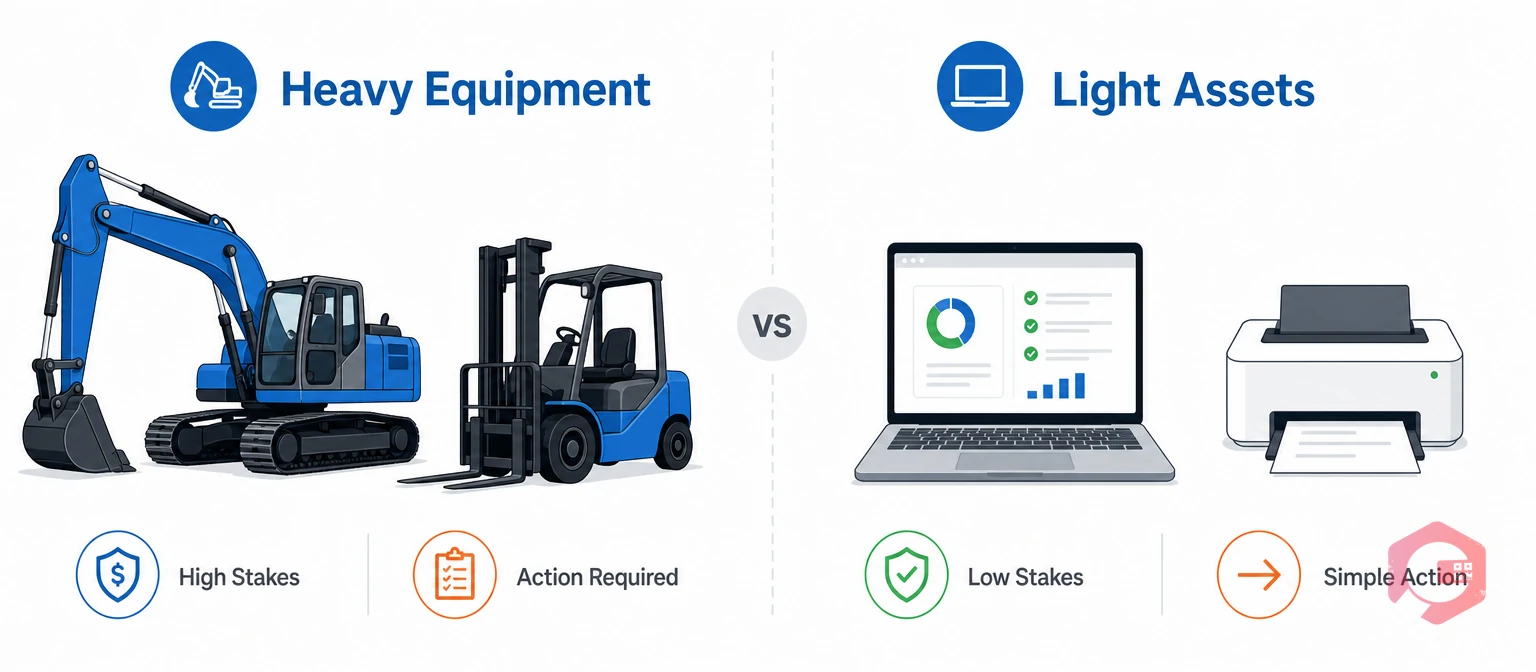
Heavy equipment is any asset with high replacement cost and a direct role in production. Think excavators, CNC machines, generators, and forklifts. A light asset is a low-cost item that plays a supporting role rather than a critical one. Laptops, printers, and office chairs are typical examples, and they cost little to swap out the same day.
The difference is not really about size. It is about how much is at stake when the asset fails. A forklift and a filing cabinet can weigh about the same, but only one of them stops a warehouse when it breaks.
Facilities that treat both categories the same way end up over-servicing the printers and under-servicing the excavators. Neither mistake is cheap. Only one of them shows up on the balance sheet right away.
Picture a forklift and a laptop sitting in the same facility. The forklift needs its hydraulic fluid, tires, and forks checked on a regular basis, because a failure there can hurt someone and stall a shipment. The laptop needs a battery replacement every couple of years, and almost nothing else. A single preventive maintenance policy applied to both assets either overspends on the laptop or underspends on the forklift. Most facilities cannot afford either mistake for long.
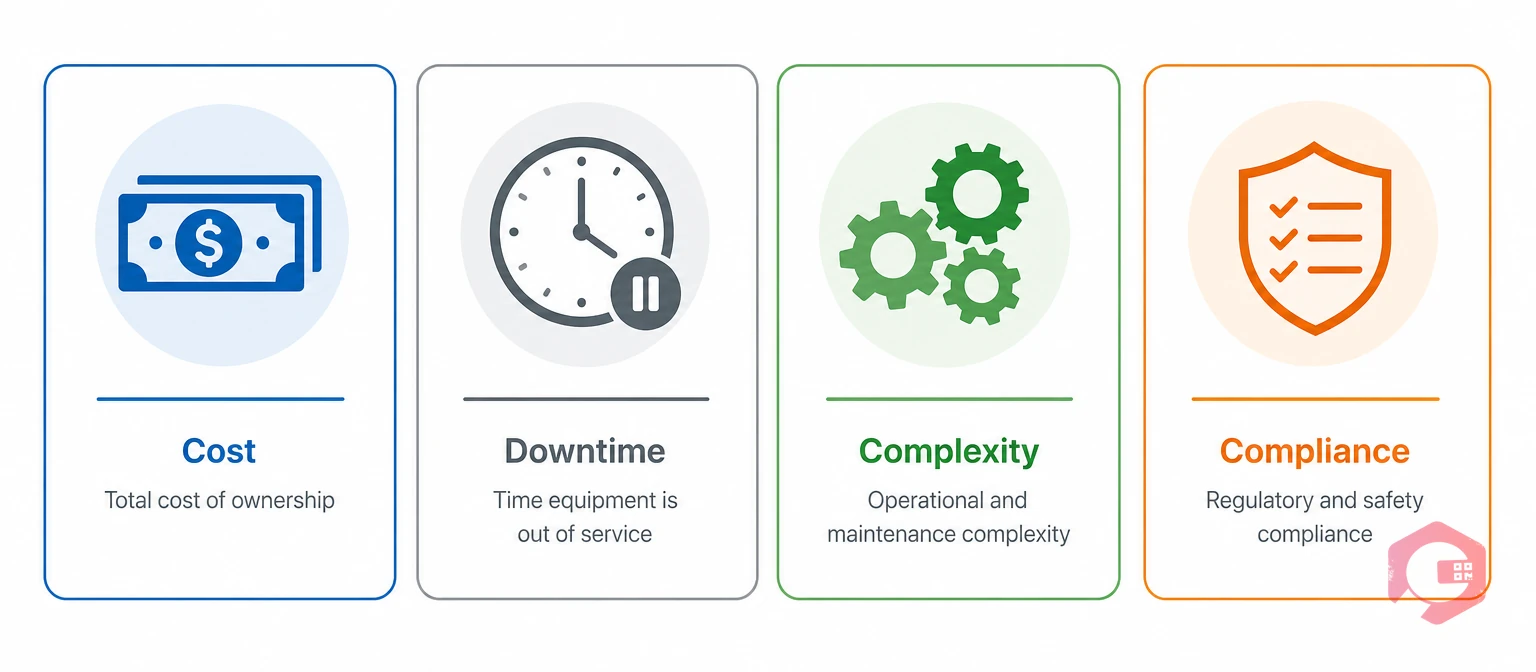
Heavy equipment carries more maintenance risk because four factors stack up at once: cost, downtime, complexity, and compliance. Reliability teams that follow reliability-centered maintenance (RCM) use a version of this same logic. They score each asset, then decide which ones earn a strict PM plan and which can run to failure.
The Four-Factor Heavy Equipment Risk Model:
Score an asset high on all four factors, and preventive maintenance stops being optional. Score it low on all four — a desk lamp, say — and a strict PM plan is usually wasted effort. Most fleets sit somewhere in between, with a mix of critical machines and low-stakes furniture on the same asset register. That is exactly where planned downtime tracking earns its keep. It shows which assets actually cost the business money when they fail without warning. The maintenance budget can then go where it matters most. It stops getting spread evenly across everything on the books.
Heavy equipment and light assets need different PM approaches because their cost, wear pattern, and risk profile do not overlap. The table below lays out where the two categories split in practice.
| Dimension | Heavy Equipment | Light Assets |
|---|---|---|
| PM trigger | Usage-based: engine hours, mileage, load cycles | Calendar-based, or none at all |
| Cost of failure | Thousands to six figures in downtime and repair | Cost of a same-day replacement |
| Failure complexity | Multiple systems: mechanical, hydraulic, electrical | One function, easy to diagnose |
| Compliance exposure | OSHA, DOT, and inspection rules apply | Little to no regulatory burden |
| Typical intake | Scheduled work order before wear becomes a failure | Reactive request after something breaks |
Once the comparison is laid out this way, the strategy is clear. Heavy equipment earns a scheduled, data-driven PM plan. Light assets are usually fine on a request-based system instead. See how much unplanned downtime your heaviest assets cost you with the MTBF calculator.
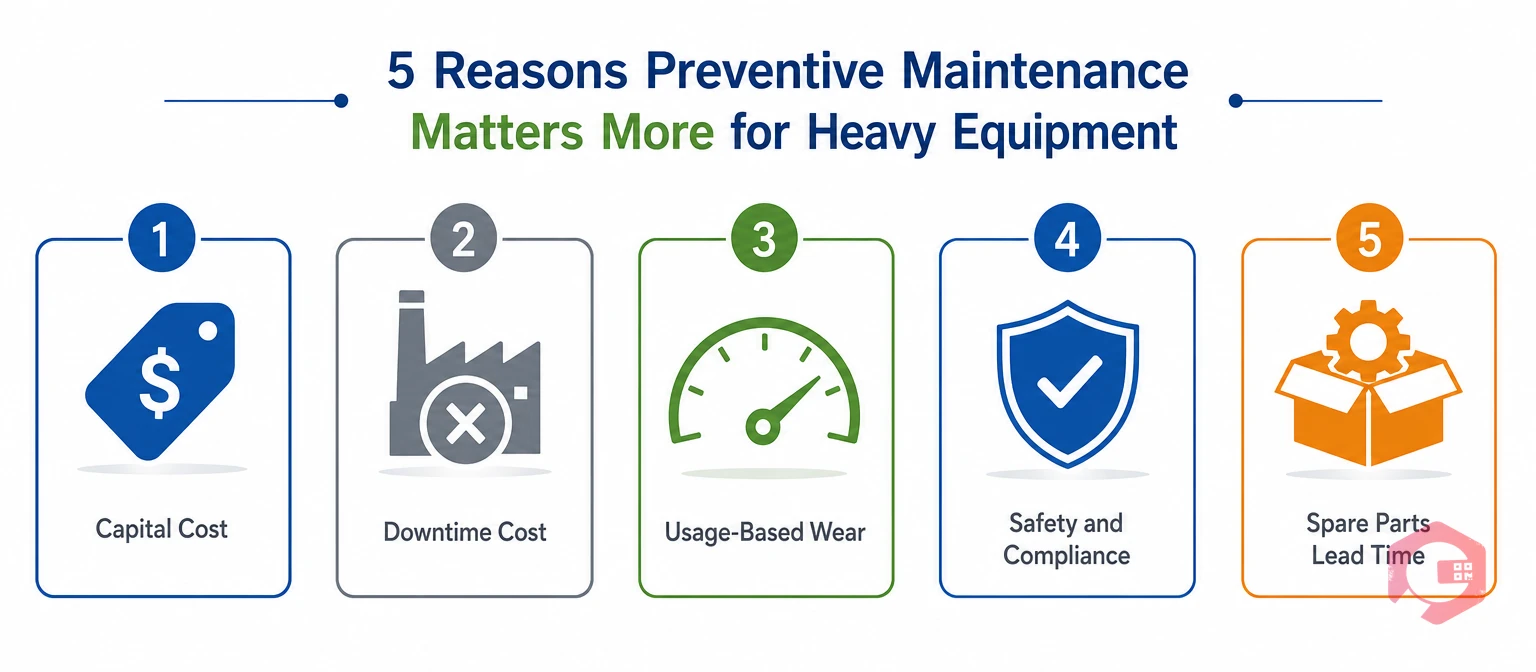
Five factors push heavy equipment PM from helpful to necessary in a way light assets rarely reach. Maintenance teams that rank assets against these five factors usually end up rebuilding their PM calendar around heavy equipment first.
Heavy equipment runs from tens of thousands to several million dollars per unit. Replacing one can take months of lead time. Custom orders and long manufacturing queues are common at that price point. Deferred maintenance on an asset like that risks real capital, not a rounding error. A skipped service on a $5 stapler risks nothing close to that. This is exactly why a preventive maintenance plan for heavy equipment gets board-level attention. A stapler never gets that kind of attention.
An ABB survey found unplanned downtime costs the typical industrial business close to $125,000 per hour. The same survey found 21% of businesses still rely on run-to-fail maintenance. Light asset downtime rarely touches production at all. A broken printer is an inconvenience, not a stoppage.
Meter-based maintenance is a PM approach that triggers service from a usage reading instead of a fixed date. Heavy equipment wear tracks engine hours, mileage, and load cycles, which is exactly the signal meter-based maintenance is built to catch. Light assets do not wear on a schedule a meter can usefully track, so calendar checks or plain reactive care are often enough.
Cranes, pressure systems, and confined-space work carry real legal liability when maintenance gets skipped. A missed inspection can mean an injury, a fine, or both. Regulators expect a documented maintenance history for this kind of equipment, not a verbal promise that it was checked. Most facilities never face that kind of exposure with a laptop or a desk chair.
Heavy equipment parts, like hydraulic cylinders or custom bearings, can take weeks to source and cost thousands of dollars. Waiting on a part that long turns a small fault into a long, expensive stoppage. A light asset part is usually in stock at the nearest retailer the same day, often for under fifty dollars.
Cryotos runs heavy equipment on dynamic, usage-triggered schedules and lets light assets stay on simple or request-based tracking, inside one platform. A Computerized Maintenance Management System like Cryotos does not force every asset through the same workflow.
Most teams that make this switch do not touch every module on day one. They usually start with their highest-risk heavy assets first, move those onto usage-based PM, then expand once the downtime numbers prove the change out. A small pilot on two or three critical machines is often enough to show the case for the rest of the fleet.
No. Low-cost, low-risk assets like office equipment are often cheaper to run reactively than to maintain on a strict schedule. A formal preventive maintenance plan earns its cost on assets where failure is expensive, dangerous, or disruptive. On assets where a breakdown barely registers, that same plan just wastes labor hours.
Calendar-based PM services an asset on a fixed date no matter how much it ran. Usage-based PM triggers service once a meter crosses a set threshold, whether that meter tracks hours, mileage, or cycles. Usage-based PM fits heavy equipment wear far better than a plain date on a calendar.
Score each asset against the Four-Factor Model: replacement cost, downtime impact, failure complexity, and compliance exposure. Assets that score high on most of these factors belong on a scheduled PM plan first, ahead of everything else in the queue.
Yes. Most CMMS platforms, including Cryotos, support different preventive maintenance rules per asset class. Heavy equipment gets dynamic, meter-based scheduling with detailed checklists attached to every work order. Everything else can stay on static or request-based tracking. Both live inside the same system, so no maintenance team has to run two separate tools.
Heavy equipment carries costs and risks that light assets simply do not, and treating every asset the same way usually means overspending on the printers while an excavator quietly runs toward a breakdown. Getting this split right is one of the fastest ways to cut both maintenance spend and unplanned downtime at the same time. Schedule a free demo to see how Cryotos applies the right PM rules to each asset class automatically.


Cryotos AI predicts failures, automates work orders, and simplifies maintenance—before problems slow you down.



