

Upstream maintenance management focuses on preventing failures before they occur — through scheduled servicing, condition monitoring, and proactive inspections — while downstream maintenance management addresses failures after they happen, restoring equipment to operational condition as quickly as possible. Both approaches are essential in any industrial environment, and knowing where each fits in your maintenance management strategy is the difference between controlled operations and costly unplanned downtime.
According to a Plant Engineering study, unplanned downtime costs manufacturers an average of $260,000 per hour. The balance of upstream and downstream maintenance is one of the most direct levers a maintenance team has to reduce that number.
In this guide, you'll learn what upstream and downstream maintenance mean, how they differ, when to use each, and how a CMMS helps you manage both within one platform.
Key Takeaways

Upstream maintenance management is the practice of addressing equipment health before a failure occurs. The term "upstream" reflects where these activities sit on the failure timeline — ahead of the breakdown event, not after it.
Teams using an upstream approach don't wait for a warning light or a production stoppage. They track asset condition, monitor wear patterns, and schedule interventions based on elapsed time, usage data, or sensor readings. A preventive maintenance schedule that services heat exchangers every 90 days regardless of visible wear is upstream maintenance. So is a food plant replacing conveyor belts based on production cycles rather than waiting for a snap.
The goal is to control when maintenance happens — not react to when it happens.
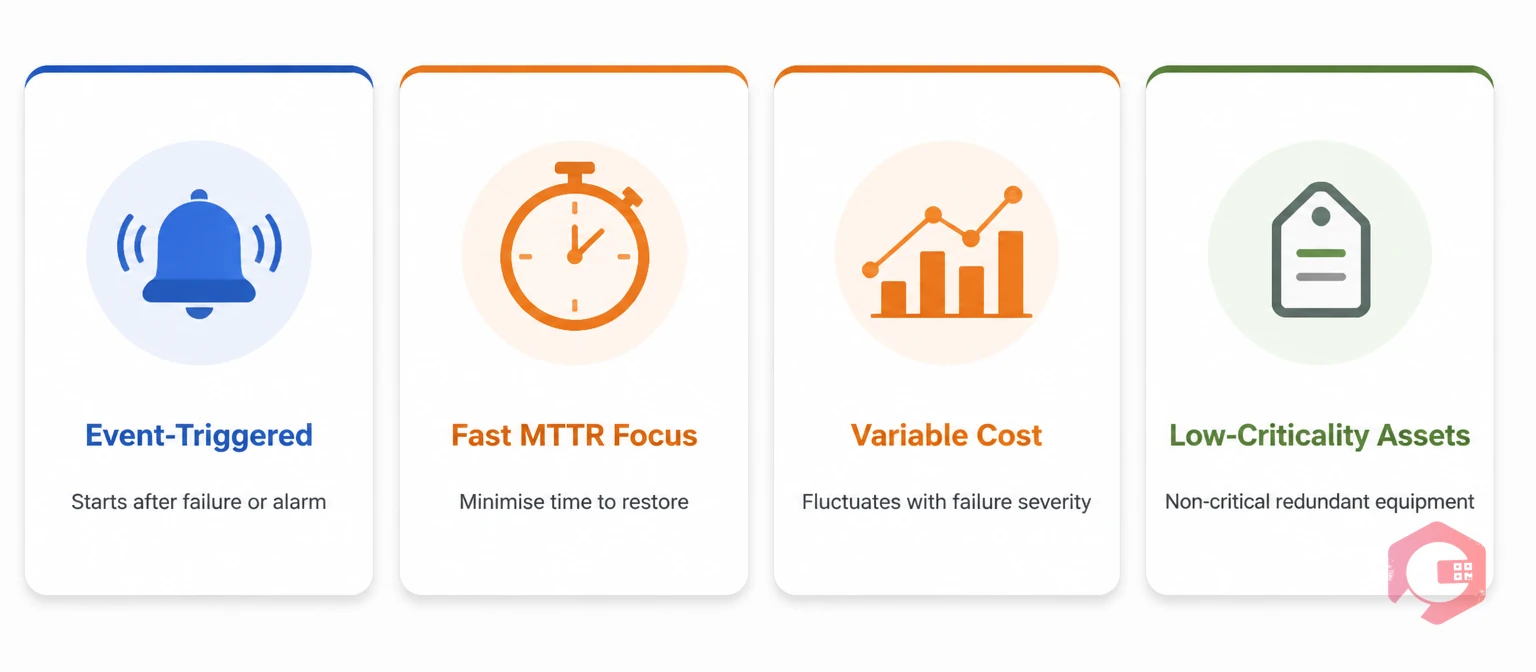
Downstream maintenance management addresses equipment issues after a failure or fault has been detected. The focus shifts from prevention to restoration — getting a broken or underperforming asset back into service as fast as possible with minimal disruption to production.
"Downstream" means these activities occur later in the failure timeline — after the event has already happened. Technicians respond to alarms, work requests, or visible breakdowns. Speed, triage accuracy, and parts availability become the primary levers.
Downstream maintenance is often mischaracterised as careless planning. In reality, it's a deliberate choice for certain asset classes — particularly non-critical equipment where the cost of failure is far lower than the cost of continuous monitoring. A broken office printer is a downstream maintenance problem. A failed cooling tower on a data centre floor is not. Corrective maintenance is the most common form of downstream work.

Here's how the two approaches compare across the dimensions that matter most to maintenance managers:
| Dimension | Upstream Maintenance | Downstream Maintenance |
|---|---|---|
| Timing | Before failure occurs | After failure occurs |
| Trigger | Schedule, usage, or sensor threshold | Alarm, breakdown, or work request |
| Primary goal | Prevent equipment failure | Restore equipment to service |
| Key KPI | MTBF, PM compliance rate | MTTR, first-time fix rate |
| Cost profile | Predictable, planned spend | Variable, often higher per event |
| Best for | Critical, high-value, or safety assets | Non-critical, low-cost, or redundant assets |
| Resource planning | Scheduled technician time and parts | On-call response and emergency spares |
| Risk level | Lower — failures anticipated and prevented | Higher — failures reach production |
Both approaches have a legitimate role in a well-structured maintenance programme. The goal isn't to eliminate downstream maintenance — it's to make sure the right assets are in the right category.
Upstream maintenance is the right choice when the cost of failure significantly outweighs the cost of prevention. Use it as the primary strategy in these situations:
A general rule: if a failure would halt production, trigger a safety incident, or generate a compliance finding, that asset belongs in your upstream maintenance programme.
Use the MTBF calculator to establish your asset's baseline failure frequency before setting upstream maintenance intervals.
Downstream maintenance isn't a failure of planning — it's a deliberate cost management strategy for the right assets. Apply it when prevention consistently costs more than the failure itself.

In most industrial environments, the strongest maintenance programmes don't choose between upstream and downstream — they use both. The key is a tiered asset strategy that assigns each asset to the right approach based on its criticality, failure behaviour, and replacement cost.
According to SMRP guidance on maintenance strategy, roughly 80% of assets in a typical facility can be managed with a downstream or run-to-failure approach without meaningful operational risk — freeing upstream resources and budget for the 20% of assets that drive most of the downtime and cost.
This tiered model lets you concentrate upstream investment where it returns the most value, while keeping your downstream response sharp enough to handle the failures that do occur. A plant that adopted this model with Cryotos CMMS reported a 30% reduction in overall downtime in the first year — by shifting preventive resources toward Tier 1 assets and tightening MTTR on Tier 3 events.
A Computerised Maintenance Management System (CMMS) is the operational backbone that makes both upstream and downstream maintenance manageable at scale. Without one, teams tend to over-invest in downstream response — fighting fires — because they lack the visibility to plan upstream work effectively.
Here's how a CMMS like Cryotos supports both sides of the maintenance equation.
Upstream maintenance depends on scheduling accuracy and data quality. Cryotos delivers both through:
When a failure happens, speed is everything. Cryotos compresses the time between failure detection and resolution through:
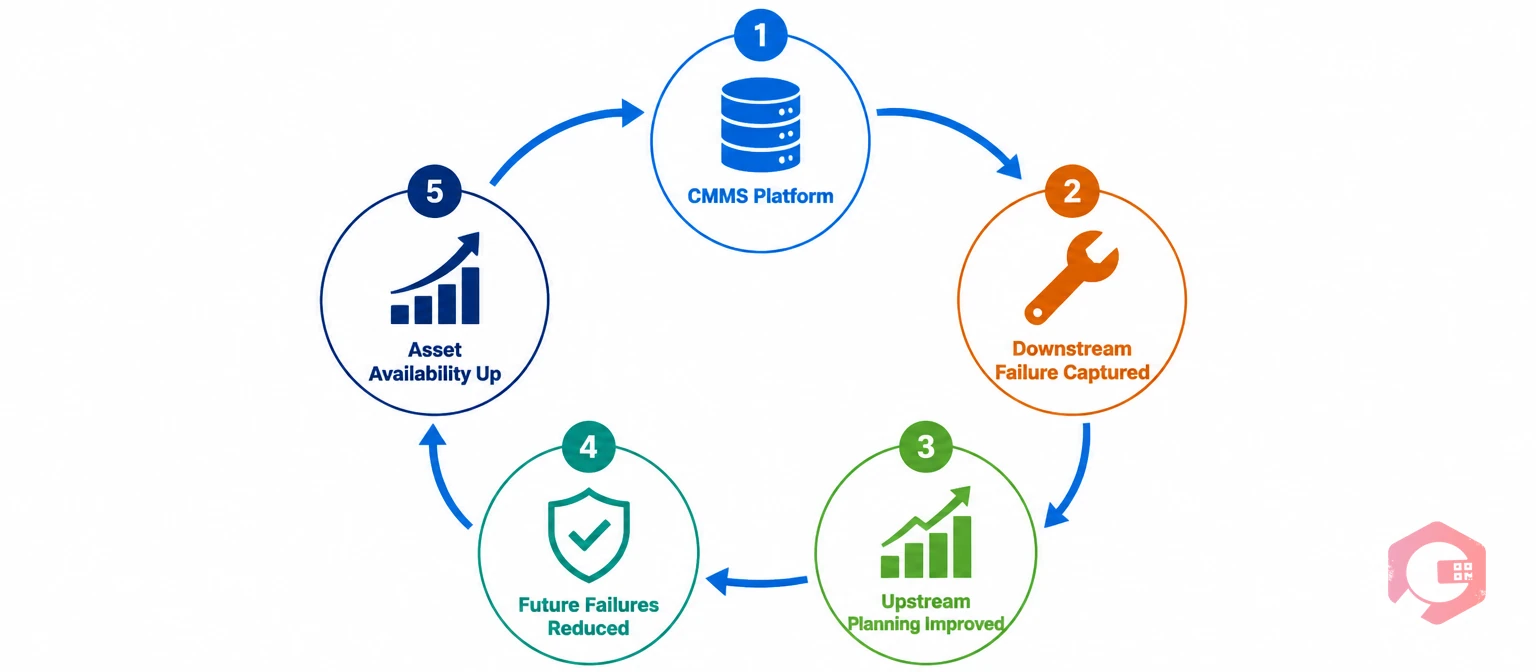
The real power of a CMMS across upstream and downstream maintenance is the data flywheel: every downstream failure captured feeds smarter upstream planning, which reduces future downstream events, which improves asset availability across the board. A Reliability Web analysis on maintenance strategy shift found that facilities moving from predominantly reactive to planned maintenance reduced overall maintenance costs by 10–25% and improved equipment availability by up to 20%.
Upstream maintenance happens before a failure — it's proactive, scheduled, and focused on prevention. Downstream maintenance happens after a failure — it's reactive, event-driven, and focused on restoring equipment fast. Both are valid strategies; the key is applying the right approach to the right asset based on criticality and cost.
Neither is universally better. Upstream maintenance is more cost-effective for critical, high-value, or safety-related assets where the cost of failure is severe. Downstream maintenance makes sense for non-critical, low-cost, or redundant assets where prevention costs more than the failure itself. Most industrial maintenance programmes use a hybrid of both.
Predictive maintenance is the most advanced form of upstream maintenance. Instead of fixed intervals, it uses real-time sensor data and analytics to predict exactly when an asset needs attention — eliminating unnecessary preventive work while preventing unplanned failures. It sits at the far upstream end of the maintenance spectrum, as close as possible to the failure event without crossing into reactive territory.
Yes — a modern CMMS is designed to handle both. It automates PM scheduling and condition-based triggers for upstream work, while providing fast work order creation, downtime tracking, and root cause analysis for downstream response. Cryotos brings both workflows into a single system, eliminating the siloes that typically form between planning and reactive teams.
For upstream: track MTBF, PM compliance rate, planned maintenance percentage, and asset availability. For downstream: track MTTR, first-time fix rate, emergency work order ratio, and downtime duration by asset. A balanced maintenance programme monitors both sets and uses the data to continuously improve the ratio of planned to reactive work.
Understanding the difference between upstream and downstream maintenance is the first step toward a smarter maintenance strategy. The second step is having the right tools to execute both. Schedule a free demo to see how Cryotos gives your team a single platform to schedule preventive work, respond fast to breakdowns, track downtime, and capture the data that drives continuous improvement.



Cryotos AI predicts failures, automates work orders, and simplifies maintenance—before problems slow you down.



