

To verify a critical control before a permit to work is issued, the issuer must test that the control is in place and working now, not just listed on the form. That means a try-out or zero-energy test for isolation, a fresh gas reading for the atmosphere, and a physical check of barriers, fire watch and PPE. Each check is recorded with a name, a time and evidence before anyone signs.
Most permit failures do not happen because a control was missing from the form. They happen because someone assumed it worked. This guide gives a five-step verification method, a check matrix by permit type, and two real Cryotos stories, including the South Jeddah Solar Plant.
Key Takeaways

A critical control is a control whose failure would allow a serious incident even when every other control works. The ICMM critical control management guide uses this idea to separate the few controls that must never fail from the long list of good practice.
A permit to work is a written or digital authorization that sets the hazards, controls and people for one high-risk job. The UK HSE permit-to-work guidance treats it as part of a safe system of work, not a form on its own.
The rule on verification is old and clear. OSHA's lockout/tagout standard, 29 CFR 1910.147, requires the authorized employee to verify isolation and de-energization before work starts. The Piper Alpha disaster in 1988 killed 167 people after a pump whose relief valve had been removed under a permit was restarted by a shift that did not know about the open work. A control on paper is a promise, while a verified control is evidence.
Listed controls fail because the permit records intent, and conditions at the job site change. Most maintenance teams have seen at least one of these gaps.
Each gap looks small on its own. Together they explain why a permit can be fully signed while the equipment is still live.
Want a quick way to review your current process? Use the free safety compliance checklist to audit your permit controls.
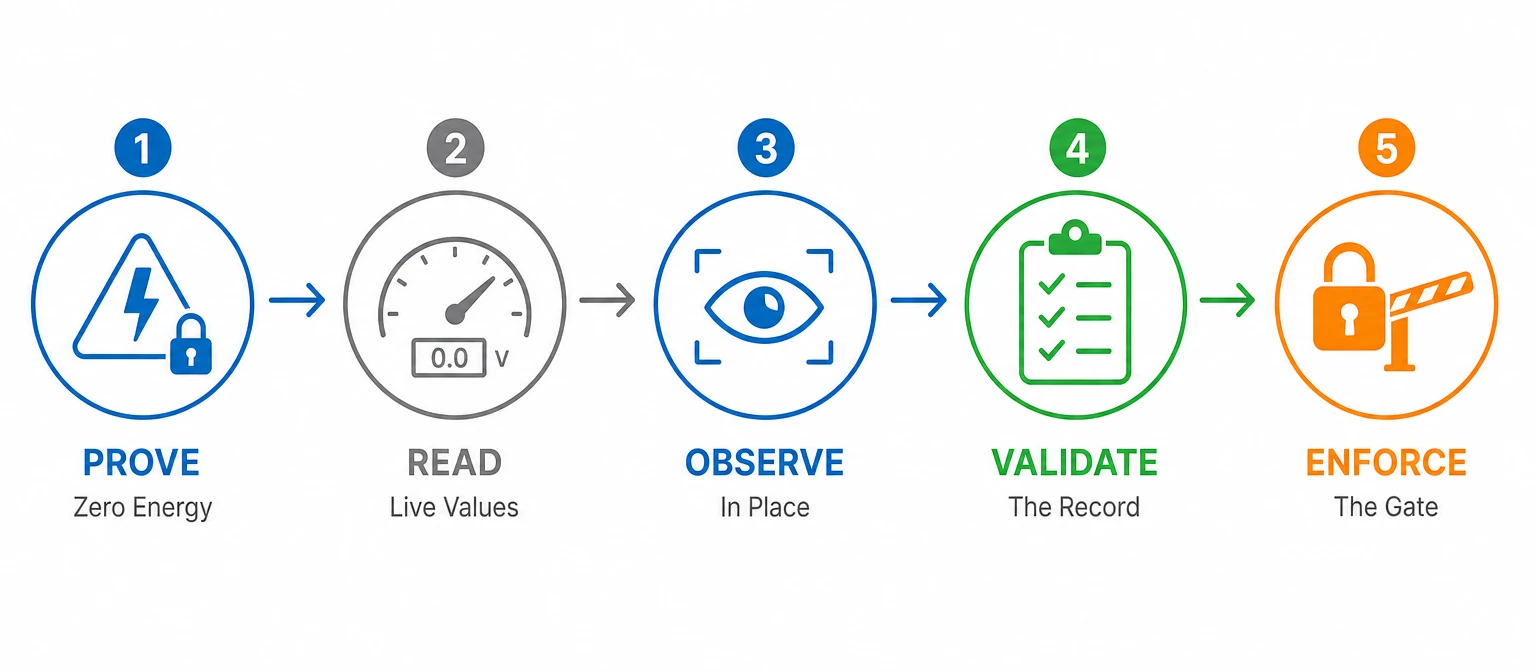
Verify each critical control with a physical test at the job site, then record the result before the permit is signed. The five-step method below keeps the order consistent across crews and shifts.
The PROVE Control Verification Method:
Locks show intent, but a try-out proves isolation. Attempt a start, test the circuit with a proven tester, and bleed or block stored energy as your lockout tagout procedure requires.
Gas readings age quickly in tanks, pits and enclosed rooms. Set a maximum age for each reading, and retest when the job is delayed or paused.
The issuer should see the evidence, not a tick box. If a reading, photo or isolation confirmation is missing, the permit stays in draft. A gate removes the pressure to sign and fix later.
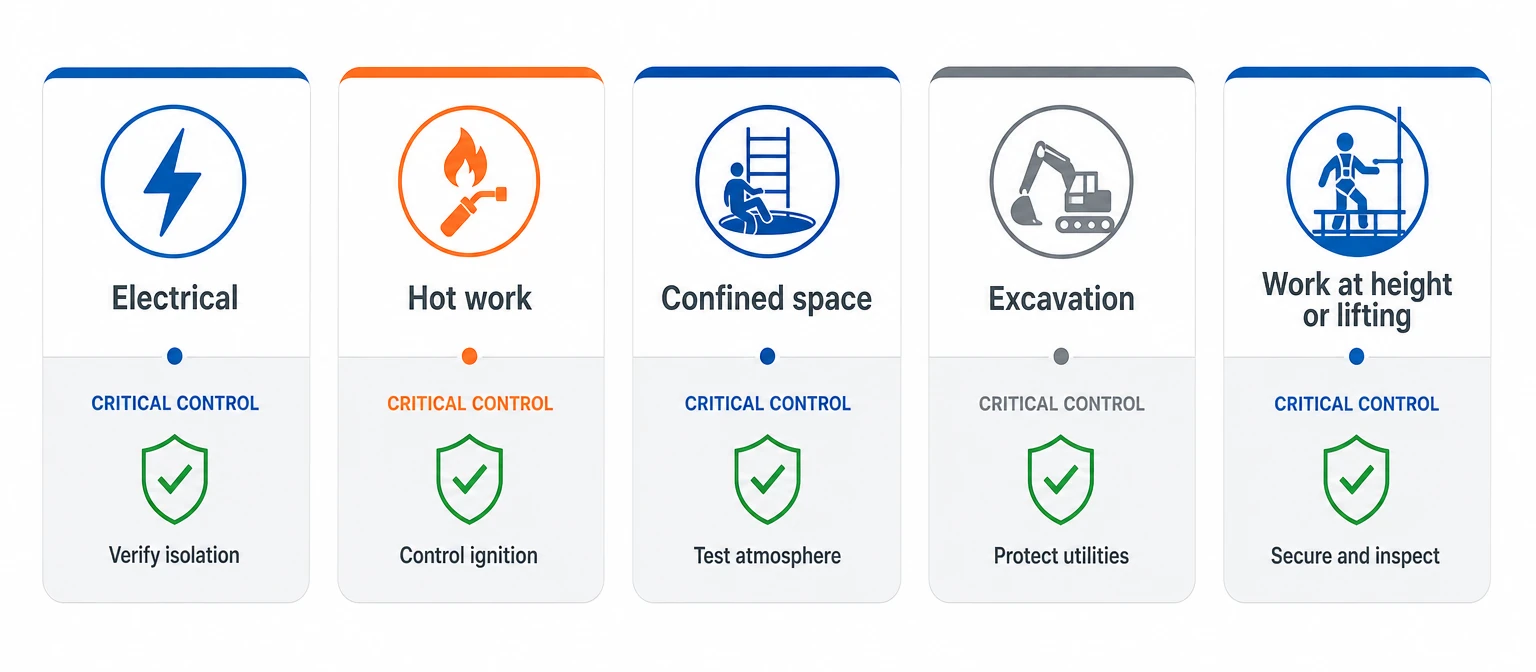
Each permit type has its own critical controls and its own proof. Use this matrix as a starting point, then adjust it to your site procedures and local rules.
| Permit Type | Critical Control | Verification Test Before Issue | Evidence to Attach |
|---|---|---|---|
| Electrical | Isolation, fuse withdrawal, earthing | Test before touch with a proven tester; try-out | Lock numbers, test result, isolator name |
| Hot work | Fire prevention, gas-free area | Gas test; walk-down for combustibles | Reading and time, fire watch name, photo |
| Confined space | Safe atmosphere, isolation, rescue | Four-gas reading at several levels | Readings, attendant name, rescue plan |
| Excavation | Buried service clearance, shoring | Cable scan and drawing check | Scan result, marked drawing, photo |
| Work at height or lifting | Fall arrest, rigging, exclusion zone | Anchor and harness check; lift plan review | Inspection tags, lift plan, photo of barrier |
The fourth column matters most. If the evidence cannot be attached, the control has not been verified.
Cryotos closes the gap between a listed control and a verified one by putting hazards, precautions, approvals and signatures into one digital permit. Two Cryotos case studies show the problem and the fix.
South Jeddah Solar Plant runs PVH trackers, grounding transformers, inverter duty transformers and other high-value equipment. Its major safety challenge was managing high-risk tasks such as electrical work, excavation, hot work and working at height, while keeping LOTO, PPE use and hazard identification consistent on every job.
The plant uses Cryotos, a Computerized Maintenance Management System, to run its permits:
The case study reports improved safety and compliance, because every maintenance activity now runs with documented safety measures in place.
The Cryotos Permit to Work case study describes a boiler shutdown at a large plant. A hot work permit waited hours for a signature from an approver across the site. Isolation sat on a separate operations form, so nobody at the boiler could tell whether the lock-out was complete. The 2 p.m. handover was verbal, and a later audit took days to rebuild.
With Cryotos, the same job runs differently:
When the auditor arrives, the full record comes up in seconds. Explore how permit to work software from Cryotos links permits, isolation and work orders. Across its wider customer base, maintenance teams using Cryotos have reported up to 30% reduction in unplanned downtime and 25% faster repair turnaround.
The most common mistake is treating a signature as proof. Watch for these four patterns during permit reviews.
Run a regulatory compliance checklist each quarter to catch these patterns before an incident does.
The person who applies the control does the test, such as the isolating authority for LOTO or the gas tester for atmosphere. The permit issuer then checks the evidence before signing. Keeping these roles separate gives a second set of eyes on every critical control.
Isolation is placing locks and tags on energy sources. Verification is proving the equipment is actually dead, through a try-out start and a test with a proven tester. OSHA requires both before work begins.
Repeat them whenever the job starts after a delay, after any pause or alarm, and at the intervals your site procedure sets. Confined spaces often need continuous monitoring. Record each reading with its time on the permit.
Yes, when it is set up with gates. In Cryotos, a permit can require approvals, linked LOTO certificates and confirmed lock-out before activation, so missing evidence keeps the permit from going live.
A permit is only as safe as the proof behind each control. Schedule a free demo to see how Cryotos links isolation, approvals and evidence so every permit to work starts on verified controls.


Cryotos AI predicts failures, automates work orders, and simplifies maintenance—before problems slow you down.



