

A warehouse conveyor maintenance schedule is a structured plan that defines exactly which inspection, lubrication, adjustment, and replacement tasks must be completed on your conveyor system - and how often. In e-commerce fulfillment centers, where conveyors run 16-24 hours a day and a single line stoppage can cost between $5,000 and $50,000 per hour, a documented PM schedule is not optional. It is the difference between hitting your SLAs on Prime Day and watching orders pile up while technicians scramble.
This guide gives you a complete, ready-to-use conveyor maintenance schedule - from daily shift checks to annual overhauls - along with guidance on the most common failure points, a peak season prep checklist, and a practical look at how a CMMS automates the entire process.
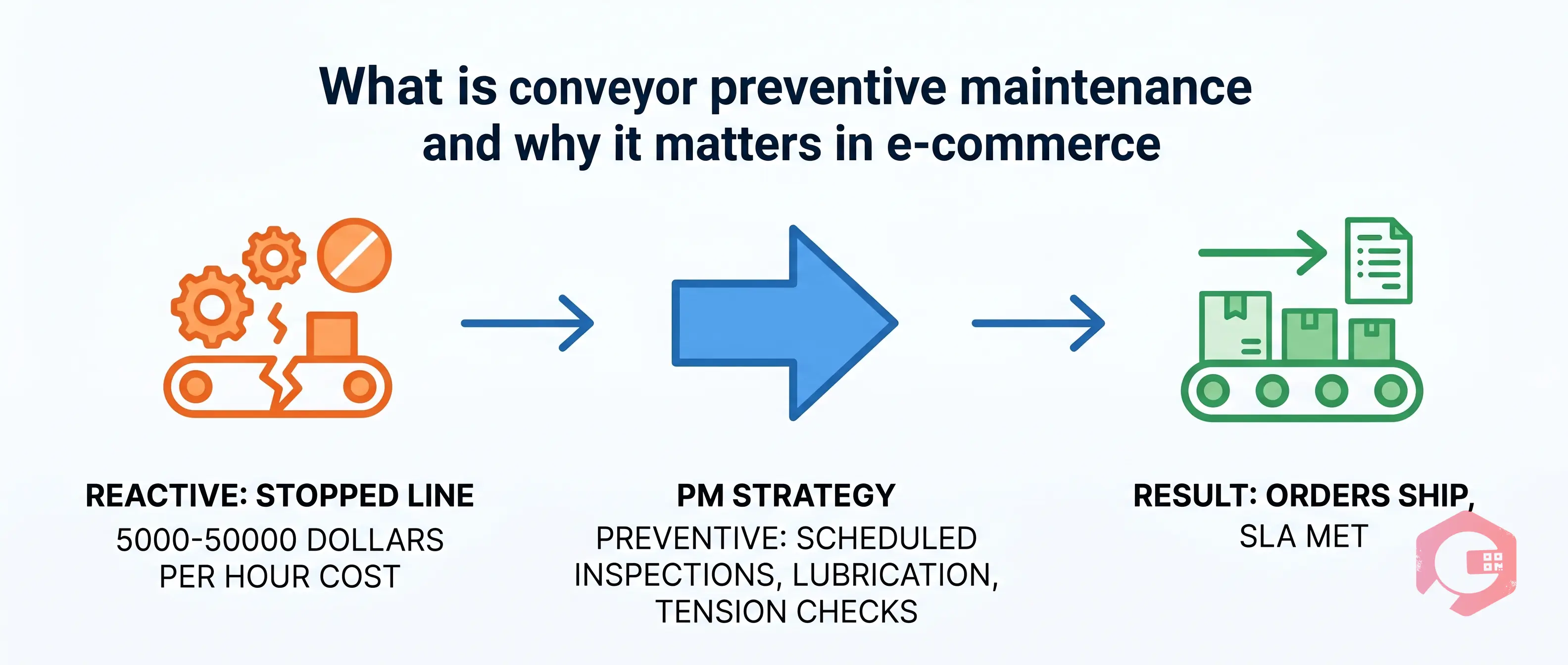
Conveyor preventive maintenance is any planned maintenance activity performed before a failure occurs - inspections, lubrication, tension adjustments, component replacements - carried out on a fixed schedule based on time, usage hours, or condition data. The goal is simple: keep the belt moving so your orders keep shipping.
For general manufacturing, unplanned conveyor downtime is disruptive. For e-commerce fulfillment, it is catastrophic. A stopped sort conveyor during a flash sale does not just slow throughput - it triggers a cascade: picking queues back up, packing stations idle, carriers miss their cut-off windows, and customers open support tickets. According to Gartner research, operational disruptions in high-velocity distribution environments can cost 3-5x more than the direct repair cost when SLA penalties and customer churn are factored in.
Industry data puts the average cost of unplanned conveyor downtime at $5,000-$50,000 per hour, with the range driven by operation size and timing. During peak periods - Black Friday, Prime Day, holiday shipping weeks - that figure climbs sharply because every idle minute represents a compounding backlog, not just a linear delay. A fulfillment center processing 50,000 units per day loses roughly $35-70 per minute of conveyor stoppage in labor waste alone, before factoring in carrier penalties.
A structured preventive maintenance program typically reduces unplanned conveyor failures by 30-50%, according to Plant Engineering. That is the ROI case for a maintenance schedule - not fewer tasks, but far fewer emergencies.
Most fulfillment operations use all three approaches at different points in their conveyor lifecycle
For most e-commerce DCs, the practical answer is: start with a solid preventive schedule, then layer IoT-based condition monitoring onto your highest-criticality lines as your CMMS data matures.

Below is a practical schedule covering every cadence from daily shift checks to annual overhauls. Use this as your baseline and adjust intervals based on your conveyor OEM's recommendations and your operational intensity.
Understanding why each component fails - not just what to check - helps your team prioritize the right tasks and catch problems earlier.
The belt is your highest-wear item. In e-commerce, belts face variable loads - a 5g envelope followed by a 30kg box - that create uneven tension cycling no fixed-weight manufacturing line produces. This accelerates edge wear and splice stress. Carryback (packaging material embedding in the belt underside) is the leading cause of premature belt failure in fulfillment centers. Install belt scrapers at the head pulley and inspect them weekly.
Seized idler rollers are often invisible until they cause belt mistracking. In dusty or debris-heavy fulfillment environments, sealed-for-life bearings are worth the premium over greaseable options - there are simply too many rollers to grease on schedule. Head and tail pulleys require lagging inspection quarterly; worn lagging is the #1 cause of belt slippage at the drive.
Motors in 24/7 operations accumulate 8,760 hours per year - the equivalent of 3-4 years of single-shift manufacturing in one calendar year. Thermal management is critical: check that motor cooling fins are clear of dust, VFD parameters match actual motor nameplate data, and motor mounts haven't loosened under vibration. Gearbox oil analysis is a cost-effective way to detect internal wear before it becomes catastrophic failure.
Modern e-commerce conveyors carry more sensors per linear foot than most manufacturing lines - barcode scanners, weight checks, photo eyes, jam detectors, and divert confirmation sensors. A single dirty or misaligned photo eye can ghost-jam an entire sort line. Build sensor cleaning and calibration into your monthly schedule and log all sensor faults in your CMMS so you can spot recurring issues before they become line stops.
Peak season - Black Friday through the holiday shipping cutoff, plus Prime Day and major sale events - puts 2-5x normal throughput through your conveyor lines for weeks at a time. The conveyor maintenance decisions you make in September and October determine whether November and December run smoothly. Complete these tasks 6-8 weeks before peak begins:

Understanding the most common failure modes helps you build a PM schedule that addresses root causes, not just symptoms.
According to Reliable Plant, approximately 70% of conveyor failures are predictable and preventable with a consistent PM program. The remaining 30% - typically freak impact events or hidden manufacturing defects - is where predictive monitoring and fast spare parts response make the difference.
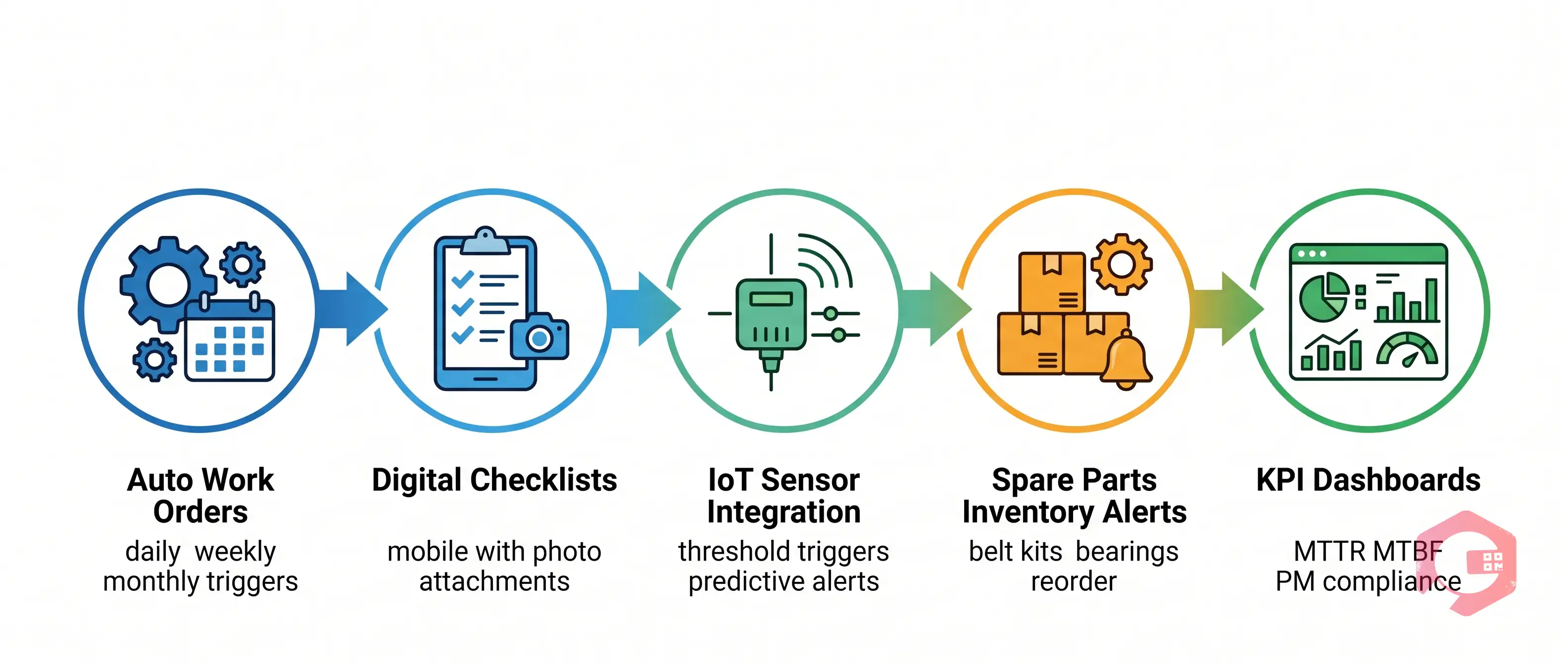
A well-designed conveyor maintenance schedule on paper is a start. The problem is execution - remembering to trigger weekly tasks across 40 conveyor lines, logging findings consistently, and escalating defects before they become failures. That's where a CMMS (Computerized Maintenance Management System) eliminates the gap between plan and reality.
Here is how a CMMS handles your conveyor PM program end-to-end
Cryotos CMMS gives e-commerce fulfillment teams a platform built for this exact workflow - static and dynamic PM schedules, mobile work orders with offline mode, IoT integrations with SCADA and edge devices, and a BI dashboard that tracks OEE, availability, and downtime by asset and location. Teams using Cryotos report a 30% reduction in downtime and 25% faster repair times after implementing structured PM programs.
Most warehouse conveyor belts last 3-5 years under standard operating conditions, but e-commerce fulfillment centers running 16-24 hours per day often see useful belt life of 2-3 years due to higher throughput cycles and variable load profiles. Replace belts proactively when they show more than 60% wear, have three or more repaired splices, or when your annual inspection reveals internal ply separation.
The five most common conveyor failures in e-commerce fulfillment are: belt mistracking (belt drifts sideways due to misaligned pulleys), belt slippage (loses traction at the drive pulley), bearing failure (from lubricant starvation or contamination), drive chain elongation and failure, and motor overheating from blocked cooling or overloading. All five are preventable with a consistent PM schedule.
Start with your conveyor OEM's recommended maintenance intervals, then adjust based on your actual operating hours and environment. Build a four-tier schedule: daily visual checks and safety tests, weekly lubrication and tension checks, monthly component inspections, and quarterly or annual deeper assessments. Document each task in a CMMS so work orders generate automatically and nothing depends on individual memory.
Yes. A CMMS automates PM work order creation on your defined schedule, sends mobile task lists to technicians, tracks completion and defect findings, manages spare parts inventory, and connects to IoT sensors for condition-based maintenance triggers. For multi-line fulfillment operations, a CMMS is the only practical way to execute a consistent PM program across dozens of conveyor assets simultaneously.
Ready to move your conveyor maintenance from reactive to proactive? Cryotos CMMS helps e-commerce fulfillment teams build and automate their entire conveyor PM program - from shift-start checklists to IoT-triggered predictive work orders. Explore how Cryotos downtime tracking and automated work order management keep your lines moving when it matters most.




Cryotos AI predicts failures, automates work orders, and simplifies maintenance—before problems slow you down.



