A CCP decision tree is a structured, question-based tool that helps food safety teams decide whether a specific step in a food production process qualifies as a Critical Control Point (CCP). It is a core part of the HACCP (Hazard Analysis and Critical Control Points) system and gives teams a consistent, repeatable way to make high-stakes decisions — without relying on guesswork.
Food manufacturers, processors, and packagers use the CCP decision tree during hazard analysis. It asks a series of yes/no questions about a process step, and the answers guide the team toward a clear conclusion: is this a CCP, a prerequisite program, or neither? Getting this right matters. A missed CCP can lead to contaminated products reaching consumers. An overcounted CCP creates unnecessary complexity that slows production and strains your team.
In this guide, you'll learn exactly how the CCP decision tree works, how to apply it step by step, how it compares to related tools, and how to document it in a way that satisfies auditors and regulators.
Before you can use the decision tree, you need to understand what it's trying to identify. A Critical Control Point is a step in your process where a control measure can be applied — and where that control is essential to prevent, eliminate, or reduce a food safety hazard to an acceptable level.
Examples of CCPs include:
Not every step where something could go wrong is a CCP. Prerequisite programs handle many of these hazards — supplier verification, sanitation procedures, and pest control, for example. The decision tree helps your team draw that line clearly.
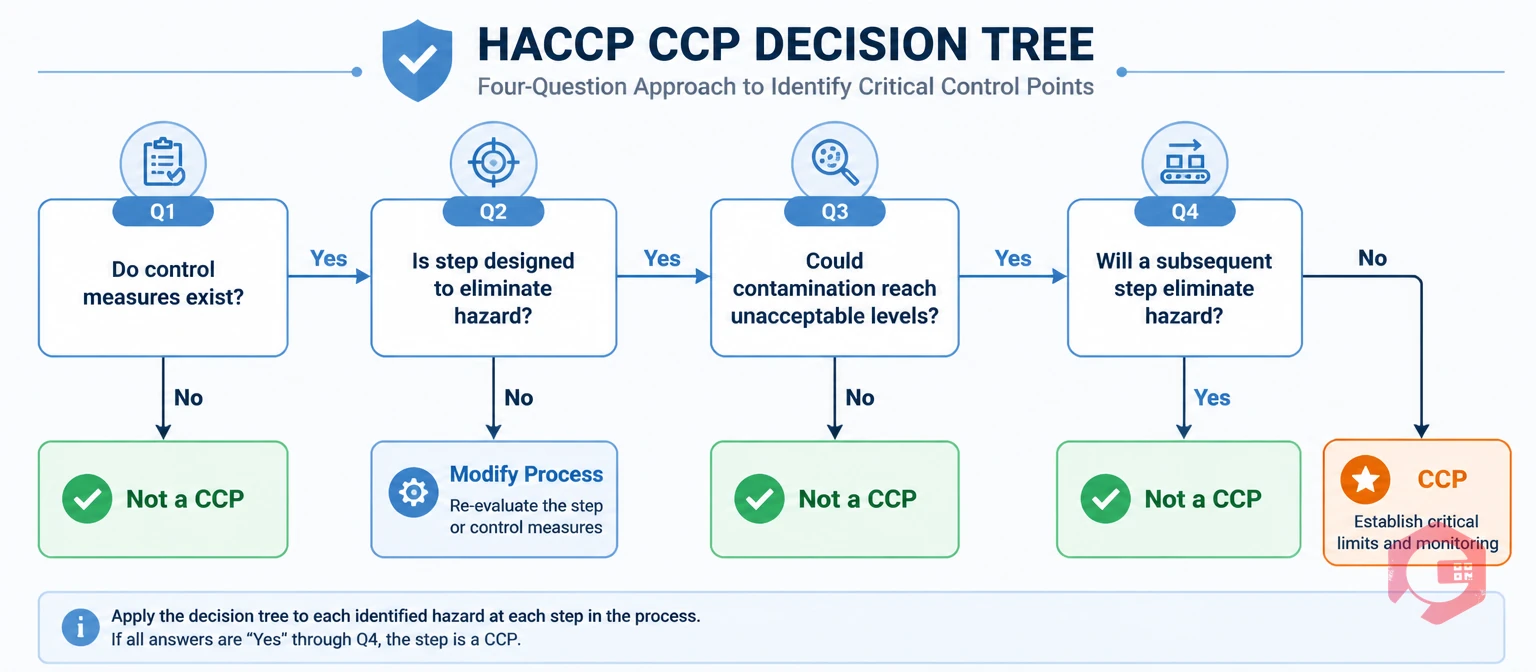
The Codex Alimentarius Commission, which sets international food safety standards, published the most widely used version of the CCP decision tree. It contains four sequential questions. You answer them in order for each hazard at each process step.
This first question asks whether your team has any way to control the hazard at this step — or anywhere in the process. If yes, move to Q2. If no, you must ask whether control at this step is necessary for food safety. If it is necessary and you have no control measure, you need to modify the step, the product, or the process before proceeding.
Some process steps are intentionally built around hazard control — like a kill step for pathogens. If the answer is yes, this step is a CCP. If no, move to Q3.
Here you're asking whether a hazard could build up at this point. If contamination could reach dangerous levels, and the answer is yes, move to Q4. If no, this is not a CCP — apply a prerequisite program and move on to the next step.
If a later step in the process will handle the hazard — for example, a cooking step downstream will kill any bacteria introduced here — then this step is not a CCP. If no later step controls it, this step is a CCP.
Work through all four questions for every significant hazard at every process step. The result is a documented, defensible CCP determination your HACCP team, auditors, and regulators can follow.
Many food safety teams confuse CCPs with Operational Prerequisite Programs (oPRPs) and standard Prerequisite Programs (PRPs). The list below shows how they differ across the dimensions that matter most.
| Feature | CCP (Critical Control Point) | oPRP (Operational Prerequisite Program) | PRP (Prerequisite Program) |
|---|---|---|---|
| Purpose | Controls a specific, significant hazard at a defined process step | Manages hazards that are significant but controlled through operational conditions, not precise limits | Provides the baseline hygiene and environmental conditions for safe food production |
| Control measure type | Measurable, validated critical limits (e.g., temperature 72°C for 15 seconds) | Monitoring and corrective actions, but not tight critical limits | Procedures, schedules, and policies (e.g., cleaning rosters, pest control) |
| Monitoring frequency | Continuous or very frequent (often every batch or in real time) | Periodic, based on risk | Routine — daily, weekly, or as scheduled |
| Documentation requirement | Full HACCP records, critical limit logs, deviation records | Monitoring logs and corrective action records | Completion records and audit logs |
| Consequence of deviation | Immediate corrective action, potential product hold or recall | Corrective action and root cause review | Corrective action and schedule adjustment |
| Regulatory scrutiny | Highest — required under HACCP plans for regulated products | High — required under ISO 22000 and FSSC 22000 | Standard — foundational to all food safety systems |
The decision tree specifically identifies CCPs. Your broader hazard analysis and food safety management system determines oPRPs and PRPs — not the decision tree itself.
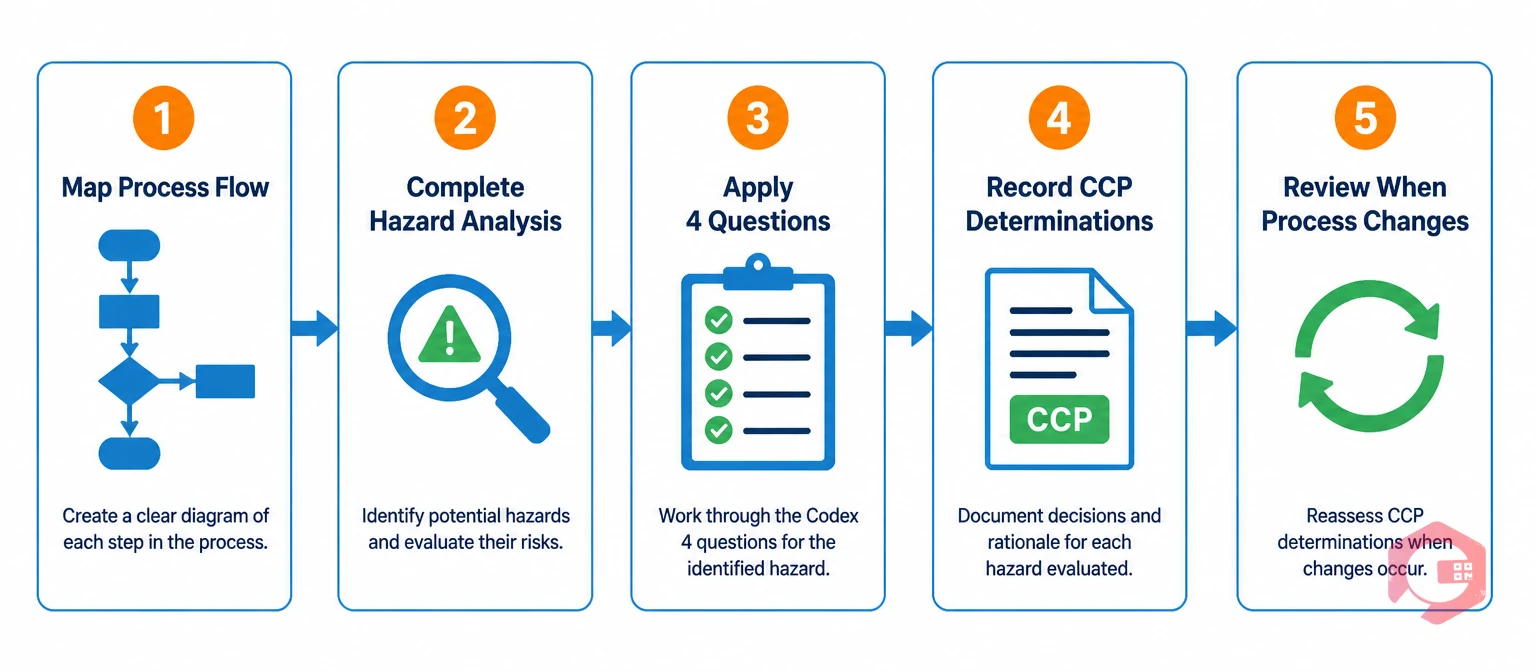
Running the decision tree is a team activity. Your HACCP team should include people with direct knowledge of the process — production supervisors, quality technicians, maintenance leads, and food safety specialists. Here is how to work through it in practice.
Start with a verified process flow diagram. Every input, step, and output should be listed. Walk the floor and confirm the diagram matches reality. Undocumented steps are where hazards hide.
For each step, identify potential biological, chemical, and physical hazards. Assess severity (how bad if it reaches a consumer) and likelihood (how probable is it without controls). Only hazards that are both significant in severity and reasonably likely to occur move forward to the decision tree. Use your maintenance checklists to support this analysis — equipment condition directly affects hazard likelihood.
Go step by step, hazard by hazard. Do not jump to conclusions. A step that looks like a CCP intuitively might not be one if a later cooking step provides adequate control. A step that seems minor might be a CCP if no downstream control exists. Document your answers and reasoning for every question.
Record which steps are CCPs, which are oPRPs, and which are controlled by PRPs. For every CCP, you'll then need to set critical limits, establish monitoring procedures, define corrective actions, and assign verification activities. This is the foundation of your HACCP plan.
The CCP decision tree is not a one-time exercise. Any change to your process — new equipment, new ingredients, new suppliers, new packaging, or new production volumes — requires a fresh hazard analysis and a re-run of the decision tree for affected steps. Schedule this as part of your preventive maintenance and food safety review calendar.
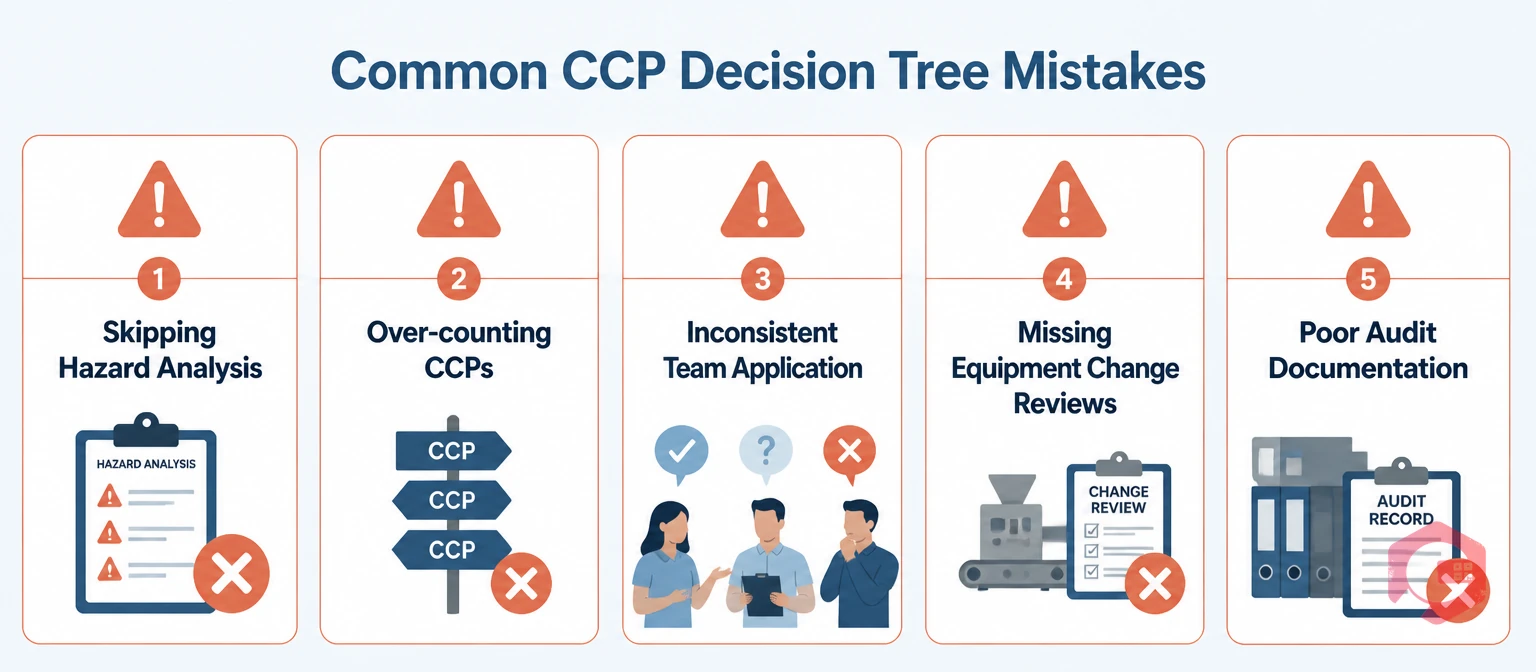
Even experienced food safety teams make avoidable errors. Here are the ones that show up most often in third-party audits and regulatory inspections.
Regulators and certification bodies — including FDA FSMA, Codex Alimentarius, and BRCGS — expect to see your CCP determination documented clearly. Your records should show:
Good documentation is not just a compliance requirement. It is the fastest way to onboard a new food safety manager, respond to a customer complaint, or prepare for a surprise audit. Teams that maintain document management systems integrated with their operational workflows find audit preparation significantly faster than those relying on spreadsheets and shared drives.
CCPs require continuous monitoring, and monitoring depends on equipment working correctly. A pasteurizer that drifts below its critical temperature limit, a metal detector with a missed calibration check, or a refrigerator with a failed temperature sensor can all turn a controlled CCP into an active food safety incident.
A food and beverage CMMS connects your maintenance operations directly to your food safety system. With Cryotos, your team can schedule and track calibration tasks for CCP monitoring equipment, receive automated alerts when equipment tied to a CCP is overdue for service, and maintain a full audit trail of maintenance records that supports your HACCP verification activities. When a deviation occurs at a CCP, your corrective action workflow — from work order creation to root cause documentation — is handled in one place rather than across disconnected systems.
The BI dashboard gives food safety managers real-time visibility into equipment health, open work orders, and overdue maintenance tasks — exactly the kind of oversight that keeps CCPs under control during high-volume production periods.
The CCP decision tree should be applied by your multidisciplinary HACCP team — typically including a food safety specialist, a production supervisor, a quality assurance technician, and a maintenance representative. Each person brings a different perspective on hazard likelihood and control feasibility. Having a maintenance rep in the room is important because equipment condition directly affects whether a control measure is reliable.
You should re-run the decision tree whenever your process changes — new equipment, new ingredients, new suppliers, or changes to process parameters like temperature, time, or flow rate. Most food safety systems also require an annual review of the full HACCP plan as part of scheduled verification activities, even if no changes have occurred.
The decision tree itself is not legally mandated, but the HACCP hazard analysis and CCP identification process is required by regulations like the FDA's FSMA Preventive Controls rule and 21 CFR Part 123 for seafood. The decision tree is a practical tool for meeting those requirements in a documented, auditable way.
No. A process step is classified as either a CCP or an oPRP — not both. The distinction matters because they require different levels of monitoring precision, documentation, and corrective action. If you're unsure which classification applies, use your hazard analysis severity and likelihood scores to guide the decision, and document your team's reasoning.
This is exactly the scenario Q1 is designed to surface. If no control measure exists and the hazard is significant, you must modify the product, the process, or the step before proceeding. You cannot simply document "no control" and move on. This might mean adding a new process step, changing a formulation, or implementing a supplier control program upstream.
If your food safety team is spending too much time chasing maintenance records and calibration logs when audits arrive, it's worth looking at how Cryotos can connect your equipment maintenance to your HACCP verification workflow. Explore Cryotos CMMS and see how food and beverage teams use it to keep CCPs under control — from daily monitoring to annual HACCP reviews.




Cryotos AI predicts failures, automates work orders, and simplifies maintenance—before problems slow you down.