
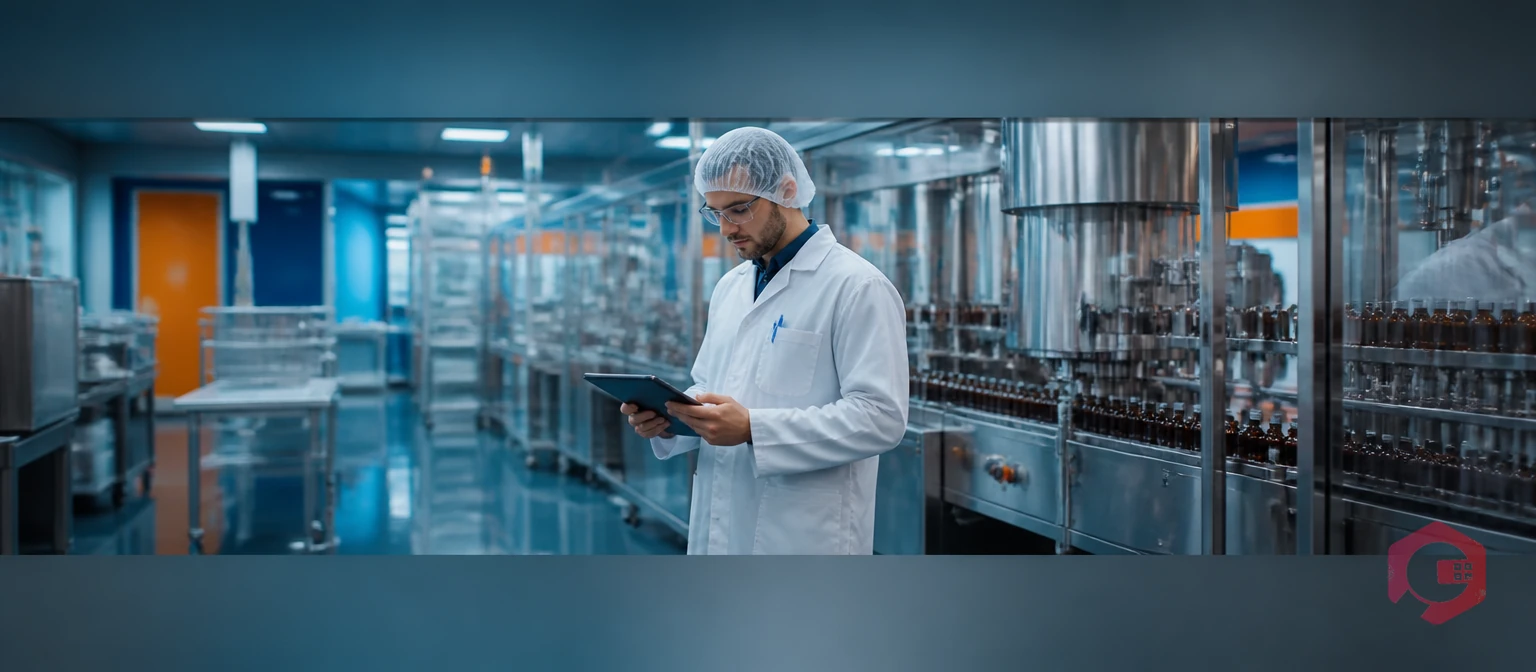
A Computerized Maintenance Management System (CMMS) is the operational backbone that pharmaceutical facilities need to keep equipment running, documentation audit-ready, and regulators satisfied. In pharma, a single equipment failure or missing maintenance record can trigger a costly production shutdown, a warning letter, or a failed inspection. CMMS software solves this by centralizing every work order, maintenance schedule, and compliance document in one place — giving maintenance teams the real-time control they need in one of the world's most regulated industries.
This guide covers what CMMS does in a pharma context, which compliance requirements it addresses, which features matter most, and how to implement it in a regulated facility. Whether you run a small API manufacturing site or a large multi-line fill-and-finish operation, the fundamentals are the same: scheduled maintenance, documented records, and audit-ready evidence.
Key Takeaways
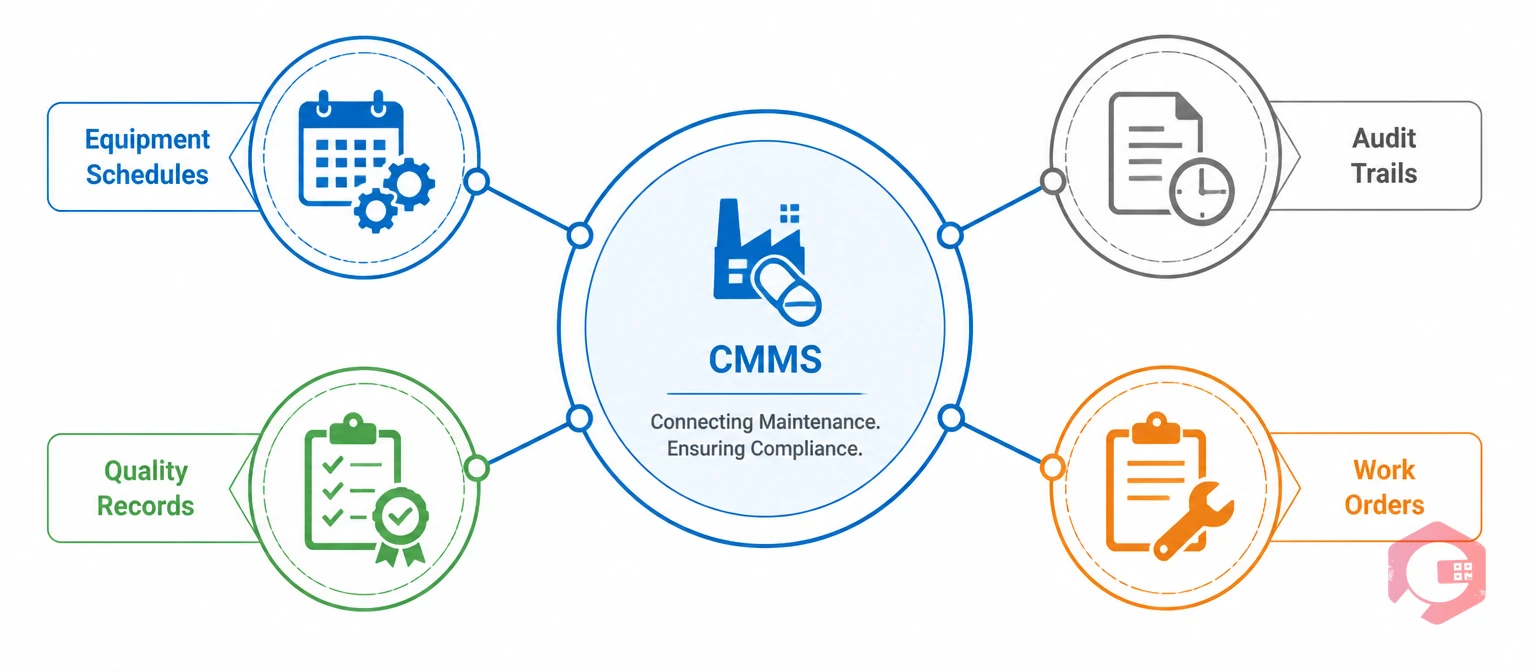
A CMMS in pharmaceutical manufacturing is a software platform that schedules, tracks, and documents every maintenance activity performed on production equipment, utilities, and facilities — creating the complete, tamper-evident record that regulators require. It replaces spreadsheets, paper logs, and disconnected systems with a single source of truth that maintenance engineers, quality assurance teams, and auditors can access instantly.
Pharmaceutical facilities run equipment that directly affects product quality and patient safety — reactors, tablet presses, lyophilizers, HVAC systems, water-for-injection units, and cleanroom utilities. When any of these fail without proper documentation, the batch they supported may be deemed non-conforming. CMMS prevents this by tying maintenance records directly to equipment history, making every work order a quality document as much as a maintenance record.
Most industries treat maintenance as a cost-reduction function. In pharma, it is a quality function. The FDA's 21 CFR Part 11 regulation requires that electronic records and signatures — including maintenance logs — meet strict integrity and traceability standards. Every completed work order must carry a date-stamped technician signature, and every modification must be traceable back to its source.
That level of traceability is impossible to maintain reliably with manual systems. Paper logs get lost, entries get skipped under production pressure, and retrieving a two-year maintenance history for a specific piece of equipment during an FDA inspection can take hours. CMMS makes comprehensive, traceable records the automatic outcome of every maintenance task — not an additional administrative burden.
Explore how pharmaceutical maintenance management software handles these requirements end to end, from calibration tracking to electronic signatures aligned with 21 CFR Part 11.

Pharma maintenance teams operate under a set of pressures that most other sectors never face. Understanding these challenges is essential before evaluating any CMMS solution, because the features that matter in pharma are different from those in manufacturing or facilities management.
In pharmaceutical manufacturing, unplanned downtime can do more than delay production. It can invalidate entire batches. A reactor that trips offline mid-cycle may require full batch rejection under current Good Manufacturing Practices (cGMP). A filling line that stops without a documented root cause triggers a deviation investigation. A cleanroom HVAC that exceeds temperature limits puts every open container at risk. FDA data shows that equipment-related failures account for a significant share of drug recalls and manufacturing deviations each year.
Most facilities that rely on reactive maintenance face this problem repeatedly. They fix equipment after it breaks. They have no feedback loop between failures and future PM schedules. Without CMMS, maintenance teams cannot identify failure patterns, cannot track mean time between failures (MTBF), and cannot build evidence-based preventive maintenance schedules.
FDA inspections, EU GMP audits, and WHO assessments all scrutinize maintenance records in detail. Inspectors look for three things: evidence that calibration schedules were followed, proof that preventive maintenance was completed on time by qualified technicians, and documentation that deviations were investigated and resolved.
Facilities that cannot produce this evidence on demand face 483 observations, warning letters, consent decrees, or import alerts. Any of these can halt production for months and cost millions in remediation.
Paper-based maintenance systems fail here consistently. Records are incomplete, overwritten, missing, or too disorganized to retrieve quickly during an inspection. Maintenance teams that pass audits on paper systems typically do so through intensive manual preparation before each visit — not through sustainable, day-to-day operational discipline.
Pharmaceutical equipment requires periodic calibration. This keeps instruments measuring within their validated ranges. When instruments drift out of calibration, they can invalidate data from every batch they supported during that period.
Without automated calibration tracking, facilities rely on calendar reminders and spreadsheets. These systems work when the equipment list is small. They break down as the fleet grows, technicians change, and production schedules get compressed.
CMMS generates calibration work orders automatically based on due dates. It flags items that are overdue. It can block equipment from production use until calibration is completed and signed off by a qualified technician. This prevents one of the most common FDA 483 findings: equipment running past its calibration date without anyone catching it in time.
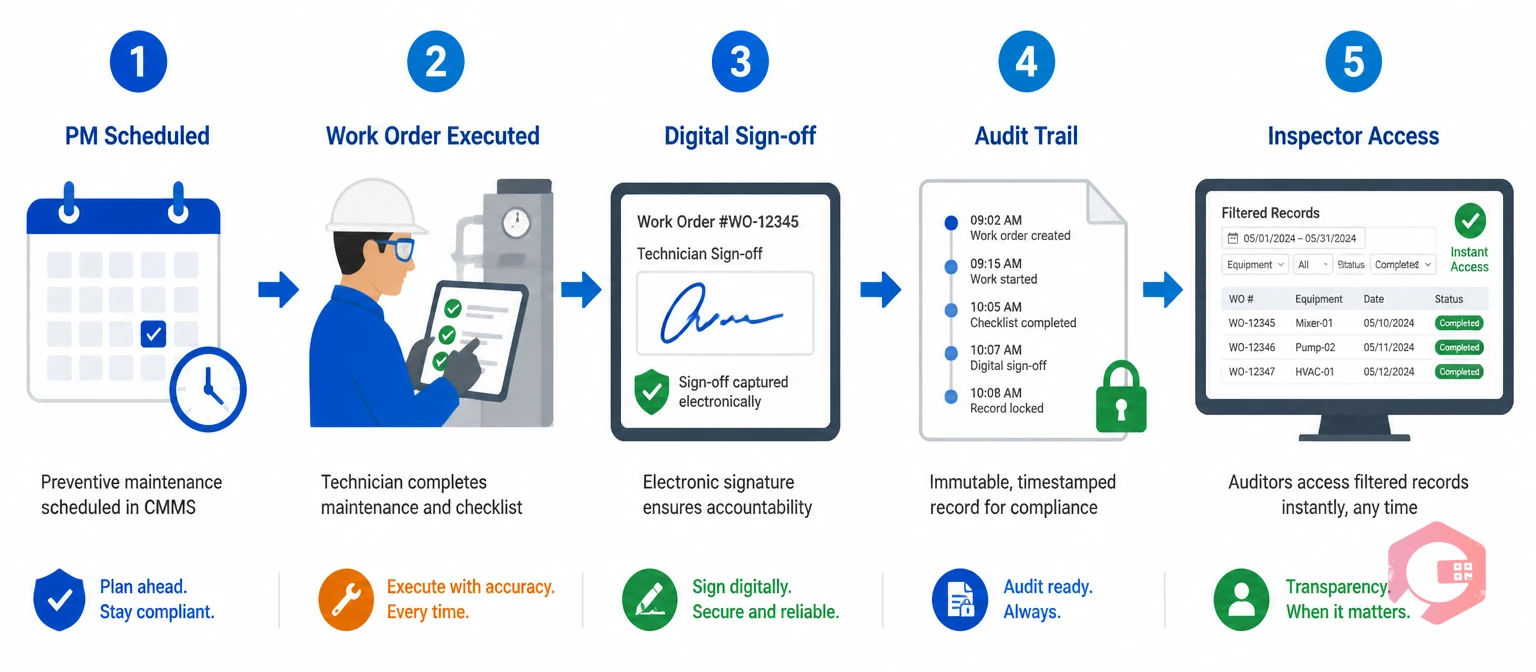
Regulatory compliance in pharma maintenance comes down to three requirements: doing the work on schedule, recording it correctly, and proving both during an audit. A CMMS enforces all three through automated workflows, electronic signatures, and tamper-evident audit logs that satisfy FDA 21 CFR Part 11 and EU GMP Annex 11 requirements.
The difference between a manual system and a CMMS becomes most visible when an inspector asks to see the maintenance history for a specific piece of equipment over the past two years. With paper logs, this retrieval takes hours and is rarely complete. With CMMS, it takes under two minutes and includes every work order, technician signature, parts used, and deviation note — filterable by asset, date, or technician name.
| Compliance Area | Manual / Paper System | CMMS |
|---|---|---|
| PM Scheduling | Calendar reminders, prone to missed or skipped tasks under production pressure | Automated triggers based on calendar intervals, runtime hours, or meter readings — cannot be skipped without a logged reason |
| Audit Trail | Paper logs — incomplete, alterable, difficult to retrieve quickly | Timestamped, tamper-evident digital records with technician signatures meeting 21 CFR Part 11 |
| Calibration Tracking | Spreadsheet with manual updates — easy to miss as equipment fleet grows | Automated calibration due-date alerts; equipment flagged or locked out if overdue |
| Deviation Documentation | Separate paper-based CAPA forms, often filed separately from maintenance logs | Integrated deviation logging linked directly to the original work order — all in one record |
| Inspection Readiness | Hours of manual document retrieval per inspector request | Instant filter by asset, date range, or technician — read-only inspector access available |
| Spare Parts Traceability | Separate inventory logs, often not linked to equipment records | Parts used recorded within each work order — full material traceability per asset |
Use Cryotos's regulatory compliance checklist to identify your current documentation gaps before your next audit cycle begins.
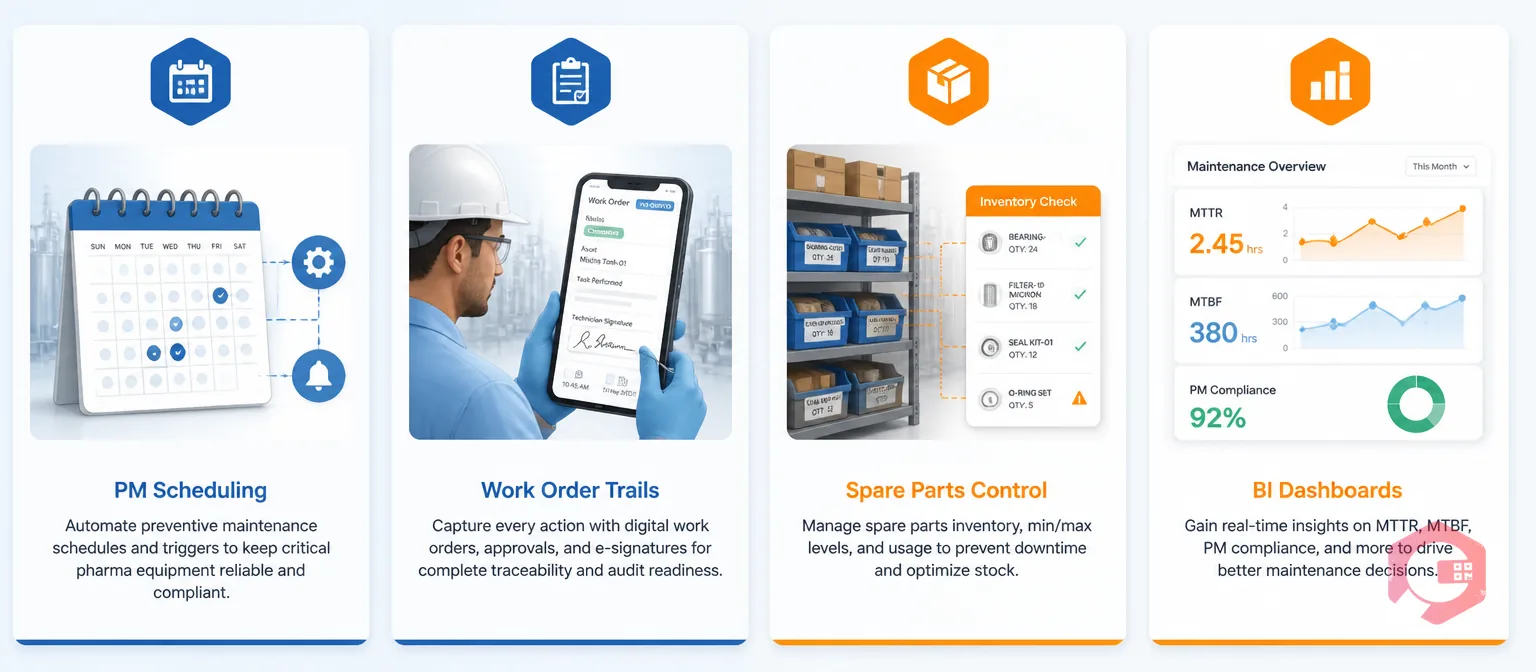
Not every CMMS is built to handle the demands of pharmaceutical manufacturing. Pharma maintenance teams need specific capabilities that address both operational reliability and the documentation precision that regulatory compliance requires.
Preventive maintenance scheduling in pharma means triggering work orders automatically based on calendar intervals, equipment runtime hours, or production cycles — not waiting for equipment to fail before acting. This keeps critical assets like autoclaves, filling lines, and HVAC systems within their validated operating parameters at all times.
Cryotos's preventive maintenance software supports both static schedules (e.g., every 30 days) and dynamic PM triggers based on actual meter readings — a critical distinction for equipment where runtime, not elapsed time, determines wear rate. Calibration schedules, filter replacements, lubrication cycles, and qualification revalidations all run automatically from a single maintenance calendar.
Work order management in pharma must capture not just what was done, but who did it, when, whether it followed the approved procedure, and what materials were used — because every closed work order is a compliance record.
With Cryotos's work order management software, technicians complete maintenance checklists directly on their mobile devices. They sign off digitally and attach photos or part serial numbers to the work order. The system timestamps every step automatically. This creates a chain of custody that satisfies 21 CFR Part 11 electronic signature requirements. Emergency repairs and unplanned interventions get logged immediately — so no maintenance activity falls outside the audit trail. Maintenance teams using Cryotos have reported up to 30% reduction in unplanned downtime and 25% faster repair turnaround — improvements that directly impact batch yield and production schedules.
Pharmaceutical facilities cannot wait two days for a critical spare part to arrive. A missing filter or worn seal should never be the reason a batch gets put on hold. CMMS links work orders to spare parts inventory so when a PM task requires a specific component, the system checks availability before the work order is scheduled. Low-stock thresholds trigger purchase orders automatically, keeping critical parts on hand without over-ordering or tying up capital in excess inventory.
Parts used are recorded within each work order, giving quality teams full material traceability per asset — a requirement that some pharma auditors specifically check during GMP inspections.
Maintenance leadership and quality assurance teams both need a live view of equipment status, overdue preventive maintenance tasks, open deviations, and calibration due dates. A maintenance reporting dashboard aggregates this data in real time — giving QA managers the evidence they need for internal reviews and the documentation they need for external audits, without waiting for weekly spreadsheet exports or manual data collection.
Cryotos's BI dashboard includes over 50 pre-built reports covering maintenance KPIs like MTTR, MTBF, PM compliance rate, and equipment availability — all filterable by department, asset type, or time period. Custom report templates can be scheduled for automatic email delivery to plant managers and QA directors on a weekly or monthly basis.
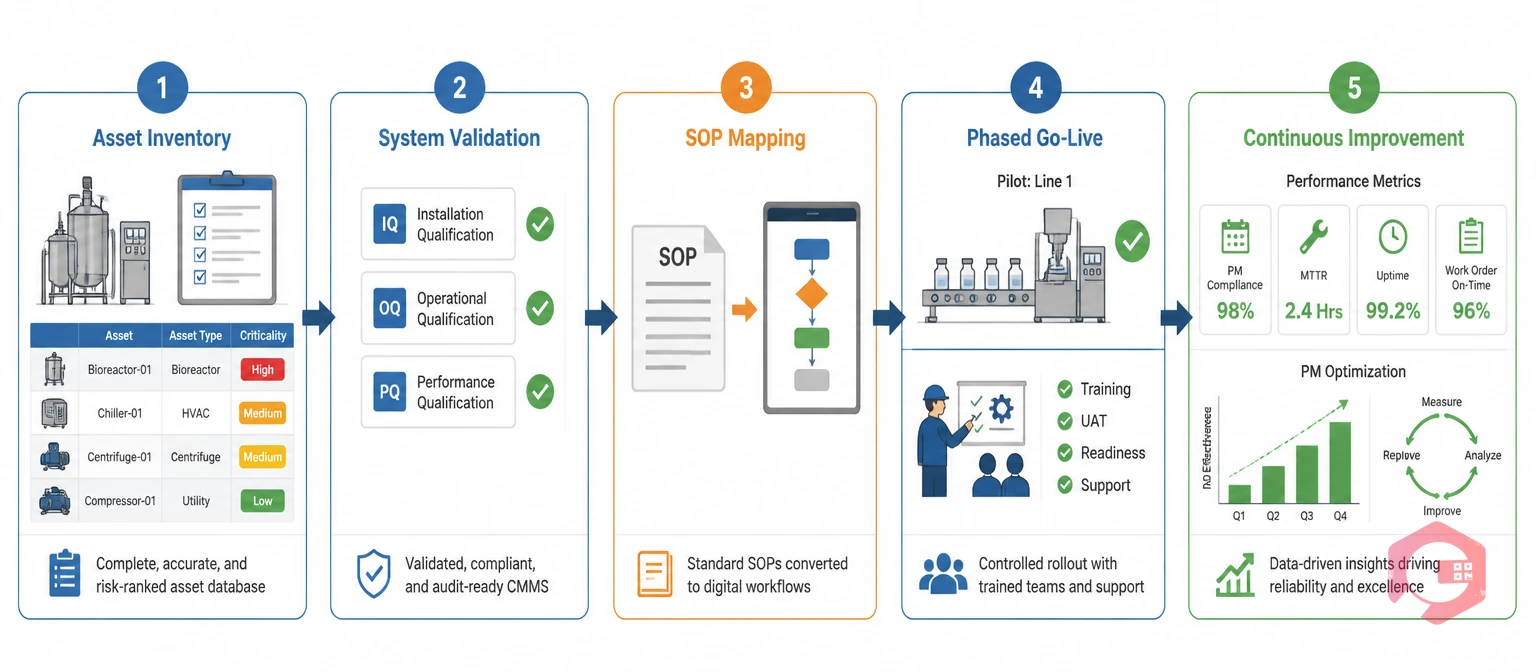
Implementing CMMS in a regulated environment requires a structured, phased approach. Rushing the rollout — or skipping validation steps — creates more compliance risk than it solves. The framework below gives pharma maintenance teams a clear path from initial selection through sustained compliance.
The 5-Stage Pharma Maintenance Compliance Framework:
The WHO Good Manufacturing Practice guidelines explicitly require that pharmaceutical manufacturing equipment be maintained in a suitable condition. Following this 5-stage framework gives your facility the documented evidence that this requirement is being met — not just during an audit, but every day.
The operational case for CMMS in pharma extends across every level of the organization. Shop-floor technicians benefit from faster work order assignment. Plant directors gain defensible compliance records. QA managers get real-time visibility into open deviations and overdue PMs.
Most facilities that successfully transition from reactive to preventive maintenance with CMMS see a measurable reduction in emergency work orders within the first six months. Automated PM triggers ensure high-criticality equipment gets serviced on schedule before failure modes develop — not after a batch is already at risk. Predictive failure data from IoT sensors can feed directly into the CMMS to flag equipment trending toward failure before any visible symptoms appear.
Faster work order assignment, mobile access to maintenance procedures, and integrated spare parts availability checking all reduce mean time to repair (MTTR) — one of the most direct measures of maintenance team performance. Use the MTTR calculator to benchmark your current repair times and track improvement after CMMS implementation.
The most common maintenance-related finding in FDA 483 observations is inadequate or incomplete equipment maintenance records. CMMS eliminates this exposure by making comprehensive records the automatic outcome of every closed work order — not a separate step that technicians must remember to complete under production pressure.
Inspectors can be given read-only access to view filtered maintenance history on demand. A request for the last two years of maintenance records on a specific reactor takes under two minutes to fulfill — turning a historically stressful audit moment into a routine demonstration of operational control.
Operations that run structured preventive maintenance through a CMMS also tend to see fewer GMP documentation findings on routine quality reviews. The reason is simple: the system enforces procedural compliance at the point of execution. Technicians cannot close a work order without completing every required step. That is fundamentally different from paper-based review that happens after the work is already done. Use Cryotos's maintenance audit checklist to prepare your maintenance team and documentation before the next scheduled inspection.
CMMS benefits every role that touches maintenance in a pharma operation. Each team has different priorities, but all of them depend on the same underlying data that CMMS provides.
Technicians spend less time hunting for work orders, chasing down parts, or writing up paper logs. Work orders come to their mobile devices. Parts availability shows up in the same screen. When a job is done, sign-off takes seconds — not a trip to the office to find the paper form.
Managers can see every open work order, overdue PM, and technician assignment in real time. Scheduling conflicts get resolved before they become missed maintenance events. Reports that used to take hours to compile for a monthly review now run in one click.
QA relies on maintenance records to support batch release decisions, deviation investigations, and audit responses. CMMS gives QA teams read-only access to complete equipment histories — so when a batch is being reviewed and the question is "was the reactor serviced within its PM window?" the answer comes in seconds, not hours.
Leadership needs visibility into maintenance performance without wading through raw data. Dashboards showing equipment availability, PM compliance rates, and maintenance cost per asset give plant directors the information they need to make resourcing, capital expenditure, and reliability investment decisions.
If your facility runs any GMP-critical equipment — and it does — then every role listed above benefits from having one reliable source of truth for maintenance data. CMMS is that source. It removes the guesswork, the manual chasing, and the documentation gaps that create compliance risk in every pharma operation, regardless of size.
A CMMS (Computerized Maintenance Management System) is software that schedules, tracks, and documents all maintenance activities performed on equipment and facilities. The pharmaceutical industry needs it because regulatory agencies like the FDA, EMA, and WHO require verifiable records of all maintenance activities. Paper-based systems cannot produce these records reliably — not at the volume, accuracy, and retrieval speed that modern pharma manufacturing demands.
A CMMS creates a complete, timestamped audit trail for every maintenance activity — including who performed the work, which procedure was followed, what parts were used, and whether any deviations occurred. During FDA or GMP inspections, this documentation can be retrieved instantly by asset, date range, or technician, directly addressing the most common maintenance-related 483 observations about incomplete or missing records.
Yes. Modern CMMS platforms integrate with ERP systems such as SAP and Microsoft Dynamics 365, allowing maintenance data to feed into procurement, inventory, and financial systems in real time. This eliminates duplicate data entry, ensures spare parts purchasing is based on accurate consumption data, and allows maintenance costs to roll up into plant-level cost accounting automatically.
Yes. Any computerized system used in a GMP environment — including CMMS — must be validated per GAMP 5 guidelines, covering Installation Qualification (IQ), Operational Qualification (OQ), and Performance Qualification (PQ). Reputable CMMS vendors provide documentation support packages for this validation process. The validation responsibility ultimately rests with the pharmaceutical company as the regulated entity operating the software.
Any maintenance performed outside the CMMS creates a documentation gap that can become a compliance finding during an audit. Best practice in pharma is to require that all maintenance activities — including emergency repairs and unplanned interventions — be logged in the CMMS, even if the work order is created after the fact. Most CMMS platforms support retroactive work order creation with mandatory deviation justification fields, so even ad-hoc repairs remain part of the official equipment history.
Pharma maintenance teams that manage equipment uptime, documentation accuracy, and audit readiness manually are carrying significant compliance risk with every production batch. Cryotos gives pharmaceutical facilities the automated PM scheduling, digital audit trails, real-time compliance reporting, and validated workflows they need to run a maintenance program that holds up under the strictest regulatory scrutiny — without doubling the administrative burden on your maintenance team. Schedule a free demo to see how Cryotos supports pharmaceutical maintenance teams from calibration tracking to full audit-ready documentation.



Cryotos AI predicts failures, automates work orders, and simplifies maintenance—before problems slow you down.



