

Remote-site breakdowns cost more to fix than the same failure at a staffed plant. Five separate delays stack up before a technician even starts the repair: detection, diagnosis, mobilization, authorization, and verification. Each delay adds hours on its own. Together, they turn a 90-minute repair into a multi-day event with inflated labor, travel, and downtime cost. Naming which delay is hitting you hardest is the first step to fixing remote-site breakdowns for good.
Key Takeaways
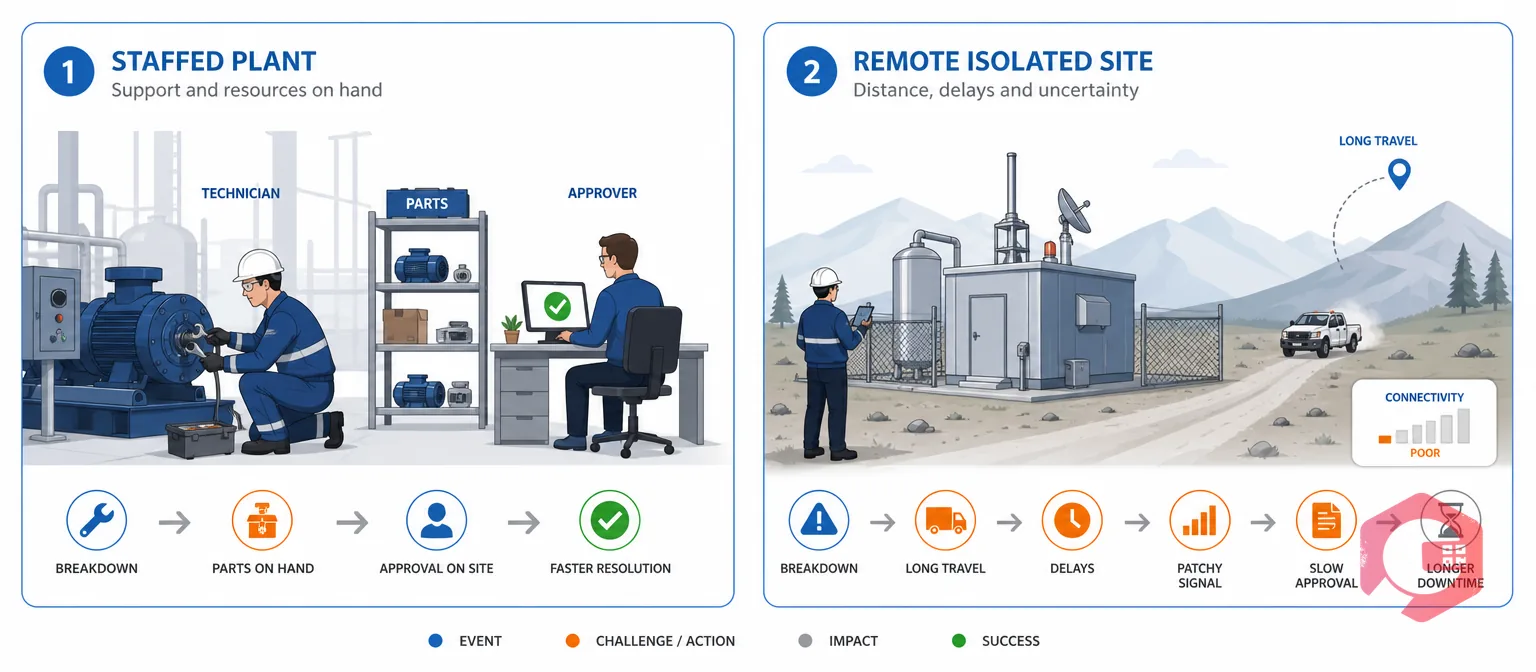
A remote site is any location where a qualified technician isn't stationed full-time, travel takes over 30 minutes, or connectivity drops out for stretches of the day. Wind farms, water substations, telecom towers, farms, and scattered retail locations all fit this pattern. The failure itself doesn't change based on location. Everything around that failure does.
At a staffed plant, an operator spots a fault right away. A technician is minutes away. The right part usually sits on a nearby shelf. At a remote site, none of those three things can be assumed. That gap is why field service management is treated as its own discipline, separate from plant maintenance, even though the repair work looks the same.
Most maintenance teams find the real difference isn't the repair itself. It's everything that has to happen before a wrench ever touches the machine. That single insight explains most of what makes remote-site breakdowns expensive to fix, and it's the thread that runs through every section below.
Remote-site breakdowns are expensive to fix because standard downtime accounting only measures the visible middle of the event. It tracks the repair itself. The costliest delays happen before and after it. A breakdown's true cost breaks into five layers, and most teams only track one or two.
The Remote Breakdown Cost Stack:
Standard downtime math — production rate times hours down — only captures mobilization and repair time. Detection, authorization, and verification delay usually stay invisible in the numbers. That gap is exactly why remote-site maintenance budgets get underestimated so often.
Check the mid-article link below to see where your own repair time actually goes before reading the delay-by-delay breakdown.
Try the free MTTR calculator to see how much of your repair time is travel and delay versus hands-on work.

Each delay in the cost stack has its own root cause and its own fix. Naming which one hits your sites hardest turns a vague "remote sites cost more" complaint into a problem you can actually solve.
| Delay Stage | What It Looks Like | Added Cost Driver | What Closes the Gap |
|---|---|---|---|
| Detection | Fault runs for hours before anyone logs it | Extended unplanned downtime | Public work request link, no login required |
| Diagnosis | Technician travels once just to look | Doubled travel time | Full asset history on one screen |
| Mobilization | Wrong part sent, second trip needed | Repeat travel plus parts lead time | Live stock visibility by site |
| Authorization | Permit sign-off waits on an off-site approver | Idle technician time on-site | Digital permit workflow with e-signature |
| Verification | Job closed from memory days later | Inaccurate cost and downtime data | Mobile closeout at the point of work |
Once a delay gets a name and a number, it stops being background noise. It becomes a line item leadership will actually fund fixing.
Detection delay is the gap between a failure happening and someone recording it in a system. Remote sites often run with light staffing, or none outside daytime hours. A fault can sit unnoticed for a full shift. A bearing running hot has time to seize and damage the shaft before anyone even knows there's a problem.
A technician without asset history on hand diagnoses from scratch, on-site, under pressure. If the wrong part gets sent because nobody tracked stock at that location, the technician travels once to look and a second time to fix. Each trip repeats the full travel cost.
Hot work, electrical isolation, and confined-space repairs need sign-off before anyone can start. When the approver isn't on-site, paper authorization queues behind email or phone availability. Once the repair is done, a job closed from memory two days later usually produces cost data that's wrong.
Remote-site breakdowns cost more than the sum of parts and labor on the work order. The real number includes lost production, technician travel, expedited parts shipping, and the compliance risk of a rushed or undocumented high-risk repair. It is not just the hands-on repair time.
Picture a hydraulic pump failing at a remote pumping station:
None of those five delays looks dramatic on its own. Stacked together, they turn a 90-minute repair into a multi-day event. Bad data sits at the end of it. That compounding effect is why remote-site breakdowns look cheap on a spreadsheet and expensive in real life. Teams that only track downtime tracking at the site level routinely underestimate what one remote breakdown actually costs the business.
According to the Society for Maintenance and Reliability Professionals, world-class maintenance organizations track planned-to-unplanned maintenance ratios closely. Unplanned work at a distributed site carries cost that a simple repair-hours figure never shows on its own. This is a big reason why remote-site breakdowns need their own cost model instead of being folded into a plant-wide average.
The core difference between remote-site and traditional plant maintenance is proximity. A staffed plant has technicians, parts, and approvers on hand. A remote site has to substitute data and process for physical presence.
| Factor | Traditional Plant | Remote Site |
|---|---|---|
| Technician arrival time | Minutes | Hours, sometimes a full day |
| Parts availability | On-site stockroom | Limited or stocked elsewhere |
| Connectivity | Reliable, constant | Patchy or absent at times |
| Permit approval | Supervisor on-site | Approver often reachable only by phone |
| Detection method | Operator notices right away | Depends on staffing and reporting channel |
This is why a like-for-like repair — the same pump seal, the same motor bearing — costs more at a remote site. That holds true even when parts and labor rates are identical on paper.
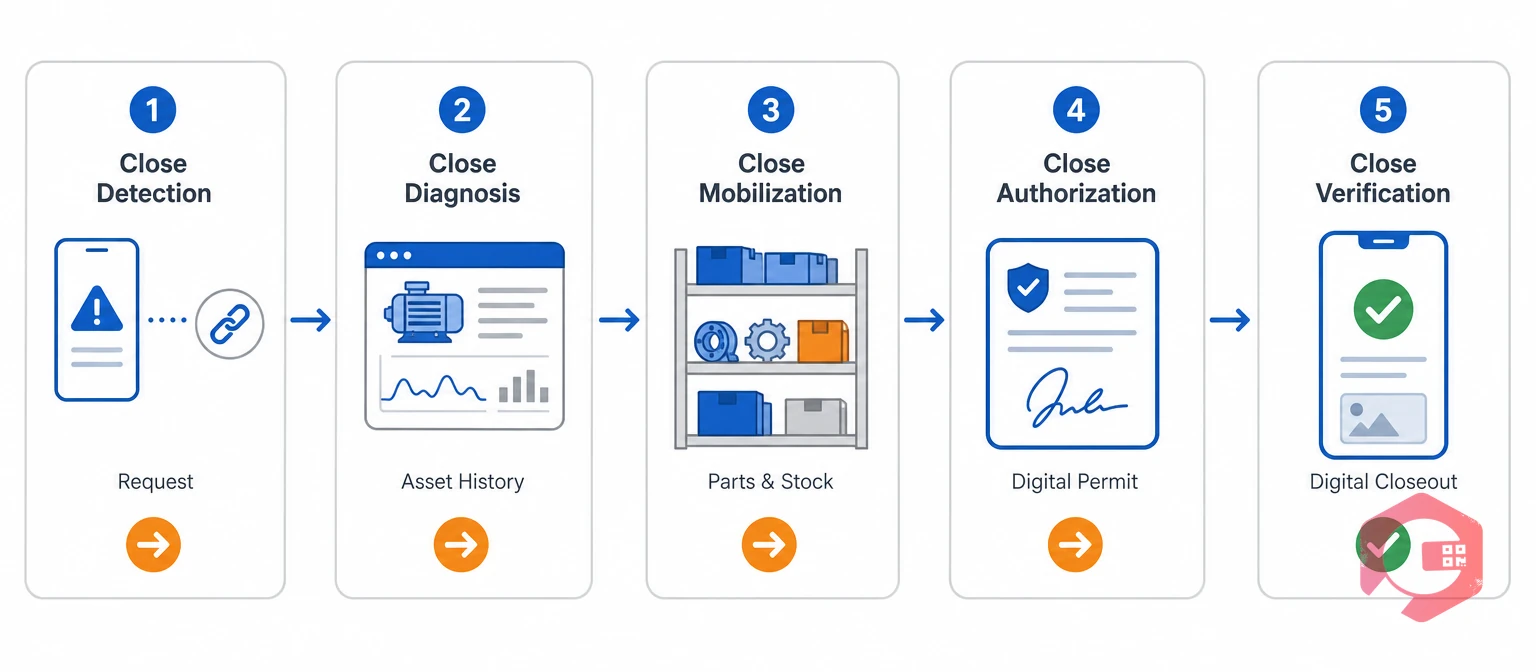
Reducing the cost of remote-site breakdowns means closing each of the five delays one at a time. There is no single broad fix. Most facilities that cut remote-site downtime successfully start with detection and mobilization first. Those two delays usually eat up the largest share of lost time, and fixing them first tends to shrink the cost of remote-site breakdowns fastest.
Give on-site staff, even non-maintenance staff, a simple way to report a fault the moment it happens. A public request link with no login needed gets a problem into the system in minutes. Compare that to waiting for a shift change or a phone call that might not happen at all.
A mobile CMMS that works fully offline lets a technician pull an asset's full repair history before or during travel. That beats diagnosing blind on arrival. Pairing that with live stock visibility by location means nobody gets dispatched with the wrong part — which is what usually forces the second trip.
Digital permit workflows with configurable approval chains and electronic signatures let a supervisor approve hot work or electrical isolation from anywhere. That approval can happen in minutes. Compare that to waiting for someone to be physically present to sign a paper form.
Closing out a job through work order management at the point of work, not from memory days later, is what makes downtime and cost data trustworthy. Teams that also connect meter readings to predictive maintenance software catch wear before it becomes an unplanned breakdown at all. That's the only way to skip the cost stack entirely instead of just shrinking it.
Most facilities that close all five gaps at once say the biggest change isn't any single fix. It's that remote-site cost data finally matches what the maintenance team already knew from experience. Team communication tools that keep dispatchers, technicians, and approvers on one thread remove a sixth, quieter delay too: the time lost simply coordinating between people who can't see each other.
According to the standard definition of Mean Time to Repair, MTTR should reflect the full time an asset stays unavailable. That is exactly the number a remote site's five-stage delay chain inflates the most. The Occupational Safety and Health Administration also flags remote and unmanned work sites as needing extra process discipline, since normal safety checks-ins are harder to enforce from a distance.
The cheapest way to handle remote-site breakdowns is to prevent them. Every delay in the cost stack assumes a breakdown has already happened. A strong preventive program shrinks how often that assumption gets tested in the first place.
None of these steps eliminates remote-site breakdowns completely. Equipment still fails. But a site running a strong preventive program sees fewer of them. The ones that still happen tend to move through the cost stack faster. The asset history, spare parts, and reporting habits are already in place before the failure even occurs.
Remote sites cost more to fix because five delays — detection, diagnosis, mobilization, authorization, and verification — each add time on top of the actual repair. A staffed plant has technicians, parts, and approvers physically present to skip most of those delays.
Mobilization delay is usually the most visible driver, since travel time and a missing spare part can force two trips instead of one. Detection delay is often the largest hidden driver, because most teams never track it at all.
Yes. A Computerized Maintenance Management System with offline mobile access, live parts visibility, and digital permit workflows closes each delay one at a time instead of relying on one broad fix. That's why Cryotos customers have reported up to a 30% reduction in unplanned downtime.
No, as long as it's built with offline-first design. Work orders, checklists, and closeouts get created and updated with no signal, then sync automatically once the device reconnects.
Add up lost production value across the full detection-to-verification window, technician travel and labor hours, any expedited parts shipping cost, and the compliance risk of a rushed or undocumented high-risk repair. Don't stop at the hands-on repair time shown on the work order.
Remote-site breakdowns don't have to stay this expensive once each delay in the chain has a name and an owner. Schedule a free demo to see how Cryotos closes the detection, mobilization, and authorization gaps that make remote-site repairs cost so much more than they should.



Cryotos AI predicts failures, automates work orders, and simplifies maintenance—before problems slow you down.



