A near-miss is any unplanned event that did not result in injury, illness, or damage but had the potential to do so. An incident is a broader term covering any workplace event that causes or could cause harm, while an accident specifically involves an unplanned event that results in actual injury or property damage. Understanding these three terms — and knowing exactly when each triggers a reporting obligation — is one of the most practical safety skills a maintenance manager or facility operator can develop.
Misclassifying a near-miss as trivial, or an incident as an accident (or vice versa), creates compliance gaps under OSHA 29 CFR 1904 recordkeeping rules and HSE RIDDOR guidance. More importantly, it silences the early warnings that prevent fatalities. According to OSHA's incident investigation data, for every major injury, there are hundreds of near-misses that preceded it.
Key Takeaways
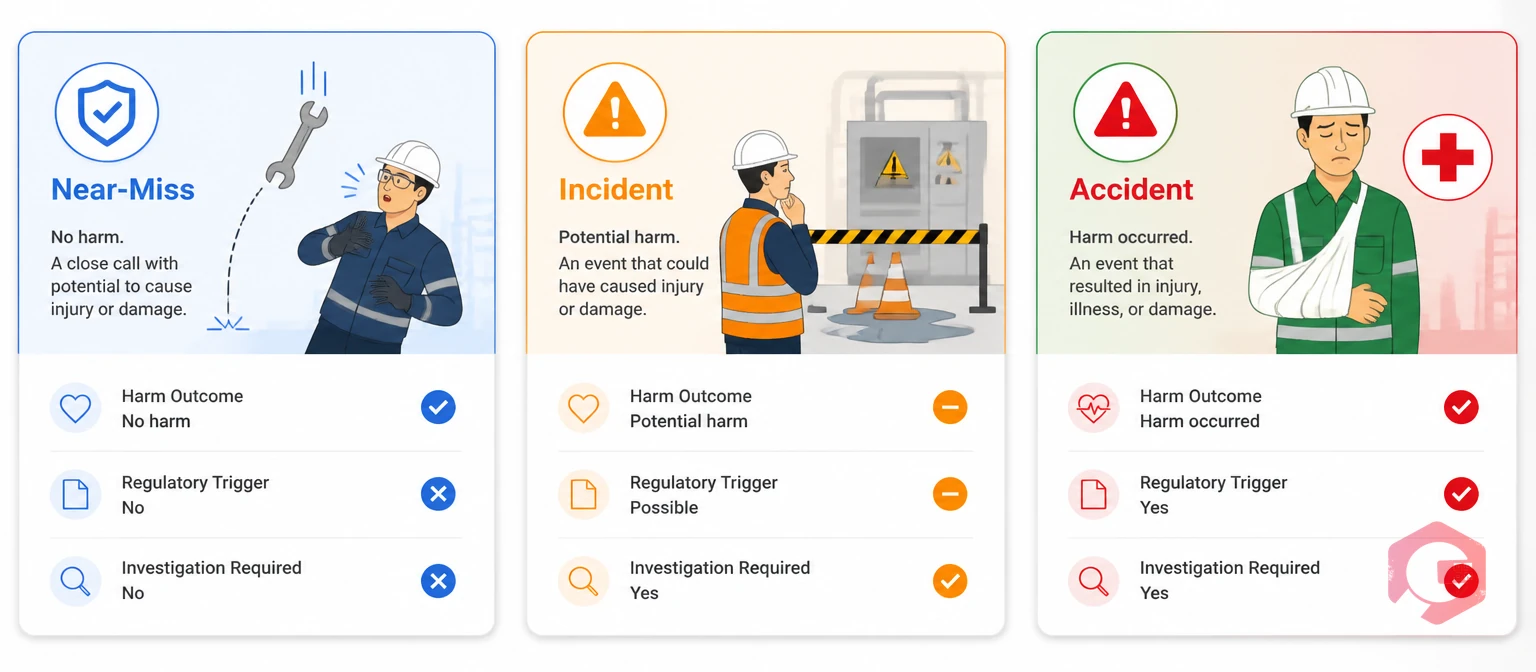
A near-miss is an unplanned event that caused no harm but could have. The critical word is “could.” A falling wrench that lands six inches from a technician is a near-miss. The wrench that hits them is an accident. The difference is luck, not the severity of the hazard.
Many organizations use the terms incident and accident interchangeably, but the distinction carries real consequences in safety management and regulatory compliance.
The 3-Tier Safety Event Classification:
ISO 45001 defines an “incident” broadly as a work-related event that results in, or has the potential to result in, injury and ill health. Under this definition, near-misses are explicitly included as incidents — meaning your OH&S management system must capture and investigate them, not just log and forget them. The ISO 45001 framework treats near-miss investigation as a core element of continual improvement, not an optional extra.
The table below maps the three terms across the dimensions that matter most to maintenance and safety teams: harm outcome, regulatory trigger, investigation requirement, and typical examples from industrial settings.
The most common classification mistake: treating near-misses as non-events because “nothing happened.” OSHA's incident investigation guidance is explicit — near-misses are warning signs of systemic hazards, and investigating them costs a fraction of what a recordable accident costs in downtime, workers' comp, and OSHA penalties.
Under 29 CFR 1904, a work-related injury or illness is OSHA recordable if it results in any of the following: days away from work, restricted work or transfer to another job, medical treatment beyond first aid, loss of consciousness, or diagnosis of a significant injury or illness by a licensed healthcare professional.
Events requiring only first aid — defined specifically as one-time treatment of minor scratches, burns, splinters, or similar conditions — are not OSHA recordable. The key word is “one-time.” If a worker returns to a clinic for follow-up care beyond the initial treatment, the event becomes recordable regardless of injury severity.
Maintenance teams using a work order management system can embed these OSHA thresholds directly into their incident intake forms, automatically flagging cases that meet recording criteria so nothing slips past a 7-day deadline.
Cryotos Permit to Work software builds OSHA-aligned safety check requirements directly into high-risk work authorizations — creating a digital paper trail before, during, and after the job that supports both incident prevention and post-incident investigation.
RIDDOR — the Reporting of Injuries, Diseases and Dangerous Occurrences Regulations 2013 — sets the UK's legal framework for workplace incident reporting. Employers, self-employed workers, and people in control of work premises must report certain types of work-related incidents to the Health and Safety Executive (HSE).
The “dangerous occurrences” category under RIDDOR is essentially a mandatory near-miss reporting requirement for specific high-hazard events. This is an important distinction: while near-misses are generally handled internally, certain categories cross into statutory external reporting territory.
Maintenance teams that log all near-misses digitally — not just the RIDDOR-triggering ones — build a richer hazard picture that supports safety compliance checklists and makes RIDDOR reporting a by-product of their existing workflow rather than an emergency administrative scramble.
Both frameworks share the same underlying logic: the more severe the outcome, the faster you must report. The practical implication for maintenance teams is to have a tiered response protocol embedded in their incident management workflow — not a paper form sitting in a drawer.

Near-miss reporting is the highest-return safety activity available to any maintenance team. For every workplace fatality, Heinrich's Triangle (and its modern equivalents) estimates hundreds of unreported near-misses preceded it. Every near-miss that goes unrecorded is a missed opportunity to break that chain.
Most near-misses go unreported. Maintenance teams working under time pressure often dismiss close calls as normal variation — “that's just how we do things around here.” The problem is systemic, not personal. If near-miss reporting creates paperwork friction, produces no visible follow-up action, or puts the reporter at risk of blame, workers stop reporting. The hazard doesn't go away; it just becomes invisible.
Effective near-miss reporting programs share three characteristics:
Maintenance teams using Cryotos have reported up to 30% reduction in unplanned downtime and 25% faster repair turnaround — partly because near-miss data feeds directly into preventive maintenance schedules, letting teams address hazards before they become recordable events.

Every safety event — near-miss, incident, or accident — deserves a structured investigation proportionate to its severity and potential. The investigation process for a near-miss that almost caused a fatality should be as thorough as for a minor recordable injury, because both carry the same systemic message.
The regulatory compliance checklist in Cryotos maps corrective actions from incident investigations directly to the relevant OSHA, RIDDOR, or ISO 45001 requirement — so audit readiness is a by-product of normal operations, not a quarterly fire drill.

A Computerized Maintenance Management System is the most practical infrastructure for capturing, classifying, and closing out safety events at scale. When near-miss reports, incident notifications, and corrective action work orders all live in the same system, safety data stops being fragmented across paper forms, email threads, and isolated spreadsheets.
Operations that build their safety reporting on a CMMS platform typically achieve three things that paper-based systems cannot:
Cryotos Permit to Work software integrates safety event data with work authorization workflows — so a near-miss on an asset can trigger both a corrective action and a review of the Permit to Work conditions before work continues. This is the practical implementation of the continuous improvement loop that ISO 45001 Section 10.1 requires.
A near-miss is any unplanned event that could have caused harm but didn't — these are handled internally. A dangerous occurrence is a specific category of near-miss defined in Schedule 2 of RIDDOR 2013 that must be reported to HSE even if no one was injured. Examples include scaffold collapse over 5 metres, accidental release of a biological agent, and the failure of closed vessels under pressure. Most near-misses fall into the internal-only category; dangerous occurrences are the exception that crosses into statutory reporting.
No. OSHA does not require employers to report near-misses externally. They are not recorded on the OSHA 300 Log. However, OSHA strongly encourages near-miss investigation as a core element of a safety management system, and failure to investigate near-misses that later result in serious injuries can factor into OSHA penalty assessments. Internal documentation and investigation are both legally prudent and operationally essential.
First aid under 29 CFR 1904.7 is defined as one-time treatment and follow-up observation for minor injuries — things like cleaning wounds, applying bandages, removing splinters, applying non-prescription medication at nonprescription strength, or providing eye patches. If treatment goes beyond this at any point — including a second visit to a medical provider — the event becomes recordable. The distinction between first aid and medical treatment is one of the most frequently misapplied thresholds in OSHA recordkeeping.
Under RIDDOR, work-related deaths must be reported to HSE by the quickest practicable means (typically by phone to the RIDDOR Reporting Line or online) and then confirmed in writing within 10 days. This is distinct from the OSHA requirement, which requires verbal notification within 8 hours. Both frameworks share the principle that fatalities require immediate action, not just documentation.
Under ISO 45001's terminology, yes — because the standard defines an incident broadly to include events where no injury occurs. So a near-miss is a type of incident. In most practical safety management contexts, however, organizations classify near-misses and harm-causing incidents separately for investigation purposes. The important operational point is that every near-miss deserves the same quality of investigation as any recordable incident, since the systemic hazard that caused it is identical.
A structured near-miss and incident reporting system — built into your maintenance workflows rather than bolted on as an afterthought — is what separates facilities that prevent serious accidents from those that simply document them after the fact. Schedule a free demo to see how Cryotos helps maintenance teams capture, classify, and close out every safety event in one connected system.




Cryotos AI predicts failures, automates work orders, and simplifies maintenance—before problems slow you down.