AI-powered digital twins are changing what a virtual model of your equipment can actually do. A basic digital twin shows you what an asset looks like right now. An AI-powered digital twin goes further. It learns from historical and live data. Then it forecasts when that asset is likely to fail. For maintenance teams, that's the difference between a nice visualization and a tool that actually changes when a work order gets created. One shows you a picture. The other tells you what to do about it.
Key Takeaways
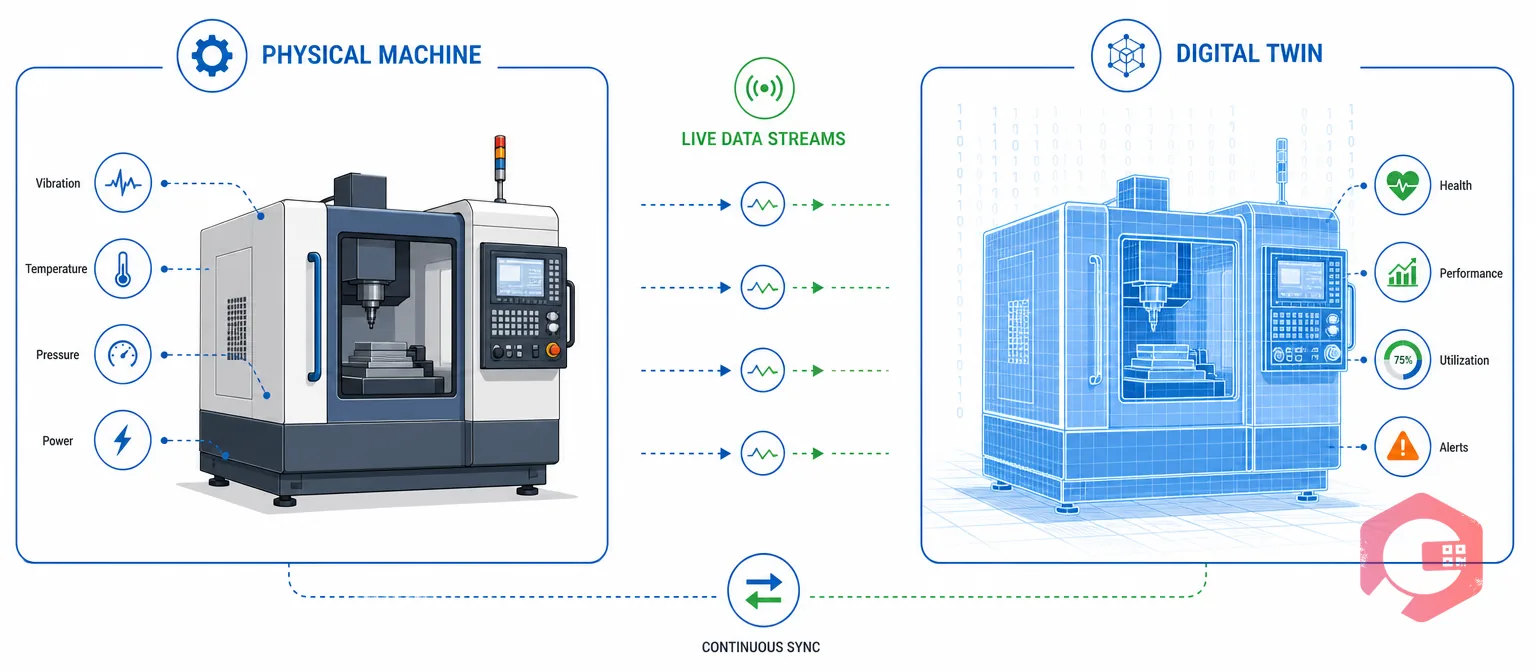
A digital twin is a virtual replica of a physical asset that updates as real data comes in. Sensors on the physical equipment feed the model, so the virtual version reflects current temperature, vibration, or run status instead of a static snapshot from when it was built.
The concept traces back to early NASA and manufacturing engineering work from the early 2000s. For years, most digital twins were used for visualization and simulation. They were useful for design and training. But on their own, they rarely changed a maintenance team's daily decisions.
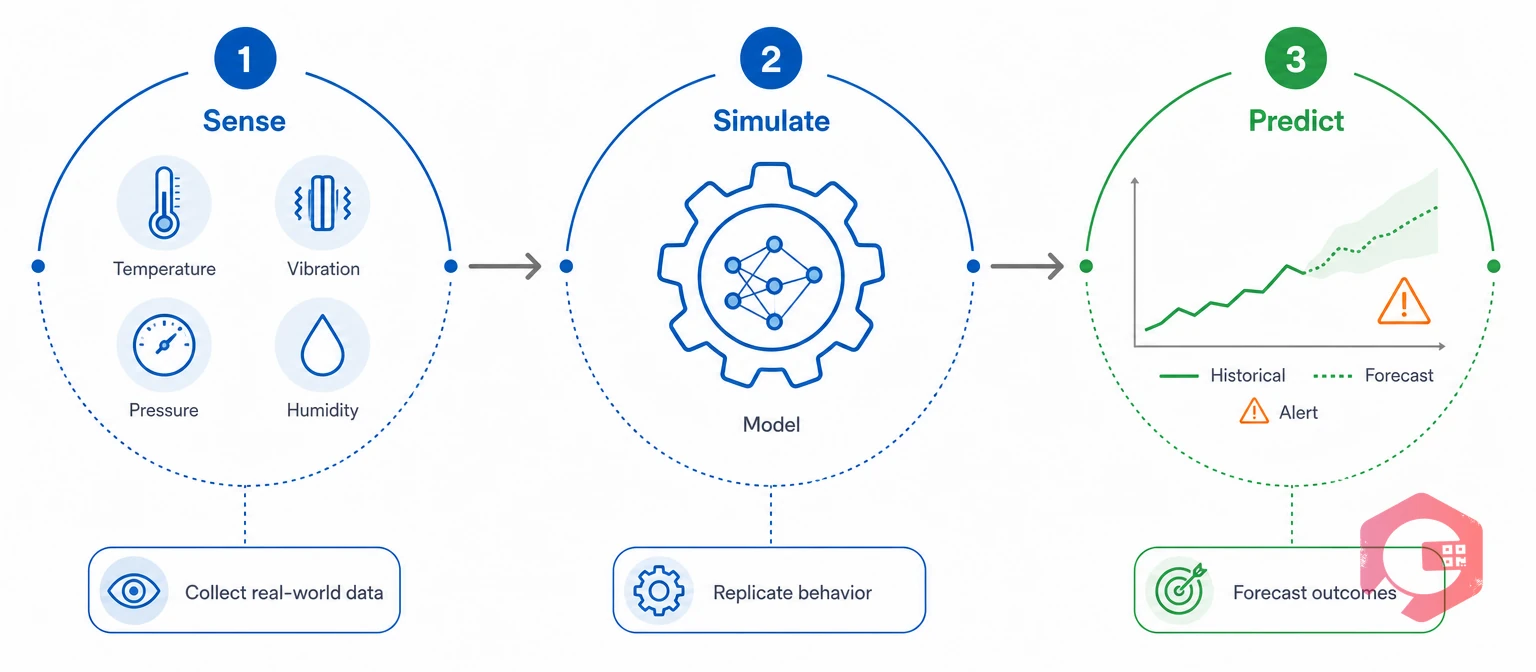
An AI-powered digital twin is a digital twin that uses machine learning to predict failures before they happen. A standard digital twin shows you what's happening now. An AI-powered digital twin uses that same live data. It adds historical failure patterns on top. Together, they answer a different question: what's likely to happen next, and how soon.
The Sense-Simulate-Predict Framework:
That third step is the real shift. A traditional digital twin can show you a temperature spike after it happens. An AI-powered one does more. It can flag that the same spike pattern preceded three past failures. Then it estimates how many days you likely have left before this one fails too.
In a maintenance context, the AI-powered digital twin doesn't replace your CMMS. It feeds it. The twin's prediction becomes the trigger. The CMMS handles what happens after that: scheduling, parts, technician assignment, and documentation.
Cryotos customers using predictive maintenance software connected to condition data have reported up to 30% reduction in unplanned downtime. They also report 25% faster repair turnaround compared to calendar-based PM alone. The twin does the forecasting. The CMMS turns that forecast into an actual work order, assigned to a technician with the right parts already flagged.
This closes a gap that condition monitoring alone often leaves open. A sensor threshold alarm tells you something is already wrong. An AI-powered twin tells you something is trending toward wrong, days or weeks earlier. That extra lead time is often the difference between scheduling a repair during planned downtime and dealing with an emergency stoppage mid-shift.
Not every digital twin does the same job. The table below shows where a traditional, visualization-focused twin stops and an AI-powered one starts.
| Capability | Traditional Digital Twin | AI-Powered Digital Twin |
|---|---|---|
| Primary use | Visualization, design, training | Failure prediction, maintenance triggers |
| Data direction | Shows current or past state | Forecasts future state |
| Improves over time | No, stays as built | Yes, model retrains on new failure data |
| Maintenance action | Manual review by an engineer | Can trigger a work order automatically |
| Setup complexity | Lower — mostly a visual model | Higher — needs historical failure data to train on |
Want to see what unplanned failures are already costing you before adding prediction on top? Try the MTBF calculator to get a baseline first.
Predictive maintenance is maintenance triggered by forecasted failure risk, not a fixed calendar. AI-powered digital twins push that idea one step further than typical predictive maintenance models. Instead of a single sensor threshold triggering an alert, the twin simulates the whole asset and can catch failure modes that no single sensor would flag on its own.
This matters most on complex equipment where multiple systems interact — a compressor with bearings, seals, and a motor all wearing at different rates. A twin can model how those parts interact, not just track each one in isolation. That matters because failures often don't come from one part in isolation. A slightly worn bearing puts extra load on a seal, which then wears faster than it would on its own. A twin that models the whole assembly can catch that chain reaction earlier than sensors watching each part separately.
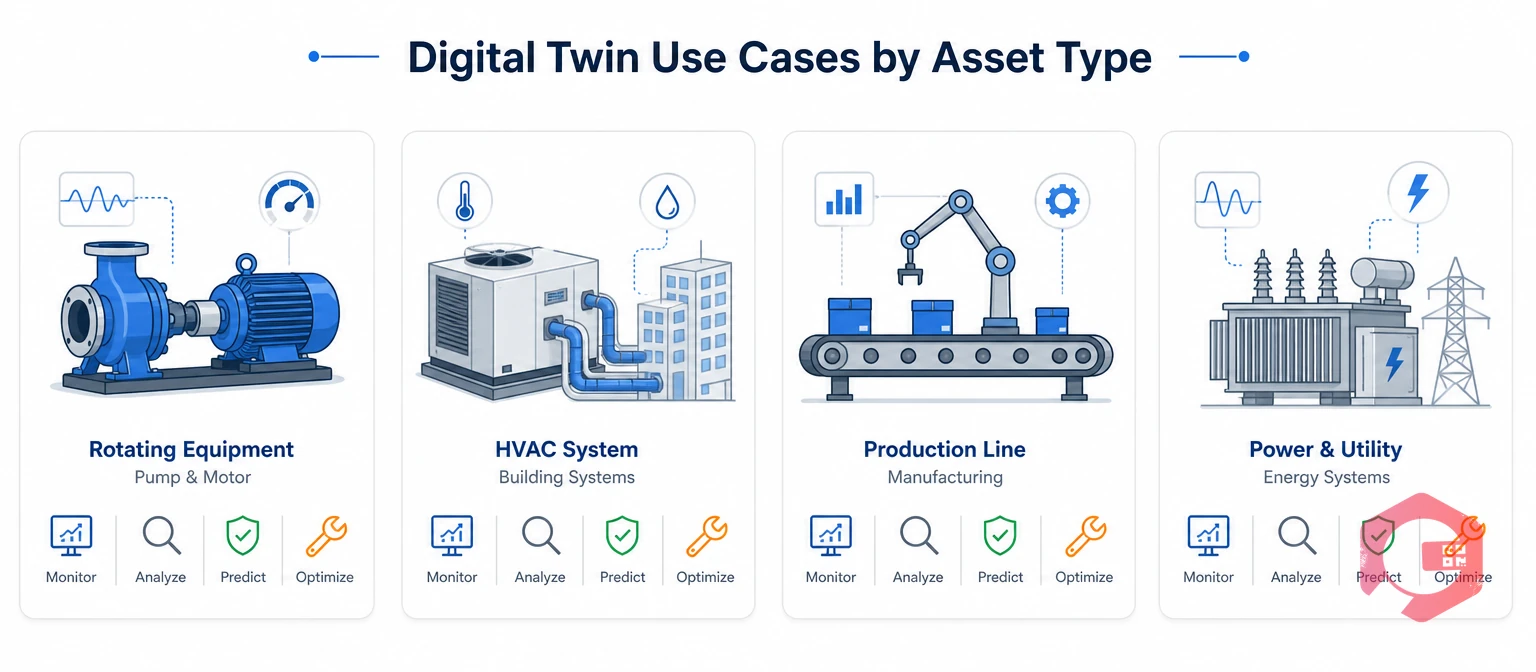
The value of an AI-powered digital twin shows up differently depending on the kind of asset it's modeling. A few common patterns:
An AI-powered digital twin gets oversold as often as it gets underestimated. A few points worth clarifying before you evaluate one for your plant.
An AI-powered digital twin predicts. Cryotos acts on that prediction. When a twin flags rising failure risk, that signal reaches Cryotos through the same predictive maintenance connections used for standard condition monitoring. A work order gets created automatically, with the relevant asset history already attached.
Cryotos's AI-powered knowledge base adds another layer on top: when a technician opens that work order, relevant repair history and troubleshooting steps for that specific failure pattern are already surfaced, instead of requiring a manual search. This lines up with the broader ISO 55000 asset management standard, which treats good data and fast response as core to reliable asset performance, not an add-on.
No. You can run predictive maintenance with sensor thresholds and condition-based maintenance alone, and many facilities do exactly that today. A digital twin adds a layer on top by simulating how the whole asset behaves. That helps most on complex equipment where several failure modes interact and a single threshold alarm won't catch the full picture.
IIoT is the sensor network and connectivity layer that generates and transmits the data. An AI-powered digital twin sits on top of that data, using it to simulate the asset and forecast failure, rather than just displaying live readings.
It needs live sensor data plus enough historical failure data to train the prediction model on. Assets with a documented failure history, even a small one, produce more accurate predictions than brand-new installations with no track record yet.
No, but scale does affect where it pays off fastest. Facilities of any size can benefit, though the clearest early wins tend to be on a handful of high-cost or safety-critical assets, not a plant-wide rollout on day one. A smaller facility with one critical compressor can get real value from a single well-built twin, without needing a plant-wide program.
No. The twin predicts; the CMMS executes. Predictions still need to become scheduled work, assigned technicians, tracked parts, and documented repairs, which is what a CMMS like Cryotos handles once the twin raises a flag.
AI-powered digital twins don't replace good maintenance practice — they give it a longer runway before a failure becomes an emergency. Schedule a free demo to see how Cryotos turns predictive signals into completed work orders.
Cryotos AI predicts failures, automates work orders, and simplifies maintenance—before problems slow you down.