Predictive maintenance algorithms are machine learning models that turn sensor data into an early warning before equipment fails. Instead of waiting for a scheduled inspection, these models score each asset in near real time. They flag the ones trending toward failure. A refinery might use one model to estimate how many days a pump has left. A food plant might use another to catch a conveyor bearing before it seizes. The details vary by industry, but AI predictive maintenance algorithms fall into a few well-understood types. This guide breaks down what those types are, how they differ from threshold-based maintenance, and what a team needs before rolling one out.
Key Takeaways
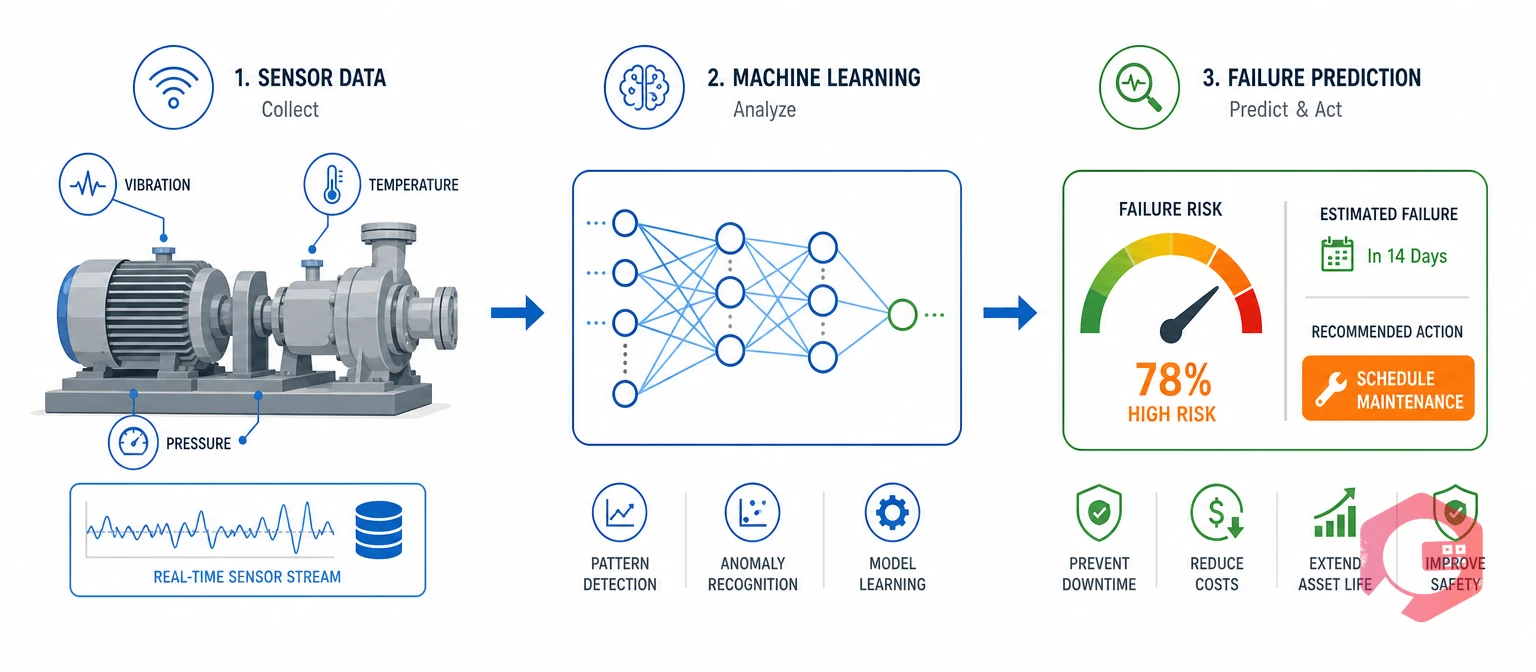
Predictive maintenance algorithms are machine learning models trained on past sensor readings and failure records. They forecast when a specific asset is likely to break down. Instead of a fixed maintenance calendar for every pump or motor, the model looks at real data — vibration, temperature, current draw, run-hours. It calculates a failure risk or a countdown.
Most facilities already run some condition monitoring. They check a value against a fixed limit. What makes an approach AI-driven is that the model learns how several signals relate to failure, instead of watching one line get crossed. A bearing might run a little hot and a little loud for weeks before it fails. A single-limit rule can miss that mix, but a trained model can catch it. This same logic sits behind reliability-centered maintenance (RCM), which matches maintenance effort to real failure risk instead of a fixed calendar.
Most rollouts start with a working condition-based maintenance program, run inside a Computerized Maintenance Management System (CMMS). AI predictive maintenance algorithms use that same sensor data. They add a statistical layer that turns raw readings into a usable forecast. For background on the wider field, see Wikipedia's overview of predictive maintenance.
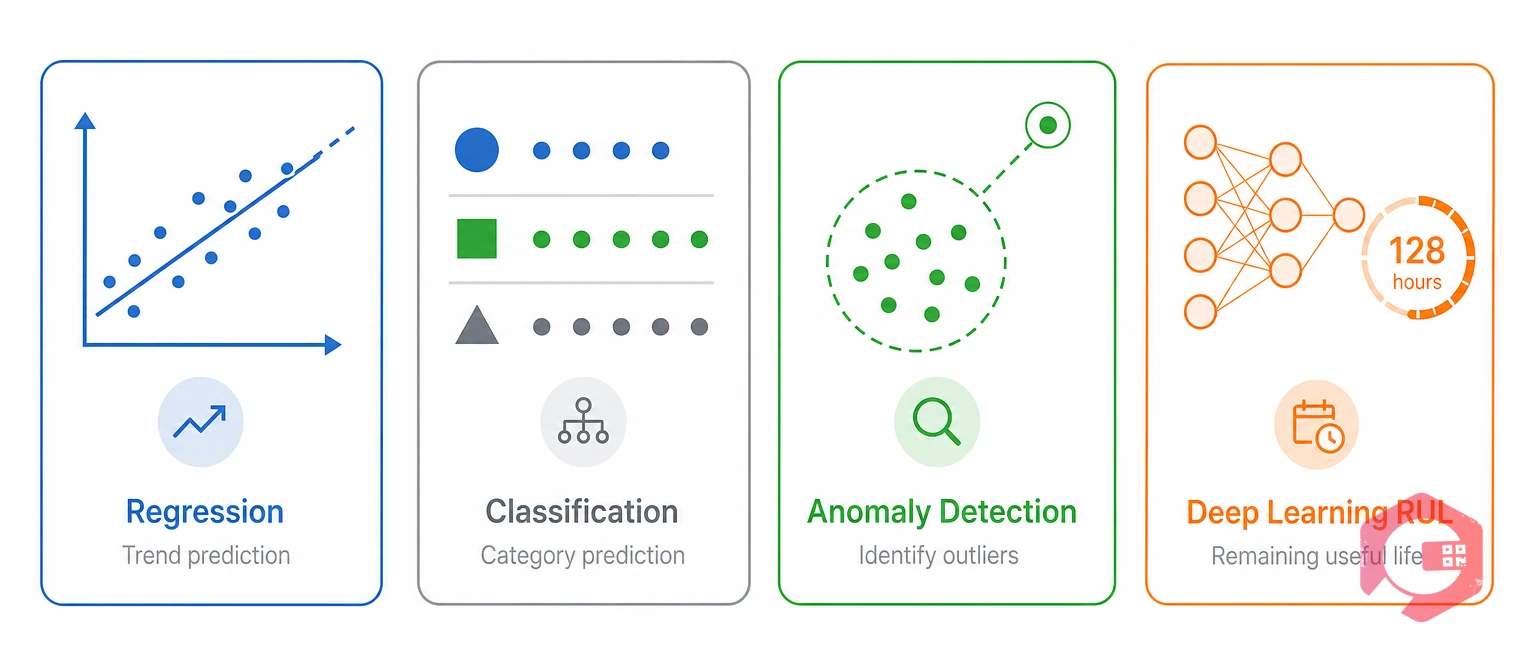
Most AI predictive maintenance programs run on four types of algorithms, not dozens. Each one answers a different question about asset health. Mature programs usually combine two or three of them instead of picking just one.
The Four-Model AI Stack for Predictive Maintenance:
A regression model is a machine learning algorithm that predicts a continuous number, such as days until failure, from historical sensor trends. An anomaly detection model is an unsupervised algorithm that flags unusual sensor patterns without needing labeled failure examples. That makes it a good starting point for assets with little failure history. Remaining useful life, or RUL, is the estimated number of operating hours or cycles an asset has left before it fails. RUL models need the most data of the four, so most teams add them last, once failure history builds up. Anomaly detection is common in IIoT setups, where sensors are cheap to install, but failure labels stay rare. All four are standard uses of machine learning on time-series data, not something built from scratch for one industry.
| Algorithm Type | Predicts | Data Required | Best Use Case |
|---|---|---|---|
| Regression | Time-to-failure or wear rate | Sensor history plus past failure dates | Assets with known wear patterns (belts, filters) |
| Classification | Current health category | Labeled examples of normal vs. failed states | Assets with clear failure records |
| Anomaly Detection | Deviation from normal behavior | Baseline sensor data, no failure labels needed | New assets or ones with little failure history |
| Deep Learning / RUL | Remaining useful life | Large volumes of time-series plus failure history | Complex, high-value rotating equipment |
Picking the wrong model for the data on hand is the most common reason a pilot stalls before it delivers a result.
Most of these models need a steady sensor feed, not one-off manual readings. The IoT and meter reading feature is usually where that data pipeline starts.
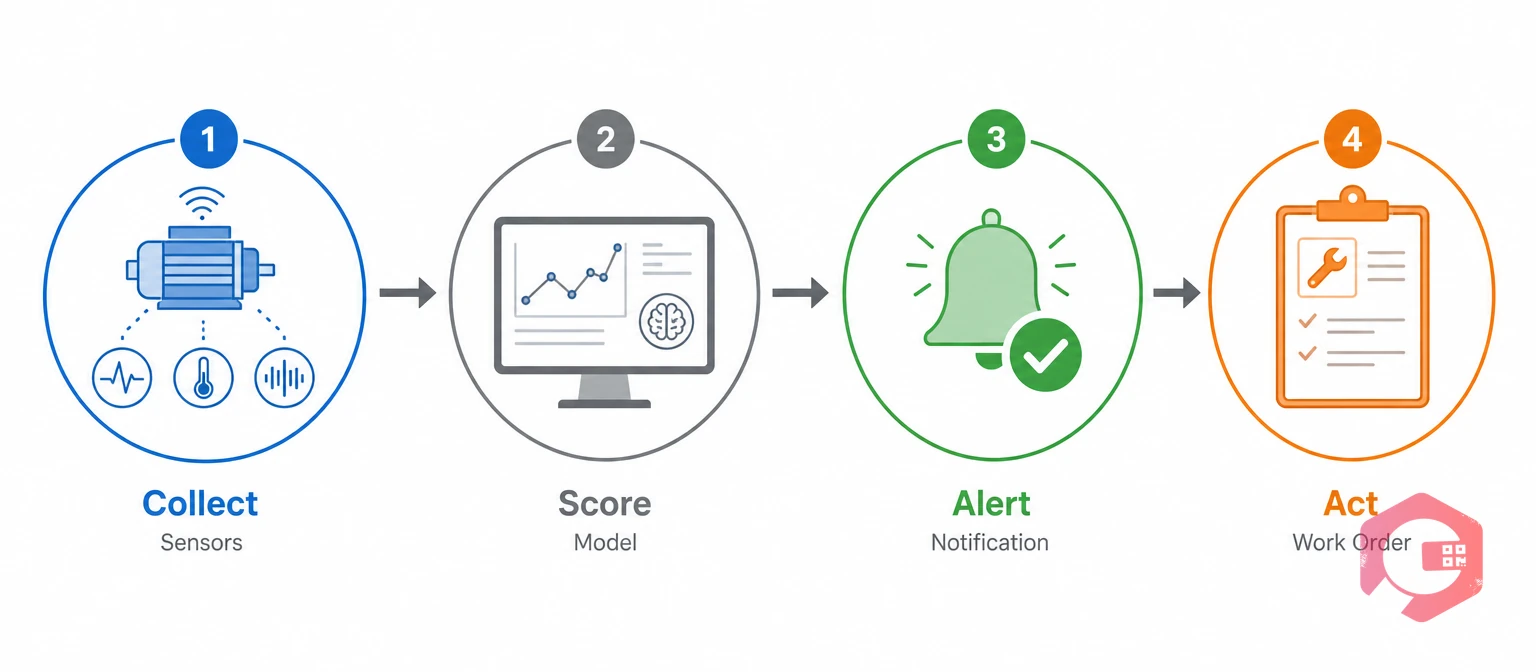
An AI predictive maintenance program runs on a simple loop: collect data, score it, and turn the score into a work order. The algorithm only adds value at the middle step. The collection and action steps still depend on the maintenance process a team already runs.
Teams that skip the "Act" step end up with an accurate model and no real downtime drop to show for it. The algorithm called the failure correctly, but nobody turned that call into a scheduled repair in time.
Traditional predictive maintenance flags a problem once one reading crosses a fixed limit. AI-driven predictive maintenance learns how several readings relate, and can predict a failure before any single limit gets crossed. Both approaches use the same condition monitoring sensors. The difference is in how the data gets read.
| Aspect | Traditional PdM | AI-Driven PdM |
|---|---|---|
| Trigger logic | Single-variable limit (e.g., vibration above 7 mm/s) | Pattern across several variables, learned from history |
| Data needed | One sensor reading per rule | Historical sensor and failure data to train the model |
| Early detection | Catches faults once a clear signal shows up | Can catch faults through combined patterns, earlier |
| Setup effort | Fast to set up, little data needed | Needs a data collection and training period first |
| Best fit | Simple assets with known failure signs | Complex or high-value assets with enough failure history |
Neither approach replaces the other. Most facilities that use AI models keep the old threshold rules running underneath as a backup. A model can still miss a fault type it has never seen before.
The main payoff from AI predictive maintenance comes from catching failures early enough to plan a repair, instead of reacting to a breakdown. That shift shows up in three places: less unplanned downtime, lower emergency repair costs, and longer asset life.
Maintenance teams using Cryotos have reported up to 30% reduction in unplanned downtime and 25% faster repair turnaround, after connecting AI-driven alerts to automated work orders. Most facilities see the clearest gains on the assets that already cause the most stops. A handful of pumps, compressors, or conveyors usually account for most downtime hours in a plant.
Benchmarks from SMRP and the ISO 55000 asset management standard point to the same pattern. Effort spent on the highest-risk assets returns the most value. AI predictive maintenance algorithms work best when pointed at that short list first, not rolled out everywhere at once.
Most AI predictive maintenance projects stall on data problems, not algorithm problems. A model is only as good as the sensor and failure history it learns from. Most facilities need more data cleanup than they expect before predictive maintenance algorithms earn their keep.
Logging what each false alarm turned out to be feeds an AI-powered knowledge base, which helps tune the next round of limits. Some advanced teams pair RUL models with a digital twin of the asset, to test predictions in simulation before trusting them live. Most teams that get past these issues start with one or two high-risk assets, prove the model works, then expand once the pipeline and limits are dialed in.
It trains a model on past sensor readings paired with past failure dates. It then applies that pattern to current readings. The model outputs a failure risk, a health category, or a countdown, depending on the algorithm type.
At minimum, you need steady sensor or meter readings and a record of past failures or repairs. Anomaly detection can start with just baseline sensor data. Classification and RUL models need labeled failure history to train on.
Condition-based maintenance triggers a task when a reading crosses a set limit. AI predictive maintenance uses the same sensor data but learns patterns across several variables, so it can flag a fault before any single reading looks off on its own.
Yes. Most modern CMMS and IoT platforms handle model training in the background. The team's main job is to keep sensor data consistent and decide which assets and failure types matter most.
Cost depends on sensor hardware, how many assets you cover, and whether you're adding AI to an existing CMMS or building a new program. A small pilot on your highest-downtime assets keeps the first cost low before you expand.
Getting from raw sensor data to a reliable prediction takes the right pipeline as much as the right algorithm. Schedule a free demo to see how Cryotos connects IoT sensor data, AI-driven alerts, and automated work orders in one system.

Cryotos AI predicts failures, automates work orders, and simplifies maintenance—before problems slow you down.