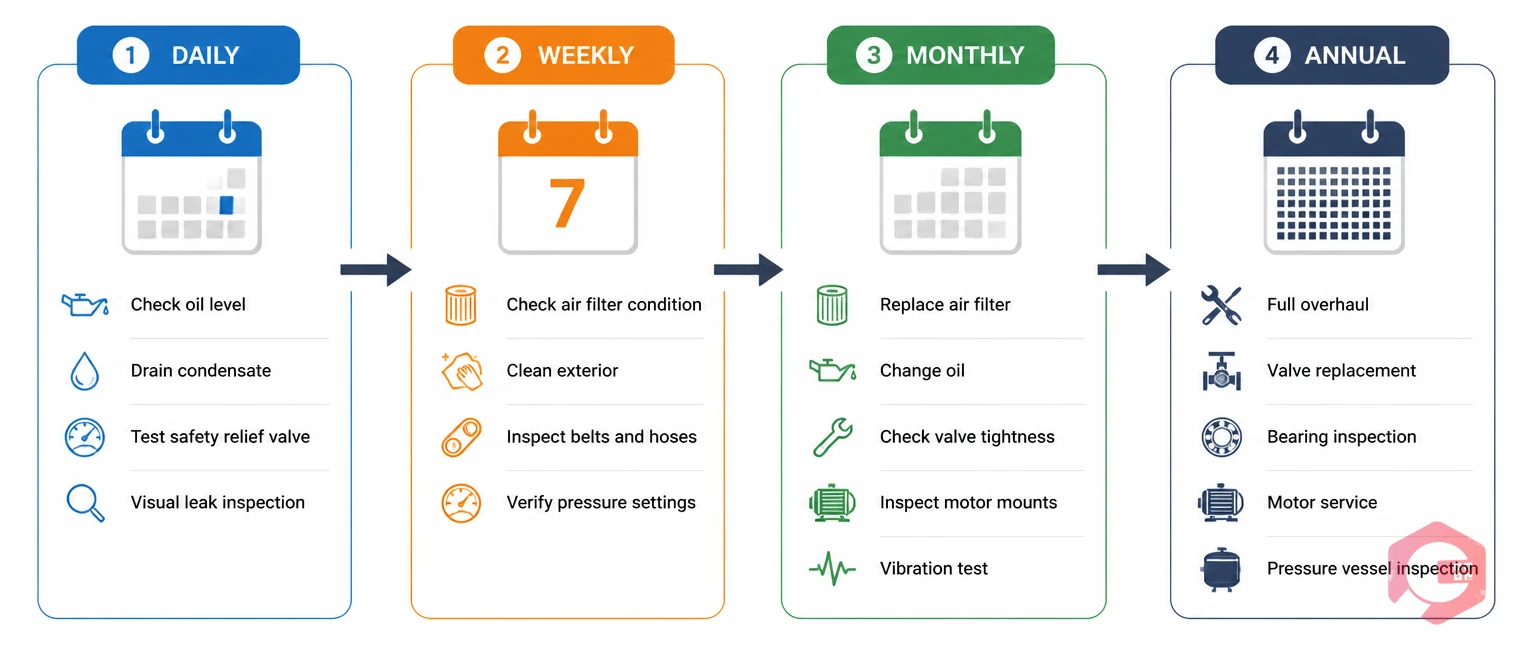
An air compressor maintenance checklist is a structured set of operator and technician tasks — performed daily, weekly, monthly, and annually — that prevents unplanned failures, cuts energy waste, and extends compressor life by up to 40%. Compressed air systems account for 10–30% of total electricity use in most industrial facilities, and U.S. Department of Energy research shows that up to 30% of that energy is lost through leaks, contaminated filters, and under-maintained components.
This guide gives you a complete, frequency-based checklist covering every major compressor type — reciprocating, rotary screw, centrifugal, and oil-free — along with a full troubleshooting table, safety protocols, and a section on how a preventive maintenance system can automate every task so nothing is missed between shifts.
Why Air Compressor Maintenance Prevents Costly Failures
The Real Cost of Compressor Neglect
A single unplanned compressor failure can halt an entire production line, shut down pneumatic tooling across a facility, and trigger emergency repair costs that run 3–9 times higher than a planned service. The numbers are stark: a 1/4-inch air leak wastes approximately $2,500 per year in energy alone. A facility with five compressors running degraded separators, clogged inlet filters, and worn belts simultaneously can easily bleed $50,000–$100,000 in excess energy and reactive maintenance costs annually.
Beyond the direct financial hit, neglected compressors create safety risks. Receiver tanks corroded by undrained condensate can fail under pressure. Overheated compressors with blocked coolers and low oil trip thermal shutdowns at the worst possible times. Relief valves that haven't been tested in years may not open when they need to.
What Maintenance Lapses Actually Look Like
Most compressor failures don't happen suddenly — they develop through a chain of skipped checks. An operator misses three consecutive daily condensate drains. The auto-drain sticks closed. Water floods the receiver. Corrosion begins on the tank walls. Six months later, a pressure test reveals a wall thickness failure that requires the vessel to be taken out of service. The repair bill? Far higher than the 10-minute daily check would have cost across those six months.
A structured checklist breaks that chain at the first link. It assigns accountability, creates a written record for audits, and gives your maintenance team the prompts they need to catch degradation early.
Air Compressor Maintenance Frequency Overview
Before diving into each checklist, here's how the four maintenance frequencies stack up — who performs each, what the focus is, and what's at risk if skipped.
Frequency
Primary Focus
Time Required
Who Performs
Risk if Skipped
Daily
Pressure, oil, condensate, noise, run hours
5–10 minutes
Operator / shift lead
Water contamination, overheating, undetected leaks
Daily checks are operator-level tasks that take under 10 minutes per compressor. They catch the most common failure triggers before they escalate. Log every check in your digital maintenance checklist — a paper log filled in from memory at shift end doesn't give you the audit trail you need.
Check system operating pressure: Verify the gauge matches the set point. A drop of more than 5 PSI under stable load is the first sign of a developing leak or regulator fault — flag it immediately, don't wait for the next shift.
Inspect oil level (lubricated units): Read the sight glass with the compressor at rest. Top up only with the OEM-specified grade if the level is below the minimum mark. Never mix oil brands or grades — cross-contamination is the leading cause of separator fouling.
Drain condensate from all tanks and traps: Water accumulation in the receiver tank corrodes walls and contaminates downstream air. If you have manual drains, open them every shift. If you have auto-drains, verify they've cycled — a blocked auto-drain is invisible until the tank fills.
Listen for unusual noise or vibration: Walk around the compressor during operation. Knocking, rattling, a higher-pitched running tone, or new vibration through the floor are early warnings of valve wear, bearing degradation, or a loose mounting. Record any changes — even if minor.
Check cooler airflow paths: Inspect that no material, debris, or stored items are blocking the inlet or exhaust airflow around the compressor enclosure. Blocked cooling is the single most common cause of thermal shutdown trips.
Verify safety relief valves are clear: Confirm that no object is resting against, tied to, or obstructing the relief valve. It takes seconds and matters every time.
Record the run hour meter: Log today's reading. Run hours drive every usage-based PM trigger. If your CMMS isn't pulling this automatically via IoT, a written log is your fallback.
Weekly Air Compressor Maintenance Checklist
Weekly tasks go deeper into mechanical and electrical systems. Do them at the same day and time each week — consistency builds the habit and makes anomalies easier to spot. A technician who checks belt tension every Monday at 7am will notice a change within a day of it developing.
Inspect and clean air inlet filters: A choked inlet filter forces the compressor to work harder, run hotter, and consume more energy. Check the differential pressure indicator if fitted — if pressure drop exceeds the manufacturer's limit, clean or replace the element regardless of how many days since the last service.
Check belt tension and condition (belt-drive units): Apply moderate thumb pressure between pulleys — deflection should be approximately 1/2 inch. A belt that's too tight overloads bearings; too loose and it slips, heats, and glazes. Cracked, frayed, or oil-contaminated belts get replaced immediately, not at the next scheduled service.
Soap-test all fittings, joints, and connections: Apply a soapy water solution or use an ultrasonic leak detector on all pipe joints, couplings, and valve connections. Bubbles confirm an air leak. Even a pinhole at 100 PSI can waste several hundred dollars in energy per year. Log every leak found and track it to resolution.
Functionally test condensate drain valves: Manually trigger the auto-drain to confirm it opens fully, discharges condensate, and reseats cleanly without dripping. A drain valve stuck closed will fill the receiver tank with water within days. A drain stuck open vents pressurised air continuously — also a loss.
Check motor amperage draw: With a clamp meter, compare actual current draw to the motor nameplate FLA. If the reading is more than 10% above nameplate, investigate immediately — the likely causes are a contaminated oil system, a failing inlet valve, an undersized compressor for current demand, or high ambient temperature around the unit.
Test unloader valve function: The unloader should allow the compressor to start against atmospheric pressure. If you hear the motor straining at startup or see the thermal overload tripping, the unloader is not opening correctly.
Check oil condition visually: Pull a small sample and check colour. Milky oil means water contamination (change it immediately). Very dark, thick oil means overheating (change it immediately and find the cause). Healthy oil is clear amber to light brown.
Monthly Air Compressor Maintenance Checklist
Monthly tasks require scheduled downtime of 45–60 minutes per unit and cover the components that degrade gradually — often invisibly until they trigger a serious fault. These are mechanical inspections that can't be rushed.
Replace or thoroughly clean air inlet filter elements: If disposable, replace. If reusable, wash with warm soapy water, rinse completely, and allow full drying before reinstalling. Never reinstall a wet filter — it restricts airflow and can cause condensation inside the intake.
Manually test safety and relief valves: Lift the test ring while the system is pressurised (follow your LOTO procedure for partial isolation). The valve must open cleanly and reseat fully. A valve that opens but doesn't reseat — or won't open at all — must be replaced before the unit returns to service.
Inspect all electrical connections and terminal blocks: Turn off and lock out power. Inspect the main power terminals, motor junction box, and control panel for loose connections, discolouration (indicating heat), corrosion, or insulation damage. Vibration loosens terminals over months — a loose motor terminal that arcs can cause a motor winding failure.
Clean motor cooling fins and verify fan integrity: Dust and airborne fibres pack the cooling fins over time. Use compressed air to clean them. Inspect the cooling fan blades for cracks or damage. A motor running 10°C hotter than normal loses years of winding life.
Torque check all mounting hardware and isolation mounts: Compressors generate significant vibration. Check all anchor bolts against spec torque values. Inspect anti-vibration mounts for cracking, compression-set, or deterioration. A compressor that transmits vibration into its pipework will crack fittings and joints over time.
Calibrate pressure gauges against a reference: Compare each gauge reading to a calibrated test gauge in-line. A faulty gauge that reads 10 PSI high causes the compressor to run at lower actual pressure than intended — and a gauge that reads low causes over-pressure. Both conditions accelerate wear.
Reconcile run hours against the PM schedule: Compare the actual hour meter reading to your scheduled PM thresholds. If production has increased, your calendar-based service dates may already be overdue by run hours. Adjust the next service date accordingly.
Annual Air Compressor Service Checklist
The annual service is a full maintenance overhaul — typically 4–8 hours of downtime per compressor — and should be scheduled during a planned production break. It resets the compressor to near-new condition for the next year of operation. Use this window to action any OEM service bulletins or recall notifications received during the year.
Complete oil and oil filter change: Drain all lubricating oil while the compressor is warm — it flows cleaner and carries more contaminants out with it. Replace the oil filter at the same time, every time. Refill with only the OEM-specified grade and volume. Overfilling causes oil carryover just as much as underfilling.
Replace the air/oil separator element: This is the single most important annual replacement on a rotary screw compressor. A degraded separator passes oil downstream into your compressed air system, contaminating tools, spray equipment, and pneumatic controls. Replace it on schedule regardless of whether oil carryover is visible yet.
Service the inlet valve and unloader assembly: Disassemble, inspect, and clean the inlet valve body and poppet. Replace the valve seat and springs if any wear, pitting, or deformation is visible. A sticking inlet valve causes high starting current, motor tripping, and premature start/stop cycling that wears out the motor contactors.
Replace all drive belts (belt-drive compressors): Replace all belts as a set annually on any compressor running more than 1,500 hours per year — even if they look acceptable. A belt failure under full load can damage pulleys, throw the compressor out of alignment, and cause an unplanned shutdown during critical production.
Inspect discharge and suction valves (reciprocating compressors): Remove valve assemblies and inspect valve plates, springs, and seats. Replace any component showing pitting, carbon deposits, or mechanical wear. A worn discharge valve that leaks back costs 5–15% in compressor efficiency and accelerates heat build-up in the cylinder.
Clean cooler cores internally and externally: Blow compressed air backwards through external cooling fins to remove scale and dust. Where access allows, chemical flush internal oil cooler and aftercooler passages with a descaling solution to remove mineral deposits.
Service the cooling system (water-cooled units): Test antifreeze concentration and pH. Check inhibitor levels against OEM specification. Inspect all hoses, clamps, and heat exchangers for deterioration. Flush and recharge the coolant circuit per the manufacturer's schedule.
Conduct vibration analysis on all bearings: Use a vibration analyser or engage a specialist to measure and record vibration signatures on motor and compressor bearings. Compare against the previous year's baseline. A rising vibration signature provides weeks of warning before failure — this data is only useful if you track the trend year over year.
Functionally test all safety shutdown systems: Test the high-temperature cutout, the high-pressure cutout, and the low-oil-pressure shutdown if fitted. These systems must operate — if any fail the test, the unit is grounded until the fault is resolved.
Update the full asset record: Document all parts replaced (with part numbers and quantities), oil volumes used, pressure readings, vibration baselines, and any anomalies found. Update the next annual service date in your asset tracking system.
Air Compressor Maintenance by Compressor Type
Not all compressors need the same maintenance schedule. The table below maps each major compressor type to its specific service requirements so you can tailor your checklist rather than apply a generic one across your entire fleet.
Type
Key Maintenance Focus
Oil Change Interval
Critical Annual Task
Main Failure Risk
Reciprocating (Piston)
Valve plates, piston rings, belt tension, cylinder head bolts
Air filter changes, cooling system, shaft seal integrity, PTFE tip wear
N/A — no oil lubrication circuit
Seal and tip wear inspection
Seal degradation, overheating, bearing failure without lubrication buffer
Air Compressor Troubleshooting Guide
When a symptom appears during a routine check or an operator reports a fault, use the table below to identify the most likely cause, take the right immediate action, and implement the preventive fix that stops the same fault recurring. Use this alongside your root cause analysis workflow for repeat failures.
Symptom
Most Likely Cause
Immediate Action
Preventive Fix
Won't reach set pressure
System air leaks, worn piston rings, faulty inlet valve, demand exceeds capacity
Isolate and leak-test the distribution system; check inlet valve operation
Shut down; inspect mounts, belts, and coupling alignment
Monthly mounting torque check; annual belt change; vibration analysis
Compressor short-cycling
Leaking check valve, faulty pressure switch, receiver tank too small for demand profile
Test check valve — replace if leaking back; verify pressure switch setpoints
Annual check valve inspection; capacity review if demand has grown
Air Compressor Maintenance Safety Protocols
Compressed air systems store significant potential energy and present real hazards to anyone working on them. Every task in this checklist — from a daily drain check to a full annual overhaul — must be performed in compliance with your facility's Lockout/Tagout (LOTO) procedure and applicable OSHA standards for compressed gas and equipment.
Full energy isolation before opening: Disconnect and lock out the main electrical supply. Bleed the system to atmospheric pressure. Verify zero energy state with a gauge before removing any cover, guard, or fitting. Never assume a system is de-energised — verify it.
Depressurise before any fitting work: Even a fitting that appears to be downstream of an isolation valve can hold trapped pressure. Open the drain or bleed valve and confirm zero pressure on a local gauge before loosening any connection.
Correct PPE for every task: Safety glasses and hearing protection are the minimum for all compressor work. Add a face shield for pressurised system checks, chemical-resistant gloves for oil changes, and heat-resistant gloves when working near hot surfaces.
Hot surface awareness: Discharge lines, compressor heads, oil coolers, and aftercoolers can exceed 150–200°C during and immediately after operation. Allow a minimum 30-minute cool-down before contact with these components.
Never point compressed air at people: Compressed air at any industrial pressure can cause fatal air embolism if directed at the skin or face. It is not a cleaning tool for personnel or clothing under any circumstances.
Document safety steps in the work order: A CMMS that embeds LOTO steps directly into the work order checklist ensures technicians complete every isolation step and sign off before work begins — creating a timestamped compliance record automatically.
How to Automate Air Compressor Maintenance with a CMMS
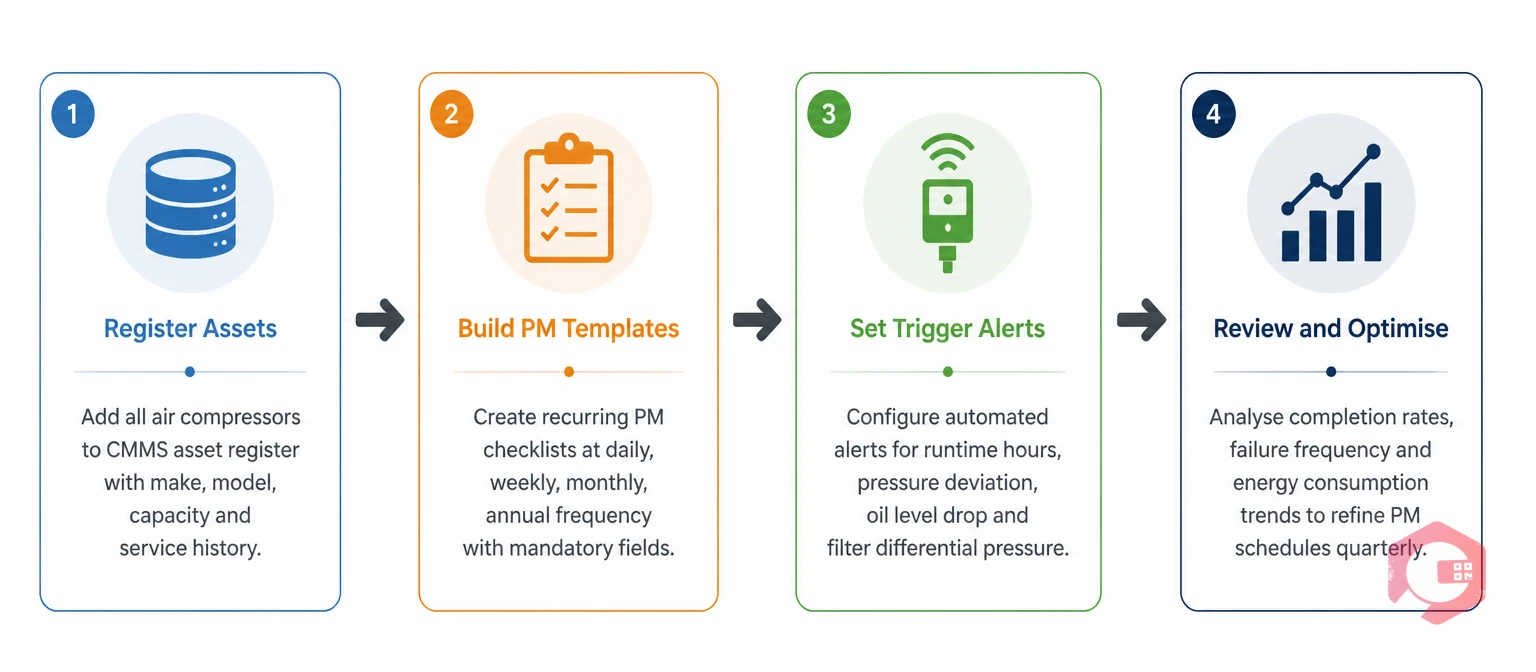
A paper-based checklist gets skipped, filled in retrospectively, or lost. A whiteboard PM schedule doesn't alert anyone, doesn't record who did what, and doesn't connect to inventory. A CMMS replaces all of that with a system that generates the right task at the right time, assigns it to the right person, and records every result automatically.
For air compressor fleets specifically, here's what CMMS automation delivers that manual processes can't:
Run-hour triggered PM: Instead of servicing by calendar date, Cryotos generates work orders when a compressor crosses 250, 500, 2,000, or any custom run-hour threshold — read automatically via an IoT connection to the hour meter or entered manually by operators during daily checks. A compressor running extra shifts gets serviced at the right interval, not an arbitrary date.
Condition-based alerts via IoT: Connect temperature sensors, pressure transmitters, and vibration monitors to the IoT meter reading module. When discharge temperature exceeds 90°C or differential pressure across the separator passes 0.8 bar, the system creates a work order automatically — before the shutdown occurs.
Inventory tied to PM tasks: Every annual service work order in Cryotos carries a pre-built parts list — separator element, oil filter, oil volume, belts. The spare parts inventory module checks stock when the work order is generated and alerts your team if a critical item is below minimum before the service date arrives, not on the morning of.
Mobile checklist execution: Technicians complete daily, weekly, and monthly checklists on the Cryotos mobile app directly at the compressor — with mandatory fields, photo attachments, and digital sign-off. No paper, no retrospective filling, no missing data.
Compliance documentation on demand: Every completed checklist is timestamped, user-attributed, and stored against the compressor's asset record. When an insurer, auditor, or OEM asks for the last 12 months of maintenance records, you generate the report in minutes.
Teams using Cryotos report a 30% reduction in unplanned downtime and 25% faster repair times. The BI Dashboard gives maintenance managers a live view of compressor availability, overdue PM tasks by site or unit, and the assets contributing most to downtime — so capital replacement decisions are driven by data rather than instinct.
Frequently Asked Questions
How often should an air compressor be serviced?
At a minimum: daily operator checks (oil, pressure, condensate drain), weekly technician inspections (filters, belts, drain valves), monthly safety and electrical checks, and a full annual service including oil change, separator replacement, and valve inspection. High-utilisation compressors running more than 2,000 hours per year should follow run-hour intervals rather than calendar dates — a compressor running double shifts may need its annual service at six months.
What is included in an annual air compressor service?
A complete annual service covers: full oil and oil filter change, air/oil separator replacement (rotary screw units), inlet valve and unloader service, drive belt replacement (belt-drive units), internal and external cooler cleaning, safety shutdown system function tests, vibration analysis on motor and compressor bearings, and a full update of the asset record with all parts replaced.
How do I check for air leaks in a compressor system?
The most accurate method is an ultrasonic leak detector, which picks up the high-frequency sound of pressurised air escaping through joints and fittings. A cost-effective alternative is soapy water applied with a brush around all fittings and connections while the system is pressurised — bubbles indicate a leak. You can also estimate total system leakage by recording pressure drop per minute with all demand isolated. A drop of more than 2–3 PSI per minute on a properly sized receiver tank indicates significant leakage.
What happens if you don't drain an air compressor regularly?
Undrained condensate accumulates in the receiver tank and wet lines. Over time, this causes internal tank corrosion that reduces wall thickness, ultimately leading to a pressure vessel failure risk. It also saturates downstream air, causing corrosion in pneumatic tools, contaminating spray finishes, and degrading air-powered control systems. A tank that hasn't been drained consistently for years may require hydrostat testing before it can be returned to service.
What causes an air compressor to overheat?
The four most common causes in order of frequency: blocked or fouled cooler fins (most common), low oil level reducing both lubrication and heat transfer, inadequate ventilation in the compressor room allowing ambient temperature to rise, and a failed thermal bypass valve allowing hot oil to recirculate without passing through the cooler. Check these in order when investigating any high-temperature shutdown before assuming a more serious fault.
Can a CMMS manage air compressor PM schedules automatically?
Yes. A CMMS generates daily, weekly, monthly, and annual work orders automatically based on calendar intervals, run hours, or sensor readings. For air compressors specifically, run-hour triggers are far more accurate than calendar dates because compressor usage is rarely uniform. The Cryotos preventive maintenance module supports both static (calendar) and dynamic (usage-based) PM scheduling, with whichever-comes-first logic so a compressor that runs extra shifts is serviced at the correct interval automatically.
If your team is managing compressor maintenance on paper forms or shared spreadsheets, every missed check and every undocumented inspection is a liability — in unplanned downtime, in energy cost, and in audit risk. Cryotos CMMS gives you the tools to build a fully documented, automated maintenance program for your entire compressor fleet — from daily drain checks to annual separator replacements — with the compliance records to prove it. Book a free demo to see how it works in a facility like yours.