
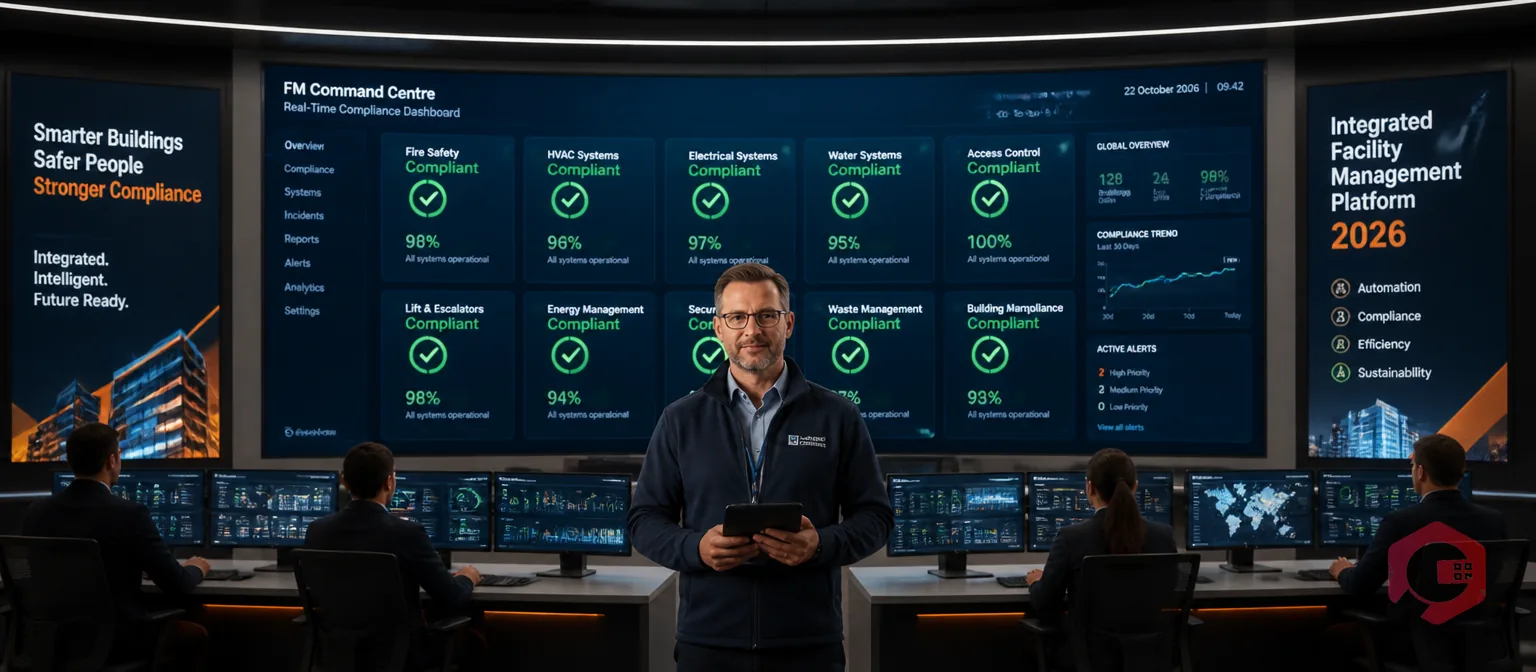
Always-on compliance in facility management means every inspection, maintenance task, permit, and regulatory requirement is tracked, documented, and actioned in real time — not reviewed once a quarter when an audit arrives. For facility teams in 2026, this shift from periodic compliance checks to a continuous, automated compliance posture is no longer optional. New ESG reporting mandates, tightening ISO 55001 requirements, and increased regulatory scrutiny across building codes and safety standards mean that a facility caught unprepared during an unannounced audit faces fines, liability exposure, and operational shutdowns that paper-based or spreadsheet-driven teams simply cannot absorb.
This guide breaks down what always-on compliance looks like operationally, the five pillars that define it, and how modern facility teams are using facility management software to maintain a compliance posture that never sleeps.
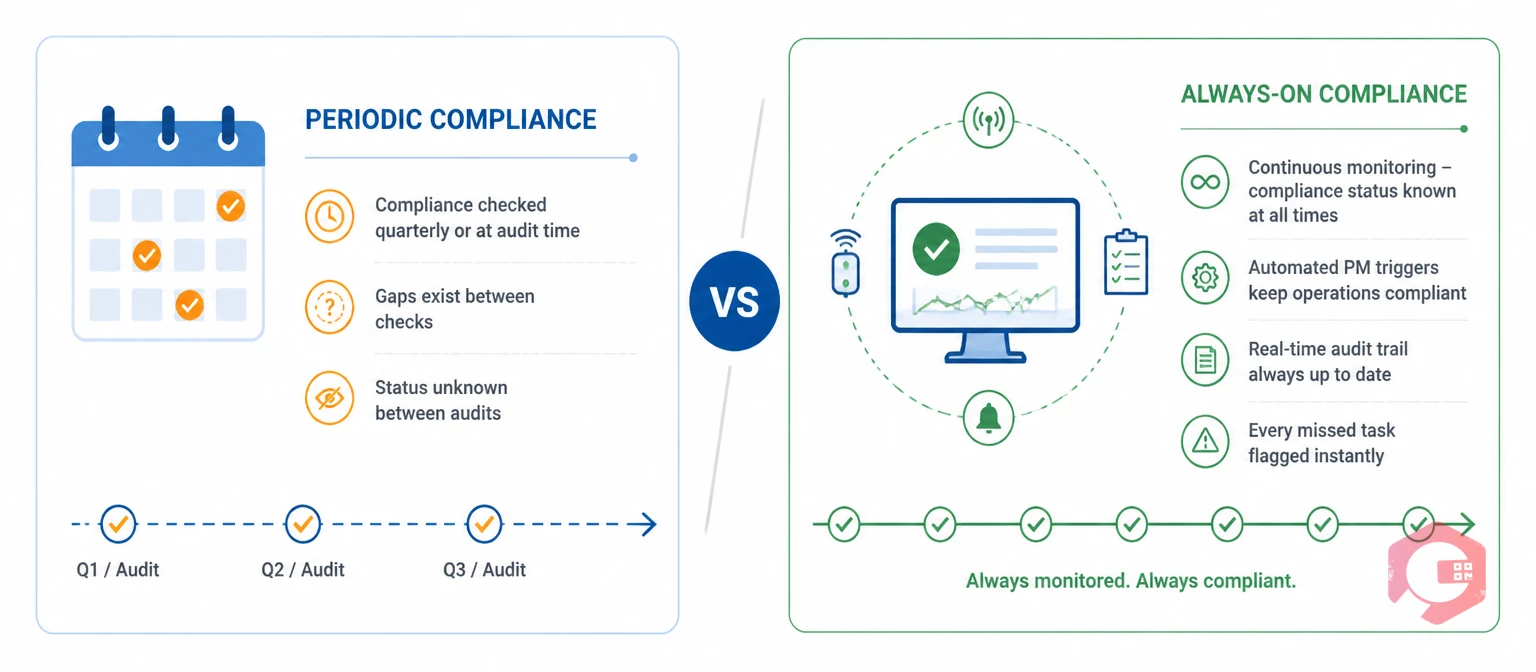
Always-on compliance is the practice of maintaining a live, continuously updated record of every compliance-relevant activity across your facility — inspections completed, equipment certified, permits issued, preventive maintenance logged — so your compliance status is accurate to the current moment, not the last time someone ran a manual report.
In traditional facility management, compliance was a periodic event. Teams would prepare documentation before an audit, pull records from spreadsheets and filing cabinets, and hope the paperwork matched the work actually done on the floor. The problem is that this model creates compliance gaps by design. Between audit cycles, equipment goes uninspected, checklists get skipped, and documentation lags weeks behind reality.
The operational shift to always-on compliance involves three fundamental changes in how facility teams work. First, every maintenance task generates a timestamped digital record the moment it is completed, not when it is logged at the end of a shift. Second, compliance thresholds are monitored automatically, with alerts firing when an inspection is overdue or a permit is expiring — not discovered during a manual review. Third, compliance dashboards show live status across all assets and regulatory categories, giving facility managers a real-time view of their compliance posture at any moment. The result is a facility that is audit-ready 365 days a year rather than for three days before a scheduled visit.
Several converging regulatory and operational pressures make 2026 a pivotal year for facility compliance programs. The ISO 55001:2024 asset management standard revision introduced stronger documentation requirements for maintenance evidence, requiring organizations to demonstrate not just that maintenance was planned, but that it was executed and recorded with verifiable audit trails. Simultaneously, ESG-linked building performance requirements are now embedded in commercial lease contracts and insurance policies across most major markets, creating financial consequences for facilities that cannot produce continuous compliance records.
The rise of Industrial IoT sensor networks has also raised the regulatory bar. Regulators in sectors from healthcare to manufacturing now expect facilities to demonstrate not just scheduled maintenance compliance, but real-time equipment condition monitoring with documented thresholds and response records. Facilities still relying on manual inspection rounds and spreadsheet logs are structurally unable to meet this evidence standard without rebuilding their compliance infrastructure.

Always-on compliance is not a single tool or process. It is a posture built on five operational pillars that work together to eliminate compliance gaps across every area of facility management.
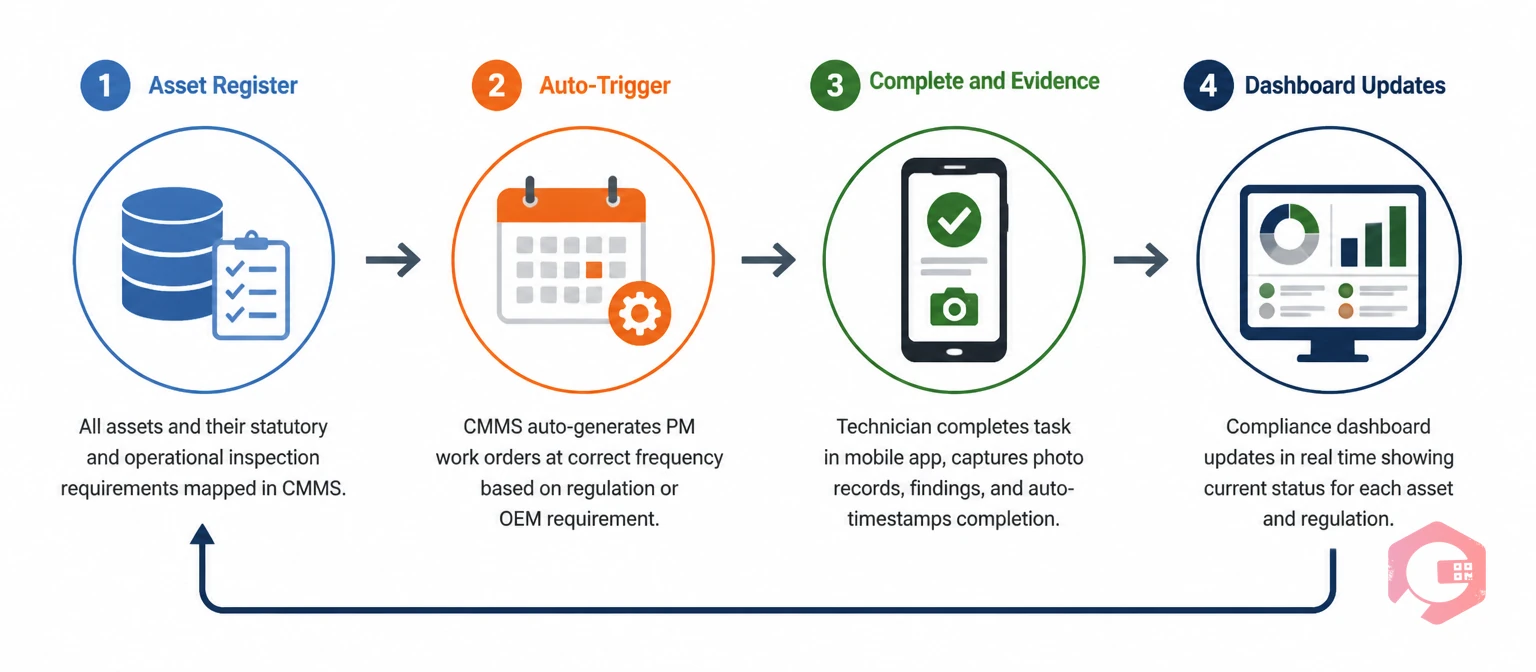
The single biggest source of compliance gaps in facility management is missed preventive maintenance. According to Plant Engineering benchmarking data, facilities that maintain PM compliance above 90% experience 40% fewer unplanned equipment failures and significantly stronger audit outcomes than those tracking at 70% or below. The challenge is that manual PM scheduling — even with the best spreadsheet — requires a human to check due dates, generate work orders, and assign technicians every time a task comes due. In a facility with hundreds of assets, that manual process creates misses by design.
Automated PM scheduling changes the model. When maintenance schedules are configured in a CMMS, the system generates work orders automatically on the correct date, routes them to the right technician based on asset assignment, and tracks completion status in real time. If a work order is not acknowledged within a defined window, the system escalates the alert to a supervisor. If it is not completed by the due date, it appears as a compliance gap on the dashboard immediately — not on the next manual review cycle.
For facilities with rotating equipment, HVAC systems, fire suppression systems, and electrical infrastructure, this automated scheduling is what makes statutory compliance achievable without adding headcount. The system does not forget, does not get distracted, and does not have a bad shift. Use the regulatory compliance checklist to map your current PM schedules against your compliance obligations and identify the gaps before your next audit does.
A digital audit trail is the evidentiary backbone of always-on compliance. When a regulator, insurer, or client asks for proof that a specific fire suppression system was inspected on a given date, by a qualified technician, with a signed sign-off and a photographic record — that proof either exists instantly or it does not exist at all. Paper-based systems and shared spreadsheets cannot reliably produce this evidence on demand.
A digital audit trail in a modern facility management system captures five layers of evidence for every compliance-relevant action. The timestamp records when the task was completed, accurate to the minute. The technician record identifies who performed the work, with their digital signature attached. The checklist record shows exactly which steps were completed and in what order. The asset record links the task to the specific piece of equipment, its service history, and its current compliance status. The media record attaches any photos, meter readings, or test results captured during the inspection. Together, these five layers create an evidence record that satisfies the documentation requirements of OSHA 29 CFR 1910.147, ISO 55001, and most national building code compliance frameworks.
The practical advantage for facility teams is speed. When an auditor requests documentation, a facility with a digital audit trail can produce a complete, formatted compliance report in minutes. A facility relying on paper records and email threads can spend days assembling the same evidence — and risk producing an incomplete file that creates more questions than it answers.
| Capability | Real-Time Compliance Dashboard | Manual Reporting (Spreadsheet) |
|---|---|---|
| Compliance status visibility | Live, updated with every task completion | Snapshot only, as of last manual update |
| Overdue inspection alerts | Automatic escalation when due date passes | Discovered only on next manual review |
| Audit documentation speed | Full report generated in minutes | Hours to days assembling records |
| Multi-site visibility | All facilities in one view simultaneously | Requires separate file per site, manual consolidation |
| Permit and cert expiry tracking | Automated advance alerts, linked to asset records | Manual calendar reminders, high error risk |
| Regulatory framework coverage | Configurable per standard (OSHA, ISO, local codes) | Generic template, manual framework mapping |
Cryotos is built to give facility teams the operational infrastructure for always-on compliance without building a compliance bureaucracy. Every feature in the platform connects back to the five compliance pillars: automated PM scheduling fires work orders on time every time; digital audit trails capture every technician action with timestamps and signatures; real-time BI dashboards surface compliance gaps the moment they appear; expiration reminders alert managers before certifications lapse; and role-based access controls ensure that compliance records are generated only by authorized personnel.
For facility managers overseeing multiple buildings or sites, the multi-organization management capability gives a unified compliance view across all locations — without requiring a separate login or report for each site. Compliance gaps at any location surface on the central dashboard instantly, allowing managers to respond before they become audit findings. The workflow automation engine routes compliance tasks to the right people based on asset type, location, and required qualification — eliminating the manual assignment step that delays compliance tasks during busy operational periods.
Cryotos also integrates directly with IoT sensor networks via SCADA and PLC connections, enabling condition-based compliance triggers. When a monitored asset crosses a threshold — bearing temperature, vibration level, air quality reading — the system automatically generates a compliance inspection work order tied to the regulatory requirement it supports. This closes the loop between live sensor data and documented compliance evidence, which is the capability that distinguishes a 2026-ready facility compliance program from one that was designed for 2015.
Teams that have moved to always-on compliance with Cryotos report 30% reduction in unplanned downtime and 25% faster repair times — outcomes that directly reflect the operational discipline that continuous compliance tracking builds. Use the safety compliance checklist to assess where your facility stands today and identify which pillars need strengthening before your next audit cycle.
Always-on compliance means your facility maintains a continuously updated, real-time record of every inspection, maintenance task, permit, and certification — so compliance status is accurate at any given moment, not just at the time of an audit. It replaces periodic compliance reviews with automated tracking, digital audit trails, and live dashboards that surface gaps the moment they appear.
A CMMS automates PM scheduling so inspections never get missed, captures digital records of every completed task with timestamps and technician signatures, tracks permit and certification expiry dates, and provides real-time compliance dashboards. These capabilities together create the audit-ready documentation that regulators, insurers, and clients increasingly expect from facility teams in 2026.
Facility teams typically need to comply with a combination of OSHA safety standards, ISO 55001 asset management requirements, local building codes and fire safety regulations, ESG reporting frameworks tied to building performance, and industry-specific standards such as those from The Joint Commission for healthcare facilities. The specific obligations vary by sector, region, and asset class.
A digital audit trail is an automatically generated, immutable record of every compliance-relevant action in your facility — who did it, when, on which asset, and with what evidence attached. It matters because modern regulatory frameworks and insurance requirements increasingly demand this level of documentation, and because producing it manually is too slow and error-prone to be reliable when an audit happens on short notice.
Yes. Modern facility management platforms with multi-organization management capabilities give facility teams a unified compliance view across all sites in a single dashboard, with location-specific reporting available on demand. This eliminates the manual consolidation work that makes multi-site compliance management so resource-intensive with spreadsheet-based systems.
If your facility team is still relying on periodic compliance reviews and manual documentation, 2026 is the year that gap becomes a liability. Cryotos Facility Management Software gives you the automated PM scheduling, digital audit trails, real-time dashboards, and multi-site compliance visibility to run a facility that is audit-ready every day of the year. Book a demo today and see what always-on compliance looks like in practice.




Cryotos AI predicts failures, automates work orders, and simplifies maintenance—before problems slow you down.



