

Key Takeaways
Asset decommissioning is the formal process of retiring a piece of equipment from active service in a safe, documented, and compliant manner. It covers everything from the moment you decide an asset has reached end-of-life to the point where it’s physically removed, its parts are salvaged or disposed of, and its record is closed in your CMMS. Done right, decommissioning protects your team, recovers value from ageing equipment, and keeps your asset register accurate. Done wrong, it creates safety hazards, regulatory exposure, and hidden costs that show up later. This guide walks through every stage of the process — what to look for, what to do, and how to avoid the mistakes that catch most teams off-guard.

Asset decommissioning is the planned retirement of a physical asset from operational service. It’s a structured transition, not a one-time event. You’re taking an asset out of production, recovering any residual value from it, managing its safe removal, and updating every record that referenced it — maintenance history, insurance, depreciation schedules, and spare parts inventory.
It’s worth separating decommissioning from the broader terms that get used interchangeably in maintenance conversations.
| Aspect | Asset Decommissioning | Asset Disposal |
|---|---|---|
| Scope | The full end-of-life process — assessment, safety, salvage, removal, documentation | The final step of transferring or discarding the physical asset |
| Timing | Begins before physical removal | Occurs at the end of decommissioning |
| Focus | Process, safety, compliance, data | Method of transfer — sale, scrap, donation, landfill |
| Documentation | Full audit trail from decision to closure | Transfer records, certificates of destruction |
Think of disposal as one step inside the larger decommissioning workflow — not a synonym for the whole thing.
| Aspect | Decommissioning | Scrapping |
|---|---|---|
| Process | Structured, documented, multi-step | Often informal, focused on material recovery only |
| Value recovery | Parts, resale, data, and material value all considered | Primarily scrap metal or materials value |
| Compliance | Regulatory and safety compliance built in | May skip environmental or safety requirements |
| CMMS closure | Asset record formally closed | Record may remain open or be deleted without audit trail |
Scrapping without a decommissioning process is how teams end up with hazardous waste violations, missing spare parts, and phantom assets still appearing in maintenance schedules.
The hardest part of asset decommissioning isn’t the physical removal — it’s knowing when to pull the trigger. Equipment rarely announces that it’s done. The decision usually builds from a mix of financial signals, operational problems, and safety concerns that accumulate over time.
The most common benchmark maintenance teams use is the repair-to-replace ratio. If your annual maintenance spend on a single asset is approaching 50% of its replacement value, retirement is worth serious consideration. Some teams use a tighter threshold — 30% — for critical production equipment where downtime costs are high.
Other financial signals worth tracking include a rising spare parts cost trend (especially when OEM parts become scarce or discontinued), increasing energy consumption compared to newer equivalent assets, and a declining resale value that makes waiting longer counterproductive. Your EAM software should be surfacing these trends automatically from your maintenance cost history.
Financial thresholds don’t capture the full picture. Some assets need decommissioning before the numbers look compelling, because the operational or safety risk is too high to justify keeping them running. Watch for these signals:
When two or more of these signals appear together, the case for decommissioning is usually clear. The longer you wait, the more you spend on reactive repairs and the less residual value you recover.
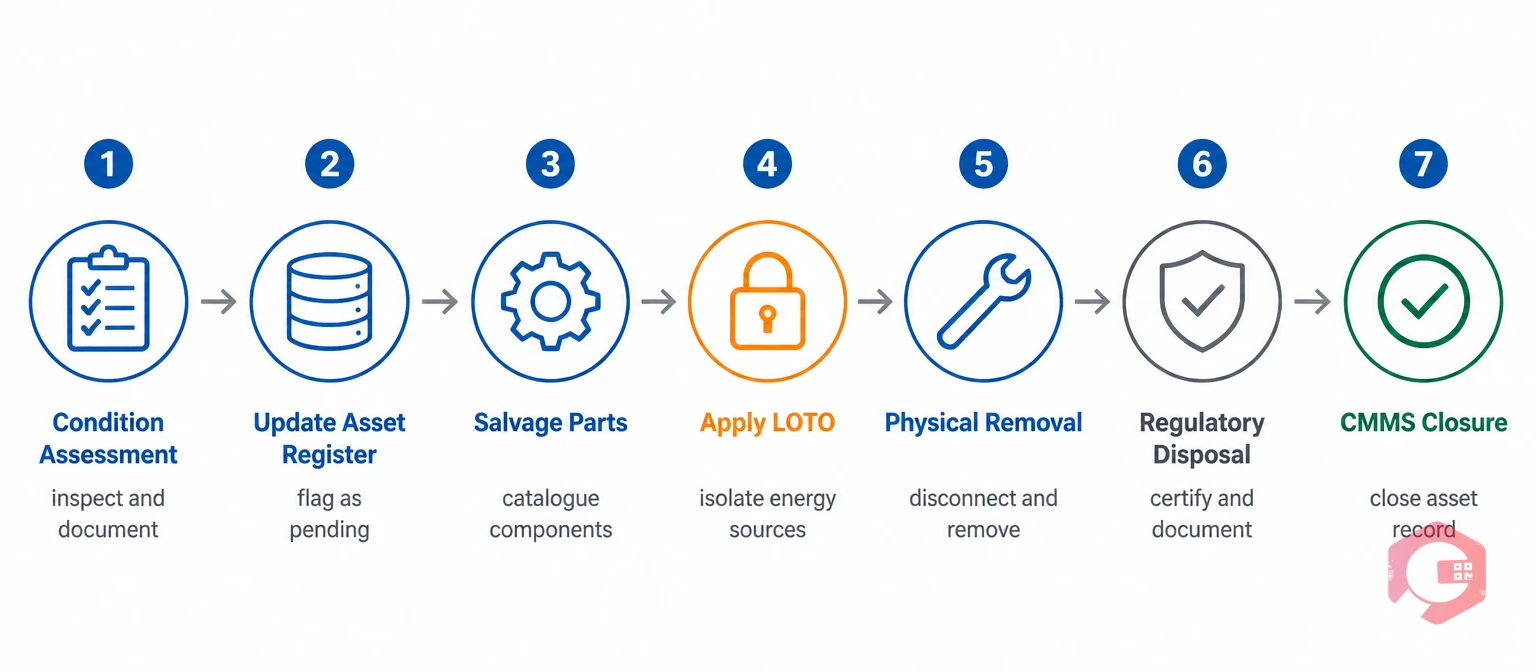
A structured decommissioning process protects your team, preserves value, meets regulatory requirements, and leaves your asset records clean. Here’s how it works in practice.
Before anything is removed or changed, document the current state of the asset thoroughly. This means a physical inspection that records what works, what doesn’t, which components are still in good condition, and what hazardous materials (oils, refrigerants, chemicals, asbestos) are present. Use your asset and equipment inspections checklist to make sure nothing is missed.
The condition assessment drives every decision that follows — what parts are salvageable, what disposal method is appropriate, what safety precautions are needed. Skipping it means guessing, and guessing gets expensive.
Flag the asset as “pending decommissioning” in your asset maintenance management software before any physical work begins. This prevents new work orders from being raised against it, stops it appearing in active preventive maintenance schedules, and creates an official record of when the decommissioning decision was made.
This step also triggers a review of the asset’s documentation — maintenance history, warranty records, OEM manuals, calibration certificates, and any regulatory compliance records that need to be retained or transferred.
Most equipment being retired has components that still have usable life. Motors, drives, sensors, valves, and structural components can often be catalogued back into your spare parts inventory and used to support similar active assets. This step directly offsets the cost of decommissioning.
Work with your maintenance team and your asset lifecycle management data to identify which parts are worth recovering. Cross-check against current spare parts requirements for your active fleet so you’re not stockpiling components you’ll never use. Whatever isn’t salvaged internally can sometimes be sold to equipment dealers or other facilities running the same asset type.
This is non-negotiable. Before any physical disassembly, decommissioned equipment must be fully isolated from all energy sources — electrical, hydraulic, pneumatic, thermal, and stored mechanical energy. OSHA’s Control of Hazardous Energy standard (29 CFR 1910.147) requires documented lockout/tagout procedures for all energy isolation activities.
Full lockout/tagout procedures must be applied and verified before decommissioning work starts. This means identifying all energy sources, applying individual locks, verifying zero-energy state, and documenting who performed the isolation and when. For complex multi-energy assets, a dedicated LOTO procedure document should be prepared in advance and reviewed with the crew doing the removal work.
With LOTO applied and the salvage plan confirmed, physical decommissioning can begin. This includes disconnecting utilities (electrical, plumbing, compressed air, data cabling), removing the equipment from its foundation or mounting, and cleaning the area to its pre-installation condition.
Hazardous materials must be handled according to applicable regulations. Refrigerants require certified recovery. Oils and hydraulic fluids need proper containment and disposal. Any materials containing asbestos, lead, or other regulated substances require specialist contractors. Documenting each of these steps — who did the work, what was recovered, what was disposed of and how — creates the compliance paper trail you’ll need if there’s ever a regulatory inspection.
Disposal method depends on what the asset is, what it’s made of, and what’s left after salvage. Options include resale to a secondary market dealer, donation to a training facility, recycling through a certified processor, or landfill disposal for residual waste. Each path has documentation requirements.
For equipment containing regulated materials, the EPA’s Resource Conservation and Recovery Act (RCRA) governs hazardous waste disposal requirements in the US. Many industries also have sector-specific requirements — healthcare, food processing, and oil and gas facilities face additional compliance obligations for decommissioned equipment. Keep certificates of destruction, transfer manifests, and recycling receipts. These documents protect your organisation if a disposal method is ever questioned.
The final step is administrative but important. Update your asset tracking records to mark the asset as decommissioned (not deleted — you want to retain its history). Cancel any open work orders, remove it from PM schedules, update your insurance schedule, notify your finance team for fixed asset write-off, and archive all decommissioning documentation against the asset record.
A clean CMMS closure means your asset register accurately reflects your active fleet, your maintenance metrics aren’t distorted by phantom assets, and your audit trail is complete if you ever need it.
Use this checklist to track progress through each decommissioning project. Each item should be signed off by a named responsible person before moving to the next phase.
Pre-Decommissioning
During Decommissioning
Post-Decommissioning
Most decommissioning problems are preventable. These are the mistakes that show up most often and cost the most to fix after the fact.

A CMMS doesn’t just manage active assets — it’s the system of record that makes decommissioning traceable and efficient. Here’s where it makes the biggest difference.
Complete maintenance history at your fingertips. When you’re evaluating whether to decommission an asset, your CMMS holds the maintenance cost history, failure frequency, parts consumption, and downtime records that make the case. Without that data, decommissioning decisions are guesswork. With it, they’re defensible business decisions.
Automatic PM blocking. The moment you flag an asset as pending decommissioning, your CMMS should stop generating new preventive maintenance work orders for it. This prevents wasted labour on equipment you’ve already decided to retire and avoids confusion on the shop floor.
Spare parts return workflow. When salvageable components are stripped from a decommissioned asset, your CMMS can receive them back into stock, update inventory counts, and associate them with compatible active assets — so your technicians know those parts are available the next time they’re needed.
Documentation storage. LOTO procedures, condition assessment reports, disposal certificates, and compliance documentation can all be attached directly to the asset record in your CMMS. When you need to demonstrate compliance to an auditor or insurance assessor, everything is in one place.
Asset register accuracy. Properly closed decommissioned assets stop appearing in asset utilisation reports, maintenance cost analyses, and compliance audits. Your data reflects your actual fleet — not a mix of active equipment and ghost assets that should have been retired years ago.
Decommissioning is the full end-of-life process — assessment, safety procedures, parts salvage, physical removal, regulatory compliance, and CMMS closure. Disposal is a single step within that process: the method used to finally transfer or discard the physical asset, whether that’s selling it, recycling it, or sending it to landfill.
The level of documentation should match the risk. High-value, complex, or hazardous assets — production machinery, pressure vessels, assets containing regulated chemicals — always need a formal written plan. Low-value equipment with no hazardous content can be handled with a simplified checklist. The minimum requirement for any asset is that the decision is documented, LOTO is applied before removal, and the CMMS record is properly closed.
In the US, OSHA’s Control of Hazardous Energy standard (29 CFR 1910.147) governs LOTO requirements during decommissioning. The EPA’s RCRA governs disposal of hazardous waste generated during removal. Industry-specific regulations may also apply — for example, EPA Section 608 for refrigerant recovery, OSHA 1910.120 for hazardous waste site work, and various state environmental regulations. Always confirm applicable requirements before starting decommissioning of anything containing regulated materials.
Start by comparing the salvageable parts against your current active fleet. Parts that are interchangeable with running equipment go straight back into your spare parts inventory — update quantities in your CMMS and cross-reference them against compatible assets. Parts that don’t apply to any active equipment can sometimes be sold through OEM buy-back programmes, equipment dealers, or online maintenance parts marketplaces. Parts that are worn beyond usable life should be disposed of properly and not stored indefinitely “just in case.”
A complete decommissioning report should include the asset identifier and description, the decision date and authorising personnel, condition assessment findings, LOTO records including who applied isolation and when, a list of salvaged parts and their destination, hazardous materials handling records, disposal method and supporting documentation (transfer receipts, certificates of destruction), and confirmation of CMMS record closure. This report becomes part of the permanent asset record.
Getting asset decommissioning right takes more than a work order and a set of spanners — it takes a system that tracks every step, from the decision to retire all the way to the final record closure. Cryotos CMMS gives maintenance teams the asset history, workflow tools, and documentation capabilities to run decommissioning properly: compliant, safe, and without leaving phantom assets clogging up your data. Schedule a free demo to see how Cryotos can support your asset lifecycle management from commissioning through to end-of-life retirement.



Cryotos AI predicts failures, automates work orders, and simplifies maintenance—before problems slow you down.



