

Digital twins and IoT are becoming the new operating system for manufacturing — a unified intelligence layer that monitors, models, and controls every asset, process, and person on the factory floor in real time. While Industry 4.0 introduced the idea of connected machines, the shift happening now goes further: manufacturers are no longer just collecting data — they are running their entire operations through live digital replicas that make decisions alongside human teams.
According to a McKinsey Global Institute report, manufacturers that deploy digital twins and advanced IoT at scale reduce time-to-market by 20–50% and cut maintenance costs by 10–40%. A single automotive plant in Stuttgart reported saving $7 million annually after replacing manual inspections with a continuous digital twin model of its assembly line. These are not pilot numbers — they are production results.
This guide breaks down exactly why digital twins and IoT are replacing traditional factory management systems as the backbone of modern manufacturing, what that looks like in practice, and how your maintenance team can start building toward it today.
Industry 4.0 gave manufacturers a framework: connect your machines, digitize your data, and automate where possible. That framework worked. Sensors got cheaper, PLCs became networkable, and cloud storage made it affordable to store months of production data. Plants that applied these principles genuinely improved their operations.
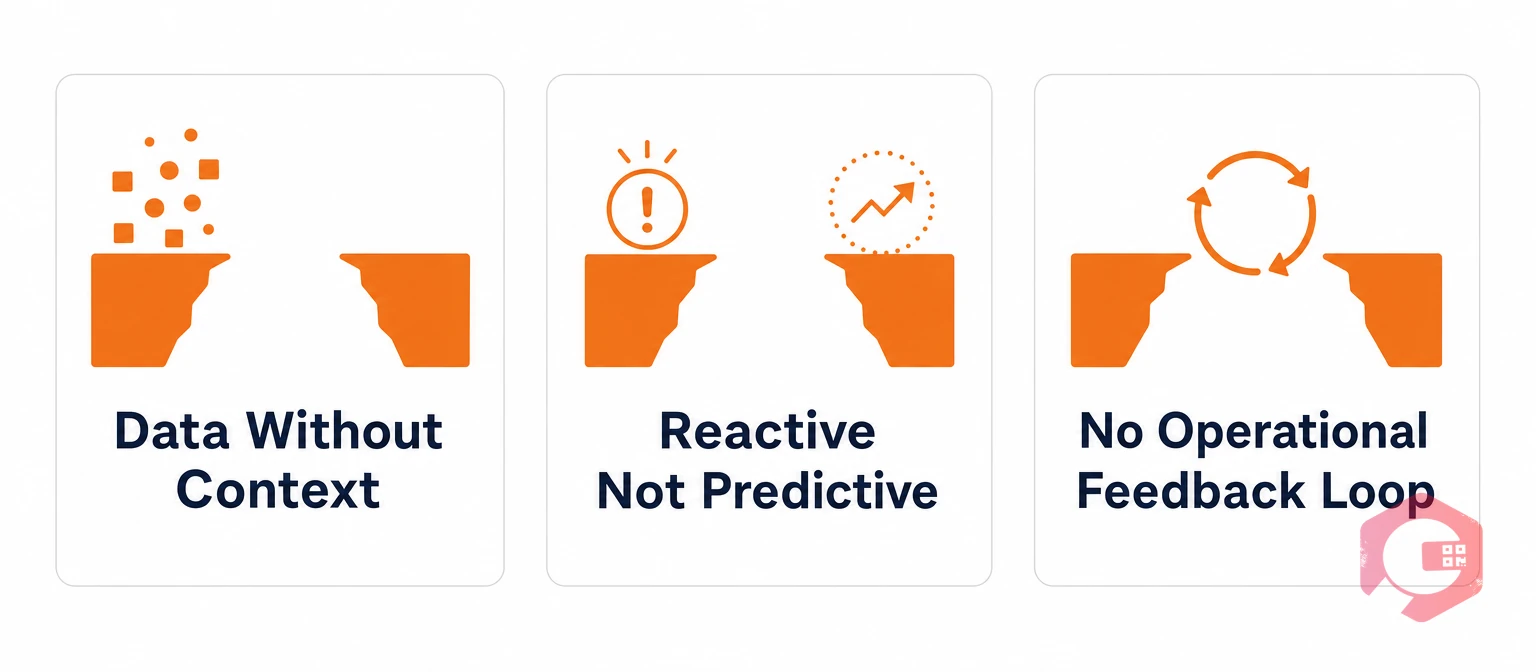
But Industry 4.0 has a ceiling. Most implementations produced data lakes that no one fully used. Dashboards showed historical trends but couldn’t predict what would happen next. Machines were connected, but the intelligence layer — the ability to act on sensor data automatically and contextually — was still missing for most manufacturers.
Digital twins and IIoT close all three gaps. They add a continuous simulation layer that understands context, models future states, and feeds decisions back into your operations automatically.
A digital twin is a live virtual model of a physical asset, production line, or entire factory that updates in real time from IoT sensor feeds. It is not a CAD model or a static simulation — it is a dynamic replica that mirrors the actual state of your equipment at every moment.
Think of it this way: your CNC machine has a digital twin that knows its current spindle speed, bearing temperature, tool wear percentage, last maintenance date, and the load profile from the past 72 hours. When the model detects a pattern that historically precedes a spindle failure, it triggers a work order before the failure happens. No human had to interpret the data — the twin did.
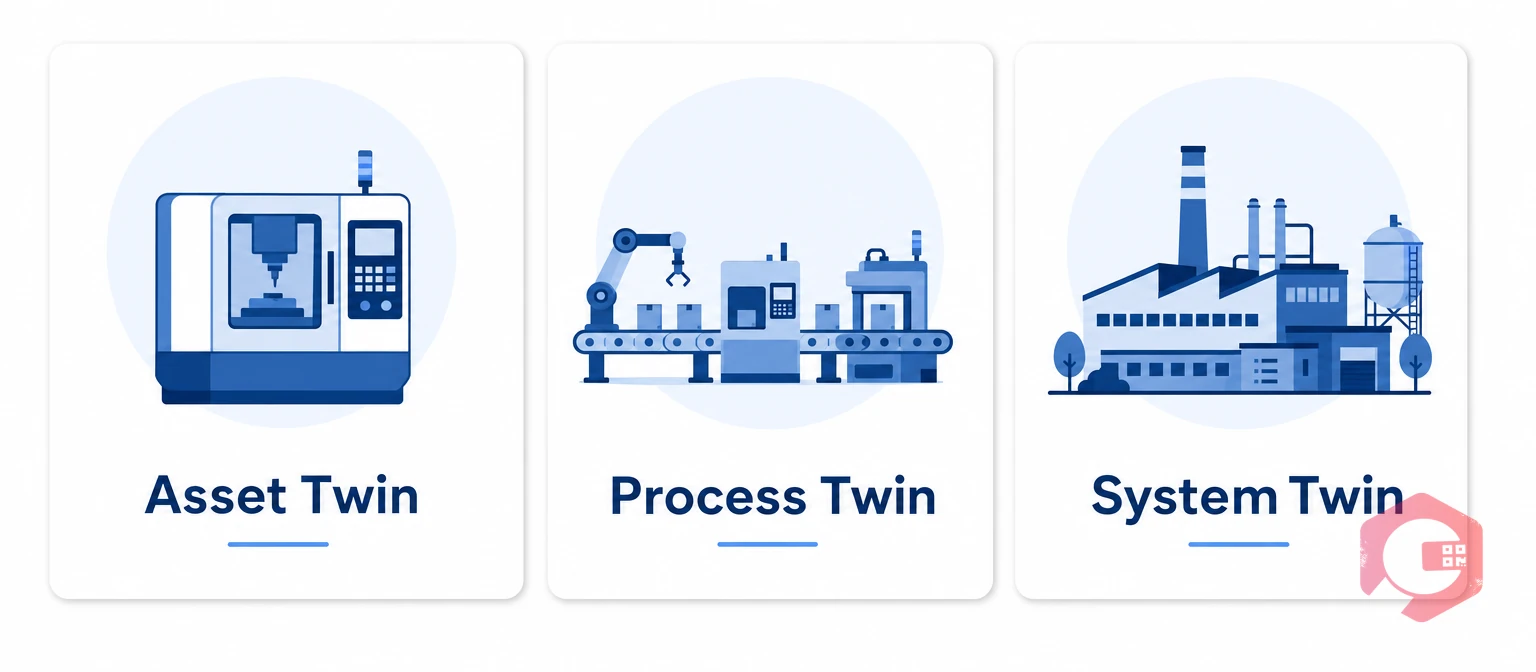
Not every digital twin operates at the same level. Manufacturers typically progress through three stages:
A digital twin is only as useful as the data feeding it. IoT sensors are the nervous system: they capture what’s happening on the floor and transmit it continuously to the twin’s model. The combination creates a closed loop — sensor data updates the twin, the twin runs its models, and the results trigger actions in your maintenance or production systems.
The key sensor types that power manufacturing digital twins include:
According to the IDC’s Global IoT Spending Guide, the discrete manufacturing sector leads all industries in IoT investment, with spending projected to exceed $310 billion globally by 2026. The reason is straightforward: every dollar spent on sensor infrastructure pays back through reduced downtime and lower maintenance costs.
The shift from Industry 4.0 to what comes next — sometimes called Industry 5.0 or simply the “intelligent factory” — is best understood through the operating system analogy. Your factory floor used to work like an old desktop computer: each application (maintenance, production, quality, inventory) ran in its own window with no shared memory. Digital twins and IoT create the shared memory layer — a unified model that all applications read from and write to.
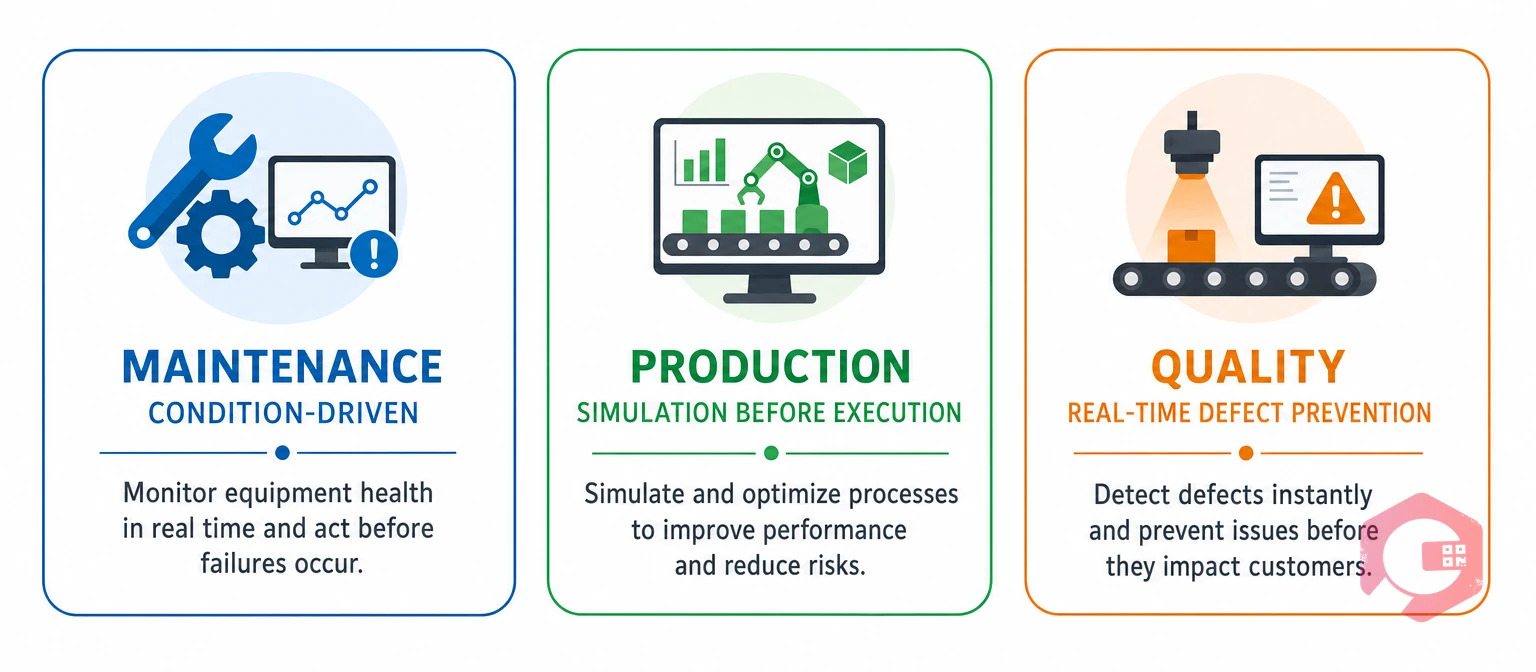
Traditional preventive maintenance software works on fixed intervals: inspect every 30 days, lubricate every 500 hours. That schedule is based on average failure rates, not your specific machine’s actual condition. A digital twin replaces the calendar with a condition model. The twin knows that this particular press, running this particular material at this ambient temperature, has a bearing life of approximately 1,400 operating hours — not the manufacturer’s nominal 2,000 — and it schedules service accordingly.
Plants that make this shift report maintenance cost reductions of 15–25% and a 30–40% drop in unplanned downtime within the first 18 months. The savings come from two directions: fewer emergency repairs and less unnecessary preventive work on machines that don’t yet need it.
A process digital twin lets you run production schedule changes as simulations before committing to them on the floor. If your production planner wants to increase output on line 3 by 15%, the twin models the impact on equipment load, predicted failure rates, energy consumption, and required raw material buffers — all in minutes, without touching a single physical machine. Bad decisions get caught in the simulation; good ones go to the floor with confidence.
Quality control in most plants still happens at the end of the process — inspectors catch defects after they are already baked in. A digital twin of the production process monitors upstream process variables in real time and correlates them with known defect signatures. When the model detects a combination of variables that historically produces out-of-spec parts, it alerts operators and can even adjust process parameters automatically through closed-loop control. Scrap rate reductions of 20–35% are achievable once this feedback loop is operating correctly.
A digital twin generates enormous predictive intelligence — but that intelligence is useless if it doesn’t connect to the systems your maintenance team uses every day. This is where IoT meter reading and CMMS integration become the critical link.
When a digital twin’s model triggers a maintenance alert, that alert needs to become a work order, get assigned to the right technician, pull the required parts from inventory, and be tracked through completion. A CMMS that integrates with your digital twin infrastructure does exactly that — automatically, without a maintenance manager manually reviewing sensor dashboards and creating tickets by hand.
Cryotos CMMS connects directly to IoT sensors and SCADA systems, translating real-time sensor thresholds into automated work orders and PM triggers. When a bearing vibration reading crosses a modeled threshold, Cryotos can automatically generate a condition-based work order, assign it to the available technician closest to the asset, and check spare parts availability — all without human intervention in the trigger chain.
The numbers from early adopters of digital twin and IIoT programs are consistent enough to treat as benchmarks rather than outliers:
The pattern across these cases is consistent: plants that connect their IoT data to active digital models — and then connect those models to their maintenance and production workflows — see compounding returns that isolated sensor deployments never deliver.
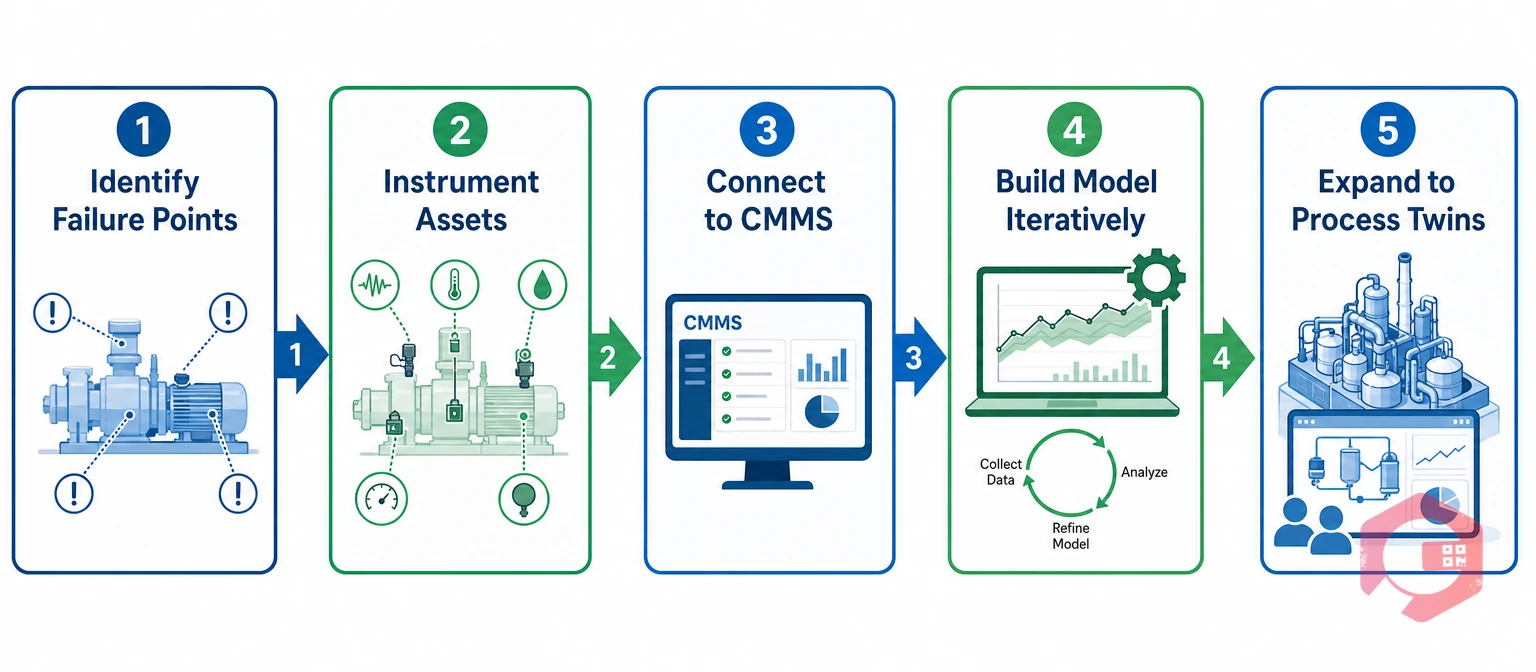
You do not need to build a full factory-level system twin in year one. Most manufacturers that successfully implement digital twins start with a single high-value asset or production bottleneck and expand from there. Here is a practical starting sequence:
One practical challenge of digital twin infrastructure is latency. If every sensor reading has to travel to a cloud server for processing before triggering an alert, the response time may be too slow for fast-moving production environments. Edge computing addresses this by processing sensor data locally — at the machine or cell level — before sending summarized insights to the cloud.
Edge nodes on a modern production line can process thousands of sensor readings per second and make local decisions (slow this motor, trigger this alert) in under 100 milliseconds. The cloud layer handles longer-horizon analysis — trend modeling, cross-site benchmarking, and simulation runs. The result is a two-tier intelligence architecture: fast local decisions from the edge, and deep analytical insight from the cloud. According to Gartner, by 2025, 75% of enterprise-generated data will be created and processed outside of centralized data centers — up from less than 10% in 2018.
Most manufacturers that stall on digital twin adoption run into the same set of obstacles. Naming them honestly is more useful than pretending the path is smooth:
A simulation is a one-time model run against static input data to test a scenario. A digital twin is a continuously updating model connected to live sensor feeds that reflects the real-time state of a physical asset or system. The key difference is the live data connection — a digital twin is always current; a simulation is only as current as the data you fed it at the time you ran it.
Asset-level twins for individual machines typically cost $15,000–$80,000 to implement, depending on sensor density and integration complexity. Factory-level system twins at large plants can run $500,000 to several million dollars. Most manufacturers see full ROI within 12–24 months through maintenance savings and downtime reduction. Starting with a single high-cost asset keeps the initial investment manageable while building internal capability.
Yes — often more so than large plants on a per-dollar basis. A mid-size manufacturer with 50–200 assets has a more tractable implementation scope, sees faster ROI payback periods, and can build a complete asset twin program without the IT complexity that large enterprises face. Cloud-based digital twin platforms have significantly lowered the entry cost since 2022, putting the technology within reach for plants with annual revenues above $10 million.
A CMMS is the execution layer for digital twin intelligence. The twin generates predictions and alerts; the CMMS turns those alerts into scheduled work orders, assigns technicians, manages parts inventory, and tracks completion. Without a CMMS connected to your twin data, alerts pile up without reliable follow-through. The twin tells you what needs to happen; the CMMS makes sure it actually gets done.
Industry 5.0 builds on Industry 4.0 by emphasizing the collaboration between humans and intelligent systems rather than automation for its own sake. Digital twins are central to this model because they give human operators a complete, real-time picture of factory performance while handling routine monitoring and prediction automatically. The goal is not to remove people from manufacturing decisions but to give them far better information to work with — and to free them from manual data collection tasks that machines can do more reliably.
Digital twins and IoT are not a technology upgrade — they are a structural shift in how manufacturing plants operate. The factories that treat this shift as infrastructure — the same way they treat electrical systems or ERP software — will pull ahead of competitors who are still treating it as a pilot project. The data is clear, the ROI is proven, and the implementation path is more accessible than it has ever been.
If your maintenance team is ready to connect your asset data to a system that turns sensor readings into work orders automatically, Cryotos CMMS integrates with IoT platforms and SCADA systems out of the box — giving you the execution layer your digital twin program needs from day one. Book a free demo and see how Cryotos connects to your floor data.


Cryotos AI predicts failures, automates work orders, and simplifies maintenance—before problems slow you down.



