
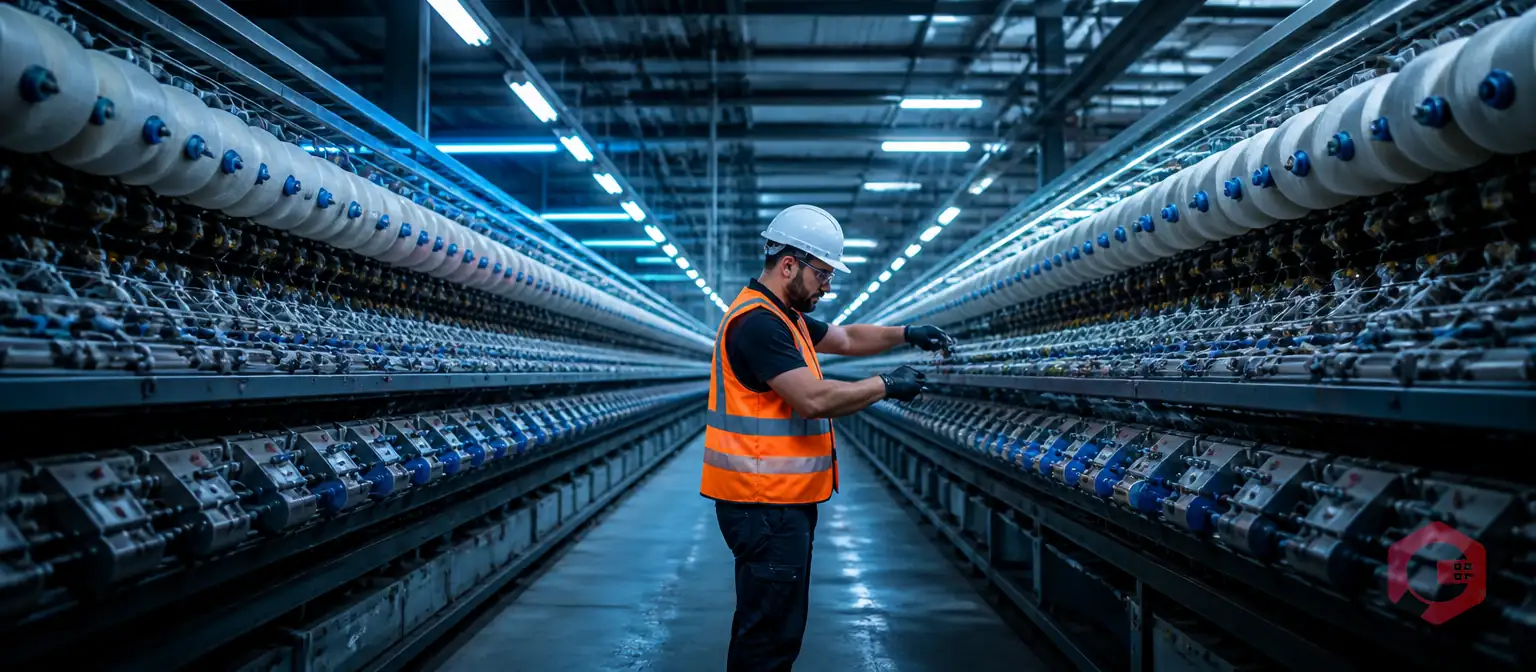
CMMS for the textile industry is maintenance management software configured for the specific demands of spinning mills, weaving plants, dyeing units, and finishing lines. Textile machinery — ring frames, rapier looms, stenter machines, humidification systems — runs continuously under extreme mechanical stress and chemical exposure. A single unplanned breakdown on a critical loom or carding machine does not just stop that asset: it stalls the entire downstream production flow. For textile plants running on thin margins with back-to-back delivery commitments, that exposure is unacceptable — and a properly configured textile manufacturing maintenance software platform is the most direct way to address it.
This guide covers everything textile maintenance teams need to build a proactive, CMMS-driven maintenance program — from the specific equipment that matters most, to PM schedules, compliance benefits, IoT integration, and how to measure the results.
Key Takeaways

Most textile plants manage maintenance through paper logbooks, verbal shift handovers, and informal messaging between teams. This seems workable until a ring frame goes down at 2 AM and the incoming shift has no record of the vibration issue flagged two days earlier. By the time the fault is diagnosed and the replacement bearing sourced, six hours of production are gone.
A CMMS creates a single, real-time operational record of every machine's maintenance history, open work orders, PM schedules, and spare parts status. When an asset shows early signs of trouble — through sensor data or a technician observation — the CMMS captures it, assigns it, and tracks it to resolution across shift changes. The incoming team sees full context the moment they log in. Nothing is lost at handover under production pressure.
Plants that implement structured CMMS-driven preventive maintenance programs consistently reduce unplanned downtime by 25–40% within the first year, according to data from Reliable Plant. For a spinning mill running three shifts with 500 ring frames, a 30% reduction in downtime translates directly into more spindle hours, better delivery compliance, and lower emergency repair costs. That shift from reactive firefighting to planned maintenance is measurable — and it compounds as the CMMS builds a richer decision-making dataset over time.
Beyond downtime, a CMMS supports the compliance obligations textile manufacturers face. ISO 9001 certification, buyer audit requirements, and export quality standards all demand documented, verifiable maintenance records. A digital CMMS generates these automatically — every completed work order is a timestamped, signed record ready for auditor review.
Use the downtime tracking module to baseline your current unplanned breakdown hours before go-live. That number becomes the benchmark against which you measure improvement at the 90-day mark.

Textile manufacturing involves 15–20 distinct machine categories across spinning, weaving, dyeing, and finishing. Not all carry equal maintenance risk, but the following asset families drive the majority of unplanned downtime and should be the first priority for any CMMS rollout.
Ring frames are the highest-spindle-count machines in any spinning mill — a single frame can carry 500 to 1,000 spindles. Spindle bearing wear is the dominant failure mode and develops progressively over weeks before actual failure. Traveller wear, ring condition, and drafting roller eccentricity are other key failure points. A CMMS with usage-based PM triggers — configured to fire after defined spindle hours or traveller life cycles — catches these issues before they cause spindle seizures or yarn quality failures that contaminate an entire production batch.
Weaving machines are high-speed, high-precision assets where minor mechanical drift causes weave defects or complete stoppages. Key failure modes include reed wear, cam and crank mechanism degradation, weft insertion system issues, and let-off tension drift. In a plant running 300 looms, the CMMS must manage the maintenance lifecycle of each one independently — not as a generic asset class — so failure patterns surface at the machine level rather than hiding in aggregate data.
Carding machines process raw fibre at high speeds across multiple rotating cylinders. Wire clothing wear, flat wear, and cylinder bearing degradation are the primary failure modes. Because carding sits early in the production sequence, a breakdown cascades into stoppages across downstream spinning and winding. The CMMS should track wire clothing life cycles, cylinder bearing condition, and flat strip replacement intervals — all with machine-specific checklists completed at each service visit.
Stenters apply heat and tension to fabric, and their chain systems, clip mechanisms, heating chambers, and exhaust fans require careful maintenance. Chain lubrication failure leads to chain breakage that can damage the fabric being processed and halt the finishing line. The CMMS should schedule chain lubrication and clip inspection on usage-based triggers — metres of fabric processed — rather than calendar dates that ignore actual throughput variation.
Humidity control is not optional in textile manufacturing. Cotton and synthetic fibres are highly sensitive to relative humidity variations, and running out of spec causes yarn breaks, static buildup, and quality failures. Humidification plant failures — fan motors, atomizer nozzles, ductwork — often go unnoticed until production quality starts slipping. CMMS-driven maintenance with scheduled motor current checks, airflow sensor verification, and filter replacement alerts protects both equipment uptime and product quality.

Textile manufacturing creates maintenance challenges that differ substantially from most other industrial environments. A CMMS must be configured to address these specifically — not mapped from a generic manufacturing template.
Most textile plants run two or three shifts. When the outgoing shift ends, the only maintenance record is often a brief verbal conversation — or nothing at all. The incoming team starts blind: they do not know which machine was vibrating abnormally, which belt is showing early wear, or which repair was left half-finished. A CMMS with continuous digital work order records eliminates this entirely. Every observation, every repair action, every pending task travels with the work order through every shift transition.
A large spinning mill can have 300–600 individual ring frames, all requiring similar but not identical maintenance. Managing PM schedules, spare parts consumption, and failure patterns across hundreds of machines simultaneously is impossible with paper-based systems. A CMMS handles this through asset hierarchies — organising machines by section, department, and production line — so managers see aggregate performance patterns while still drilling down to individual machine histories when needed.
Dyeing and finishing sections expose equipment to acids, alkalis, and chemical finishing agents that aggressively degrade rubber seals, bearings, and electrical contacts. Cotton dust in spinning sections accelerates bearing contamination and filter clogging at rates that standard OEM maintenance intervals do not account for. A CMMS allows plant-specific PM intervals to be set based on actual operating conditions — not generic manufacturer recommendations that assume a cleaner, less intense environment.
Textile demand spikes ahead of export shipment cycles, festive seasons, and fashion order windows. During peaks, every hour of production matters and maintenance is routinely deferred. The CMMS creates accountability for this deferral — flagging overdue PMs, calculating the growing risk profile of deferred maintenance, and helping managers front-load maintenance before peak periods rather than reacting to breakdowns during them.
Run your current unplanned breakdown rate through the MTBF calculator to establish a baseline before configuring your first PM schedules. That number tells you exactly which machines to prioritise first.
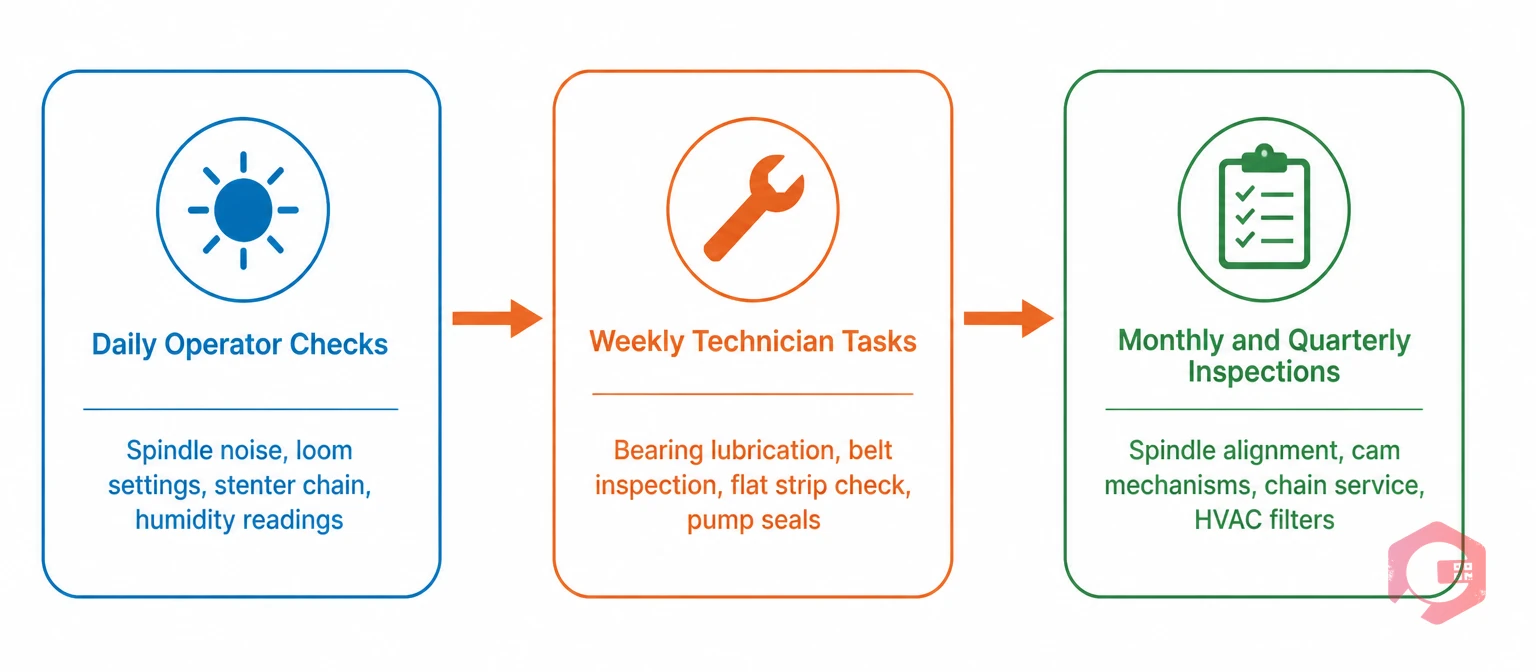
A well-structured PM program for a textile plant must be tiered — daily operator-level checks, weekly technician tasks, and monthly or quarterly deep inspections. The intervals below are practical starting points, refined based on your plant's actual failure data. Configure all of these inside your preventive maintenance software so they trigger automatically on time or usage thresholds.

A CMMS running PM schedules alone is a major improvement over paper-based maintenance. A CMMS connected to IoT sensors is a fundamentally different level of protection. Condition-based maintenance — where the CMMS generates work orders from actual equipment readings rather than calendar dates — catches the 30–40% of failures that scheduled PM misses between service visits.
In a textile plant context, this means mounting vibration sensors on ring frame motor bearings and loom main drives. When a bearing's vibration amplitude trends upward over two weeks — a clear signature of fatigue — the CMMS generates a predictive maintenance work order with the asset ID, sensor trend data, and recommended action, days before the bearing would have failed during a production run. The technician arrives briefed, with the correct replacement bearing already pulled from inventory.
Temperature sensors on stenter heating chambers, current sensors on dyeing machine drive motors, and airflow sensors on humidification fans are equally valuable. Each covers different failure modes. Together, they create a continuous monitoring layer that extends the value of scheduled PM by catching unpredictable failures that no calendar schedule can prevent.
Research from Plant Engineering consistently shows that IoT-enabled condition monitoring reduces maintenance costs by 25% and cuts breakdowns significantly compared to time-based PM programs alone. For textile plants with high machine counts and thin production margins, this is a current-day competitive advantage that leading mills are already deploying. The key requirement is a CMMS that supports direct IoT integration with SCADA systems and PLC data feeds — so sensor threshold breaches automatically create and route work orders without manual intervention.
Textile manufacturers face a growing compliance landscape. ISO 9001:2015 quality management certification, OEKO-TEX STANDARD 100, GOTS (Global Organic Textile Standard), and export buyer requirements all include maintenance documentation as a verifiable element. When an international buyer or third-party auditor asks for evidence that your ring frames were serviced on schedule, your stenter chain was replaced before degradation, or your chemical handling equipment was properly calibrated — the answer either comes from a clean digital audit trail or from a paper register someone needs to find under pressure.
A CMMS eliminates this problem. Every maintenance activity — inspection, repair, calibration, lubrication — generates a timestamped, user-attributed digital record automatically. The technician's digital signature, the photo of completed work, and the parts consumed are all stored against the asset record, searchable and exportable in seconds. When the auditor arrives, compliance documentation is not a three-day preparation exercise. It is a two-minute report export.
For GOTS and OEKO-TEX certification bodies, chemical handling equipment calibration and water treatment system maintenance are increasingly scrutinised. CMMS records that capture chemical dosing equipment PM intervals, calibration dates, and corrective maintenance events provide the documentation these certifications require without any additional manual record-keeping effort.
Spare parts availability is the single most controllable variable in textile plant repair times. When a ring frame spindle bearing fails at midnight, the repair takes 45 minutes if the bearing is in the storeroom — or six hours if someone has to call a supplier and wait for emergency delivery. That difference, multiplied across dozens of similar events per year, represents real production loss that a structured inventory system captures back.
A spare parts inventory software module tracks every critical component in real time: rapier tapes, loom drive belts, ring frame bearings, stenter chain segments, pump seals. For each part, minimum stock thresholds are configured — the CMMS sends an automatic alert to procurement when stock falls below the reorder point, before a stockout can delay a repair. Parts are reserved automatically when a PM work order is scheduled, so relevant components are allocated before the maintenance date arrives.
Over time, the CMMS builds a parts consumption history that reveals actual usage patterns — which parts are consumed fastest on which machine types, which supplier lead times create the most risk, and where safety stock levels need adjustment. This turns spare parts management from an intuition-driven activity into a facts-driven one, reducing both stockouts and excess inventory that ties up working capital in over-cautious buffers.
A textile maintenance program without measurement stays stagnant. These six KPIs give maintenance managers the visibility needed to identify what is working, what is not, and where to focus next.
| KPI | What It Measures | Textile Benchmark |
|---|---|---|
| Mean Time Between Failures (MTBF) | Average operating time between unplanned breakdowns per asset. Rising MTBF means your PM intervals are correctly calibrated. | Track per machine; target consistent improvement quarter over quarter |
| Mean Time to Repair (MTTR) | Average time from breakdown to machine restored to service. High MTTR almost always traces to parts unavailability, missing repair docs, or slow work order assignment. | Under 4 hours for standard repairs; under 8 hours for major overhauls |
| PM Compliance Rate | Percentage of scheduled PM tasks completed on time. Below 80% signals reactive breakdowns are crowding out planned work. | World-class: 90%+ |
| Planned vs. Reactive Ratio | Proportion of total maintenance hours on planned work versus emergency response. Below 60% planned means the reactive spiral is costing significantly more than a PM program would. | Target: 70–80% planned |
| Overall Equipment Effectiveness (OEE) | Composite of Availability × Performance × Quality. Maintenance drives the Availability component directly. | World-class: 85%+; most textile plants start 60–70% |
| Maintenance Cost as % of RAV | Total maintenance spend divided by replacement asset value. Significantly above 4% signals reactive costs are inflating the total. | Industry benchmark: 2–4% of RAV |
Track Overall Equipment Effectiveness as your headline KPI — it ties maintenance performance directly to production output in a metric your operations and finance teams already understand.
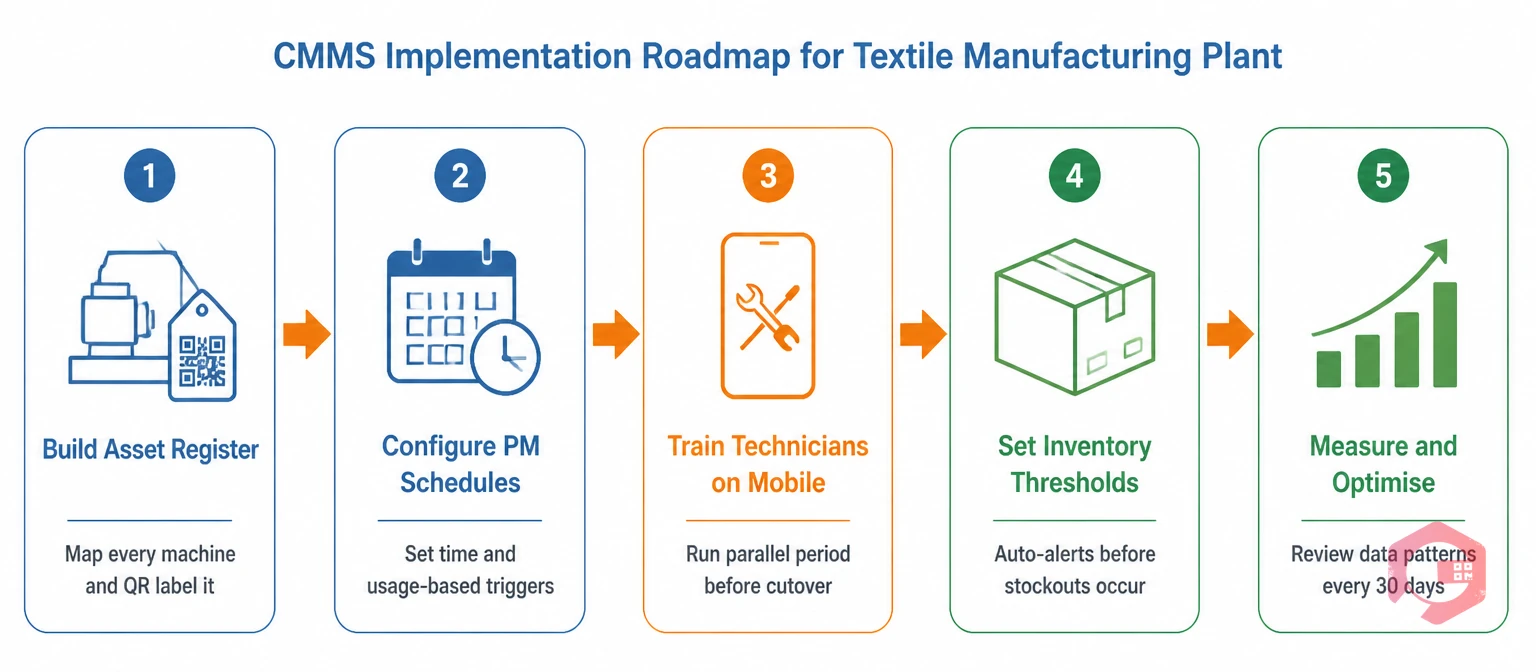
Implementing a CMMS in a textile environment does not require a massive IT project or months of production disruption. A phased approach — starting with your most critical assets and expanding outward — delivers early results while building team confidence in the new system.
Cryotos is built for high-intensity manufacturing environments where machine count is high, shifts run continuously, and downtime has immediate commercial consequences. Textile manufacturing is exactly this environment, and Cryotos addresses its specific challenges with purpose-built features.
Preventive maintenance in Cryotos supports both static PM (calendar-based: daily lubrication, weekly belt checks) and dynamic PM (usage-based: traveller replacement after spindle hours, chain service after fabric metres). Complex scheduling conditions — "service every 200 hours OR 30 days, whichever comes first" — are configured without code. Work order management allows technicians to raise faults by voice command or photo — valuable in noisy spinning and weaving sections where typing is impractical. The AI layer classifies the fault, links it to the correct asset, and pre-populates the relevant checklist automatically.
The mobile app operates in full offline mode, syncing when connectivity is restored. This matters in textile plants where cellular coverage can be patchy on machine floors surrounded by metal structures. Technicians in the most remote plant sections never lose access to work orders, checklists, or asset histories.
Textile manufacturers using Cryotos report a 30% reduction in unplanned downtime and 25% faster repair times. These outcomes reflect the combined impact of structured PM compliance, faster fault response through mobile work orders, and parts availability guaranteed by proactive inventory management. The shift from reactive firefighting to planned, data-driven maintenance is measurable — and it compounds over time as the CMMS data builds into a richer decision-making foundation.
Cryotos can be configured and operational within 4–6 weeks for a mid-size mill. The initial setup — asset register, PM schedules, inventory thresholds — is structured through a guided onboarding process that maps the system to your specific machine inventory and production environment. Schedule a free demo to see how Cryotos maps to your specific machines, shifts, and compliance requirements.
A CMMS (Computerized Maintenance Management System) centralises all maintenance operations — work orders, preventive schedules, asset tracking, spare parts, and reporting — in a single platform. For textile manufacturers, it eliminates paper-based maintenance logs, reduces unplanned breakdowns by enabling proactive maintenance, and provides the digital audit trail needed for ISO 9001, GOTS, and buyer compliance requirements. Plants using a CMMS consistently report 25–40% reductions in unplanned downtime within the first year.
The highest-priority assets are ring frames and open-end spinning machines (spindle bearing wear is progressive and detectable early), rapier and air-jet looms (cam and crank mechanisms degrade with high downstream consequence), carding machines (wire clothing wear cascades to spinning and winding), and stenter machines (chain failure damages fabric and halts the finishing line). These assets have the greatest production impact when they fail and the most detectable failure signatures.
A cloud-based CMMS like Cryotos can be operational within 4–6 weeks for a mid-size textile plant. The critical path is the asset register — building the digital inventory of all machines, utilities, and HVAC systems. Most platforms support Excel import, which accelerates this significantly if you already have a machine list. Full adoption across all shifts typically follows within 30 days of go-live.
Yes — this is one of the most immediate operational benefits. A CMMS automatically generates timestamped, user-attributed maintenance records for every work order completed. When an ISO auditor or export buyer requests evidence of maintenance compliance, the CMMS exports a complete maintenance history in minutes. The manual documentation effort that previously took days before an audit is reduced to a two-minute report export.
Yes. Modern cloud-based CMMS platforms scale from small single-section operations to large multi-plant textile groups. Small mills — even those with 50–100 machines — benefit immediately from organised PM schedules, digital work orders, and inventory alerts, without needing a dedicated IT team or complex infrastructure. The ROI tends to be proportionally faster for smaller operations because every hour of reduced downtime represents a higher percentage of total available production capacity.

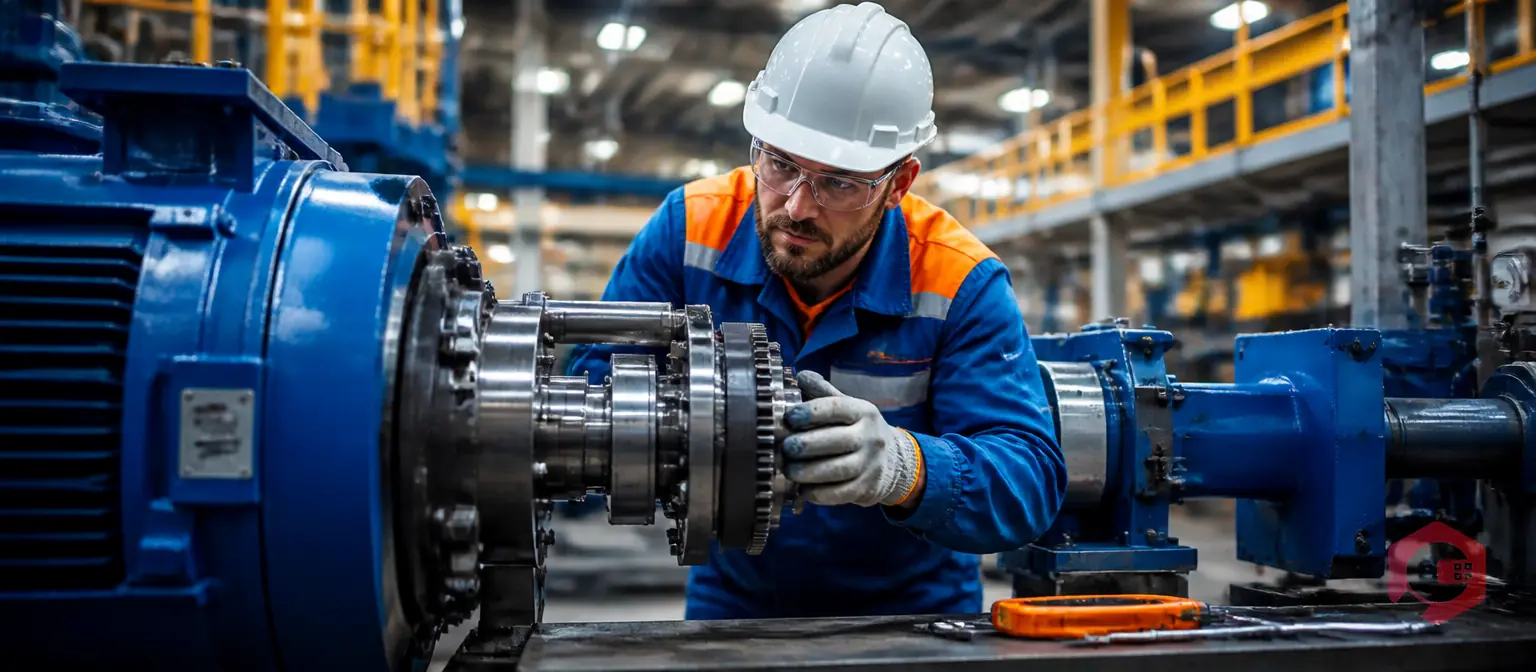


Cryotos AI predicts failures, automates work orders, and simplifies maintenance—before problems slow you down.



