

TPM and autonomous care eliminate chronic failures by giving machine operators direct ownership of basic equipment care — cleaning, inspection, lubrication, and tightening — so that the small deterioration signals that cause repeat breakdowns are caught and corrected before they escalate. According to Reliable Plant, plants that implement Total Productive Maintenance correctly report up to a 30% reduction in unplanned downtime within the first 12 months.
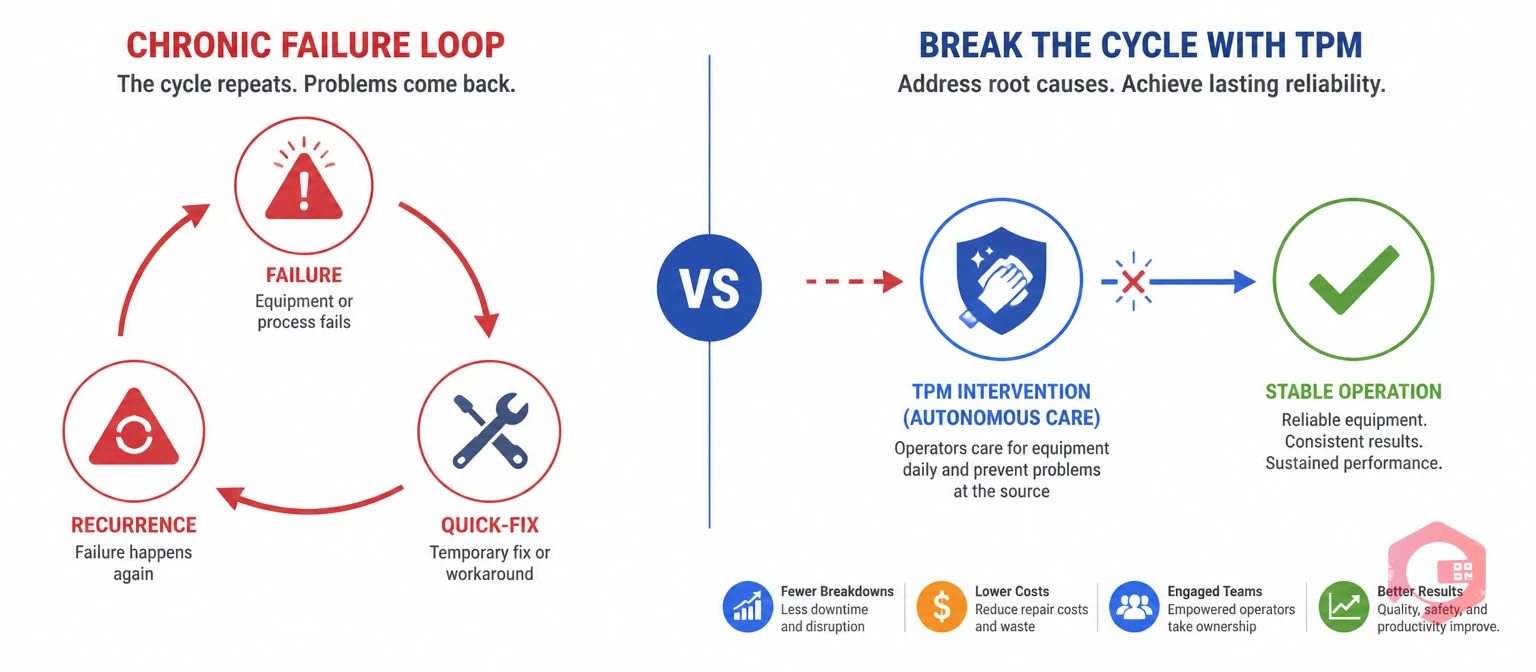
Chronic failures are low-severity equipment problems that happen repeatedly, often at irregular intervals, and rarely receive a definitive fix because each individual event seems manageable. A conveyor belt that slips every two weeks, a pump seal that leaks every month, a CNC spindle that overheats under load three times per quarter — these are chronic failures. They are not catastrophic. They are grinding.
The reason chronic failures persist is almost always that the underlying cause is never fully eliminated. Research from the Plant Engineering community consistently shows that 70–80% of unplanned downtime in manufacturing comes from a small number of recurring failure modes — the chronic failures — not from rare catastrophic events.
Autonomous maintenance — known in Japanese as Jishu Hozen — is the first and most foundational pillar of Total Productive Maintenance (TPM). Its core principle is that the people who operate machines every shift are best positioned to detect the early signs of deterioration, because they interact with that equipment constantly and know what "normal" looks, sounds, and feels like.
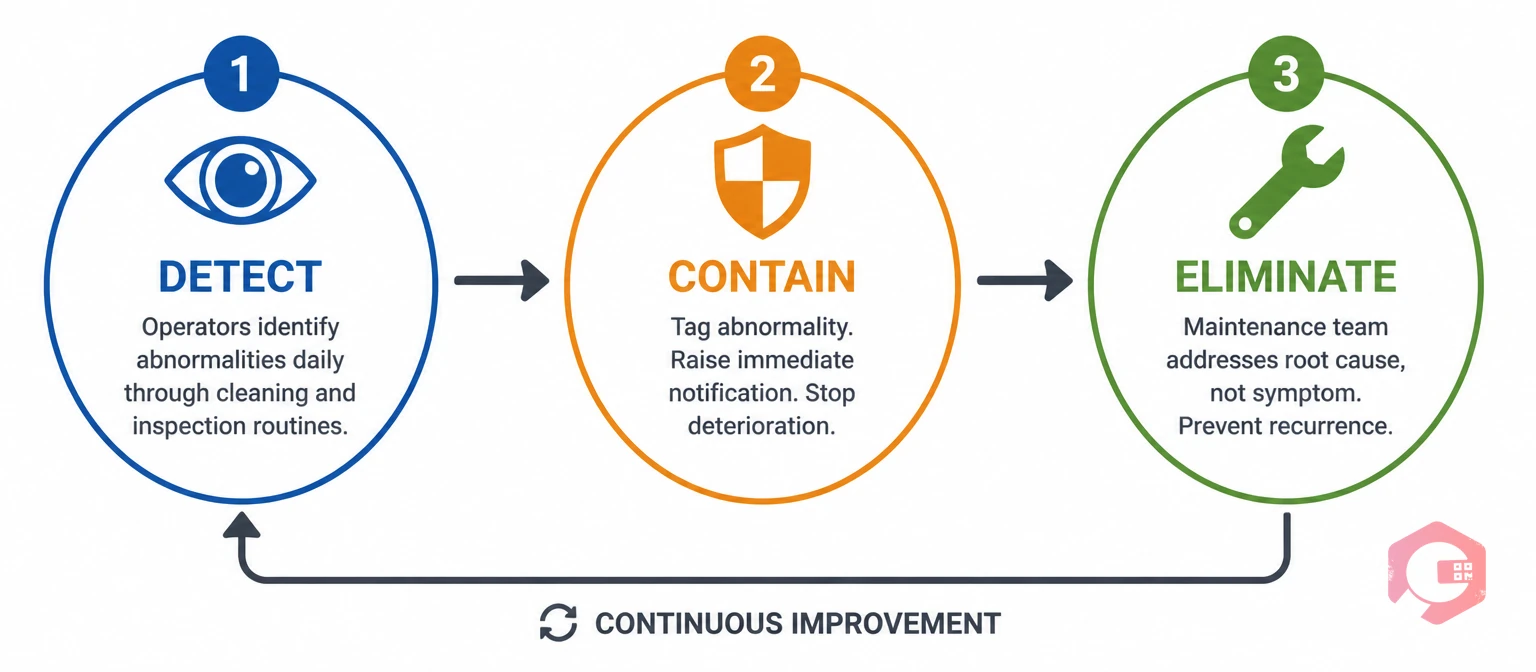
Chronic failures in manufacturing almost always originate from one of three sources: forced deterioration, ignored minor defects, or equipment operating outside its basic conditions. Autonomous maintenance addresses all three directly — which is why it consistently outperforms reactive repair strategies for eliminating repeat breakdowns.
Natural deterioration is wear that happens over time, even with proper care. Forced deterioration is wear caused by poor operating conditions: contamination, inadequate lubrication, loose fasteners creating vibration, or operators running equipment beyond its design limits. Studies in TPM-implementing plants show that 70–80% of equipment deterioration is forced, not natural.
TPM frames all equipment losses — downtime, speed losses, quality defects — through the Overall Equipment Effectiveness (OEE) framework. OEE measures three things: availability (is the machine running when it's supposed to?), performance (is it running at the right speed?), and quality (is it producing good parts?). Chronic failures attack all three.
TPM's response to chronic losses is systematic. First, losses are quantified and categorized using OEE data. Second, the assets generating the most chronic losses are prioritized for autonomous maintenance improvement activities. Third, the root causes of those losses are traced using root cause analysis, not just repaired. Fourth, countermeasures are implemented, standardized, and sustained through updated autonomous maintenance procedures.
Successfully implementing autonomous maintenance requires more than distributing cleaning rags and inspection checklists. The change is cultural as much as procedural. Operators need to genuinely believe that machine ownership is part of their role — not an add-on imposed by management.
Cryotos CMMS supports autonomous maintenance programs in four specific ways. First, operators can submit work requests directly from the shop floor using a mobile device or QR code scan. Second, Cryotos's maintenance checklists module allows AM inspection routines to be digitized. Third, the BI Dashboard tracks which assets are generating the most operator-detected abnormalities. Fourth, Cryotos's built-in Five Whys RCA tool allows root cause analysis to be documented directly in the work order. Customers using Cryotos have reported a 30% reduction in downtime and 25% faster repair times.
Preventive maintenance is performed by maintenance technicians on a scheduled basis. Autonomous maintenance is performed by machine operators on a continuous basis as part of their daily work. The two complement each other: AM keeps equipment in baseline condition between PM intervals, and PM technicians perform the more complex technical tasks operators aren't trained for.
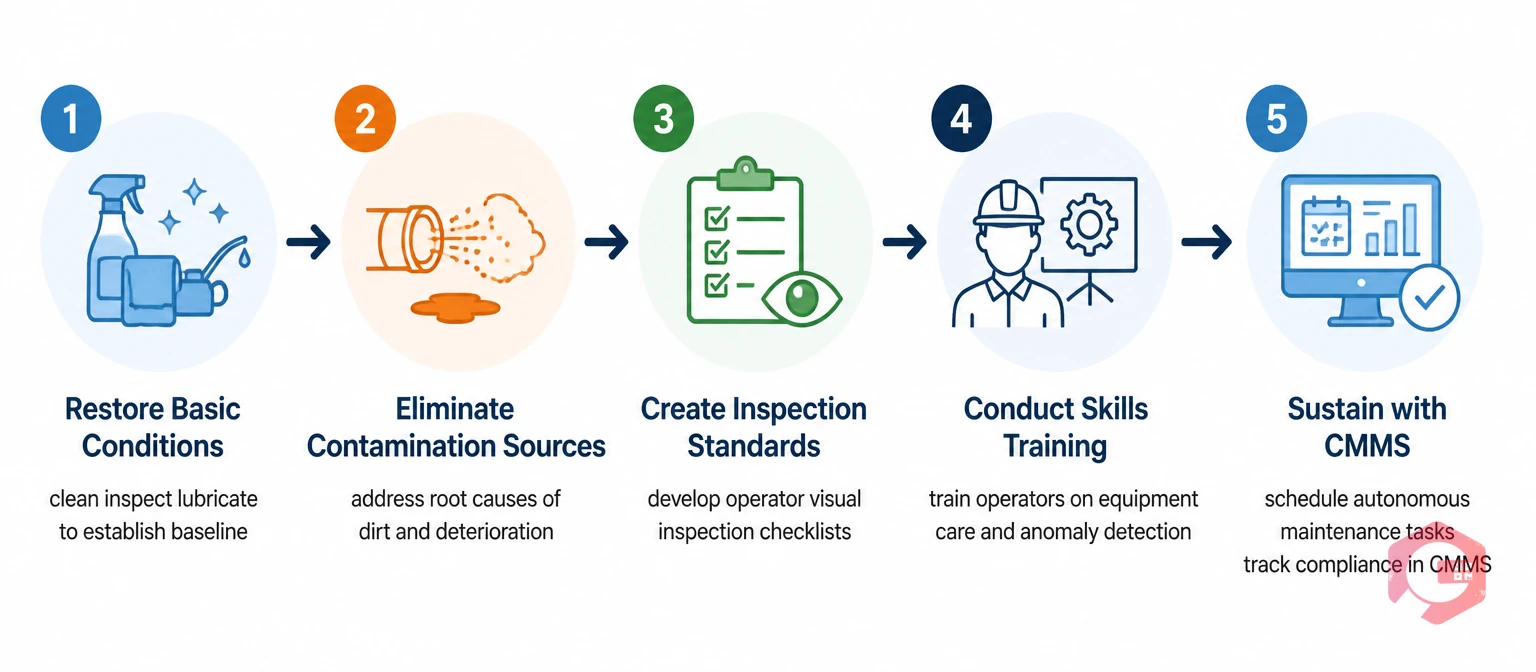
Most plants see measurable reductions in chronic failure frequency within 3–6 months of completing Steps 1 and 2 for their highest-priority assets.
Yes — many plants have run successful AM programs with paper-based tag systems and handwritten logs. However, a CMMS like Cryotos closes these gaps by converting operator observations directly into tracked work orders and providing the OEE and failure trend data that shows whether AM is working.
If your maintenance team is fighting chronic failures that keep returning despite repairs, the problem isn't your technicians — it's the absence of the operator-led basic care that eliminates forced deterioration before it becomes a failure. Book a free demo today and see how Cryotos supports your TPM autonomous maintenance program from operator observation to resolved root cause.



Cryotos AI predicts failures, automates work orders, and simplifies maintenance—before problems slow you down.



