A tyre manufacturing plant runs on precision. Every compound mix, every cure cycle, every press stroke must be executed within exact tolerances - and the equipment that drives these processes operates under some of the harshest conditions in industrial manufacturing. When a banbury mixer goes down unexpectedly or a curing press misses its temperature window, the result is not just lost production time. It is wasted compound, failed batches, and a domino effect across the entire line. A CMMS for tyre manufacturing industry environments solves exactly this problem by replacing reactive chaos with structured, data-driven maintenance management.
Tyre manufacturing is not a standard process industry. It combines high-temperature chemical processing, precision mechanical operations, and high-volume repetitive production - all within a single facility. The compounds used (natural rubber, synthetic rubber, carbon black, sulfur, and accelerators) are temperature-sensitive, time-critical, and expensive to waste. A batch of misprocessed compound due to equipment downtime cannot simply be restarted - it is scrapped, adding direct material cost to the already painful production loss.
The maintenance challenges in a tyre plant are compounded by the sheer diversity of equipment. A single plant operates banbury internal mixers, two-roll mills, extruders, calenders, bead winders, tyre building machines, curing presses, and vulcanizers - each with its own maintenance schedule, failure modes, and criticality level. Managing all of this without a centralized system is, in practice, impossible at scale. Teams end up relying on tribal knowledge, paper logbooks, and verbal handovers - and predictable failures happen unpredictably.
The industry is also under increasing competitive pressure. Global tyre manufacturers like Michelin, Bridgestone, and MRF have invested heavily in Total Productive Maintenance (TPM) frameworks. For mid-tier and regional tyre producers, a CMMS provides the most practical path to achieving similar levels of equipment reliability without the enormous TPM implementation overhead.
Understanding the specific equipment in a tyre plant is the starting point for any CMMS implementation. Each machine has a different failure profile, and the maintenance approach must match.
Banbury mixers are the heart of compound preparation. They operate at high temperatures and pressures, mixing rubber with chemicals for precise durations. The rotors, ram, and cooling jacket are subject to heavy wear and thermal stress. Seal failures in the rotor shaft are among the most common causes of unplanned downtime. A CMMS can track rotor hour usage, schedule seal inspections, and automate work orders when temperature or pressure deviates from baseline - preventing compound contamination and costly mixer downtime.
Curing presses are where the tyre gets its final shape and properties through vulcanization - a heat and pressure process that bonds rubber molecules. A failed press mid-cycle results in an uncured tyre that must be scrapped. The bladder, mold, and hydraulic system all require regular attention. Bladder life is typically tracked by cure cycles rather than calendar time, making usage-based PM scheduling essential. A CMMS that supports dynamic scheduling by cycle count rather than fixed intervals is critical for this equipment.
Calenders produce the rubber sheets used in tyre construction, while extruders shape the tread and sidewall profiles. Both machines have roll surfaces, drive gears, and bearings that degrade gradually under continuous use. Roll surface condition directly affects product quality - even minor wear causes thickness variation that fails quality checks. Scheduling regular roll inspections and maintaining accurate service history in a CMMS enables early detection of degradation before it affects product specifications.
TBMs are highly automated machines that assemble the raw tyre components. Pneumatic systems, stitching rollers, and turn-up bladders are subject to rapid wear at high production speeds. A breakdown on a TBM halts an entire production line. Preventive maintenance intervals here are typically set in cycles (number of tyres built) rather than hours, and CMMS systems that support meter-based PM triggers are best suited to this environment.
A CMMS does not simply digitize paper logbooks. When implemented correctly in a tyre manufacturing environment, it fundamentally changes how maintenance is planned, executed, and learned from.
The most immediate impact is the shift from reactive to preventive maintenance. Instead of waiting for a press to fail, maintenance teams receive automated work orders based on cure cycle counts, operating hours, or time intervals. Technicians arrive at the equipment with the right checklist, the right parts, and the full service history of the machine. First-time fix rates improve, and equipment downtime falls significantly.
Beyond scheduling, a CMMS creates institutional knowledge that survives staff turnover. In tyre plants, experienced technicians carry years of equipment-specific knowledge in their heads - which machines tend to fail at which intervals, which failure modes are early warning signs, which spare parts are most commonly needed. A CMMS captures this knowledge in work order records, failure codes, and root cause analysis logs. When a senior technician leaves, the knowledge stays.
The inventory management dimension is equally important. Tyre plants use a wide range of specialized spare parts - press bladders, mixer rotor seals, calender roll bearings - that are expensive, have long lead times, and are not interchangeable between machines. A CMMS linked to inventory ensures that critical spares are on hand before scheduled maintenance, and alerts are triggered before stock falls below minimum levels. Emergency procurement - at premium prices and with production on hold - becomes the exception rather than the rule.

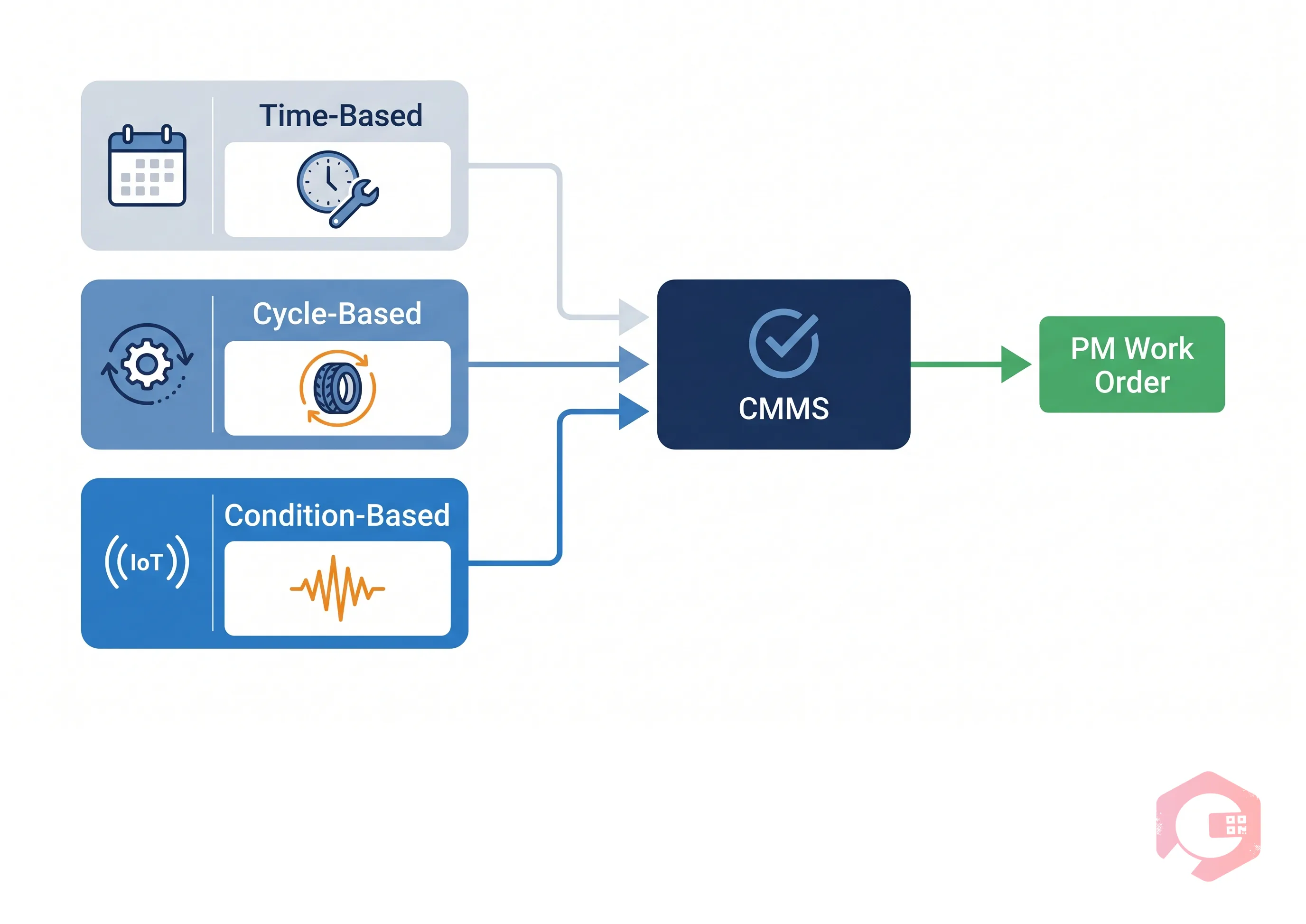
Effective preventive maintenance in a tyre plant requires two types of scheduling that must run in parallel: time-based and usage-based.
Time-based maintenance handles lubrication, fluid changes, filter replacements, and safety inspections that are best governed by calendar intervals regardless of production volume. Weekly greasing of conveyor bearings, monthly hydraulic fluid sampling, and quarterly electrical inspections fall into this category. A CMMS automates these schedules and sends technicians timely reminders, ensuring nothing slips through the cracks during high-volume production runs.
Usage-based maintenance is where tyre plants differ from most other industries. Because the intensity of equipment use varies considerably - a curing press running three shifts produces far more wear per day than one running a single shift - scheduling purely on calendar time results in both over-maintenance (replacing parts too early) and under-maintenance (missing failures between service intervals). A CMMS that supports meter readings from production counters, cycle trackers, and running hour logs provides the precision that tyre plant maintenance demands.
The combination of these two approaches, configured correctly in a CMMS, produces a maintenance plan that is both comprehensive and efficient. Technicians spend their time on work that needs to be done - not on unnecessary services, and not scrambling to respond to breakdowns that a better schedule would have prevented.

Modern tyre plants are increasingly equipped with sensors that monitor temperature, pressure, vibration, and power consumption across critical assets. These sensors generate continuous streams of operational data that, without the right software, remain unread and unused. A CMMS integrated with IoT sensors converts this data into actionable maintenance intelligence.
For curing presses, temperature sensors can alert maintenance teams when a press is not reaching its target cure temperature within the expected ramp time - an early indicator of a heating element failure or steam supply issue. For banbury mixers, vibration sensors on the rotor bearings can detect emerging bearing damage weeks before it becomes a catastrophic failure. For hydraulic systems, pressure sensors can flag slowly declining pressure that signals a developing seal leak.
When these sensor alerts are connected directly to a CMMS, the system automatically generates work orders with the relevant asset history, assigns them to available technicians, and tracks response and resolution time. The entire cycle from fault detection to repair completion is managed without manual intervention. Cryotos CMMS connects directly to SCADA systems, PLCs, and edge devices, enabling this level of integrated condition-based maintenance in tyre manufacturing environments.

Tyre manufacturers operate under a demanding compliance environment. IATF 16949 (the automotive quality management standard) requires documented maintenance procedures, calibration records, and evidence of preventive maintenance compliance. QS-9000 and BIS requirements in India add further documentation obligations for domestic manufacturers. In export markets, tyres must meet ECE, DOT, or other regional standards that trace quality assurance back through the manufacturing process - including equipment maintenance records.
A CMMS provides the audit-ready documentation that these compliance frameworks require. Every work order completed is time-stamped, technician-signed, and stored with the relevant asset record. Calibration due dates for gauges and test equipment are tracked and alert maintenance teams before expiry. When a quality auditor requests the maintenance history for a specific curing press over the past year, a CMMS can produce that report in seconds - not the hours or days it would take to reconstruct from paper records.
Beyond formal compliance, equipment maintenance records directly support root cause analysis when a quality defect is traced back to a production batch. If a batch of tyres fails uniformity testing, the CMMS record for the tyre building machines used during that production window provides immediate insight into whether equipment condition was a contributing factor.

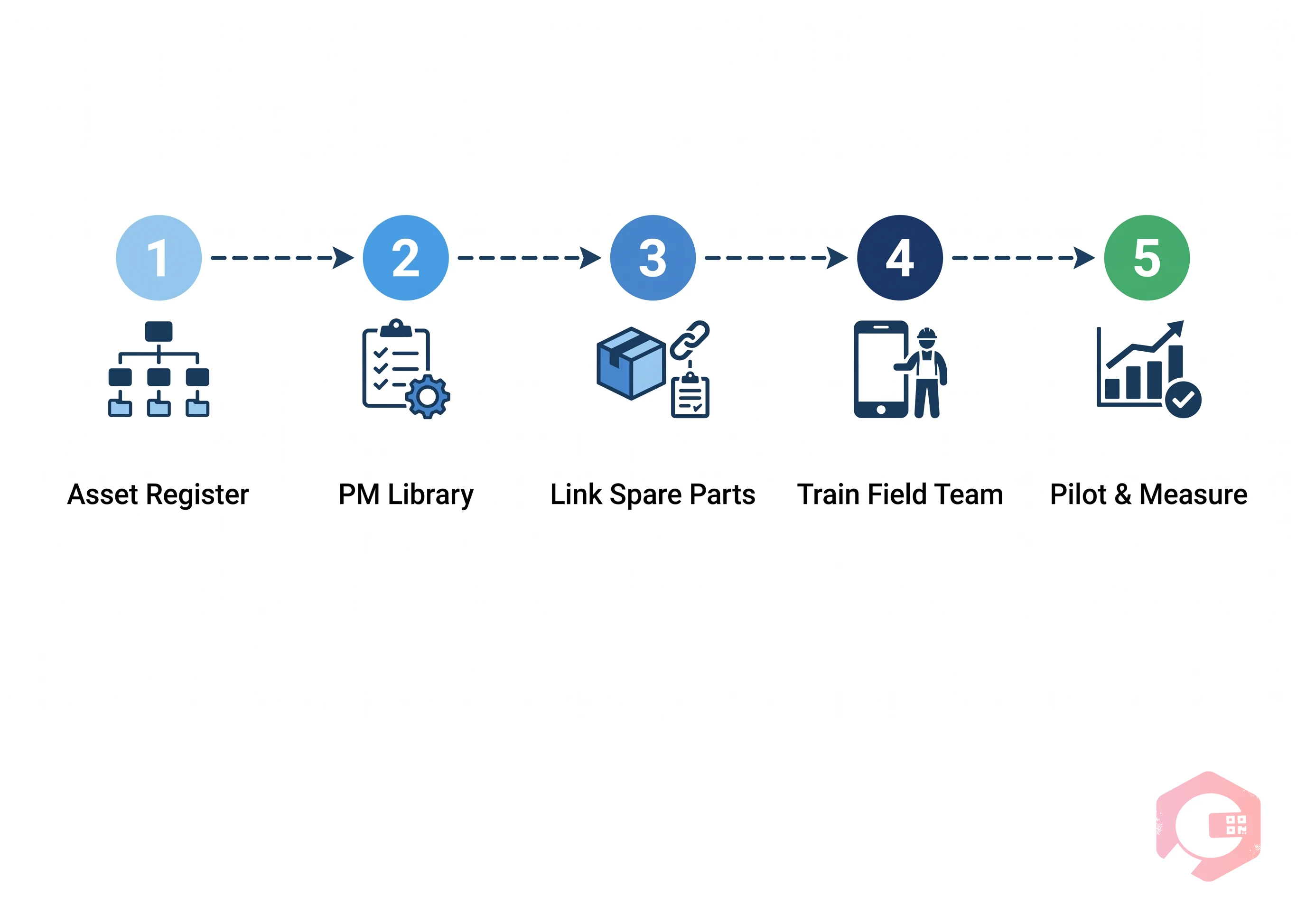
A successful CMMS implementation in a tyre plant follows a structured sequence. Rushing the setup phase creates data quality problems that undermine the system's value for months afterward.
The first step is asset inventory and hierarchy setup. Every piece of production and utility equipment needs to be identified, assigned a unique code, and placed within the plant hierarchy - from plant level down to department, line, machine, and component. This hierarchy enables cost tracking, failure analysis, and reporting at the appropriate level of detail. For a tyre plant, a typical hierarchy might look like: Plant ? Compounding Department ? Banbury Line 1 ? Banbury Mixer ? Rotor Assembly.
The second step is building the PM schedule library. For each asset, maintenance tasks are defined with their triggers (time, cycles, or condition), checklists, required tools, and estimated labor hours. This is best done in collaboration with experienced technicians who know the equipment, not just from OEM manuals. The OEM intervals are a starting point; real-world experience in your specific production environment refines them.
The third step is spare parts linkage. Each PM task should be linked to the spare parts it consumes, so inventory is automatically checked and reserved when work orders are generated. This prevents the frustrating scenario where a scheduled service cannot be completed because a critical part is out of stock.
The fourth step is technician training and mobile deployment. A CMMS is only as good as the data its users enter. Training technicians on mobile work order completion - including how to select failure codes, attach photos, and document root causes - determines whether the system builds useful historical data or becomes a glorified to-do list.
Cryotos is built for the demands of asset-intensive manufacturing environments, and its capabilities align closely with what tyre plant maintenance teams need. The platform supports both time-based and usage-based (meter-driven) PM scheduling, making it directly applicable to cure cycle tracking, press bladder life management, and production-counter-triggered maintenance.
The mobile-first design means that technicians on the plant floor can receive work orders, access equipment manuals, complete checklists, and log findings without returning to a central terminal. Offline capability ensures that maintenance activities in areas with poor connectivity are captured and synced automatically when the device reconnects. For tyre plants with large facilities and multiple buildings, this is a practical necessity, not a luxury.
Cryotos integrates with IoT devices and SCADA systems, enabling condition-based alerts from curing press temperature sensors and banbury mixer vibration monitors to automatically generate prioritized work orders. The built-in 5 Whys root cause analysis module prompts technicians to document the underlying cause of failures - not just the symptom - building a failure history that continuously improves PM intervals and reliability outcomes.
The inventory management module tracks spare parts down to bin level, sets minimum stock alerts for critical items like press bladders and mixer seals, and links parts consumption directly to work orders for accurate cost tracking. The BI dashboard gives maintenance managers and plant heads real-time visibility into MTBF, MTTR, downtime by asset and department, and PM compliance rates - the metrics that drive continuous improvement in tyre plant reliability.
Organizations using Cryotos have reported up to 30% reduction in equipment downtime and 25% faster repair times. For tyre manufacturers where every hour of press downtime translates directly to lost production volume, these are not marginal improvements - they are the difference between a profitable plant and one that is permanently in firefighting mode.
Ready to move your tyre plant from reactive maintenance to proactive reliability? Schedule a free Cryotos demo and see how leading manufacturers are transforming their maintenance operations.
The highest-value CMMS applications in tyre manufacturing are curing presses, banbury internal mixers, tyre building machines, and calenders - equipment where unplanned downtime causes production loss, compound waste, or quality failures. These assets have complex maintenance schedules that are best managed through a combination of time-based and cycle-based PM triggers, which a CMMS automates reliably.
A CMMS with meter-based PM scheduling can receive production counter data from curing presses - either manually entered or automatically via IoT integration - and trigger maintenance work orders when a press reaches a defined number of cure cycles. This ensures that bladder inspections, mold cleaning, and hydraulic checks happen at the right usage intervals, not on an arbitrary calendar date that may come too early or too late.
Yes. IATF 16949 requires documented evidence of preventive maintenance procedures, calibration records, and maintenance history for production equipment. A CMMS creates this audit trail automatically - every work order is time-stamped, technician-attributed, and stored against the relevant asset record. Compliance reports that would take days to assemble from paper records can be generated in minutes from a CMMS.
ROI in tyre manufacturing typically comes from three sources: reduced unplanned downtime (which directly impacts production output), lower emergency repair costs (parts and labor at premium rates), and extended asset life through consistent preventive maintenance. Most tyre manufacturers see measurable improvement within the first three to six months of implementation, with full ROI typically achieved within 12 to 18 months.
Cryotos integrates with SCADA systems, PLCs, ERP platforms including SAP and Microsoft Dynamics 365, and IoT edge devices. For tyre manufacturers, this means that production counter data, sensor alerts, and equipment status can flow directly into the CMMS without manual data entry, enabling true condition-based and predictive maintenance at scale.
A tyre manufacturing plant runs on precision. Every compound mix, every cure cycle, every press stroke must be executed within exact tolerances - and the equipment that drives these processes operates under some of the harshest conditions in industrial manufacturing. When a banbury mixer goes down unexpectedly or a curing press misses its temperature window, the result is not just lost production time. It is wasted compound, failed batches, and a domino effect across the entire line. A CMMS for tyre manufacturing industry environments solves exactly this problem by replacing reactive chaos with structured, data-driven maintenance management.
Tyre manufacturing is not a standard process industry. It combines high-temperature chemical processing, precision mechanical operations, and high-volume repetitive production - all within a single facility. The compounds used (natural rubber, synthetic rubber, carbon black, sulfur, and accelerators) are temperature-sensitive, time-critical, and expensive to waste. A batch of misprocessed compound due to equipment downtime cannot simply be restarted - it is scrapped, adding direct material cost to the already painful production loss.
The maintenance challenges in a tyre plant are compounded by the sheer diversity of equipment. A single plant operates banbury internal mixers, two-roll mills, extruders, calenders, bead winders, tyre building machines, curing presses, and vulcanizers - each with its own maintenance schedule, failure modes, and criticality level. Managing all of this without a centralized system is, in practice, impossible at scale. Teams end up relying on tribal knowledge, paper logbooks, and verbal handovers - and predictable failures happen unpredictably.
The industry is also under increasing competitive pressure. Global tyre manufacturers like Michelin, Bridgestone, and MRF have invested heavily in Total Productive Maintenance (TPM) frameworks. For mid-tier and regional tyre producers, a CMMS provides the most practical path to achieving similar levels of equipment reliability without the enormous TPM implementation overhead.
Understanding the specific equipment in a tyre plant is the starting point for any CMMS implementation. Each machine has a different failure profile, and the maintenance approach must match.
Banbury mixers are the heart of compound preparation. They operate at high temperatures and pressures, mixing rubber with chemicals for precise durations. The rotors, ram, and cooling jacket are subject to heavy wear and thermal stress. Seal failures in the rotor shaft are among the most common causes of unplanned downtime. A CMMS can track rotor hour usage, schedule seal inspections, and automate work orders when temperature or pressure deviates from baseline - preventing compound contamination and costly mixer downtime.
Curing presses are where the tyre gets its final shape and properties through vulcanization - a heat and pressure process that bonds rubber molecules. A failed press mid-cycle results in an uncured tyre that must be scrapped. The bladder, mold, and hydraulic system all require regular attention. Bladder life is typically tracked by cure cycles rather than calendar time, making usage-based PM scheduling essential. A CMMS that supports dynamic scheduling by cycle count rather than fixed intervals is critical for this equipment.
Calenders produce the rubber sheets used in tyre construction, while extruders shape the tread and sidewall profiles. Both machines have roll surfaces, drive gears, and bearings that degrade gradually under continuous use. Roll surface condition directly affects product quality - even minor wear causes thickness variation that fails quality checks. Scheduling regular roll inspections and maintaining accurate service history in a CMMS enables early detection of degradation before it affects product specifications.
TBMs are highly automated machines that assemble the raw tyre components. Pneumatic systems, stitching rollers, and turn-up bladders are subject to rapid wear at high production speeds. A breakdown on a TBM halts an entire production line. Preventive maintenance intervals here are typically set in cycles (number of tyres built) rather than hours, and CMMS systems that support meter-based PM triggers are best suited to this environment.
A CMMS does not simply digitize paper logbooks. When implemented correctly in a tyre manufacturing environment, it fundamentally changes how maintenance is planned, executed, and learned from.
The most immediate impact is the shift from reactive to preventive maintenance. Instead of waiting for a press to fail, maintenance teams receive automated work orders based on cure cycle counts, operating hours, or time intervals. Technicians arrive at the equipment with the right checklist, the right parts, and the full service history of the machine. First-time fix rates improve, and equipment downtime falls significantly.
Beyond scheduling, a CMMS creates institutional knowledge that survives staff turnover. In tyre plants, experienced technicians carry years of equipment-specific knowledge in their heads - which machines tend to fail at which intervals, which failure modes are early warning signs, which spare parts are most commonly needed. A CMMS captures this knowledge in work order records, failure codes, and root cause analysis logs. When a senior technician leaves, the knowledge stays.
The inventory management dimension is equally important. Tyre plants use a wide range of specialized spare parts - press bladders, mixer rotor seals, calender roll bearings - that are expensive, have long lead times, and are not interchangeable between machines. A CMMS linked to inventory ensures that critical spares are on hand before scheduled maintenance, and alerts are triggered before stock falls below minimum levels. Emergency procurement - at premium prices and with production on hold - becomes the exception rather than the rule.

Effective preventive maintenance in a tyre plant requires two types of scheduling that must run in parallel: time-based and usage-based.
Time-based maintenance handles lubrication, fluid changes, filter replacements, and safety inspections that are best governed by calendar intervals regardless of production volume. Weekly greasing of conveyor bearings, monthly hydraulic fluid sampling, and quarterly electrical inspections fall into this category. A CMMS automates these schedules and sends technicians timely reminders, ensuring nothing slips through the cracks during high-volume production runs.
Usage-based maintenance is where tyre plants differ from most other industries. Because the intensity of equipment use varies considerably - a curing press running three shifts produces far more wear per day than one running a single shift - scheduling purely on calendar time results in both over-maintenance (replacing parts too early) and under-maintenance (missing failures between service intervals). A CMMS that supports meter readings from production counters, cycle trackers, and running hour logs provides the precision that tyre plant maintenance demands.
The combination of these two approaches, configured correctly in a CMMS, produces a maintenance plan that is both comprehensive and efficient. Technicians spend their time on work that needs to be done - not on unnecessary services, and not scrambling to respond to breakdowns that a better schedule would have prevented.

Modern tyre plants are increasingly equipped with sensors that monitor temperature, pressure, vibration, and power consumption across critical assets. These sensors generate continuous streams of operational data that, without the right software, remain unread and unused. A CMMS integrated with IoT sensors converts this data into actionable maintenance intelligence.
For curing presses, temperature sensors can alert maintenance teams when a press is not reaching its target cure temperature within the expected ramp time - an early indicator of a heating element failure or steam supply issue. For banbury mixers, vibration sensors on the rotor bearings can detect emerging bearing damage weeks before it becomes a catastrophic failure. For hydraulic systems, pressure sensors can flag slowly declining pressure that signals a developing seal leak.
When these sensor alerts are connected directly to a CMMS, the system automatically generates work orders with the relevant asset history, assigns them to available technicians, and tracks response and resolution time. The entire cycle from fault detection to repair completion is managed without manual intervention. Cryotos CMMS connects directly to SCADA systems, PLCs, and edge devices, enabling this level of integrated condition-based maintenance in tyre manufacturing environments.

Tyre manufacturers operate under a demanding compliance environment. IATF 16949 (the automotive quality management standard) requires documented maintenance procedures, calibration records, and evidence of preventive maintenance compliance. QS-9000 and BIS requirements in India add further documentation obligations for domestic manufacturers. In export markets, tyres must meet ECE, DOT, or other regional standards that trace quality assurance back through the manufacturing process - including equipment maintenance records.
A CMMS provides the audit-ready documentation that these compliance frameworks require. Every work order completed is time-stamped, technician-signed, and stored with the relevant asset record. Calibration due dates for gauges and test equipment are tracked and alert maintenance teams before expiry. When a quality auditor requests the maintenance history for a specific curing press over the past year, a CMMS can produce that report in seconds - not the hours or days it would take to reconstruct from paper records.
Beyond formal compliance, equipment maintenance records directly support root cause analysis when a quality defect is traced back to a production batch. If a batch of tyres fails uniformity testing, the CMMS record for the tyre building machines used during that production window provides immediate insight into whether equipment condition was a contributing factor.

A successful CMMS implementation in a tyre plant follows a structured sequence. Rushing the setup phase creates data quality problems that undermine the system's value for months afterward.
The first step is asset inventory and hierarchy setup. Every piece of production and utility equipment needs to be identified, assigned a unique code, and placed within the plant hierarchy - from plant level down to department, line, machine, and component. This hierarchy enables cost tracking, failure analysis, and reporting at the appropriate level of detail. For a tyre plant, a typical hierarchy might look like: Plant ? Compounding Department ? Banbury Line 1 ? Banbury Mixer ? Rotor Assembly.
The second step is building the PM schedule library. For each asset, maintenance tasks are defined with their triggers (time, cycles, or condition), checklists, required tools, and estimated labor hours. This is best done in collaboration with experienced technicians who know the equipment, not just from OEM manuals. The OEM intervals are a starting point; real-world experience in your specific production environment refines them.
The third step is spare parts linkage. Each PM task should be linked to the spare parts it consumes, so inventory is automatically checked and reserved when work orders are generated. This prevents the frustrating scenario where a scheduled service cannot be completed because a critical part is out of stock.
The fourth step is technician training and mobile deployment. A CMMS is only as good as the data its users enter. Training technicians on mobile work order completion - including how to select failure codes, attach photos, and document root causes - determines whether the system builds useful historical data or becomes a glorified to-do list.
Cryotos is built for the demands of asset-intensive manufacturing environments, and its capabilities align closely with what tyre plant maintenance teams need. The platform supports both time-based and usage-based (meter-driven) PM scheduling, making it directly applicable to cure cycle tracking, press bladder life management, and production-counter-triggered maintenance.
The mobile-first design means that technicians on the plant floor can receive work orders, access equipment manuals, complete checklists, and log findings without returning to a central terminal. Offline capability ensures that maintenance activities in areas with poor connectivity are captured and synced automatically when the device reconnects. For tyre plants with large facilities and multiple buildings, this is a practical necessity, not a luxury.
Cryotos integrates with IoT devices and SCADA systems, enabling condition-based alerts from curing press temperature sensors and banbury mixer vibration monitors to automatically generate prioritized work orders. The built-in 5 Whys root cause analysis module prompts technicians to document the underlying cause of failures - not just the symptom - building a failure history that continuously improves PM intervals and reliability outcomes.
The inventory management module tracks spare parts down to bin level, sets minimum stock alerts for critical items like press bladders and mixer seals, and links parts consumption directly to work orders for accurate cost tracking. The BI dashboard gives maintenance managers and plant heads real-time visibility into MTBF, MTTR, downtime by asset and department, and PM compliance rates - the metrics that drive continuous improvement in tyre plant reliability.
Organizations using Cryotos have reported up to 30% reduction in equipment downtime and 25% faster repair times. For tyre manufacturers where every hour of press downtime translates directly to lost production volume, these are not marginal improvements - they are the difference between a profitable plant and one that is permanently in firefighting mode.
Ready to move your tyre plant from reactive maintenance to proactive reliability? Schedule a free Cryotos demo and see how leading manufacturers are transforming their maintenance operations.
The highest-value CMMS applications in tyre manufacturing are curing presses, banbury internal mixers, tyre building machines, and calenders - equipment where unplanned downtime causes production loss, compound waste, or quality failures. These assets have complex maintenance schedules that are best managed through a combination of time-based and cycle-based PM triggers, which a CMMS automates reliably.
A CMMS with meter-based PM scheduling can receive production counter data from curing presses - either manually entered or automatically via IoT integration - and trigger maintenance work orders when a press reaches a defined number of cure cycles. This ensures that bladder inspections, mold cleaning, and hydraulic checks happen at the right usage intervals, not on an arbitrary calendar date that may come too early or too late.
Yes. IATF 16949 requires documented evidence of preventive maintenance procedures, calibration records, and maintenance history for production equipment. A CMMS creates this audit trail automatically - every work order is time-stamped, technician-attributed, and stored against the relevant asset record. Compliance reports that would take days to assemble from paper records can be generated in minutes from a CMMS.
ROI in tyre manufacturing typically comes from three sources: reduced unplanned downtime (which directly impacts production output), lower emergency repair costs (parts and labor at premium rates), and extended asset life through consistent preventive maintenance. Most tyre manufacturers see measurable improvement within the first three to six months of implementation, with full ROI typically achieved within 12 to 18 months.
Cryotos integrates with SCADA systems, PLCs, ERP platforms including SAP and Microsoft Dynamics 365, and IoT edge devices. For tyre manufacturers, this means that production counter data, sensor alerts, and equipment status can flow directly into the CMMS without manual data entry, enabling true condition-based and predictive maintenance at scale.
Cryotos AI predicts failures, automates work orders, and simplifies maintenance—before problems slow you down.