

Total Productive Maintenance (TPM) asks operators, maintenance, and engineering to share ownership of equipment reliability. The framework runs on eight TPM pillars that each attack a different source of loss, from breakdowns to defects to slow changeovers. A Computerized Maintenance Management System is the software layer that turns those eight TPM pillars from posters on a wall into daily, measurable work. It logs operator checks, runs the planned maintenance schedule, and rolls every pillar's data into one reliability picture. This guide walks through how a CMMS supports each of the TPM pillars, one at a time.
Key Takeaways
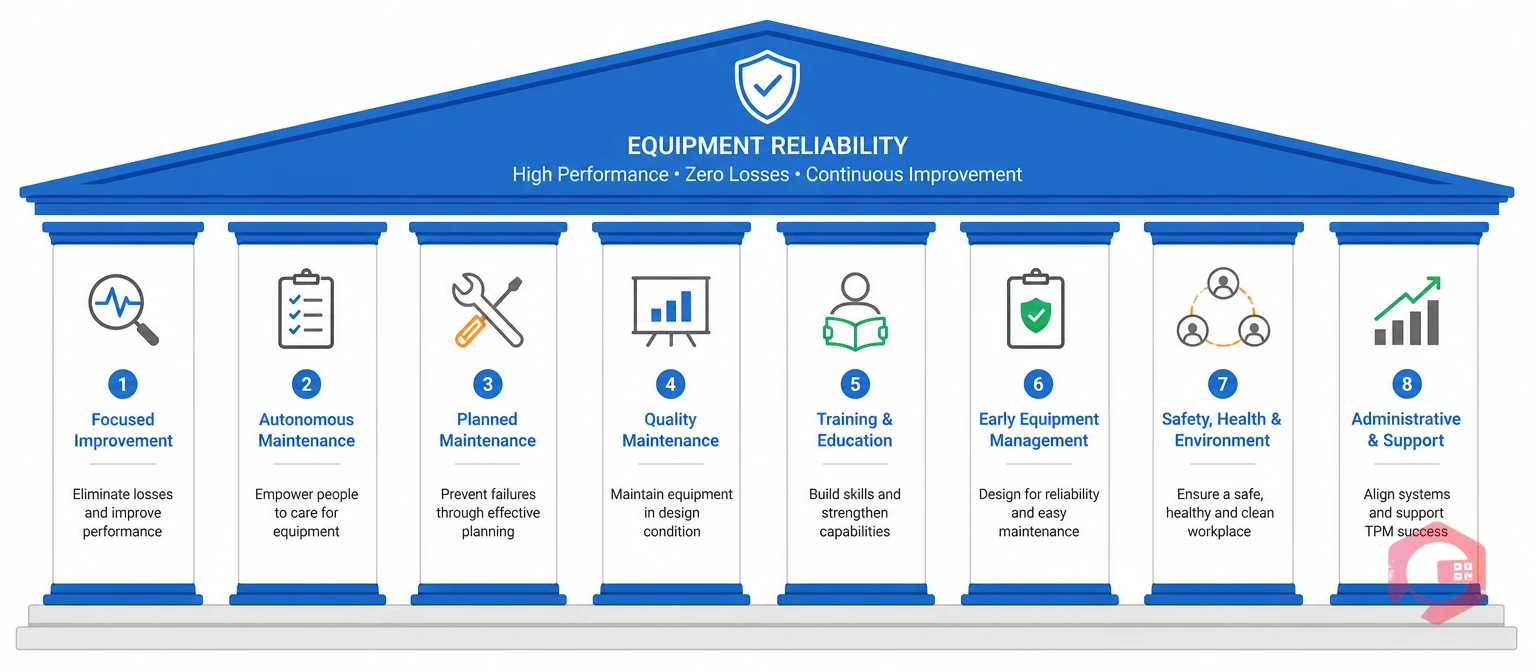
Total Productive Maintenance makes operators, maintenance, and engineering jointly responsible for equipment reliability. It is not just a job for the maintenance department. Overall Equipment Effectiveness (OEE) is the metric TPM exists to improve. OEE is calculated as Availability × Performance × Quality, and it shows exactly where a line is losing output.
TPM is a journey built on eight TPM pillars, not one single event. Each pillar targets a different loss: breakdowns, defects, slow changeovers, and more. The Japan Institute of Plant Maintenance (JIPM) formalized this structure decades ago. It remains the reference model most manufacturers still follow, per Wikipedia's overview of Total Productive Maintenance. Every one of the eight TPM pillars needs steady data capture to move past workshops and into daily practice. That is exactly where most programs run into trouble.

Most TPM launches fail the same way. Autonomous maintenance checklists live on paper. Planned schedules live in someone's memory. OEE gets calculated once a quarter in a spreadsheet. Improvement ideas get raised in a meeting and never logged anywhere, so nobody can prove they closed.
Most facilities that sustain TPM past year one run it through a connected system. A BI dashboard replaces the spreadsheet as the single source of truth.
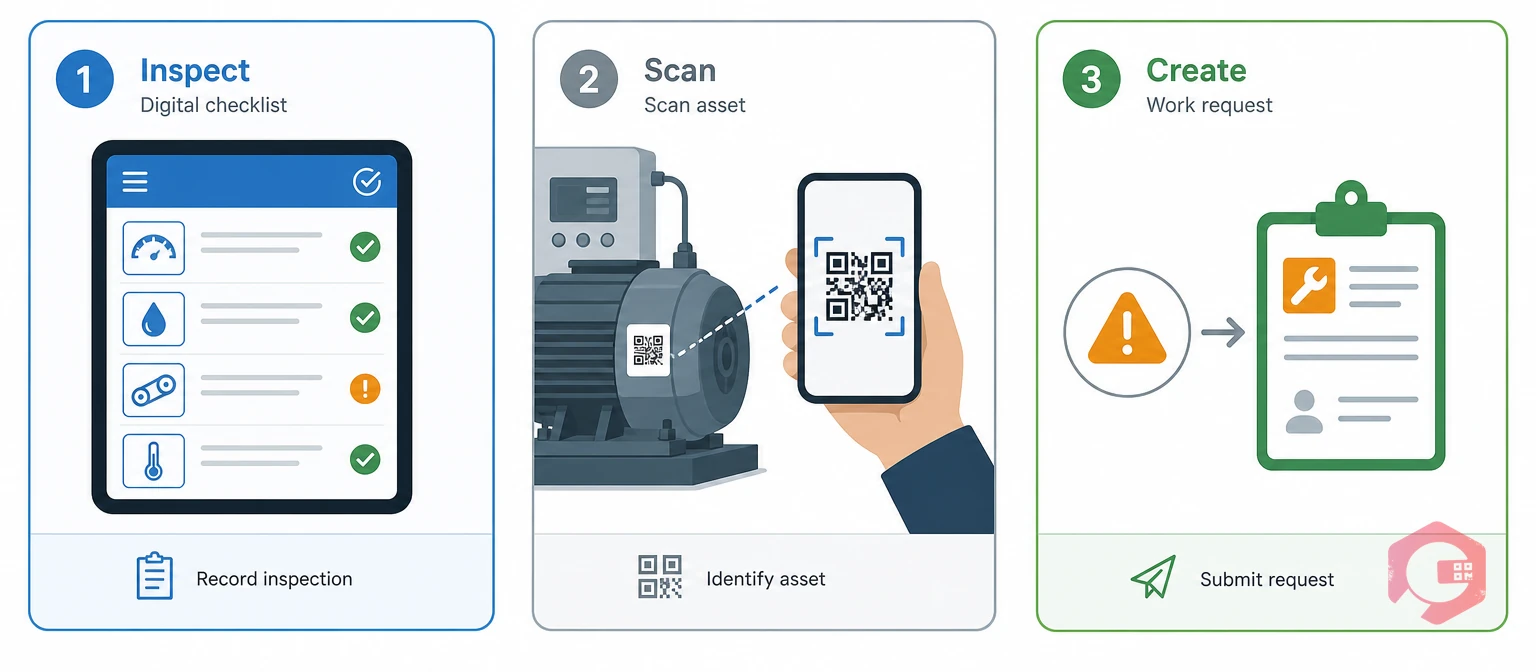
This TPM pillar gives operators ownership of routine cleaning, inspection, and lubrication. Early signs of wear get caught before they turn into failures. Standard operator checklists and visual tags for abnormalities are the backbone of this pillar.
Autonomous maintenance only sticks when the operator's finding reaches maintenance the same day it's spotted, not at the next shift huddle.
This TPM pillar shifts work from reactive, run-to-failure repairs to calendar- and condition-based plans built on asset history. Planned maintenance percentage is the share of total maintenance work completed on a schedule rather than in response to a breakdown. It is one of the clearest signs a TPM program is holding.
Check where your own planned-versus-reactive split stands with the Cryotos OEE calculator before setting new PM targets.
This TPM pillar links equipment condition directly to product quality. Poka-yoke checks and condition parameters prevent defects at the source instead of catching them downstream. Every quality deviation should tie back to the specific asset and condition that caused it.
Most facilities running this pillar well treat quality as an engineering problem to control, not a detection problem to inspect around.
This TPM pillar puts small, cross-functional teams against the biggest sources of loss on the OEE waterfall: breakdowns, changeovers, minor stops, speed loss, and rework. Each loss gets tackled one at a time. Logging every idea with an owner and a due date is what separates a real kaizen program from a suggestion box nobody checks.
This TPM pillar feeds lessons from existing assets into the specification of new equipment. Recurring failures, hard-to-maintain designs, and inspection bottlenecks all become input for the next purchase, so new equipment is designed for reliability from day one. That knowledge needs to live in searchable asset and failure history, not in a retiring engineer's notes.
Facilities that skip this pillar tend to buy the same maintenance headache twice, once per generation of equipment.
This TPM pillar builds operator and technician skill through structured, role-based training and skill matrices. Both autonomous and planned maintenance depend on people knowing how to inspect and repair correctly. Refresher schedules keep that skill from quietly fading.
A reliable, well-maintained asset is a safer asset. That is why near-miss reporting, lockout-tagout verification, and hazard observations belong in the same system used for maintenance work, not a separate program nobody checks twice. Routing safety findings into the same corrective action workflow as any other defect keeps this pillar from becoming a compliance folder.
The OSHA safety and health management guidelines and a safety compliance checklist both point the same way: safety data belongs next to maintenance data, not apart from it.
The same TPM principles of cutting waste and standardizing process apply to the admin work behind maintenance: purchase approvals, permits, and reporting. Automating approval chains and report generation removes the quiet delays that slow every shop-floor pillar above it.

A CMMS is the backbone that connects every one of the TPM pillars into one system of record. It captures the operator's autonomous maintenance findings, runs the planned maintenance schedule, tracks focused-improvement actions to closure, and rolls all of it into OEE and reliability dashboards.
The CMMS-TPM Alignment Loop:
Maintenance teams using work order management built around this loop have reported up to 30% reduction in unplanned downtime and 25% faster repair turnaround. Software speeds up and proves the TPM journey. But the discipline behind it, leadership reviews, floor-level ownership, and root cause follow-through, still determines whether the TPM pillars actually stick. SMRP points to that same discipline as the standard for mature reliability programs.
The eight pillars are autonomous maintenance, planned maintenance, quality maintenance, focused improvement, early equipment management, training and education, safety-health-environment, and office TPM. Each one targets a different source of equipment or process loss, and a mature program runs all eight together rather than picking a favorite.
Preventive maintenance is one piece of TPM's planned maintenance pillar. TPM is the broader company-wide framework that also covers operator ownership, quality, training, safety, and continuous improvement, with OEE as the shared scoreboard tying all of it together.
You can start TPM with paper checklists and spreadsheets, but most programs stall within a year without a system of record. A CMMS gives every pillar a consistent place to log data, assign ownership, and prove that improvements actually held.
Most manufacturers roll out TPM pillar by pillar over 18 to 36 months, typically starting with autonomous and planned maintenance before layering in quality, focused improvement, and the remaining pillars. Sites that connect pillars to a CMMS from day one tend to move faster because they aren't rebuilding data trails partway through.
A TPM journey built pillar by pillar only holds together when every pillar shares the same system of record. Schedule a free demo to see how Cryotos connects autonomous maintenance, planned schedules, and OEE tracking into one TPM program that actually sticks.


Cryotos AI predicts failures, automates work orders, and simplifies maintenance—before problems slow you down.



