
A Corrective Action Request (CAR) is a formal demand to investigate a nonconformity, identify its root cause, and implement a fix that prevents it from happening again. When a CAR feeds into a CAPA (Corrective and Preventive Action) workflow, the scope extends beyond fixing the immediate problem — it also addresses systemic risks that could trigger similar failures across other assets or processes. According to ISO 9001:2015 Clause 10.2, organizations must react to nonconformities, evaluate the need for action, implement corrective actions, and verify their effectiveness. A Computerized Maintenance Management System turns that requirement from a paper exercise into a trackable, auditable workflow that closes the loop every time.
Key Takeaways

A Corrective Action Request is a documented notice that a nonconformity exists and requires investigation, root cause analysis, and a verified fix. The nonconformity can be an equipment failure, a process deviation, a safety incident, a quality defect, or a failed audit finding. The CAR itself is not the fix. It is the trigger that starts the formal corrective action process.
CARs typically originate from four sources: internal audits, customer complaints, inspection findings, and recurring work order patterns flagged in maintenance data. Each source carries its own urgency and documentation requirements, but the CAR format stays consistent — a description of the nonconformity, the affected asset or process, the date of discovery, and the person responsible for initiating the response.
Without a formal CAR process, nonconformities get handled informally. A technician fixes the immediate problem, logs a work order, and moves on. The root cause stays unaddressed. The same failure returns weeks later. A structured CAR process prevents that cycle by requiring investigation before closure.
CAPA (Corrective and Preventive Action) is a quality management process that investigates the root cause of a nonconformity, implements a permanent corrective action, and applies preventive measures to stop similar issues across related assets or processes. The corrective side fixes what went wrong. The preventive side asks where else the same risk exists and addresses it before a failure occurs there too.
CAPA is required by every major quality and safety framework. ISO 9001 Clause 10.2 governs corrective action. ASQ's CAPA guidance treats prevention as the higher-value outcome. In regulated industries like pharmaceuticals, food manufacturing, and medical devices, a weak CAPA program generates repeat audit findings faster than almost any other gap.
Corrective action removes the cause of a detected nonconformity. Preventive action removes the cause of a potential nonconformity that has not yet occurred. Both require root cause analysis, but preventive action also requires a risk assessment across the broader system.
Maintenance teams that successfully reduce repeat failures treat the preventive side as the real return on the CAPA investment. Fixing one bearing is a work order. Preventing six bearing failures is a reliability improvement.
Cryotos's work order management module links corrective work orders to their originating CAR and generates preventive work orders for related assets in a single workflow — so the preventive side does not depend on someone remembering to check other equipment.
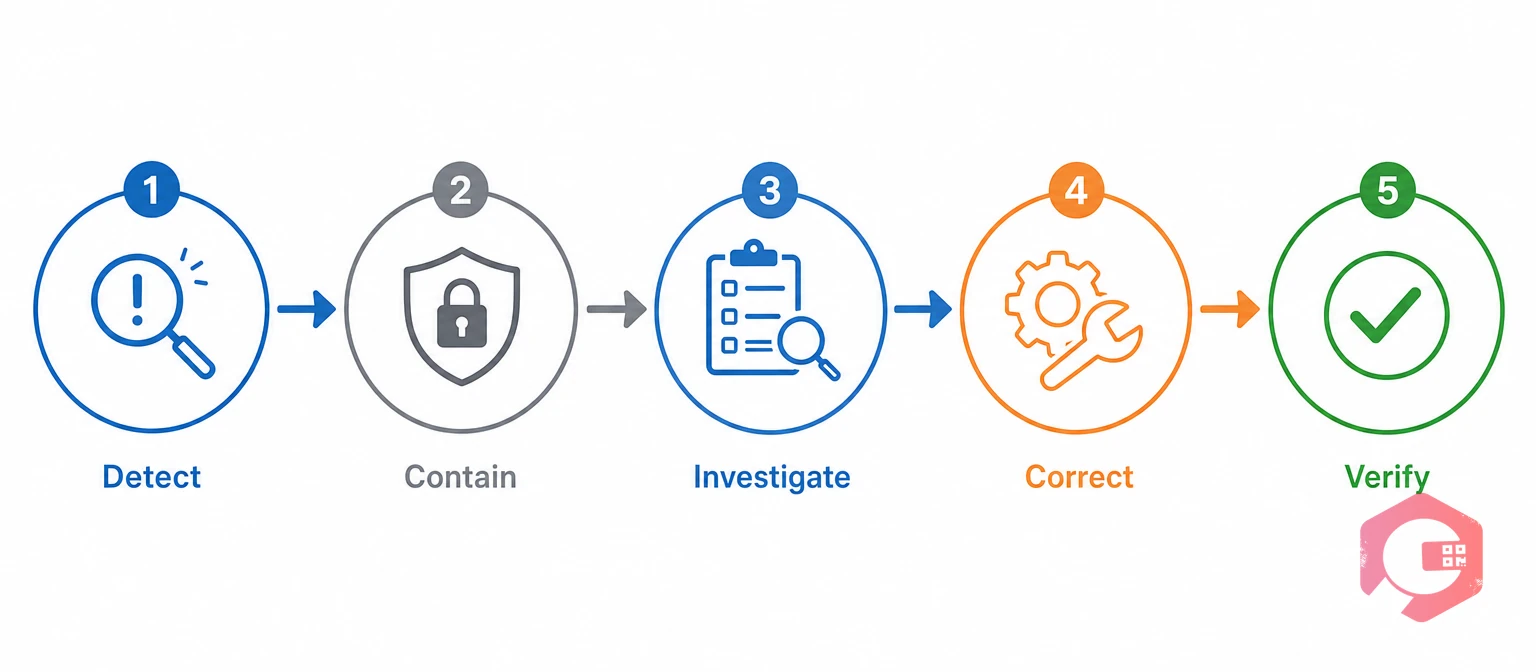
Most CAPA failures happen because teams skip stages or combine investigation with correction. A structured method prevents those shortcuts.
The CAPA Close-Out Method:
Skipping Stage 5 is the most common reason CAPA programs lose credibility. A corrective action marked "complete" without verification is an assumption, not evidence. Cryotos's workflow automation enforces this sequence by requiring verification sign-off before a CAPA work order can be closed.

Running CAPA on paper or spreadsheets breaks down at every stage. CARs get lost in email. Containment actions have no due date. Root cause analysis stays in someone's head. Verification does not happen because nobody tracks whether the fix held.
A CMMS built for maintenance operations solves each of these gaps by embedding the CAPA workflow directly into the work order lifecycle.
When a technician, auditor, or supervisor identifies a nonconformity, they log it directly in the CMMS — linked to the specific asset record. The system routes the CAR to the responsible team lead based on asset type, location, or severity. No email chain. No paper form sitting in a tray. The CAR arrives with the asset's full maintenance history attached, so the investigator starts with context instead of questions.
The CMMS shows every past work order, failure code, and PM completion record for the affected asset. An investigator running a root cause analysis can see whether this is the first occurrence or the fourth. That history turns a guessing exercise into an evidence-based investigation. Patterns that would stay invisible in a spreadsheet become obvious when the full failure record is in front of the investigator.
Each corrective and preventive action becomes a trackable work order with one named owner, a due date, and an automatic escalation if the due date passes without completion. Containment actions get the tightest deadlines. Permanent corrective actions carry realistic dates that account for parts, shutdown windows, and contractor lead times.
Maintenance teams using Cryotos have reported up to 30% reduction in unplanned downtime and 25% faster repair turnaround — results driven in part by CAPA actions that close failure paths before they generate repeat emergency work orders.
The CMMS holds the CAPA open until a designated verifier confirms the fix. Verification evidence — before-and-after photos, test results, inspection records, updated SOPs — attaches directly to the CAPA record. When an auditor asks for proof that a corrective action was effective, the answer is one search away instead of a binder hunt.
Cryotos's BI dashboard tracks CAPA metrics across the entire operation: open CARs by age, overdue actions, verification pass rate, and repeat nonconformity count. A rising repeat count on a specific failure mode tells you the corrective action did not hold — before the next audit does.
Not every equipment problem needs a full CAPA process. Using the right tool for the right situation keeps the system from drowning in unnecessary paperwork.
| Situation | Right Tool | Why |
|---|---|---|
| One-time equipment failure, known cause, no pattern | Standard work order | Fix and close — root cause is obvious and isolated |
| Nonconformity found during audit or inspection | CAR → CAPA workflow | Regulatory or quality framework requires formal investigation and evidence of correction |
| Repeat failure on the same asset or failure mode | CAR → CAPA workflow | Pattern indicates the root cause was not addressed by previous repairs |
| Near-miss or safety observation with systemic risk | CAR → CAPA workflow | Preventive action across related assets prevents a future incident |
| Minor deficiency, low risk, no repeat pattern | Standard work order | CAPA overhead not justified — fix it and document it |
The threshold matters. Too many CARs and the system becomes a paperwork burden that nobody takes seriously. Too few and real problems slip through as routine fixes that never get properly investigated. Most facilities set a clear trigger: any repeat failure, any audit finding, and any near-miss with high potential severity automatically generates a CAR.
A Corrective Action Request (CAR) is the formal notice that a nonconformity exists and needs investigation. CAPA is the full workflow that follows — root cause analysis, corrective action implementation, preventive action across related assets, and verification that the fix worked. The CAR starts the process. CAPA is the process.
Raise a CAR when the failure is a repeat occurrence on the same asset or failure mode, when it was found during an audit or regulatory inspection, or when a near-miss carries high potential severity. A one-time failure with a known, isolated cause typically needs only a standard work order with proper documentation.
A CMMS captures every step of the CAPA lifecycle — from nonconformity detection through root cause analysis, action assignment, and verification of effectiveness — in a single, timestamped, auditable record. During an ISO 9001 audit, the system produces filtered reports showing open CARs, completed actions, verification evidence, and repeat nonconformity trends without manual compilation.
Skipping verification of effectiveness. Teams implement a corrective action, mark the CAPA "complete," and move on without confirming the fix actually held. When the same nonconformity returns, it generates another CAR — and the cycle repeats. A CMMS that requires verification sign-off before closure prevents this pattern.
Corrective Action Requests and CAPA workflows give maintenance teams a structured way to stop repeat failures instead of endlessly repairing the same problems. Schedule a free demo to see how Cryotos connects nonconformity detection, root cause investigation, corrective and preventive actions, and verification of effectiveness in one auditable system.




Cryotos AI predicts failures, automates work orders, and simplifies maintenance—before problems slow you down.



