

The Deming Cycle — also known as the PDCA cycle (Plan-Do-Check-Act) — is a four-stage iterative framework that helps organizations identify problems, test solutions, verify results, and lock in improvements permanently. First developed by statistician Walter Shewhart and popularized by quality management pioneer W. Edwards Deming in post-war Japan, the model gives maintenance and operations teams a repeatable structure for solving problems rather than reacting to them.
According to a McKinsey report on operational excellence, companies that apply structured continuous improvement frameworks reduce operational costs by 15–25% over three years. The Deming Cycle is one of the most widely used of those frameworks — and for good reason. It's simple enough for a shop-floor team to use on Monday morning, yet rigorous enough to drive organization-wide change.
In this guide, you'll learn what each phase of the Deming Cycle does, how it applies to maintenance operations specifically, how it compares with similar frameworks, and how a CMMS makes it faster to execute at scale.
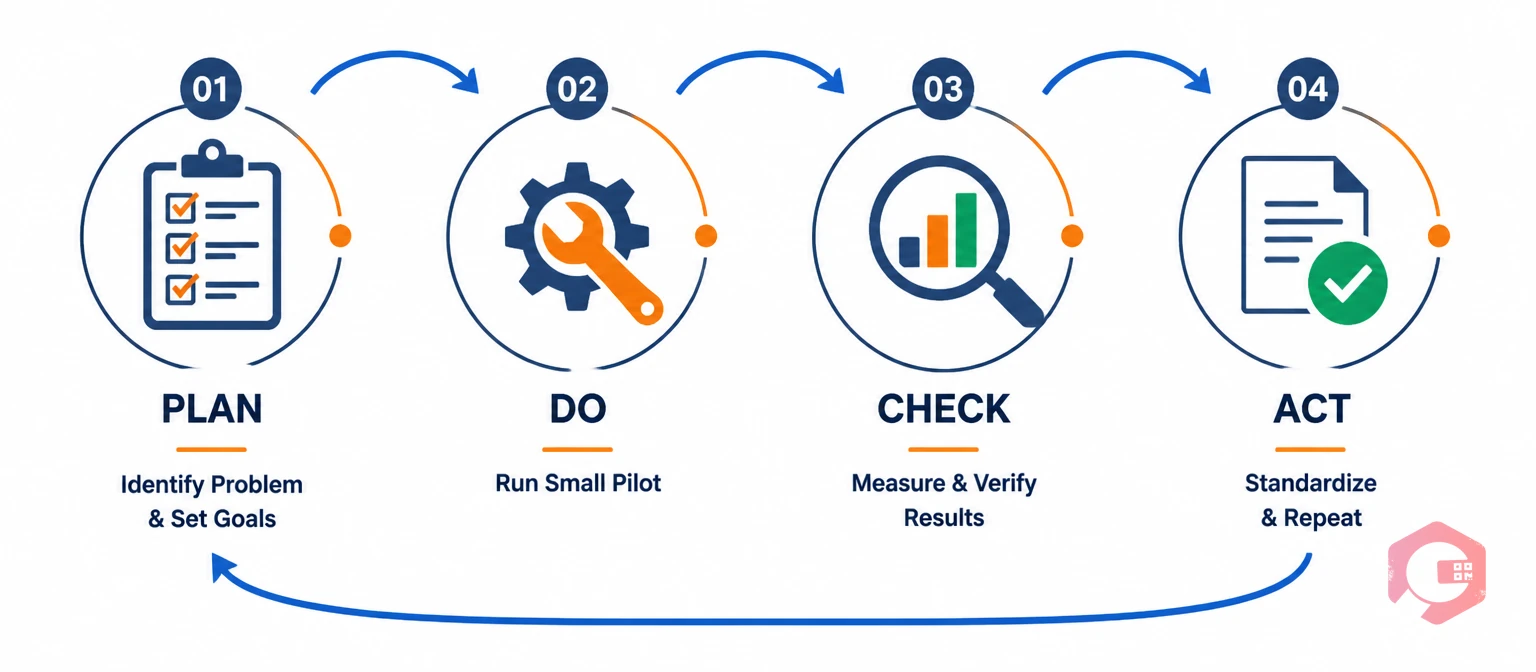
The Deming Cycle is a scientific approach to process improvement built on four sequential steps: Plan, Do, Check, and Act. Each loop through the cycle is intended to leave the process measurably better than it was before.
W. Edwards Deming adapted the framework from Walter Shewhart's earlier work — which is why it's also called the Shewhart Cycle in some quality management literature. Deming introduced it to Japanese manufacturers in the 1950s, and it became a cornerstone of Japan's post-war industrial rise. Today, ISO 9001, ISO 14001, and most lean manufacturing standards embed PDCA as their core improvement engine.
The four phases work like this:
That last point matters: the cycle doesn't end at "Act." It feeds back into a new "Plan" phase, creating a spiral of incremental gains over time. That compounding effect is what separates organizations using PDCA from those that fix issues once and move on.
Most process improvement fails not because the solution was wrong, but because teams skip verification or forget to standardize changes. The Deming Cycle prevents both failures by making them mandatory steps in the sequence.
Here's why it works where ad-hoc problem-solving doesn't:
For maintenance teams specifically, this structure maps cleanly to how equipment problems actually unfold — an anomaly surfaces, a root cause is identified, a countermeasure is tried, and the result is checked before the countermeasure becomes standard practice.
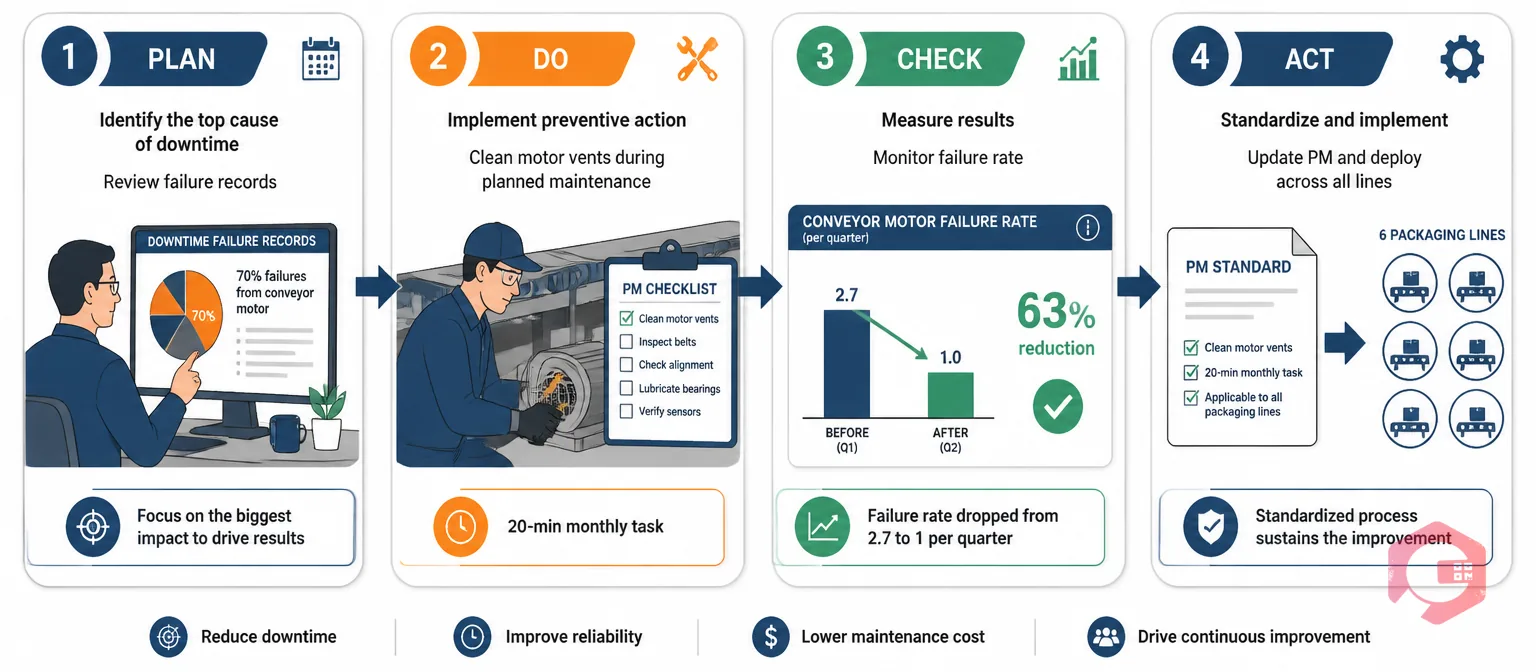
Let's walk through a real maintenance scenario to show how each phase plays out on the floor.
A food manufacturer's packaging line is experiencing three to four unplanned failures per month, each taking an average of four hours to repair. Total downtime cost: roughly 48 hours per month. The maintenance manager decides to apply the Deming Cycle.
The team pulls downtime records for the past six months and identifies that 70% of failures originate from one conveyor drive motor. They use a root cause analysis (specifically the Five Whys method) and find the motor is overheating because its cooling vents are clogged with product dust — a problem their current PM schedule doesn't address. The plan: add a monthly vent-cleaning task to the PM checklist and set a goal to reduce motor-related failures by 50% within 90 days.
The new task is added to one line's maintenance checklists as a pilot. Technicians perform the vent cleaning each month and log the time taken (about 20 minutes per session). The pilot runs for 90 days.
After 90 days, the team reviews the data. The pilot line recorded only one motor failure — down from an average of 2.7 per quarter. Repair time was unchanged at four hours, but frequency dropped by 63%. The 20-minute monthly cleaning is generating a significant return.
The vent-cleaning task is added to PM schedules on all six packaging lines. The updated checklist becomes the new standard. The team also notes that the motor temperature sensors could flag early overheating before failure occurs — a finding that feeds directly into the next Plan phase.
This cycle took 90 days from start to standardization. The next iteration might target the motor temperature monitoring improvement. Over time, the packaging line's Overall Equipment Effectiveness (OEE) improves quarter after quarter.
The PDCA cycle isn't the only continuous improvement framework in use. Here's how it compares to the two most common alternatives:
For most maintenance and reliability teams, PDCA hits the right balance between rigor and speed. It doesn't require a statistician or a dedicated project team — a maintenance supervisor and two technicians can run a full cycle in a month.
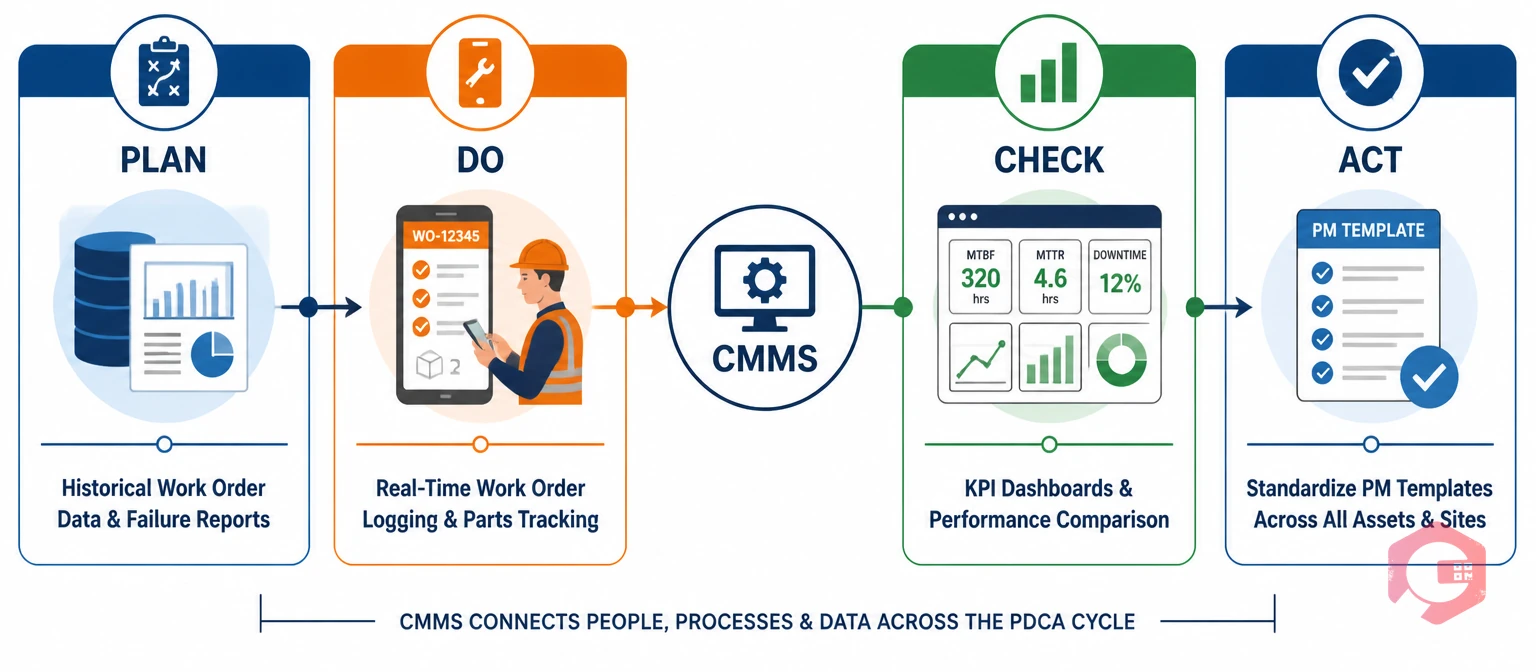
The Deming Cycle is only as good as the data feeding it. Without accurate failure records, maintenance histories, and real-time performance metrics, the Plan and Check phases become guesswork. A maintenance management software platform eliminates that problem by capturing everything automatically.
Here's how a CMMS supports each PDCA phase:
According to ISO 9001's quality management guidelines, one of the key enablers of effective PDCA is documented information — meaning systems that capture and preserve process data. A CMMS is precisely that system for maintenance teams.
Even experienced teams make the same errors when running PDCA. Knowing these in advance saves a lot of wasted cycles.
If your organization operates under a lean manufacturing system or holds ISO certification, you're almost certainly already expected to use PDCA — whether or not it's named explicitly.
Lean manufacturing treats the elimination of waste as a continuous, never-ending pursuit. PDCA is the mechanism that makes that pursuit structured and measurable rather than reactive. Every lean maintenance event — whether it's a 5S audit, a value stream mapping session, or a kaizen burst — uses PDCA logic to plan the change, run it, verify it, and lock it in.
ISO 9001:2015 explicitly adopts the Plan-Do-Check-Act model as the foundation of its quality management system requirements. Clause 10.3 of the standard requires organizations to "continually improve the suitability, adequacy and effectiveness" of the QMS — a requirement that PDCA directly fulfills. The same structure appears in ISO 14001 (environmental management) and ISO 45001 (occupational health and safety).
For maintenance teams supporting ISO-certified manufacturing sites, running documented PDCA cycles isn't just good practice — it's an audit requirement. A CMMS that captures every cycle's data, actions, and outcomes becomes a compliance asset as much as an operational one.
The Deming Cycle stands for Plan-Do-Check-Act (PDCA). It's a four-phase iterative model for continuous process improvement developed by quality management expert W. Edwards Deming. Each pass through the cycle is designed to leave the process better than it was before.
Six Sigma's DMAIC framework is more statistical and data-intensive, suited to complex problems with high variation. The Deming Cycle (PDCA) is faster and lighter, making it better for frontline teams running incremental improvements. Many organizations use both: PDCA for routine improvements and DMAIC for deeper problem-solving projects.
It depends on the scope of the change. A simple maintenance task adjustment might take two to four weeks from Plan to Act. A complex process change — like redesigning a PM program for an entire plant — might take a quarter or more. The goal is to keep cycles short enough that teams stay engaged and results are visible.
Yes — PDCA is one of the most scalable improvement frameworks available. A single maintenance supervisor can apply it to a specific recurring failure. There's no requirement for a formal project team, statistical analysis, or dedicated improvement specialists. Start with one problem, one hypothesis, and one measured result.
Significantly. A CMMS provides the historical data needed for the Plan phase, the real-time logging needed for the Do phase, the KPI tracking needed for the Check phase, and the standardization tools needed for the Act phase. Without a system capturing clean data, PDCA cycles are slower and less reliable.
If your maintenance team is serious about continuous improvement, the Deming Cycle gives you a proven framework — and Cryotos CMMS gives you the data infrastructure to run it at scale. From preventive maintenance scheduling to real-time downtime analysis, Cryotos captures everything your PDCA cycles need to produce real, measurable results. See how Cryotos supports continuous improvement across your maintenance operations.



Cryotos AI predicts failures, automates work orders, and simplifies maintenance—before problems slow you down.



