Digital technology is changing turnaround planning and execution by replacing manual scheduling, paper-based work packs, and disconnected communication with integrated platforms that give maintenance teams real-time visibility across every phase of a shutdown. Industrial plants that still rely on spreadsheets and whiteboard schedules for turnarounds face budget overruns, safety incidents, and extended downtime that costs millions per day in lost production.
A Computerized Maintenance Management System (CMMS) anchors the digital turnaround by centralizing work orders, scheduling, parts logistics, and progress reporting in one platform. This guide covers what turnaround planning and execution involves, the five technologies driving the shift, and a practical framework for implementing digital turnaround management at your facility.
Key Takeaways
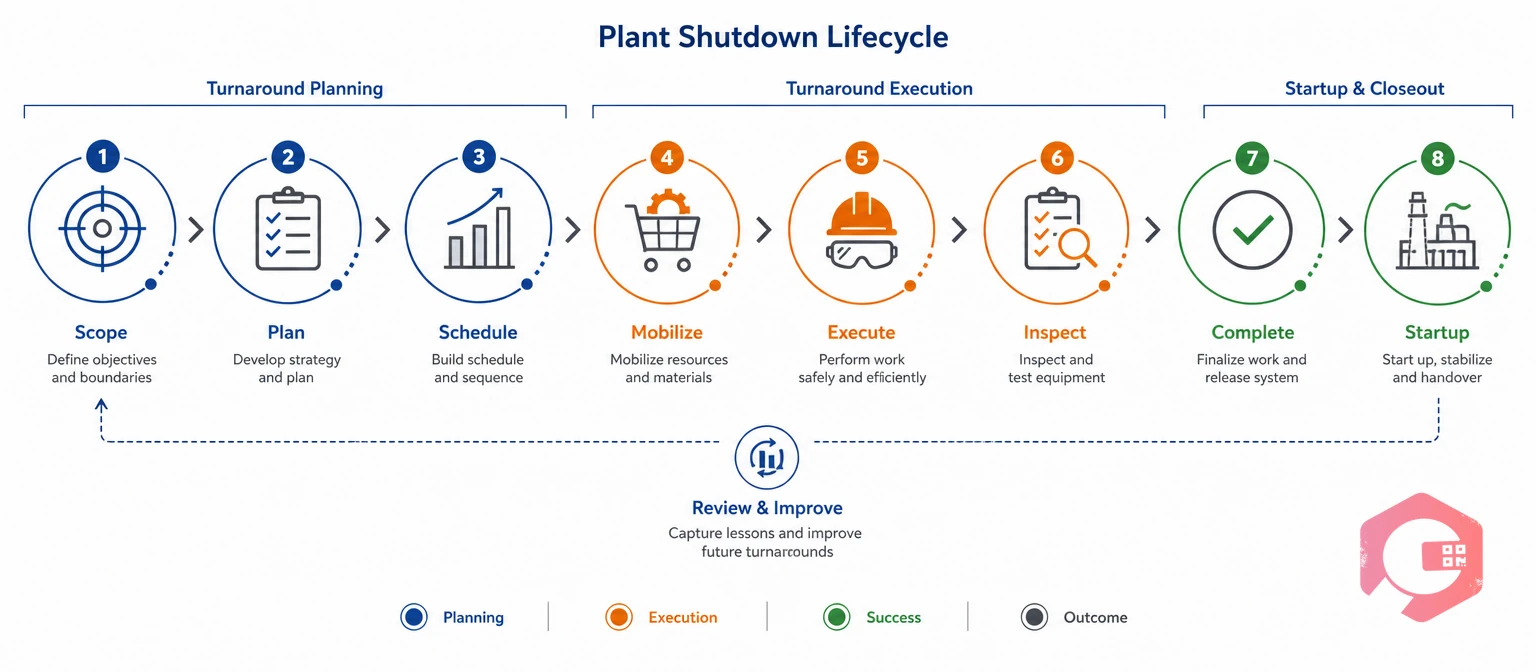
Turnaround planning and execution is the structured process of shutting down an entire process unit or plant for a defined period to perform maintenance, inspections, and equipment replacements that cannot happen during normal operations. Unlike routine maintenance that targets individual assets, a turnaround affects the entire production line and requires coordination across maintenance, operations, engineering, procurement, and contractor teams.
According to the turnaround process in refining, these events represent the largest single maintenance expenditure most plants face. A single refinery turnaround can cost over $100 million, and every additional day of downtime adds $1 million or more in lost production revenue.
Traditional turnaround planning relies on spreadsheets for scope tracking, email chains for approvals, and physical walk-downs for progress updates. These disconnected tools create three critical problems.
A downtime tracking system makes these delays visible and quantifiable, giving planners the data they need to justify digital investment.
Turnaround overruns are not just schedule inconveniences. They compound across labor, production, and safety dimensions in ways that traditional tracking methods cannot capture.
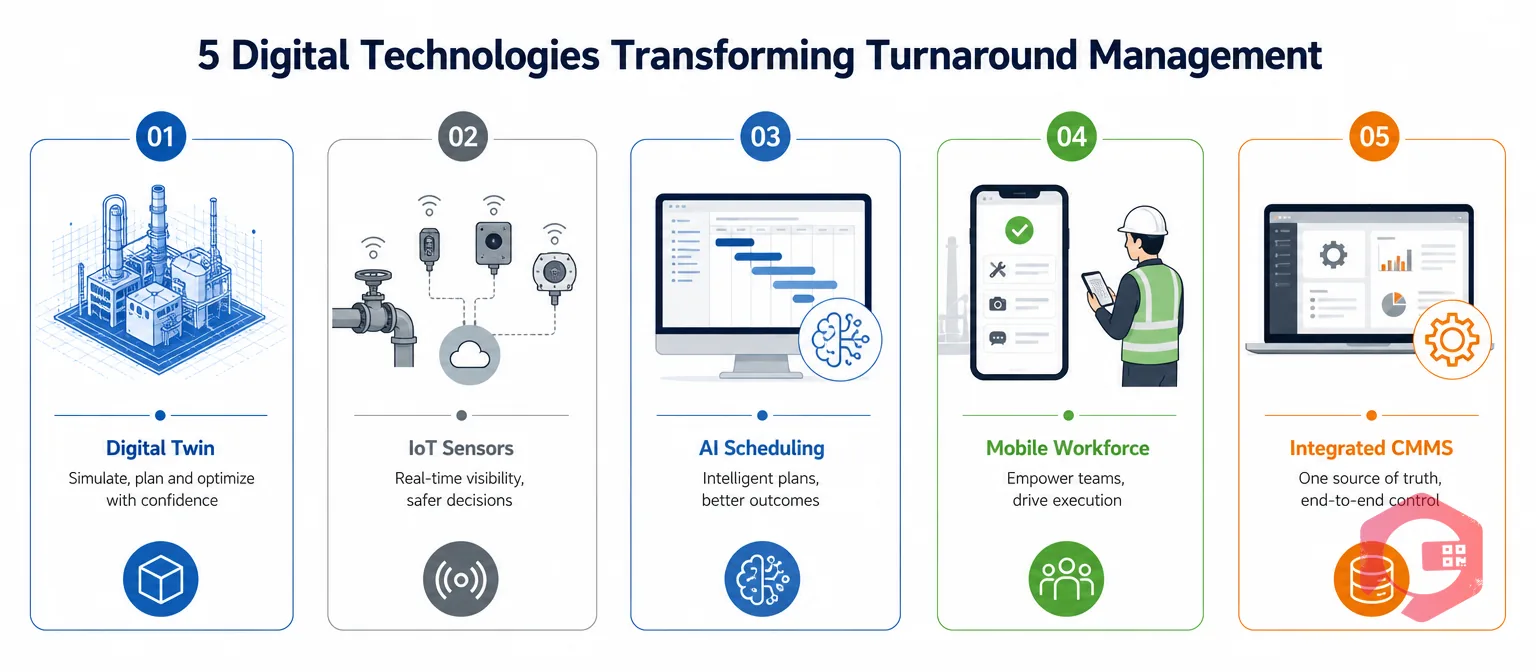
Digital turnaround management replaces manual coordination with technology platforms that provide real-time data flow from planning through closeout. Each of the following five technologies addresses a specific failure point in the traditional approach, and facilities seeing the strongest results combine multiple technologies into an integrated system.
Digital twins create a virtual replica of the physical plant that planners can use to simulate turnaround scenarios before a single wrench turns. Teams run through crane placement, scaffolding access paths, and equipment removal sequences in the model to identify conflicts that would otherwise surface mid-execution.
Planning teams using 3D digital twin models have reported savings of 8 to 12% on pre-planning costs alone. For a $100 million turnaround, that represents $8 to $12 million in avoided rework and wasted site mobilization.
IoT-driven condition monitoring is the technology that determines which equipment actually needs turnaround work and which can safely wait until the next cycle. Instead of opening and inspecting every piece of equipment on a fixed schedule, sensors measuring vibration, temperature, corrosion rates, and pressure provide continuous health data.
This data-driven scoping reduces unnecessary work. Facilities using IoT-driven condition monitoring can defer 20 to 30% of their planned turnaround scope to the next cycle when sensor data confirms the equipment is still within safe operating parameters.
AI scheduling tools analyze task dependencies, crew availability, equipment lead times, and historical performance data to generate optimized turnaround schedules. Unlike static Gantt charts that break at the first delay, AI schedulers dynamically resequence remaining work when a task runs long or a part arrives late.
Early adopters of AI-driven turnaround scheduling report schedule reductions of 15 to 25% compared to manually planned events of similar scope. The improvement comes primarily from eliminating idle time between dependent tasks and optimizing crew assignments across parallel work fronts.
Mobile platforms replace the paper-based permit, work order, and progress reporting systems that slow turnaround execution. Field crews receive work assignments on tablets or phones, complete digital permits, capture photo documentation, and report task completion in real time.
An integrated CMMS and ERP platform is the connective layer that ties all other turnaround technologies together. Without integration, digital twins feed data into one system, IoT sensors into another, and scheduling tools into a third. The result is digital tools operating in the same silos that paper processes created.
ERP integration connects maintenance work orders directly to procurement, finance, and inventory systems so that parts orders trigger automatically when work packs are approved, costs flow to the correct project codes in real time, and inventory levels update as materials are issued to specific jobs.
Facilities that connect their preventive maintenance software to turnaround planning systems gain a complete asset history that informs scope decisions for every future turnaround event.
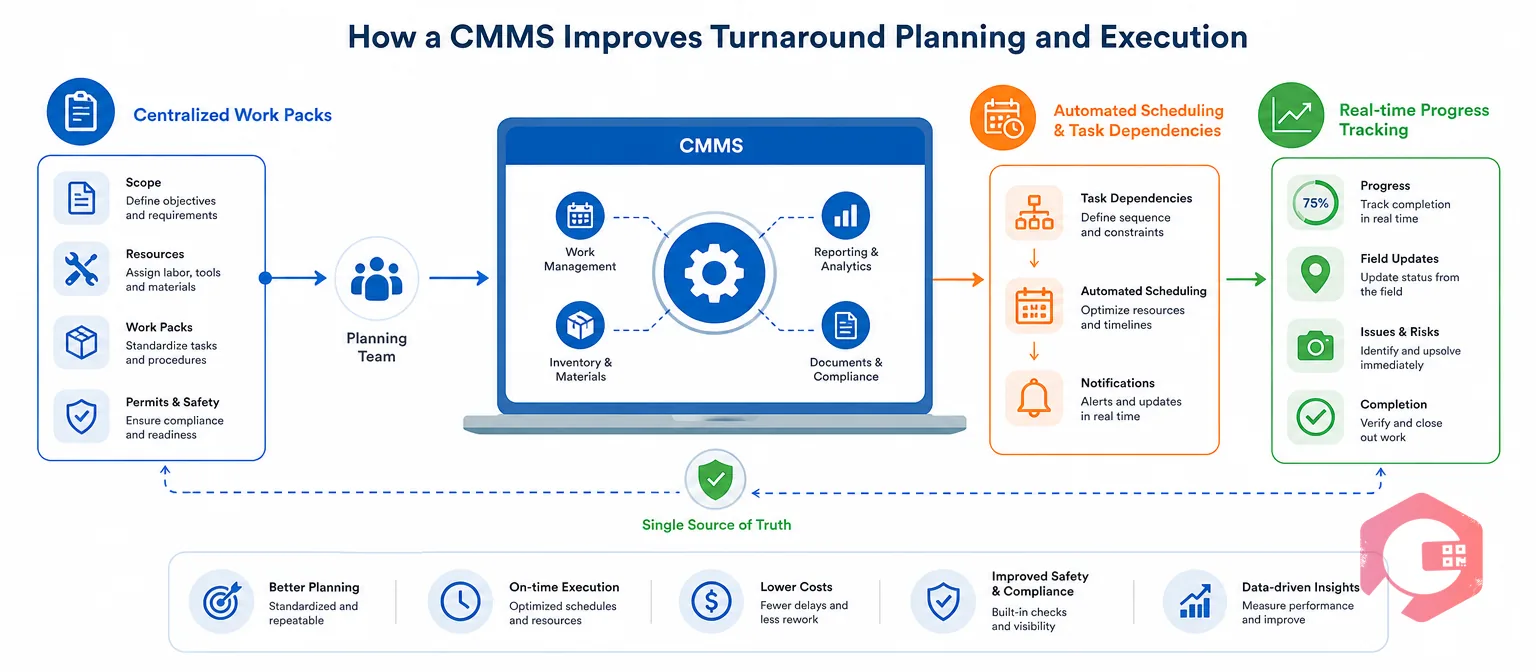
A CMMS improves turnaround planning and execution by providing a single platform where every work pack, resource assignment, parts requirement, and progress update lives in one accessible system. Instead of assembling turnaround plans from dozens of spreadsheets and email threads, planners build and manage the entire event within a structured digital environment.
Work packs are the building blocks of turnaround execution. Each work pack defines a specific job — the tasks involved, the skills required, the parts needed, the safety permits, and the estimated duration. In traditional turnarounds, work packs exist as Word documents or spreadsheet rows that cannot link to each other or to inventory systems.
A CMMS converts work packs into structured work orders with embedded task dependencies, linked parts lists that check real-time inventory availability, and attached safety procedures that crews access on mobile devices at the job site.
Workflow automation within a CMMS handles the complex task sequencing that makes or breaks a turnaround schedule. When a prerequisite task completes, the system automatically releases downstream work orders, notifies assigned crews, and updates the master schedule.
This automation eliminates the manual coordination that traditional turnarounds require, where a planner must physically verify task completion, update the schedule, and notify the next crew. Maintenance teams using Cryotos have reported up to 30% reduction in unplanned downtime and 25% faster repair turnaround through better planning and visibility.
Real-time dashboards show turnaround progress by area, by discipline, and by completion percentage against the baseline schedule. Supervisors identify falling-behind areas immediately instead of discovering problems in the next morning's status meeting.
Calculate your facility's equipment reliability with Cryotos' free MTBF calculator to establish a baseline before your next turnaround planning cycle.
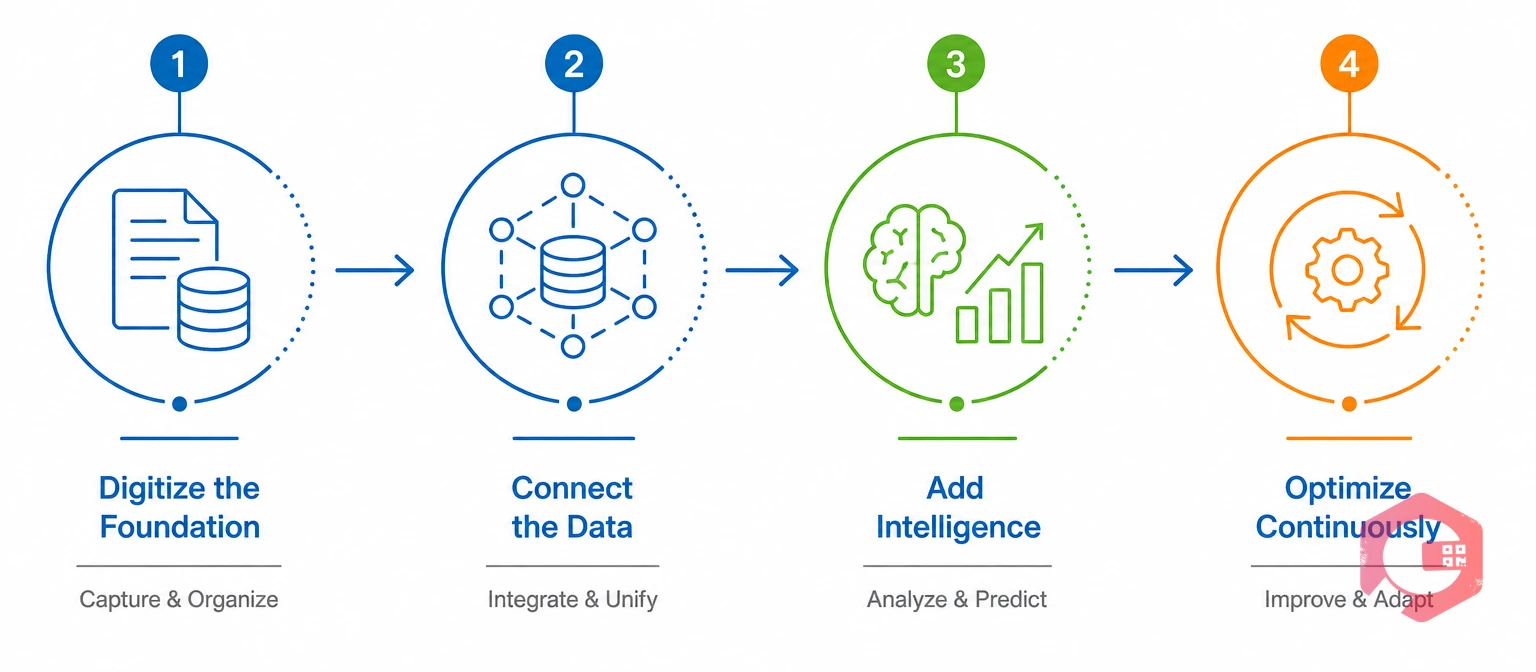
Implementing digital turnaround management requires a phased approach that builds capability without disrupting the turnaround events already in the planning pipeline. Organizations that try to deploy every technology at once during an active turnaround create more chaos than they resolve.
The 4-Phase Digital Turnaround Maturity Model:
Each phase builds on the previous one. Organizations that embrace Industry 4.0 principles in their turnaround strategy move through these phases faster because the underlying data infrastructure already supports integration.
Digital turnaround planning differs from traditional methods across every dimension of the turnaround lifecycle. The following comparison highlights the specific improvements that digital tools deliver at each stage, according to industry benchmarks on shutdown optimization.
| Dimension | Traditional Approach | Digital Approach |
|---|---|---|
| Scope Development | Spreadsheet-based work lists with manual updates | CMMS-managed scope with IoT-informed deferral decisions |
| Scheduling | Static Gantt charts that break at the first delay | AI-optimized schedules that resequence dynamically |
| Work Packs | Word documents or paper packets | Digital work orders with linked parts, permits, and procedures |
| Progress Reporting | End-of-shift paper reports, 12-24 hour lag | Real-time mobile updates with photo verification |
| Parts Management | Manual requisitions with frequent stockouts | Automated procurement triggered by work pack approval |
| Safety Documentation | Paper permits with physical sign-off routing | Electronic permits with instant digital approval routing |
| Post-Turnaround Review | Binder-based reports rarely referenced again | Searchable digital records feeding next-cycle planning |
| Typical Budget Variance | 10-30% over budget | Within 5% of budget |
| Typical Schedule Variance | 2-5 days over planned duration | On time or 1-2 days early |
The comparison shows that digital turnaround planning and execution delivers measurable improvements at every stage. The largest gains come from eliminating the information delays that cascade through traditionally managed turnarounds.
Turnaround planning and execution is the end-to-end process of scoping, scheduling, staffing, executing, and closing out a planned plant shutdown for major maintenance, inspections, and equipment replacements. It typically involves 18 to 24 months of planning, a concentrated execution window of 15 to 40 days, and coordination across maintenance crews, operations teams, engineering groups, and external contractors. The goal is to complete all required work safely, on time, and within budget while minimizing the production loss window.
Digital technology reduces turnaround duration by eliminating the manual handoffs, paper-based reporting, and delayed decision-making that extend traditional shutdowns. IoT sensors enable risk-based scope deferral that removes 20 to 30% of unnecessary work. AI scheduling optimizes crew assignments and task sequencing to reduce idle time. Mobile workforce platforms save 40 to 50 minutes per worker per shift by replacing paper processes. Together, these technologies can shorten turnaround duration by 15 to 25% compared to manually managed events.
A CMMS serves as the operational backbone of digital turnaround management. It centralizes work pack development, automates task scheduling and dependencies, manages parts inventory against specific work orders, tracks real-time progress, and stores all turnaround data for post-event analysis. Maintenance teams using Cryotos gain the ability to build standardized turnaround templates, track KPIs like SPI and CPI during execution, and carry lessons learned forward to the next turnaround cycle automatically.
Plant turnaround planning typically begins 18 to 24 months before the execution date. The first 6 to 12 months focus on scope development, risk screening, and budgeting. The next 6 months cover detailed work pack creation, parts procurement, and contractor engagement. The final 3 months handle pre-turnaround readiness reviews, safety briefings, and logistics staging. Digital planning tools compress these timelines by automating scope tracking, enabling parallel work streams, and providing real-time visibility into preparation status across all departments.
Digital technology is transforming turnaround planning and execution from a high-risk, manually coordinated event into a data-driven, continuously improving process. Facilities that adopt digital turnaround management report shorter durations, lower costs, better safety records, and stronger post-turnaround performance. Schedule a free demo to see how Cryotos helps maintenance teams plan, execute, and close out turnarounds with full digital visibility from scope to startup.



Cryotos AI predicts failures, automates work orders, and simplifies maintenance—before problems slow you down.