IT/OT convergence is the strategic integration of information technology (IT) systems with operational technology (OT) systems to create a unified data and process layer across an organization. For maintenance and operations teams, this convergence means connecting plant-floor sensors, PLCs, and SCADA systems directly to enterprise software — enabling real-time asset visibility, automated work orders, and data-driven maintenance decisions.
According to the ISA-95 standard, IT and OT have historically operated in separate layers of the Purdue Enterprise Reference Architecture. IT/OT convergence collapses those layers, letting maintenance data flow from the shop floor to the boardroom without manual handoffs. The result is fewer breakdowns, faster repairs, and lower maintenance costs. For maintenance teams, convergence is the difference between reacting to failures and preventing them.
Key Takeaways
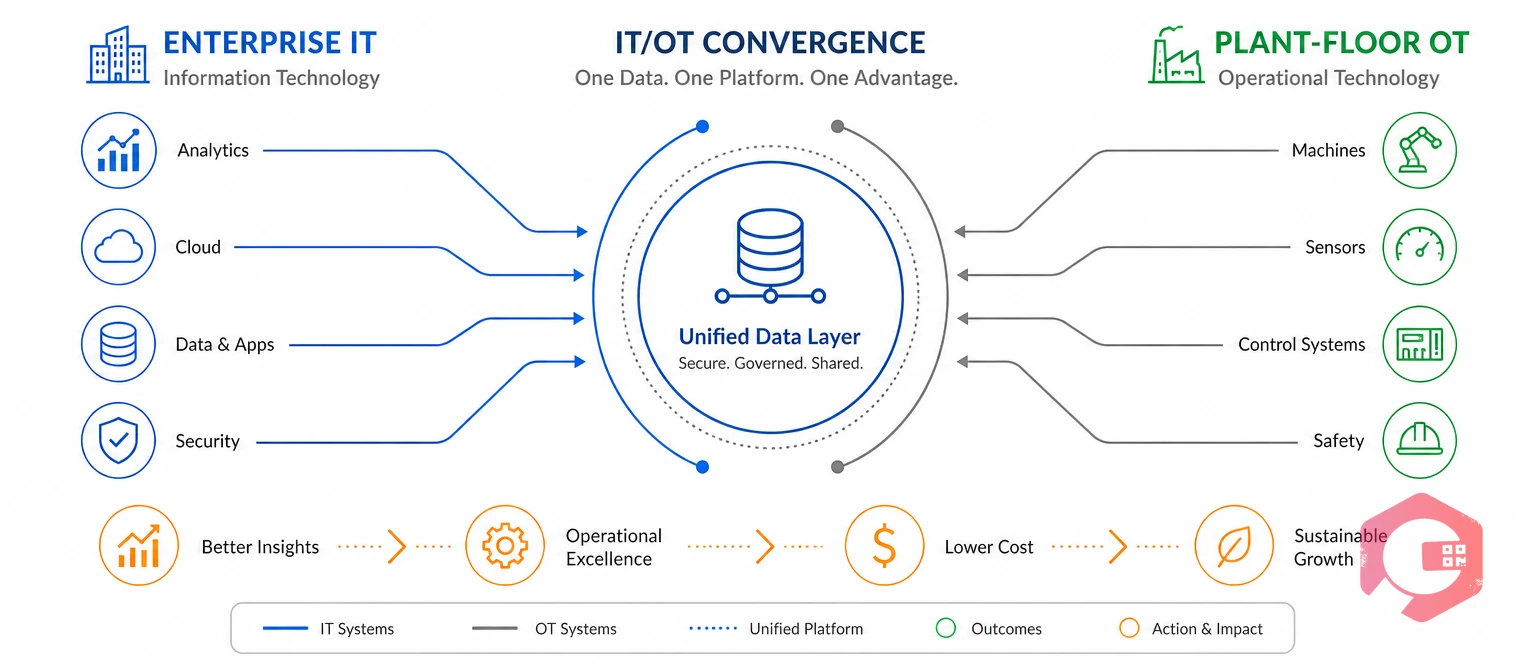
IT/OT convergence is the process of unifying an organization's information technology infrastructure with its operational technology systems into a single, interoperable architecture. Instead of running two parallel technology stacks — one for business data and one for machine control — convergence creates a shared environment where data moves freely between both.
The concept gained traction alongside Industry 4.0, which positions smart manufacturing, Industrial IoT (IIoT), and cloud computing as pillars of modern production. Before convergence, a maintenance technician checking vibration data on a pump had no connection to the ERP system tracking that pump's warranty or spare parts. IT/OT convergence closes that gap.
Here is what convergence looks like in practice. A temperature sensor on a compressor detects an anomaly. The system creates a work order, pulls the correct SOP, checks spare parts availability, and notifies the assigned technician by mobile push. No manual step required. That level of automation is only possible when IT and OT systems share a common data and workflow layer.
IT refers to the systems used for storing, processing, and transmitting business data. This includes servers, databases, enterprise resource planning (ERP) platforms, cloud services, and business intelligence dashboards. IT systems prioritize data integrity, confidentiality, and availability — following frameworks like NIST and ISO 27001.
In a manufacturing context, IT manages everything from purchase orders and inventory records to work order histories and compliance documentation. IT teams deploy software updates frequently, often weekly or monthly, and design systems around the CIA triad — confidentiality first, then integrity, then availability.
OT refers to the hardware and software that monitors and controls physical processes. This includes programmable logic controllers (PLCs), distributed control systems (DCS), SCADA networks, sensors, and human-machine interfaces (HMIs). OT systems prioritize uptime, safety, and deterministic response times — a valve must open in milliseconds, not seconds.
Unlike IT systems, OT equipment often runs for 15 to 25 years with minimal software changes. Firmware updates are rare because any interruption risks production loss or safety incidents. OT networks traditionally operate in air-gapped environments — physically separated from the corporate IT network. That isolation was once a security feature, but it also created the data silo that convergence now aims to dissolve.
Understanding the core differences between IT and OT is the first step toward bridging the gap. The table below breaks down how each technology stack operates, what it prioritizes, and where the friction points arise during convergence.
| Attribute | IT (Information Technology) | OT (Operational Technology) |
|---|---|---|
| Primary Goal | Data processing and business logic | Physical process control and safety |
| Top Priority | Confidentiality, data integrity | Uptime, safety, deterministic response |
| Update Cycle | Frequent patches (weekly/monthly) | Rare updates (years between patches) |
| Protocols | TCP/IP, HTTP, SQL | Modbus, OPC UA, PROFINET, MQTT |
| Lifecycle | 3-5 years (cloud, SaaS) | 15-25 years (embedded, proprietary) |
| Security Model | CIA triad (Confidentiality first) | AIC triad (Availability first) |
| Managed By | IT department, CIO | Operations/maintenance, plant manager |
These differences explain why convergence is not simply "plugging OT into the corporate network." Each stack was designed with different assumptions about risk, latency, and change management.
The IT/OT gap is the operational disconnect caused by running information technology and operational technology as separate, non-communicating systems. This gap shows up as duplicated data entry, delayed maintenance responses, and blind spots in reliability reporting. Every time a technician manually copies a sensor reading from a SCADA screen into a spreadsheet, the IT/OT gap is costing the organization time and accuracy.
Closing this gap does not mean merging IT and OT into a single team or a single platform. It means building controlled bridges — APIs, edge gateways, middleware — that let data flow between the two environments while preserving each stack's integrity and security requirements.
Most maintenance teams still operate with a blind spot between what happens on the plant floor and what shows up in their management systems. A technician may know a motor is running hot because they felt it during a walkthrough. But the maintenance manager looking at a dashboard sees nothing — because the temperature sensor feeds a standalone SCADA system that does not talk to the CMMS.
IT/OT convergence eliminates that blind spot. When OT sensors feed data directly into IT-managed platforms, maintenance teams gain three capabilities that change how they work:
Maintenance teams using Cryotos have reported up to 30% reduction in unplanned downtime and 25% faster repair turnaround — results directly tied to connecting OT data streams to structured maintenance workflows.
The shift also changes how maintenance teams measure success. Without convergence, KPIs are lagging indicators — you calculate last month's MTTR from manually logged work orders. With convergence, KPIs become leading indicators — you see MTTR trending upward in real time and intervene before the number makes the monthly report.

Convergence gives maintenance managers a single-pane-of-glass view of every asset's operating condition. Temperature, pressure, vibration, and runtime data from OT sensors appear alongside maintenance history, warranty status, and cost data from IT systems. No more switching between SCADA screens and spreadsheets.
This visibility also enables better capital planning. When asset health data flows continuously into an IT-managed reporting layer, reliability engineers can identify equipment approaching end-of-life months before a catastrophic failure — turning an emergency replacement into a budgeted capital expenditure.
When an OT alarm triggers, a converged system can automatically generate a work order in the CMMS, assign it to the nearest available technician via mobile push notification, and attach the relevant SOP. Response times drop because the gap between "machine flagged an issue" and "technician received the task" shrinks from hours to minutes.
In traditional setups, an operator notices an anomaly, walks to a supervisor, fills out a paper request, and waits for the maintenance planner to schedule the job. That handoff chain can take half a shift. Convergence replaces the entire chain with a single automated trigger.
Predictive maintenance is a condition-driven strategy that uses real-time sensor data and analytical models to forecast equipment failures before they occur. Unlike preventive maintenance, which runs on fixed schedules, predictive maintenance triggers action only when data indicates an approaching failure — saving both time and parts.
IT/OT convergence makes predictive maintenance practical by feeding vibration signatures, thermal profiles, and energy consumption data into IoT meter reading modules. Maintenance teams can forecast failures before they happen and schedule repairs during planned downtime windows rather than reacting to emergency breakdowns.
Convergence eliminates the manual data stitching that most plants rely on for monthly reports. When OT and IT share a data layer, KPIs like OEE, availability percentage, and mean time between failures calculate automatically from live data — not from spreadsheets assembled days after the fact.
Unified dashboards also improve decision-making speed. A plant manager reviewing a weekly reliability meeting can see which assets had the highest downtime, what work orders were created in response, and whether spare parts were available — all in one screen. Without convergence, assembling that same view requires pulling data from three or four separate systems and manually reconciling timestamps and asset IDs.
Every manual step removed from a maintenance workflow saves time and reduces errors. Automated meter readings replace manual gauge checks. Digital checklists triggered by sensor thresholds replace calendar-based inspections. Over time, these efficiency gains compound.
SMRP benchmarks indicate that best-in-class plants spend 2-3% of replacement asset value on maintenance — converged data environments help facilities reach that target faster. The cost savings come from three areas: fewer emergency repairs (which cost 3-5x more than planned work), reduced spare parts inventory (because condition data replaces safety stock assumptions), and lower labor costs per work order (because automated routing eliminates manual dispatch).
Calculate your OEE to measure convergence impact and see where your plant stands against industry benchmarks.
IT/OT convergence delivers measurable gains, but the path is not without friction. Most facilities encounter three categories of obstacles during implementation.
The IT/OT boundary is the single highest-risk attack surface created by convergence. OT systems were designed to run in isolated networks — air-gapped from the internet. Connecting them to IT infrastructure exposes industrial controllers to threats they were never built to handle: ransomware, credential theft, and lateral movement attacks.
The NIST Cybersecurity Framework provides a structured approach to managing this risk. Key mitigations include network segmentation — keep OT on a separate VLAN with controlled access points. Deploy industrial firewalls at the convergence layer. Add role-based access controls to restrict who can read OT data from the IT side.
A CNC machine installed in 2005 speaks Modbus. The cloud-based CMMS speaks REST APIs. Bridging that gap requires protocol translators, edge gateways, or middleware — and each adds complexity. Most facilities operate a mix of equipment spanning two or three decades, making a single-standard approach unrealistic.
Common protocol mismatches include Modbus RTU (serial) versus Modbus TCP/IP (Ethernet), proprietary vendor protocols, and legacy 4-20 mA analog signals. Each of these needs conversion before any IT system can read the data. Catalog these mismatches during an asset audit — you cannot bridge a gap you have not measured.
The practical solution is an edge computing layer: lightweight industrial gateways that translate OT protocols into IT-friendly formats (OPC UA, MQTT) before data reaches the enterprise network. This keeps legacy equipment running without requiring firmware upgrades that could void warranties or disrupt production.
Technology is only half the convergence challenge. The other half is people. IT teams optimize for data security and uptime of business systems. OT teams optimize for production uptime and operator safety. Their KPIs, risk models, and change management processes are different — and those differences create friction when the two groups are asked to share infrastructure.
Facilities that bridge this silo successfully start with a joint governance committee. Include both IT and OT leaders, define shared KPIs (such as overall equipment effectiveness), and run pilot projects on non-critical assets before rolling convergence out plant-wide.
Language barriers add another dimension to the silo problem. IT teams talk about latency, APIs, and cloud uptime. OT teams talk about cycle time, interlocks, and safety integrity levels. A convergence project stalls when each side assumes the other understands its vocabulary. Creating a shared glossary — a simple document that maps IT terms to their OT equivalents — accelerates collaboration more than any technology investment.

The Four-Layer IT/OT Convergence Stack:
Start by mapping your current OT network topology. Identify every PLC, sensor, and gateway, and document the protocols each device uses. Install an industrial demilitarized zone (IDMZ) between the OT and IT networks — this is the firewall-controlled handoff point that allows data to flow outward without giving IT systems direct access to control networks.
Edge gateways sit at this layer, translating Modbus, PROFINET, or BACnet traffic into OPC UA or MQTT messages that IT systems can consume. Choose gateways with built-in encryption and certificate-based authentication. Most facilities start with a single production line as a pilot rather than attempting plant-wide network integration on day one.
Raw OT data — vibration readings at 10-second intervals, temperature logs, cycle counts — needs structure before it becomes useful to IT applications. Define a data schema that tags each reading with asset ID, location, timestamp, and unit of measure. Time-series databases (InfluxDB, TimescaleDB) handle the high-frequency write patterns that OT data generates better than traditional relational databases.
Data quality matters as much as data volume. Establish validation rules at the edge — reject out-of-range readings, flag missing timestamps, and deduplicate sensor pings before they reach the central data store. Clean data entering the system means reliable KPIs coming out of it.
This is where convergence becomes tangible for maintenance teams. Connect the unified data layer to your CMMS so that sensor thresholds trigger work orders, meter readings auto-populate PM schedules, and asset health scores update in real time. API-based integrations are the cleanest approach — they keep each application independent while sharing data through well-defined contracts.
Common integration patterns include connecting SCADA alarm outputs to the CMMS work order API, linking ERP purchase orders to CMMS inventory modules, and feeding OT runtime data into BI dashboards for executive reporting. Each connection should follow a standard data contract — agreed field names, units, and error-handling rules — so that adding a new sensor or a new application does not require custom development each time.
Technology integration without process alignment leads to confusion. Define a shared change management procedure that covers both IT patches and OT firmware updates. Establish a single incident response workflow that treats a SCADA alert and a server outage with the same severity classification. Train maintenance planners and IT admins on each other's tools — cross-functional literacy reduces the "that's not my system" reflex.
Process standardization also means agreeing on data ownership. Who is responsible for the accuracy of a vibration reading — the OT team that calibrates the sensor, or the IT team that stores the data? Clear ownership prevents the finger-pointing that slows resolution when a data quality issue surfaces. Document these responsibilities in a RACI matrix and review it quarterly as roles evolve and new assets come online.
A CMMS is the application-layer bridge between OT data and IT-managed maintenance workflows. It receives sensor data from the OT side — meter readings, alarm triggers, runtime hours — and converts them into actionable maintenance tasks on the IT side: work orders, PM schedules, inventory requests, and compliance records.
Here is how that bridge works in practice:
For facilities beginning their convergence journey, the CMMS is often the fastest path to measurable results because it does not require replacing existing OT infrastructure — it layers on top, connecting what already exists.
Many convergence roadmaps begin with a massive network overhaul or a multi-year digital twin project. Those approaches work, but they take years to show ROI. Starting with a CMMS integration delivers results in weeks, not years. Connect a handful of critical asset sensors to the CMMS, automate work order generation for those assets, and measure the improvement in response time and downtime. That measurable win builds the business case for broader convergence investments.
A phased approach also reduces risk. If a sensor-to-CMMS integration introduces a false alarm or an incorrect threshold, the worst outcome is a spurious work order — not a production shutdown. Facilities learn and adjust their convergence rules on low-stakes processes before applying them to mission-critical assets.
IT (Information Technology) handles business data — ERP systems, databases, email, and cloud services. OT (Operational Technology) controls physical processes — PLCs, SCADA systems, sensors, and industrial controllers. IT prioritizes data confidentiality and integrity, while OT prioritizes equipment uptime and operator safety. In manufacturing, IT manages the business side and OT manages the production side.
IT/OT convergence eliminates the data gap between shop-floor equipment and maintenance management systems. Without convergence, sensor data stays trapped in standalone SCADA systems while maintenance managers rely on manual inspections and calendar-based schedules. Convergence enables condition-based maintenance, automatic work order generation, and real-time KPI dashboards — reducing unplanned downtime and improving asset reliability. Facilities that implement convergence typically see measurable improvements in MTTR and overall equipment effectiveness within the first quarter of deployment.
The primary risk is expanding the attack surface. OT systems were designed for isolated networks and often run unpatched firmware. Connecting them to IT infrastructure exposes industrial controllers to ransomware, credential theft, and lateral movement attacks. Mitigation strategies include network segmentation with an industrial DMZ, role-based access controls, and continuous monitoring using the ISA/IEC 62443 standard for industrial cybersecurity.
A CMMS acts as the application-layer bridge between OT data and IT-managed workflows. It receives sensor readings, meter data, and alarm triggers from the OT side, then converts them into structured maintenance tasks — work orders, PM schedules, and inventory requests — on the IT side. This eliminates manual data entry, enables predictive maintenance, and provides unified reporting across both technology stacks. Most modern CMMS platforms also integrate with ERP systems, closing the loop between maintenance execution and financial planning so that repair costs, parts consumption, and labor hours flow into the same reporting layer.
IT/OT convergence is no longer a future initiative — it is the foundation of modern maintenance strategy. Facilities that bridge this gap gain real-time visibility, faster response times, and measurable cost reductions. Whether your plant runs legacy Modbus equipment or modern IIoT sensors, the path to convergence starts with connecting the data your machines already produce to the workflows your maintenance team already follows. Schedule a free demo to see how Cryotos connects your OT sensor data to automated maintenance workflows.


Cryotos AI predicts failures, automates work orders, and simplifies maintenance—before problems slow you down.