
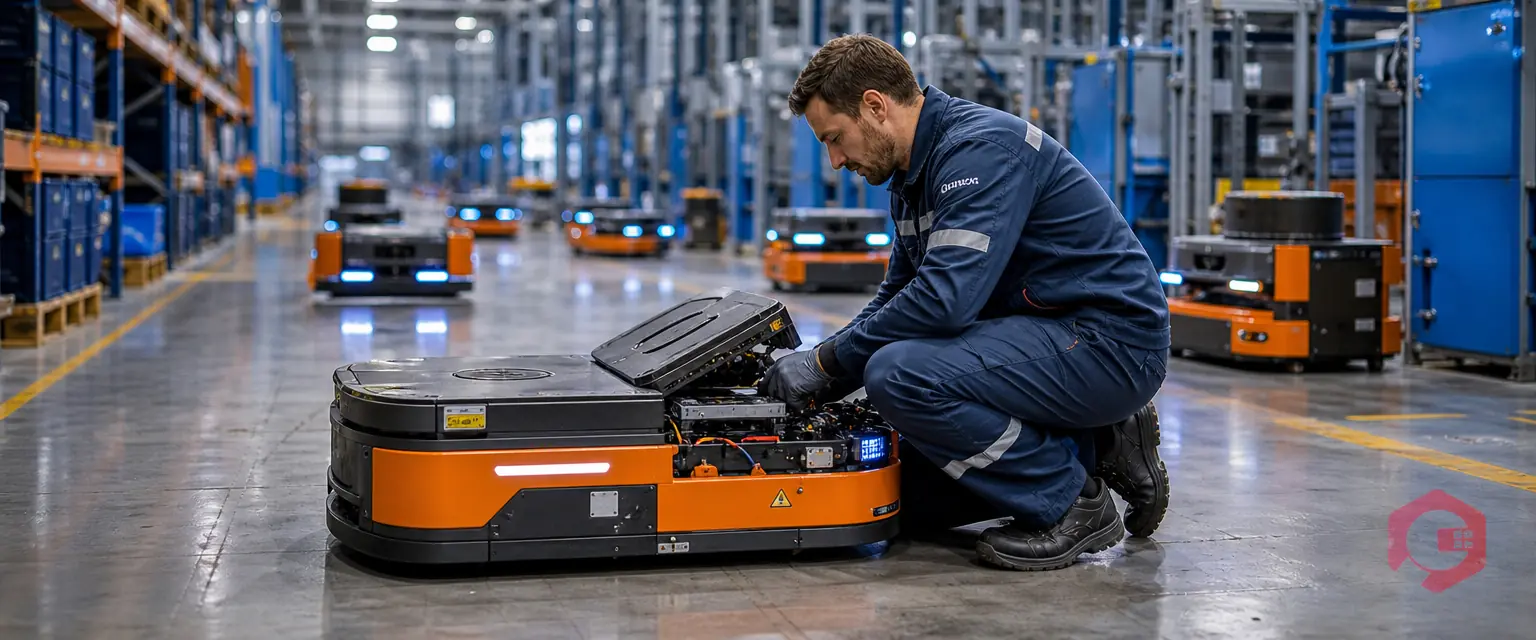
The AGV vs AMR choice comes down to one question: do your robots need to follow fixed paths, or find their own way? An automated guided vehicle (AGV) runs along set routes marked by magnetic tape, wires or reflectors. An autonomous mobile robot (AMR) uses LiDAR, cameras and onboard maps to plan its own route and steer around obstacles in real time.
For smart factory maintenance, this decision shapes more than material flow. It sets what your technicians inspect, how often they inspect it, which spare parts you stock and how fast a stalled robot turns into line downtime. This guide compares both options side by side, explains the upkeep each one needs, and gives you a five-factor framework for picking the right mobile robot strategy.
Key Takeaways
The quickest way to compare AGV vs AMR options is to look at how each robot navigates, adapts and fails. Both fall under ISO 3691-4, the safety standard for driverless industrial trucks, but they meet it in very different ways.
| Factor | AGV | AMR |
|---|---|---|
| Navigation | Fixed guides: magnetic tape, wires, reflectors or QR markers | LiDAR, cameras and SLAM maps with no floor guides |
| Route changes | Need new tape, wire or reflector layout | Edited in software, often in minutes |
| Obstacle response | Stops and waits until the path clears | Slows, then plans a way around it |
| Infrastructure | Floor guides plus charging points | Wi-Fi coverage, fleet server and charging docks |
| Upfront unit cost | Usually lower per vehicle | Usually higher per vehicle |
| Best environment | Stable, repeat routes with little foot traffic | Busy, changing floors shared with people |
| Main maintenance focus | Guide paths, wheels, drives and batteries | Sensors, software, maps and batteries |
In short, AGVs trade flexibility for predictability, while AMRs trade simplicity for adaptability. Your layout and traffic mix decide which trade makes sense.
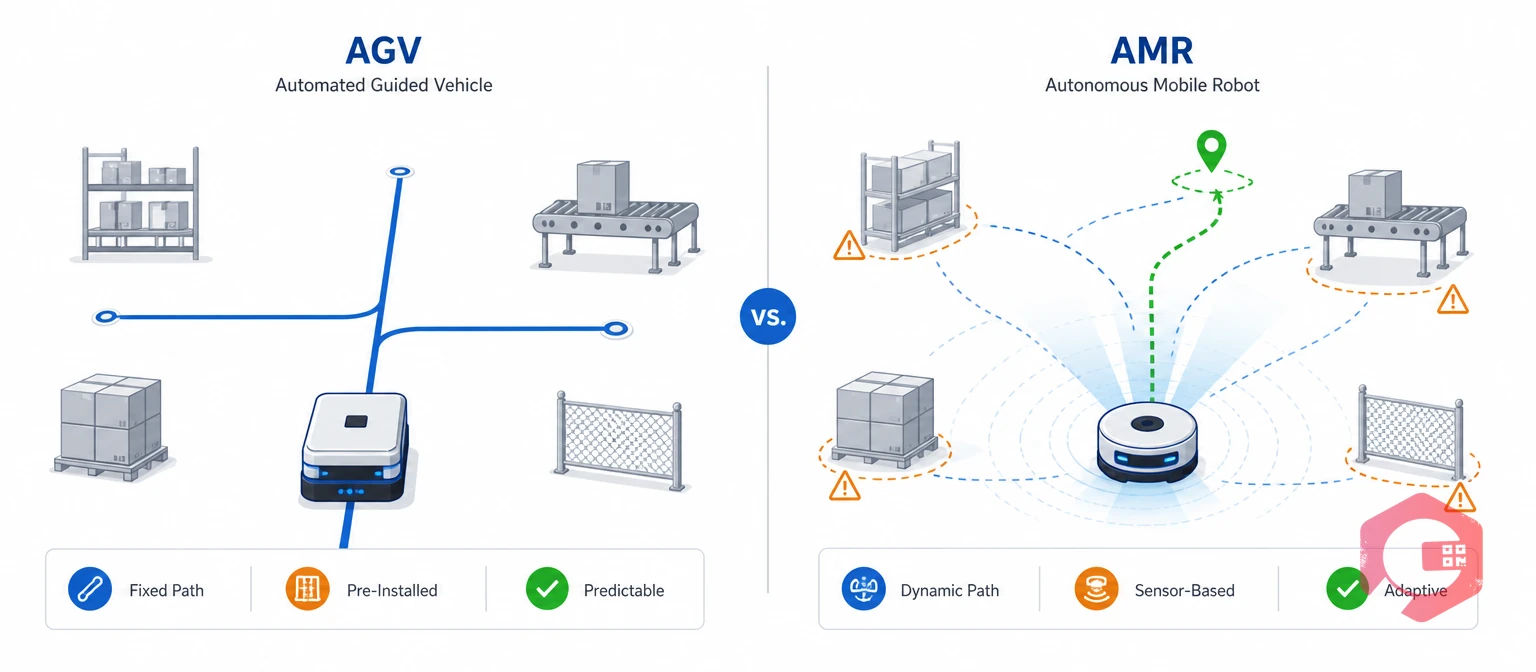
An automated guided vehicle (AGV) is a driverless material-handling robot that follows fixed, predefined paths. It moves pallets, carts and parts between set stations and does the same run thousands of times.
AGVs are not new. The first automated guided vehicle reached the market in the 1950s as a tow truck that followed a wire in the floor. Today's models are far smarter, but the core idea is the same: the route lives in the building, not in the robot.
AGVs shine in plants where the route rarely changes. Think engine lines, paper mills or heavy pallet runs between a dock and a warehouse. When a robot does the same loop every shift, fixed guidance gives you predictable timing and fewer surprises.
The takeaway: an AGV is a dependable workhorse for stable, repeat routes.
An autonomous mobile robot (AMR) is a self-driving robot that builds its own map and plans routes without floor guides. It decides the best path each trip and reroutes when something blocks the way.
AMRs rely on simultaneous localization and mapping (SLAM), which lets a robot map a space while tracking its own spot inside it. That makes them a core building block of Industry 4.0 factories, where layouts and product mixes shift often.
AMRs fit busy floors where people, forklifts and carts share aisles. Each robot is also a connected device on your Industrial Internet of Things (IIoT) network, sending status, battery and error data every second.
The takeaway: an AMR suits dynamic plants that change often and want rich machine data. That self-navigation trait sits at the heart of every AGV vs AMR comparison.
Planning a new robot fleet? Check how reliable your current material handling equipment is with the free MTBF calculator before you choose a replacement.
In any AGV vs AMR evaluation, the biggest split for maintenance teams is what breaks, how you find it and how you fix it. The right choice depends on whether your team is stronger with mechanical work or with sensors and software.
AGV guide paths wear out. Forklifts scuff tape, floor scrubbers lift it, and reflectors get knocked out of line. AMRs skip the floor guides, but their LiDAR windows and cameras need regular cleaning and calibration checks.
Moving an AGV route means relaying tape or wire, which often calls for a weekend shutdown. An AMR route change is a map edit. Your planners still need to test it, but the floor stays open.
Both robot types use safety scanners, bumpers and emergency stops that must pass regular function tests. In mixed traffic, OSHA's powered industrial truck guidance is a useful reference for aisle rules, pedestrian zones and forklift interaction.
The takeaway: AGVs lean on mechanical upkeep, while AMRs lean on sensor care and software discipline.
A written AGV vs AMR maintenance schedule keeps both fleets available and stops small faults from halting a line. Use the intervals below as starting points, then tune them to your OEM manuals and your own failure history.
| Component | AGV Task | AMR Task | Suggested Interval |
|---|---|---|---|
| Batteries and chargers | Check charge contacts, cables and cycle count | Review battery health data and dock contacts | Weekly check, cycle-based replacement |
| Drive wheels and casters | Inspect tread wear, bearings and alignment | Inspect tread wear and clear debris | Monthly or by run hours |
| Navigation system | Repair tape, wire and reflector damage | Clean LiDAR and cameras, check calibration | Weekly visual, quarterly calibration |
| Safety devices | Test scanners, bumpers and e-stops | Test scanners, bumpers and e-stops | Daily pre-shift, formal test quarterly |
| Software and maps | Back up controller settings | Apply firmware updates, back up maps | Per vendor release, backup monthly |
| Load handling | Lube lift tops, forks or tow hitches | Check top modules, rollers or lifts | Monthly |
Loading these tasks into preventive maintenance software turns the table into auto-generated work orders, so no robot slips through the cracks.
Total cost of ownership (TCO) is the full cost of buying, running, maintaining and replacing a robot over its working life. An AGV usually costs less to buy, but an AMR can cost less to own when layouts change often. When you run AGV vs AMR cost numbers, the sticker price is only one line in the budget.
Keep wheels, battery packs, bumpers and scanner windows on hand with spare parts management that alerts you before stock runs low. The takeaway: judge each option on five-year cost, not purchase price.
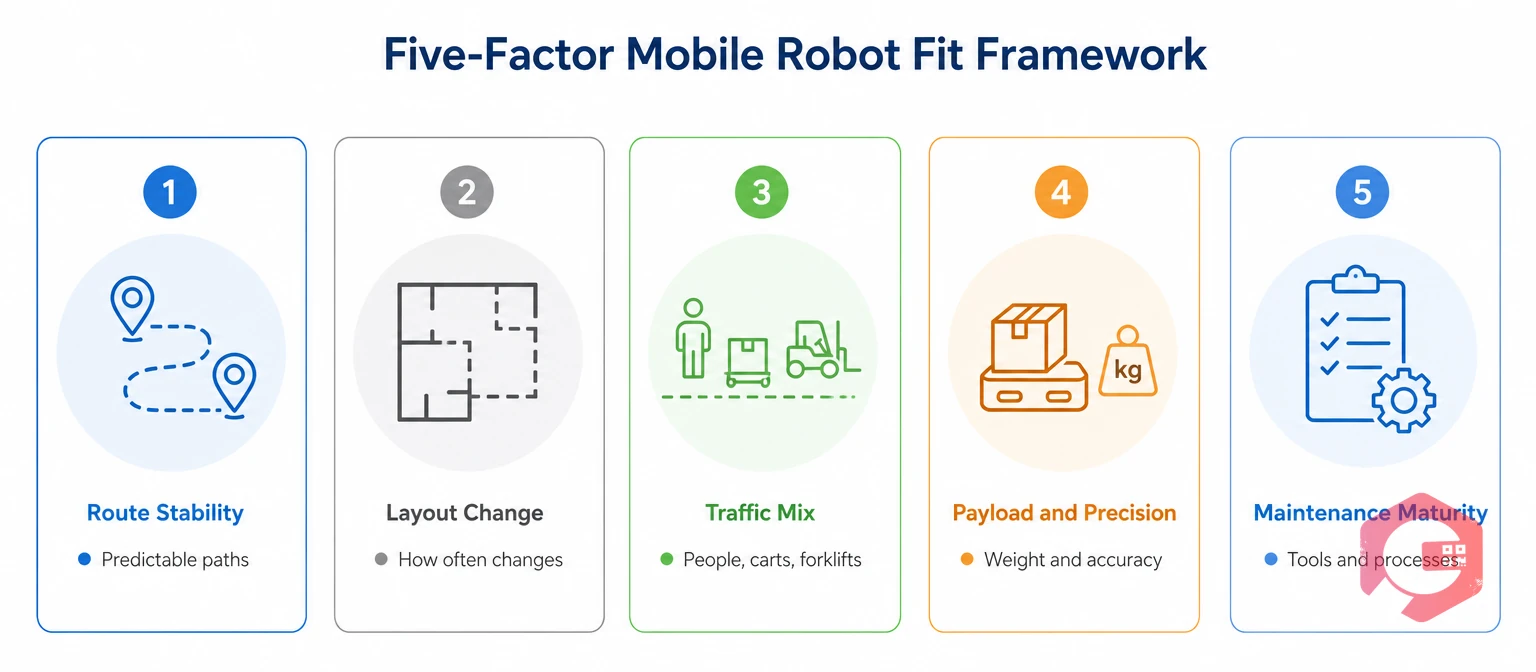
The simplest way to settle the AGV vs AMR question is to score your plant on five factors. Rate each one from 1 (low) to 5 (high).
The Five-Factor Mobile Robot Fit Framework:
The takeaway: score your plant honestly, and the right robot strategy usually becomes clear.
Most plants can match their AGV vs AMR situation to one of three patterns. Here is how each one plays out on the shop floor.
Your plant has both fixed trunk routes and changing last-meter deliveries. Many automotive and electronics plants run AGVs for heavy trunk moves and AMRs for kitting and spare-parts delivery to technicians. The takeaway: you don't have to pick just one robot type.
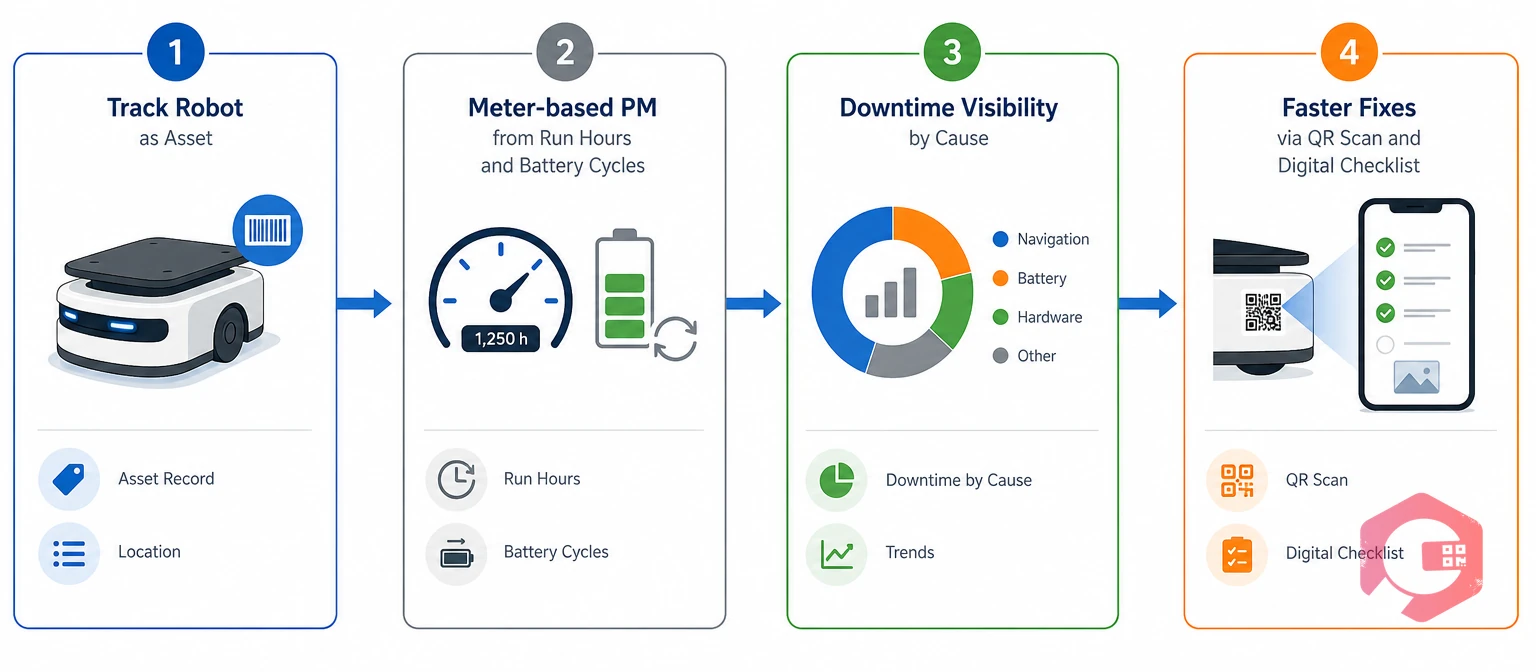
A Computerized Maintenance Management System keeps a robot fleet reliable, whatever the outcome of your AGV vs AMR decision. It treats every robot as a tracked asset. Each robot gets its own record, history, spare parts list and PM plan.
Maintenance teams using Cryotos have reported up to 30% reduction in unplanned downtime and 25% faster repair turnaround. For a robot fleet, those gains mean fewer starved lines and more robots on the floor each shift.
The most common mistake is treating robots like appliances that need no care. Operations that get the most from an AGV vs AMR rollout plan upkeep from day one.
The takeaway: plan robot maintenance before the first unit arrives, not after the first breakdown.
No. An AMR is better when routes change often and floors are busy. An AGV is often the smarter, cheaper pick for heavy, repeat moves on stable routes.
Yes. Many plants run a hybrid fleet, with AGVs on fixed trunk routes and AMRs on flexible deliveries. The key is shared traffic rules and one maintenance system that tracks both robot types.
Most fleets need daily pre-shift safety checks, weekly battery and sensor checks, and monthly mechanical inspections. Adjust intervals using run hours, battery cycles and your own failure history.
ISO 3691-4 sets safety requirements for driverless industrial trucks, which covers both AGVs and AMRs. Local rules and your insurer may add extra requirements for mixed traffic areas.
Not always. AMRs have more sensors and software to manage, but they skip the floor guide repairs that AGVs need. Total upkeep cost depends on your layout, traffic and how well you track each robot.
Whichever side of the AGV vs AMR debate you land on, strong maintenance keeps your fleet moving. Schedule a free demo to see how Cryotos tracks every AGV and AMR as an asset, triggers PM from real usage and cuts robot downtime across your smart factory.



Cryotos AI predicts failures, automates work orders, and simplifies maintenance—before problems slow you down.



