
A functional failure in maintenance is a condition in which an asset cannot perform its intended function to the required standard — even if the asset is still physically intact. According to the Society of Automotive Engineers' SAE JA1011 standard for Reliability-Centered Maintenance (RCM), functional failures are the foundation of the entire RCM analysis process. Studies by the Plant Engineering maintenance benchmarking group consistently show that up to 40% of industrial downtime traces back to assets that technically "run" but no longer deliver their required output. Understanding functional failure is therefore the first and most critical step in designing a maintenance strategy that actually protects production.
A functional failure occurs when an asset fails to deliver its required function at the level the business demands — regardless of whether a physical breakdown has happened. The key distinction is that functional failure is defined by performance against a standard, not by the condition of the asset.
John Moubray, who developed the modern RCM framework, defined a functional failure as "the inability of an item to fulfil a function to a performance standard acceptable to the user." This definition matters because it shifts the focus from the asset itself to the output it must deliver. A pump that is supposed to deliver 500 litres per minute but is only moving 300 litres per minute has experienced a functional failure — even if no component has physically broken.
There are two types of functional failure maintenance teams need to recognise:
A physical failure is a change in the condition of an asset — a cracked bearing, a worn seal, or a burnt-out coil. A functional failure is a change in what the asset delivers. The two often go hand in hand, but not always. An asset can have a physical defect and still meet its functional requirement. Conversely, an asset with no visible physical problem can fail functionally if the process demand has changed or if performance has degraded gradually below the acceptable threshold.
Understanding this distinction is critical in Reliability-Centered Maintenance because RCM analysis starts with functions and functional failures — not with failure modes or root causes. You cannot identify the right maintenance task until you first define what the asset must do and what it means for it to fail to do so.

Functional failures can be classified in several ways depending on the context of the RCM analysis. The most widely used classification in practice breaks them into three categories:
In a formal RCM analysis, every function of an asset is paired with at least one functional failure statement. A pump with three defined functions — deliver flow, maintain pressure, contain fluid — will have at least three separate functional failure statements in the RCM analysis, each of which leads to its own set of failure modes and maintenance tasks.
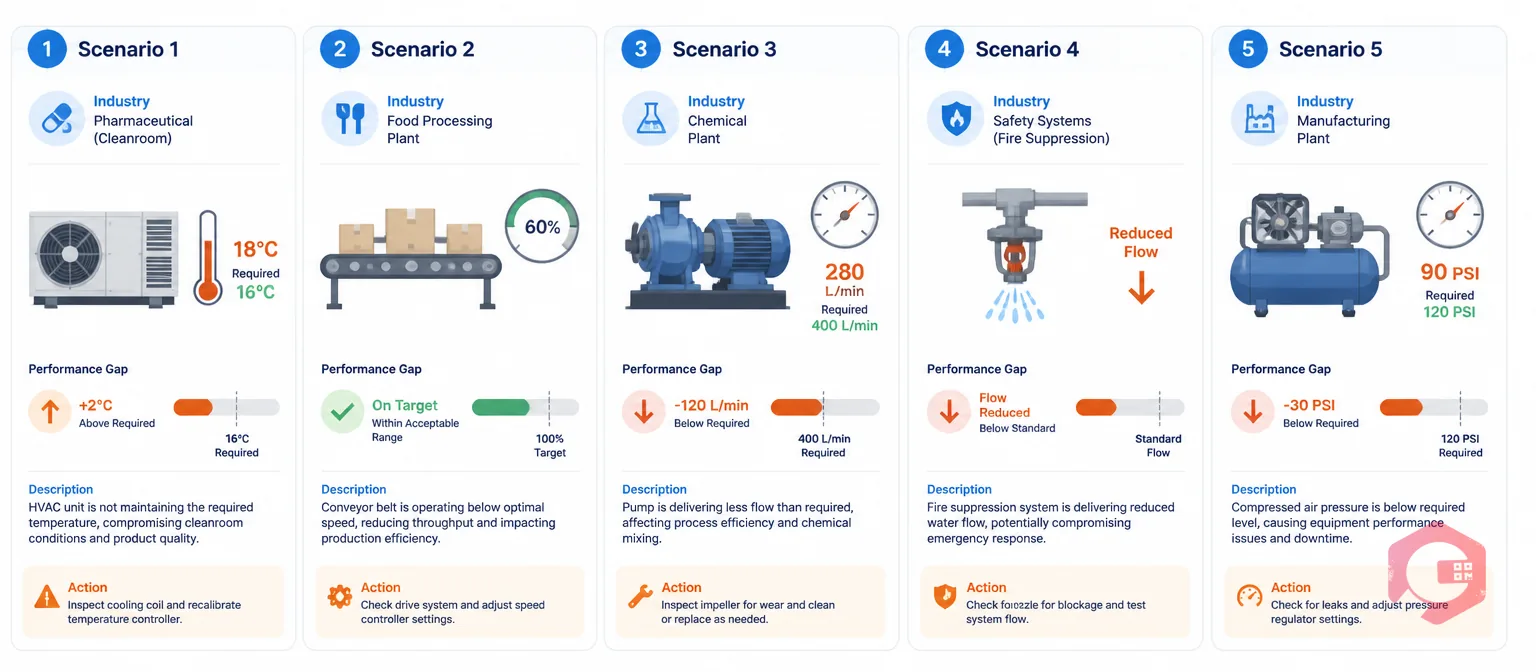
Seeing functional failure through concrete examples makes the concept far easier to apply in practice. Below are five industry-specific scenarios that illustrate how functional failures look different from physical failures in real maintenance environments.
Reliability-Centered Maintenance (RCM) is a structured methodology for determining the most effective maintenance strategy for each asset based on its functions, functional failures, and the consequences of those failures. Functional failure is not a component of RCM — it is the starting point of the entire analysis.
The RCM process follows a seven-question framework originally developed for aircraft maintenance and later adapted across industrial sectors by Moubray and others:
Without clearly defined functional failures, none of the downstream RCM analysis is possible. You cannot identify failure modes without knowing which functional failures those modes produce. You cannot prioritise maintenance tasks without knowing the consequence of each functional failure. And you cannot measure the effectiveness of your maintenance strategy without tracking functional failure rates over time.
This is why CMMS tools that support failure-mode logging and root cause analysis are so important in organisations running formal RCM programs — the software becomes the system of record for functional failure data across the entire asset base.
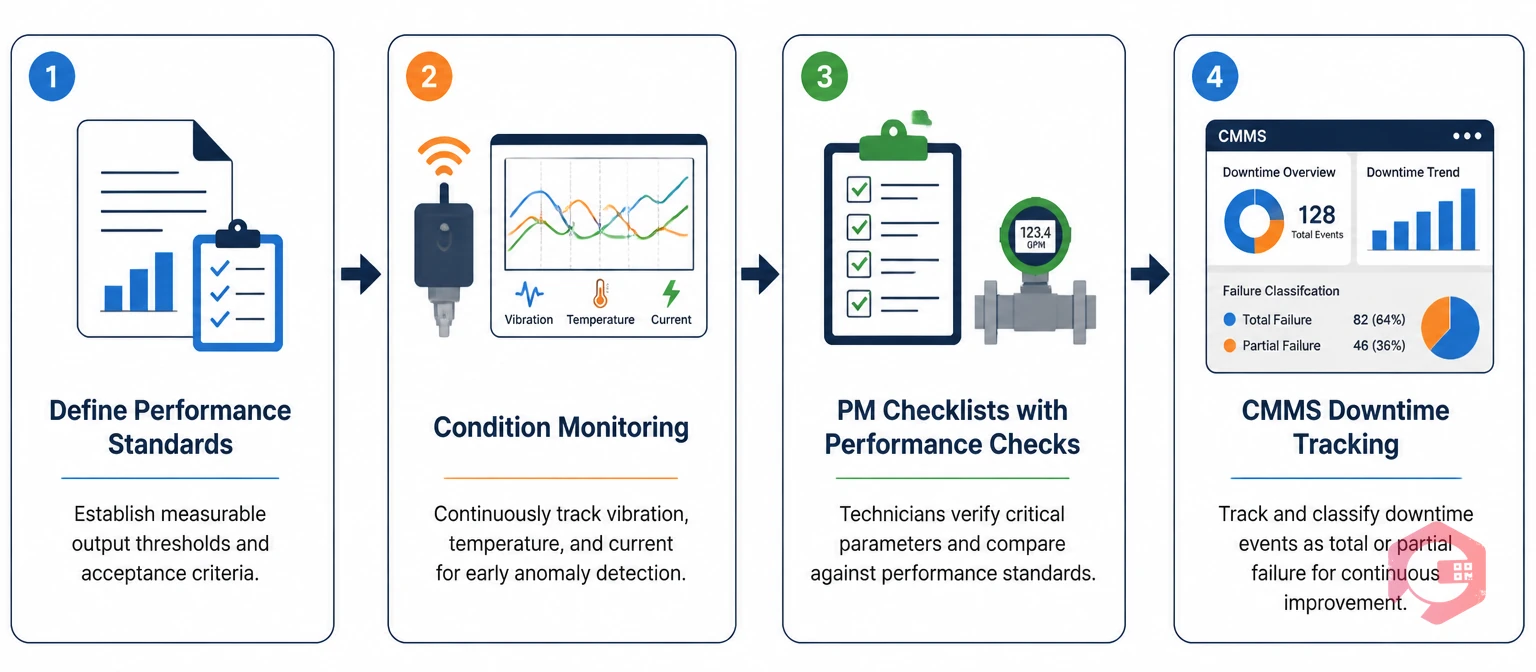
The challenge with functional failures — particularly partial ones — is that they are invisible to reactive maintenance programs. An asset that is still running does not generate an alarm, trigger a work request, or attract technician attention. Organisations that only respond to physical breakdowns miss most of their functional failure events entirely.
There are four practical approaches maintenance teams use to identify functional failures proactively:
The distinction between functional failure and physical failure is one of the most important concepts in modern maintenance management — and one of the most commonly confused. The table below captures the key differences to help maintenance teams apply the right analysis approach in each situation.
| Dimension | Functional Failure | Physical Failure |
|---|---|---|
| Definition | Asset cannot meet required performance standard | A component has physically changed state or broken |
| Detection | Output measurement, condition monitoring, process data | Visual inspection, physical examination, alarms |
| Asset still running? | Often yes (partial failure) | Often no (component failure) |
| RCM role | Starting point of RCM analysis | Failure mode that leads to functional failure |
| Example | Pump delivers 60% of required flow rate | Pump impeller has worn to below 70% thickness |
| Consequence focus | Impact on process or safety output | Impact on asset condition and component state |
| Maintenance trigger | Performance drops below defined threshold | Physical condition crosses acceptable limit |
Managing functional failures requires a maintenance system that can do more than track work orders. It needs to capture performance data against defined standards, classify failure types accurately, support formal RCM analysis, and surface functional failure trends before they escalate into production loss.
Cryotos CMMS supports every stage of the functional failure management cycle:
Maintenance teams using Cryotos report a 30% reduction in downtime and 25% faster repair times — outcomes that reflect what happens when functional failures are identified early, classified correctly, and addressed before they cause production stoppages. Explore Cryotos maintenance management software to see how the platform supports your RCM program end to end.
A functional failure is the inability of an asset to perform its required function to the required standard. A failure mode is the specific cause that leads to the functional failure. For example, "pump cannot deliver required flow rate" is a functional failure. "Impeller erosion due to cavitation" is a failure mode that causes that functional failure. In an RCM analysis, you first define functional failures, then identify all the failure modes that could produce each one.
Yes — most assets have multiple functions, and each function can fail in more than one way. A pump that must deliver flow, maintain pressure, and contain fluid has at least three separate functions. Each function can have both total and partial failure modes. A thorough RCM analysis will identify every function and every associated functional failure before selecting the appropriate maintenance task for each failure mode.
In Failure Mode and Effects Analysis (FMEA), functional failures are the link between failure modes and their consequences. FMEA starts with a function, identifies how that function can fail (functional failure), then asks what failure modes cause the functional failure and what effects those failure modes produce. Without clearly defined functional failures, an FMEA cannot accurately assess the consequences of individual failure modes or prioritise maintenance tasks by risk.
A partial functional failure occurs when an asset can still perform its function but not to the required standard. It is still operating — motors run, pumps move fluid, compressors compress — but output has degraded below the defined performance threshold. Partial functional failures are the most common type in industrial operations and the hardest to detect without performance measurement. They are also responsible for significant hidden production losses because they generate no alarms and attract no reactive maintenance until they deteriorate into total failure.
A CMMS helps manage functional failures by storing defined performance standards against each asset, capturing failure classification data on every work order, enabling IoT-triggered alerts when performance drops below threshold, and providing the failure pattern data that RCM and FMEA analysis requires. Without a CMMS that classifies failures systematically, most organisations cannot distinguish between assets that stopped and assets that degraded — which makes it impossible to design a maintenance strategy that targets the actual causes of downtime.
Functional failure analysis is the foundation of every effective RCM program — and the clearest path from reactive firefighting to a maintenance strategy that prevents production loss before it starts. If your team is still tracking only physical breakdowns, you are missing the majority of the failure events that drive your downtime. Cryotos CMMS gives you the tools to define, detect, classify, and respond to functional failures across your entire asset base — making the shift from reactive to reliability-driven maintenance measurable and achievable.



Cryotos AI predicts failures, automates work orders, and simplifies maintenance—before problems slow you down.