Preventive maintenance frequency for industrial machines typically runs daily for visual checks, weekly to monthly for lubrication and minor inspections, quarterly for moderate servicing, and annually for major overhauls — but the right cadence depends on machine type, criticality, duty cycle, and environment. There is no single answer that fits every plant.
This post gives you the actual frequency ranges by machine category, the five factors that adjust those baselines up or down, and a 4-step decision framework for tuning intervals at your own site. By the end you'll know how often to run PM on every major asset class in your plant.
The Short Answer: PM Frequency by Machine Type
Most industrial machines fall into one of three frequency bands. As a starting point before any tuning:
High-frequency PM (daily to weekly): Critical rotating equipment in continuous service — compressors, primary process pumps, conveyor drive motors. Visual checks daily, light inspections weekly.
Mid-frequency PM (monthly to quarterly): Most production equipment — secondary motors, HVAC units, hydraulic systems, packaging machines. Monthly lubrication and inspection, quarterly minor service.
Low-frequency PM (semi-annually to annually): Standby equipment, slow-cycle machines, structural assets — backup generators, overhead cranes, electrical switchgear. Major service once or twice a year.
These bands assume single-shift operation in a clean indoor environment with no special compliance overlay. Three-shift operations, harsh environments, and regulated industries all pull frequencies up — sometimes by a factor of 2 or 3.
The Three Ways to Set PM Frequency
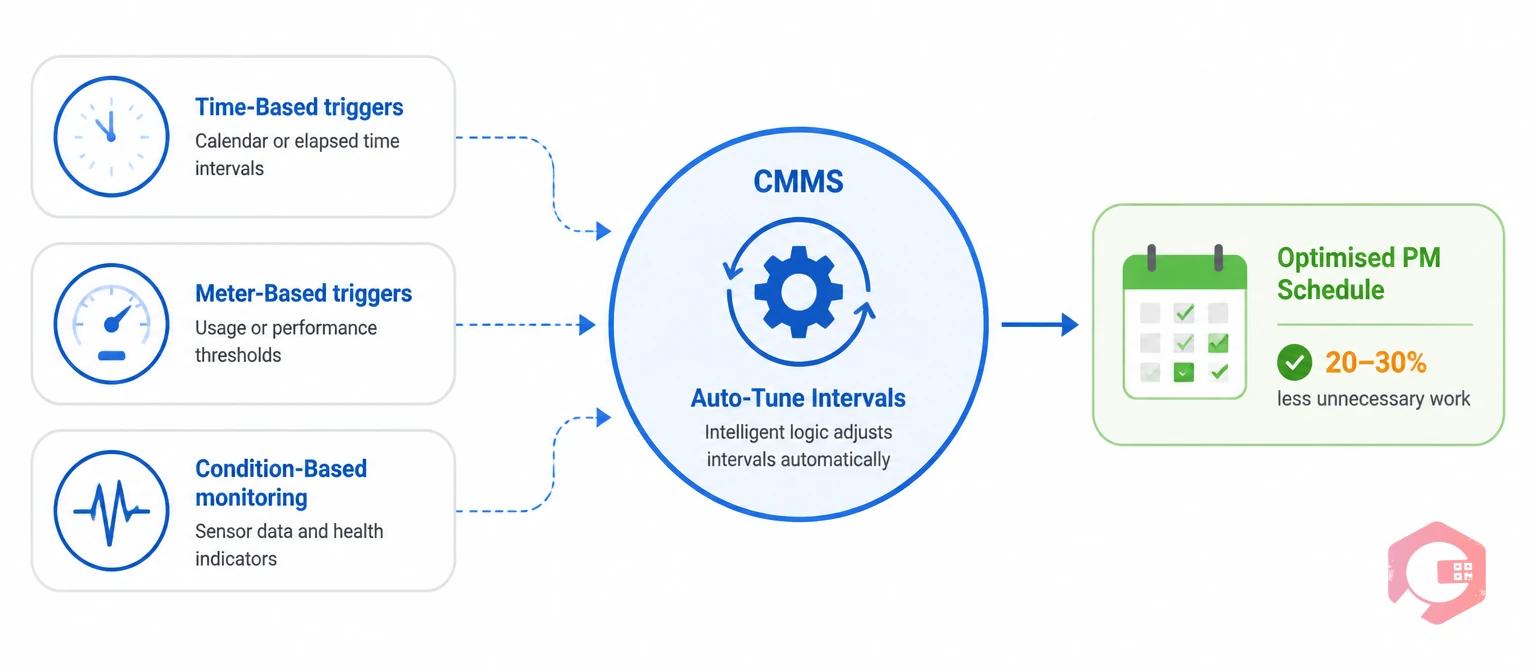
Before picking intervals, decide which trigger type each PM uses. Most plants mix all three:
Time-based: "Every 90 days." Simplest to schedule, weakest correlation with actual wear. Best for inspection-style PMs and assets with predictable, steady-state operation.
Meter-based: "Every 500 run-hours" or "every 10,000 cycles." Strong correlation with usage. Best for variable-duty equipment where calendar time doesn't reflect wear.
Condition-based: "When vibration exceeds 8 mm/s" or "when oil particle count trips threshold." Best correlation with actual condition. Best for critical assets where downtime costs justify sensor investment.
A well-designed PM program uses time-based triggers for routine inspections, meter-based for variable-duty machines, and condition-based for the top 10% of critical assets where failure costs justify the monitoring investment.
Frequency by Machine Category
Below are typical baseline frequencies by category. These are starting points — your OEM manual and local conditions adjust them.
Electric motors: Visual inspection weekly. Bearing lubrication every 2,000 run-hours (or 6 months, whichever first). Megger insulation test annually. Full overhaul at 5 to 7 years for critical motors.
Air compressors: Daily oil level and filter check. Weekly drain trap inspection. Quarterly belt and coupling alignment. Oil change every 2,000 run-hours. Annual valve and intercooler service.
Centrifugal pumps: Weekly vibration spot check. Monthly seal and packing inspection. Quarterly alignment verification. Annual bearing replacement on high-duty units, every 2 to 3 years on standard duty.
Hydraulic systems: Daily fluid level and leak check. Monthly filter pressure reading. Quarterly fluid sampling for oil analysis. Fluid change every 4,000 to 6,000 hours based on analysis results.
Conveyor systems: Daily visual belt check. Weekly roller and bearing inspection. Monthly belt tension and tracking adjustment. Quarterly drive gearbox service. Annual belt replacement assessment.
HVAC units: Monthly filter inspection (more often in dusty environments). Quarterly coil cleaning and condensate drain check. Semi-annual refrigerant charge verification. Annual full service before peak season.
Robotics and CNC machines: Daily way oil and coolant check. Weekly accuracy and backlash verification. Monthly spindle bearing inspection. Quarterly servo motor and encoder calibration. Annual ballscrew and linear guide service.
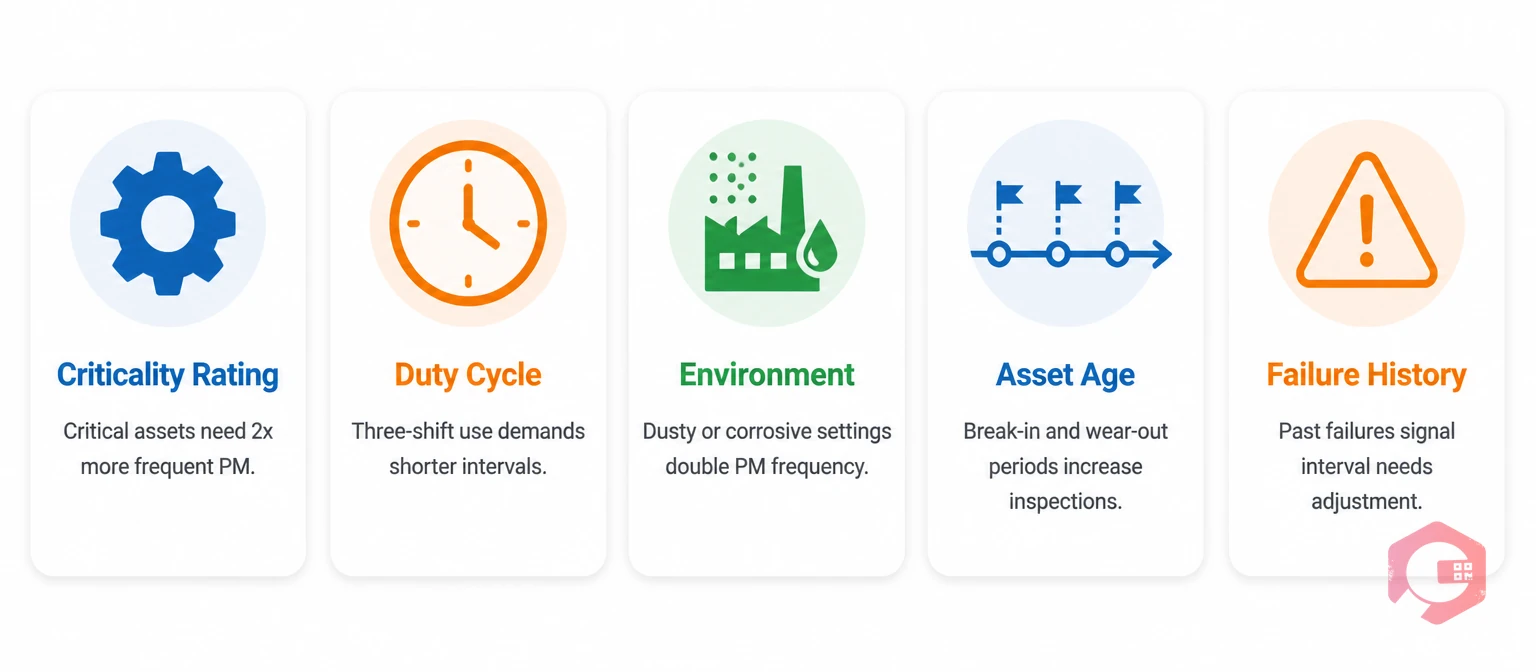
The intervals above assume normal conditions. Five factors push frequencies up or down from baseline:
Criticality: An asset whose failure shuts down a production line warrants 2x more frequent PM than a redundant or standby asset. Use an A/B/C criticality rating to drive this multiplier.
Duty cycle: Three-shift continuous operation runs assets 3 to 4 times harder than single-shift work. Adjust meter-based intervals proportionally — but also shorten time-based intervals since the calendar still moves forward.
Environment: Dusty, humid, corrosive, or high-temperature environments accelerate wear dramatically. Cement plants and food-processing wash-down areas often run PM at half the baseline interval.
Asset age: Equipment in the first year of life often needs more frequent inspection during the break-in period. The same is true after 70% of expected service life, when wear-out failures spike.
Failure history: If a class of assets has failed 3 times in the past year, the existing PM frequency is wrong. Either the interval is too long or the checklist tasks are missing the failure mode — see common problems your PM checklist prevents for the failure modes worth tracking.
Most plants reset their PM intervals roughly every 12 months based on actual failure data. Plants that never review intervals end up either over-maintaining low-criticality assets or under-maintaining the ones that fail.
The 4-Step Decision Framework for Setting PM Intervals
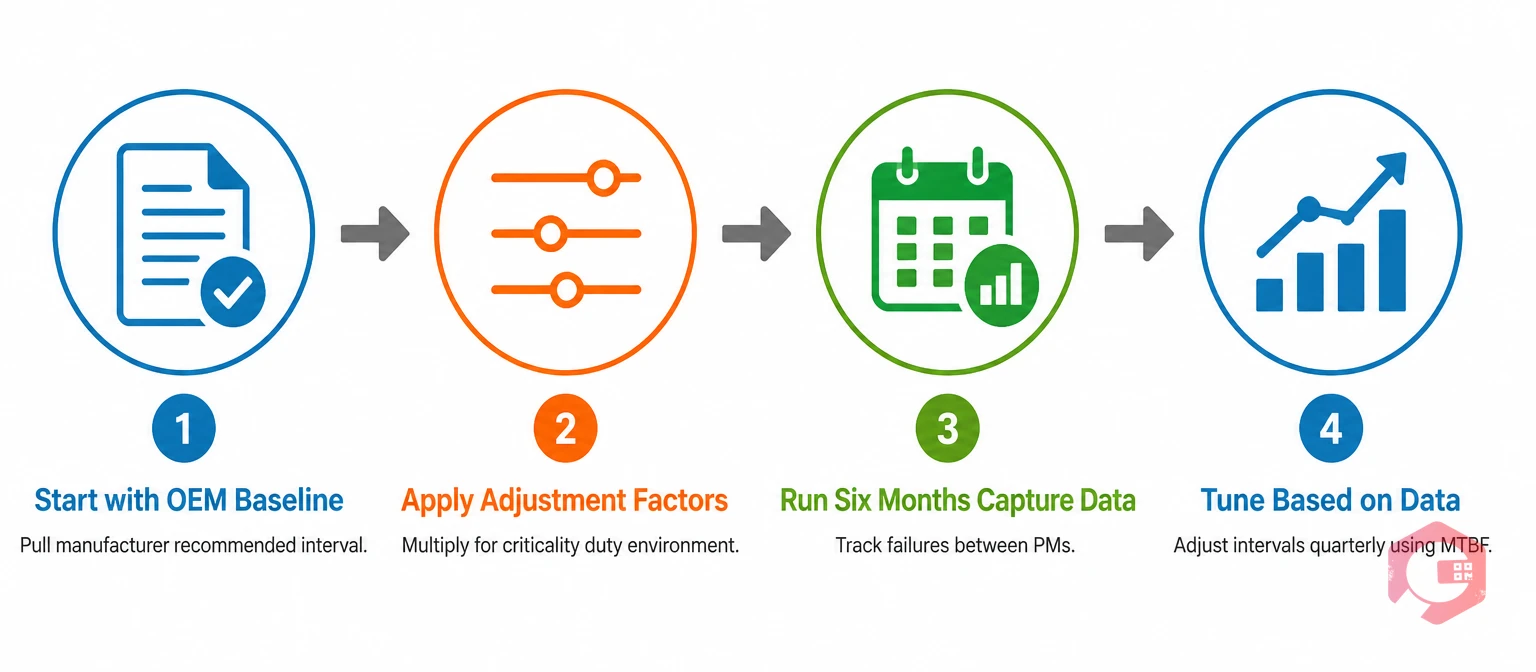
For any new asset entering service, use this 4-step path to set its PM interval:
Step 1 — Start with the OEM baseline. The manufacturer's recommended PM schedule is the right starting point, never the final answer. Pull it from the manual and load it into your CMMS as the initial interval.
Step 2 — Apply your adjustment factors. Multiply or divide by criticality, duty cycle, and environment factors from the section above. A baseline of "every 90 days" might become "every 45 days" for a 3-shift critical asset in a dusty environment.
Step 3 — Run the schedule for 6 months and capture failure data. If failures happen between PMs, the interval is too long. If PMs find nothing wrong for 3 consecutive cycles, the interval may be too short.
Step 4 — Tune based on data, not opinions. Adjust intervals quarterly using failure rates, mean time between failures (MTBF), and PM finding rates. Every interval change gets documented with the reason.
The most common mistake is skipping Step 4. Plants set intervals once at go-live and never touch them again — which means the schedule is no longer matched to reality after 2 years.
Regulated Industries: When the Frequency Isn't Up to You
In some industries, minimum PM frequency is set by regulation, not by your data. The most common examples:
Pharmaceutical and food manufacturing: FDA 21 CFR Part 211 effectively requires documented PM on production-critical equipment at frequencies that prove product safety.
Oil and gas: API standards prescribe inspection intervals for pressure vessels, relief valves, and rotating equipment.
Power generation: NERC and grid operator standards drive turbine, transformer, and switchgear inspection frequencies.
General industrial safety:OSHA penalty data shows that lockout-tagout and machine guard inspection lapses regularly trigger $16,550+ violations. ISO 55001 also defines documented frequency expectations for asset-management-certified plants.
For regulated assets, treat the prescribed frequency as a hard floor and only adjust upward from there.
How Cryotos Tunes PM Frequency Automatically
Cryotos handles all three trigger types on the same checklist — a single PM can fire on time, meter reading, or sensor threshold, whichever comes first. Asset history and failure data feed into recommended interval adjustments quarterly, so the schedule stays matched to real wear. Critical assets can layer condition-based monitoring on top of time-based PMs through the Cryotos CMMS platform, with auto-escalation when readings trip a threshold. Most teams cut unnecessary PM work by 20% to 30% within 6 months while improving compliance on the PMs that actually matter.
Frequently Asked Questions
Can I do PM too often?
Yes — over-maintenance is a real and expensive problem. Excessive PM consumes labor, accelerates wear on components that were fine before being disturbed (sealed bearings are the classic example), and burns out your maintenance team on busy work. If your PMs consistently find nothing wrong for 3 to 5 cycles in a row, the interval is too aggressive.
What's the most cost-effective frequency for a new asset?
Start with the OEM-recommended interval for the first 6 months, then adjust based on what you observe. New assets often need slightly more frequent inspection during the break-in period (first 200 to 500 run-hours), then settle into the OEM baseline. Don't lock the interval in permanently — review it after 12 months with real data.
How do I know my current PM frequency is right?
Two signals tell you the interval is correct: failures rarely happen between PMs, and PMs consistently find minor issues that can be addressed before they escalate. If you're seeing breakdowns mid-cycle, shorten the interval. If you're finding nothing for 3 cycles running, extend it.
Should small teams stick to time-based PM?
Mostly yes. Time-based PM is the easiest to schedule and audit with limited staff. Add meter-based triggers for variable-duty equipment as a second step, and consider condition-based monitoring only for the top 2 to 5 critical assets where downtime cost justifies the sensor investment.
Get the Cadence Right
Getting PM frequency right is the difference between a maintenance program that prevents failures and one that just generates paperwork. Start with the baselines above, apply the adjustment factors honestly, and tune quarterly based on real failure data. To see how Cryotos can manage frequencies, triggers, and condition-based logic on the same checklist, book a demo with our team.