
A continuous improvement culture in manufacturing is a company-wide commitment where every employee — from operators on the floor to maintenance managers — actively identifies problems, proposes fixes, and standardises gains. Unlike a one-off project, CI culture is an operating system. It changes how your teams think, talk, and make decisions every day. Research from the American Society for Quality shows that organisations with embedded CI cultures consistently outperform peers on reliability, safety, and cost metrics. This guide walks you through exactly how to build a continuous improvement culture in manufacturing — with a practical framework, eight implementation steps, and the tools that make it stick.
Key Takeaways
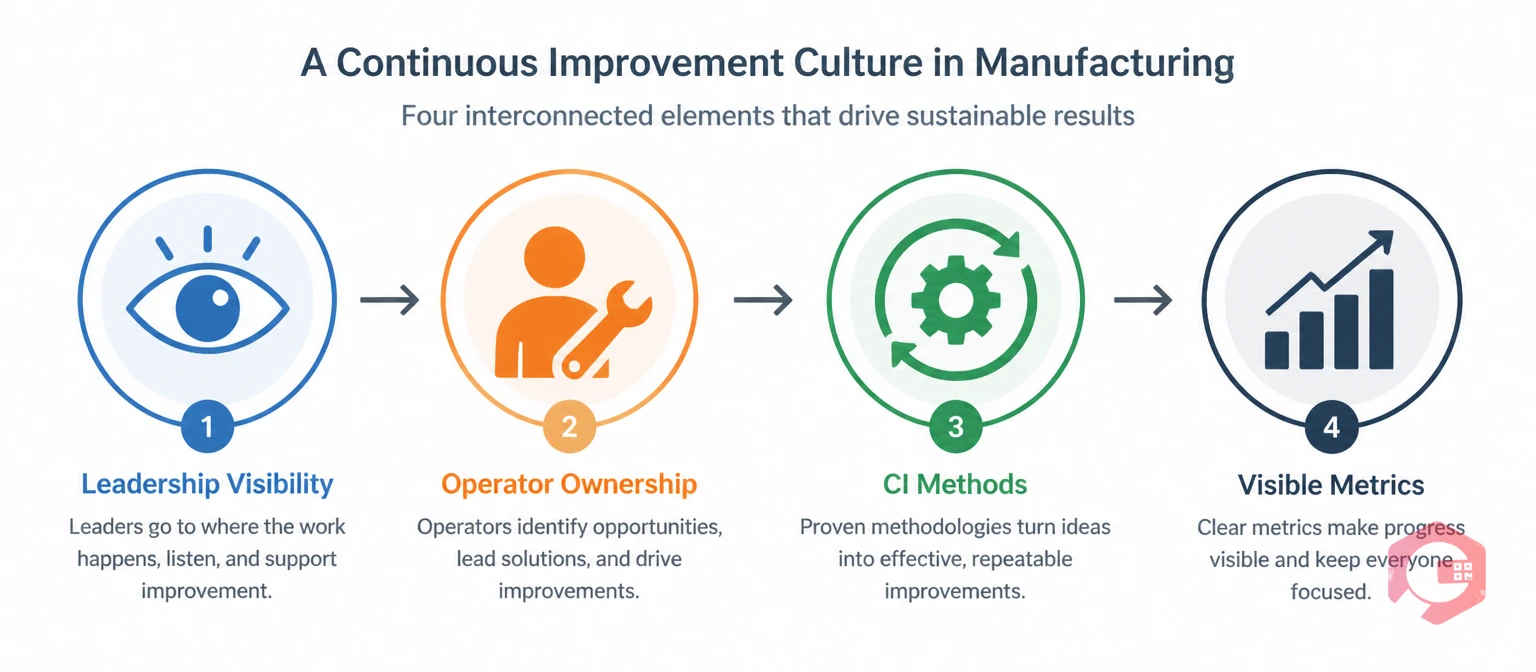
A continuous improvement culture in manufacturing is an organisational environment where every person at every level is expected and empowered to identify waste, surface problems, and propose better methods on an ongoing basis. It is not a programme with a fixed end date. It is a fundamental shift in how your facility operates.
It draws from several proven methods: Kaizen (small daily improvements), Lean (cutting waste), TPM (Total Productive Maintenance), Six Sigma (reducing variation), and PDCA cycles. The key difference between using CI methods and having a true CI culture is ownership. In a true CI culture, ideas come from operators and technicians. Not from a central team pushing directives down.
A continuous improvement culture in manufacturing starts at the programme level. A CI programme is typically led by a dedicated team, runs for a fixed period, and produces a report. A CI culture, by contrast, is woven into daily operations. Shift meetings include improvement reviews. Work orders trigger root cause analysis. Near-misses become One Point Lessons. The difference in outcomes is significant: manufacturers with embedded CI cultures report up to 30% lower unplanned downtime and 25% faster repair turnaround than those running periodic improvement projects.
ISO 55000, the international standard for asset management, explicitly links continuous improvement to long-term asset performance. It requires organisations to plan, implement, review, and improve their systems. CI culture is what makes this real.
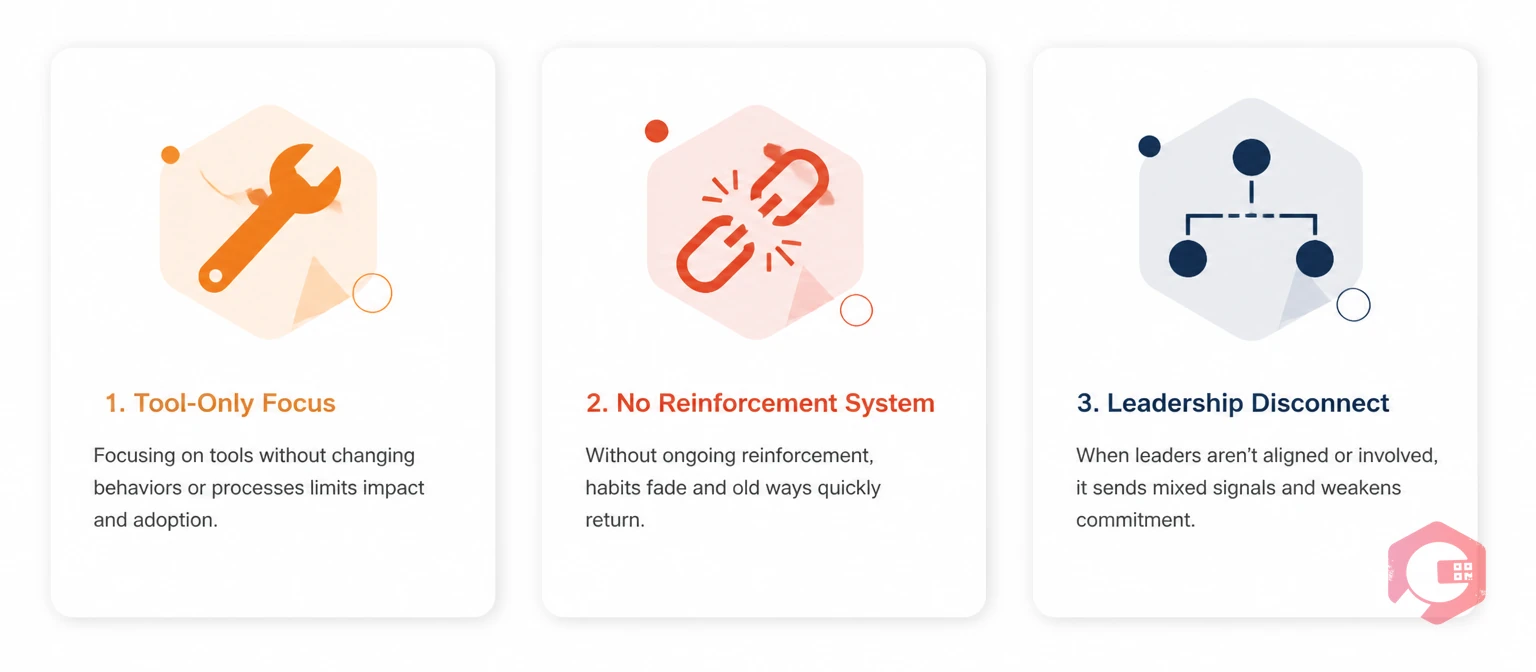
Most manufacturing plants that invest in CI training never build a true continuous improvement culture in manufacturing. They see only short-term gains. Three months after a Kaizen workshop, old habits return. Six months later, the boards are outdated. The reason is almost always the same. Organisations focus on CI tools without fixing the culture that sustains them.
Teams that avoid these failure modes share one pattern. They treat every breakdown as a learning event — not just a repair task. RCA is mandatory, not optional. Improvement ideas are tracked in the same system as work orders. There is always a clear link between the problem and the fix.
Building a continuous improvement culture in manufacturing means addressing all three failure modes before a single Kaizen event is run. Starting with tools before fixing the structure produces the same disappointing results every time.
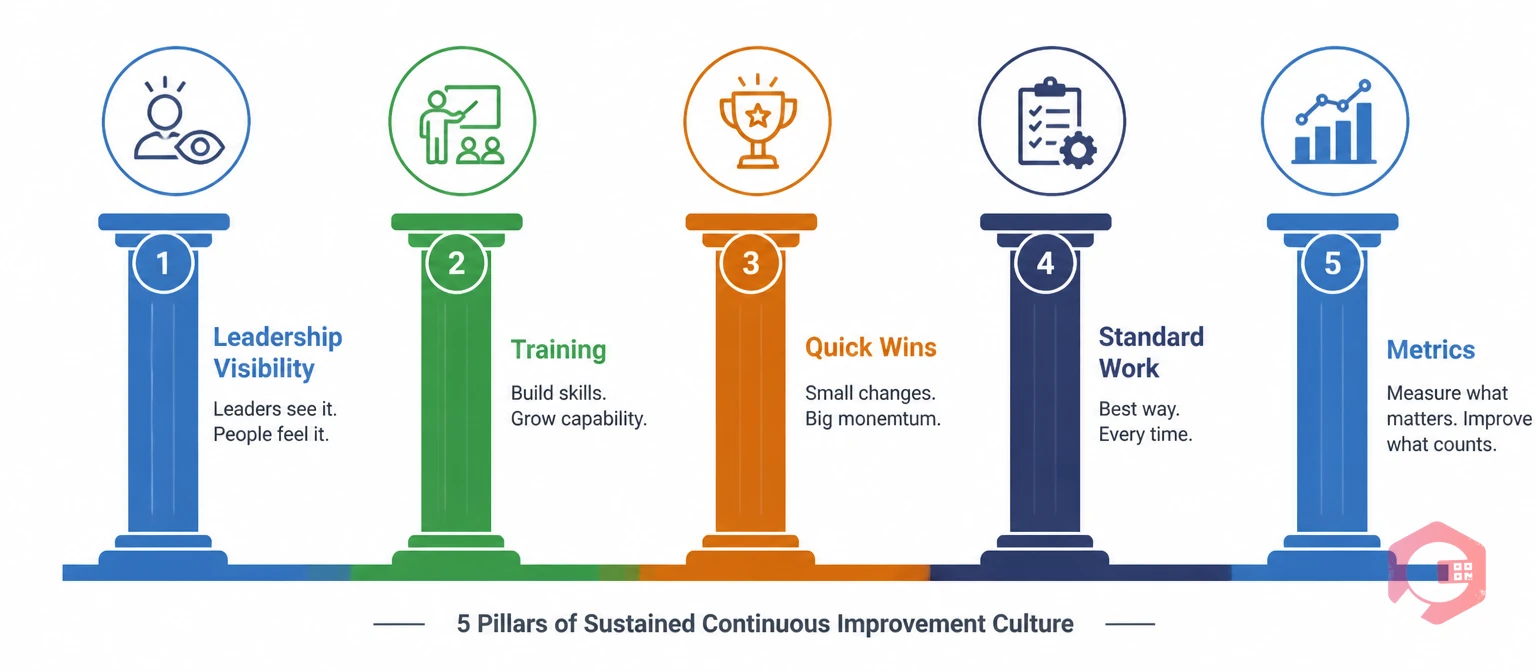
The most effective way to build a continuous improvement culture in manufacturing is around five key pillars. Each one addresses a different dimension of the organisation — and weakness in any single pillar undermines the others.
The Sustained CI Culture Framework:
These five pillars form a self-reinforcing loop. Strong Mindset drives more ideas (Methods). Better Metrics make progress visible, which motivates Management to act quickly. Fast Management response builds Momentum, which reinforces Mindset going into the next cycle.
Manufacturing teams using manufacturing maintenance software that connects these five pillars digitally — linking Kaizen ideas to assets, approvals, and PM updates — close the loop faster and retain gains longer than teams managing CI on paper or standalone spreadsheets.
Use our free OEE Calculator to establish a baseline before you begin — so you can measure the real impact of your CI culture programme over time.
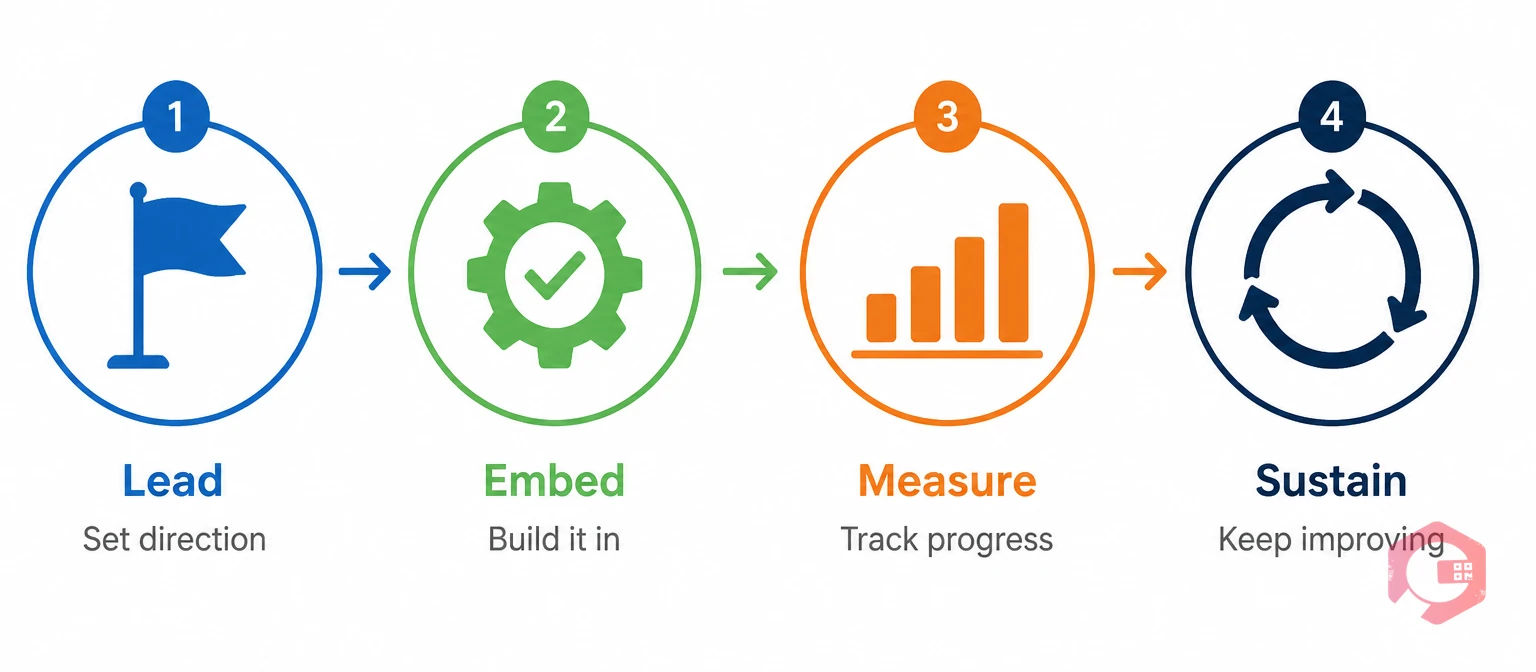
Building a continuous improvement culture in manufacturing is not a single event. It is a sequenced process that typically takes 12–18 months to become self-sustaining. Most manufacturing plants that succeed follow a consistent sequence of eight steps.
CI culture starts at the top — but it has to look genuine. Leaders who only talk about improvement without acting on suggestions undermine the whole effort. Gemba walks — floor visits by managers to watch work as it happens — show that leadership is serious about listening.
Operators and technicians need to understand each tool before using it. Short sessions of 30–60 minutes prevent the confusion that kills early engagement. Use real examples from your own facility — not generic case studies.
Pick one visible, frequent problem — a recurring bearing failure, a missing tool, an ignored checklist — and run a focused Kaizen around it. Publicise the result in shift meetings and on the CI board. Nothing builds CI confidence faster than a visible win that the team created themselves.
Make it easy for anyone to raise a CI idea. Use a card on the machine, a QR code, or a mobile form. Every idea must get a reply within 48 hours — approved, under review, or declined with a reason. Silence kills participation.
Every breakdown should trigger an RCA. Every RCA that reveals a systemic cause should generate a Kaizen. Every completed Kaizen should update the relevant PM checklist or SOP. This chain — breakdown → RCA → Kaizen → PM update — turns reactive maintenance into a CI engine. Work order management software can enforce this sequence automatically, prompting technicians to log root causes before closing a work order so the learning is always captured.
Post your CI KPIs where the team can see them every day: Kaizens submitted this month, ideas implemented, repeat failures this week, MTBF trend. When teams see their own numbers, they engage with them. Locked in a spreadsheet, those numbers get ignored. Visibility drives participation.
Recognition does not need to be expensive. Monthly "Best Kaizen" awards, a team CI board where contributions are named and posted, or a direct acknowledgement from a supervisor in a shift meeting are enough. Teams that feel valued submit three to five times more ideas than those that don't.
The most important step — and the one most often skipped. Every successful improvement must update a standard document — an SOP, a PM task, an OPL, or a Poka-Yoke procedure. Without standardisation, improvements disappear when staff changes or memory fades. Lean maintenance practice calls this "yokoten" — horizontal replication of improvements across all relevant assets and sites to prevent the same problem from recurring elsewhere in the plant.

Three CI tools do the most practical work on the manufacturing floor: Kaizen events, One Point Lessons (OPLs), and Poka-Yoke solutions. They serve different purposes and work best in different situations. The table below shows when to apply each one.
| CI Tool | Best Used When | Who Leads It | Output | Time to Implement |
|---|---|---|---|---|
| Kaizen Event | A recurring problem has a known root cause and needs a coordinated fix across a team | Maintenance engineer or CI lead | Updated SOP, PM task, or process change | 1 day to 2 weeks |
| One Point Lesson (OPL) | A single piece of knowledge needs to be shared quickly — after a breakdown, near-miss, or process change | Technician who found the problem | 1-page visual document for training and future reference | 30 minutes to 2 hours |
| Poka-Yoke Solution | A recurring error is caused by human variability and cannot be solved by training alone | Maintenance engineer or equipment designer | Physical or digital error-proofing mechanism | Days to weeks depending on complexity |
The most effective CI cultures use all three tools together in a closed loop. A Kaizen event identifies the root cause of a recurring failure. An OPL captures the learning for the whole team. A Poka-Yoke device prevents the error from happening again at the source. Together, they form a complete improvement cycle that addresses the problem, shares the knowledge, and locks in the fix.
Poka-Yoke is not interchangeable with training. OPLs and Kaizen events are knowledge tools — they depend on people remembering to apply what they learned. Poka-Yoke is a physical or digital mechanism that makes the right action automatic and the wrong action impossible or at least immediately visible. For high-consequence errors — wrong bearing, wrong oil grade, loose bolt — Poka-Yoke outperforms training every time.
Maintenance teams using autonomous maintenance frameworks under TPM integrate all three tools into their daily AM routines. Operators run OPLs in toolbox talks. They raise Kaizens from PM observations. They flag Poka-Yoke gaps during machine cleaning cycles. Routine maintenance becomes a steady stream of improvement data.
You cannot manage what you do not measure. A CI culture KPI scorecard gives maintenance managers a clear picture of engagement, implementation quality, and reliability outcomes across three dimensions: people, process, and plant performance.
| KPI | Category | How to Calculate | Target Benchmark |
|---|---|---|---|
| Kaizens submitted per person per month | Engagement | Ideas raised ÷ team size | ≥1 per person |
| Kaizen implementation rate | Execution | Ideas implemented ÷ ideas approved × 100 | >80% within 30 days |
| OPL training completion rate | Knowledge sharing | Staff trained on OPL ÷ total staff × 100 | >90% within 2 weeks of issue |
| Repeat failure rate | Reliability outcome | Repeat breakdowns ÷ total breakdowns × 100 | |
| MTBF trend | Reliability outcome | Total uptime ÷ number of failures | Improving quarter over quarter |
| PM compliance rate | Process discipline | PMs completed on time ÷ PMs scheduled × 100 | >95% |
| Poka-Yoke solutions deployed YTD | Error-proofing | Count of error-proofing mechanisms implemented | Track trend, not absolute target |
Review the full scorecard monthly. Include operators, technicians, supervisors, and maintenance managers in the meeting. Each quarter, compare MTBF and repeat failure trends against your starting baseline. This gives you a clear before/after picture of what CI culture delivers.
A maintenance KPI dashboard inside a CMMS automates this data collection — pulling Kaizen completion rates, PM compliance, and MTBF data in real time rather than requiring manual spreadsheet updates before every review meeting. Teams that automate CI reporting spend 80% less time collecting data — and 80% more time acting on it.
A Computerised Maintenance Management System is the connective tissue of a CI culture. Without a digital backbone, improvement ideas sit on paper forms. Root cause analyses get buried in email threads. PM updates depend on someone remembering to change a document after a Kaizen closes. With a CMMS, every improvement is tracked, linked to an asset, and converted into a measurable outcome.
A Computerised Maintenance Management System supports each stage of the CI workflow in the following ways:
Maintenance teams using Cryotos have reported up to 30% less unplanned downtime and 25% faster repairs. Improvements no longer get lost between idea and standardisation. Preventive maintenance software with built-in checklist management makes it easy to update PM tasks the moment a Kaizen closes, so the improvement is locked in before the next scheduled maintenance window.
Manufacturers who move to OEE-linked CI dashboards report that visibility alone drives a 15–20% increase in Kaizen submissions — because teams can see their own improvement data in real time and understand the direct connection between their ideas and the plant's performance numbers.
A quality management system (QMS) sets standards a company must meet. It focuses on compliance and consistency. A CI culture goes further. It is a mindset where people actively look for better ways to work — not just ways to meet the current standard. In practice, CI culture is what drives a QMS to improve over time rather than stagnate at the baseline it was designed around.
Most manufacturing plants see early behavioural changes within 3–6 months of consistent CI activity — more ideas submitted, more RCAs completed, more OPLs created and shared. A self-sustaining culture, where CI happens without being constantly pushed by management, typically takes 12–18 months. The key accelerators are fast manager responses to ideas, visible metrics on the floor, and early standardisation of first wins.
Leadership is the single biggest factor in whether CI culture takes hold. Employees sustain CI behaviour only when they see their ideas acted on quickly and their contributions recognised publicly. Leaders who walk the floor, respond to Kaizen ideas within 48 hours, and celebrate wins build the trust needed for CI to take hold at every level. Leaders who are absent from the floor or slow to act undermine CI faster than any other factor.
Yes — and in fact, smaller manufacturers often build stronger CI cultures than large ones because the feedback loops are shorter. A supervisor can see a Kaizen idea in the morning and help implement it by afternoon. You need three things: a simple idea submission system, one supervisor who champions CI visibly, and a CMMS to track improvements so knowledge stays in the system when staff changes.
Start with three: Kaizens submitted per person per month (engagement), repeat failure rate (reliability impact), and PM compliance rate (process discipline). These three give you a clear picture of whether people are participating, whether improvements are reducing failures, and whether the maintenance process is stable enough to build on. Add MTBF trend and OPL training completion once the first three are being tracked and reviewed consistently in monthly CI meetings.
Building a continuous improvement culture in manufacturing takes time — but the compounding effect on reliability, safety, and cost is measurable within months of consistent application. Schedule a free demo to see how Cryotos connects Kaizen workflows, OPL management, and PM updates in one system to make your continuous improvement culture stick.



Cryotos AI predicts failures, automates work orders, and simplifies maintenance—before problems slow you down.



