A maintenance audit is a systematic review of your facility's maintenance practices, documentation, asset conditions, and compliance status — designed to identify gaps before they become breakdowns, safety incidents, or regulatory failures. According to a Plant Engineering report on industrial downtime, 80% of equipment failures are self-inflicted through poor maintenance practices — all of which a structured audit would catch. Whether you manage a manufacturing plant, a healthcare facility, or a commercial property, knowing how to organize and conduct effective maintenance audits is the single most reliable way to improve reliability, reduce costs, and stay audit-ready for regulators and insurers alike.
This guide walks you through every stage: what maintenance audits actually cover, how to structure and run one, what to put on your checklist, and how a CMMS like Cryotos transforms the entire process from a stressful event into a routine part of operational excellence.
A maintenance audit is a formal, documented evaluation of your maintenance program — not just equipment condition. It covers whether your preventive maintenance schedules are being followed, whether work orders are being completed on time, whether spare parts are properly managed, and whether your team is adhering to safety procedures. Think of it as a health check for your entire maintenance operation, not just the machines it serves.
The distinction matters because most equipment failures trace back to process failures, not random mechanical events. A motor that fails is usually preceded by a skipped lubrication round, a deferred inspection, or a spare part that wasn't on the shelf when it was needed. A maintenance audit surfaces those process gaps while there's still time to correct them.
Beyond preventing failures, maintenance audits deliver four measurable business outcomes. First, they reduce unplanned downtime by identifying deferred PMs and overdue inspections before they cascade into failures. Second, they improve compliance readiness — regulatory standards like ISO 55001 and OSHA 29 CFR 1910.147 require documented evidence of structured maintenance. Third, they extend asset life by catching wear and degradation before components fail. Fourth, they benchmark your maintenance program against best practice — giving leadership the data to justify maintenance budgets and headcount.
How often you run audits should match asset criticality and regulatory exposure. A good starting framework is quarterly audits for safety-critical assets, semi-annual audits for production-critical equipment, and annual audits for support systems and general facility infrastructure. Unplanned audits triggered by a significant failure or near-miss are also valuable — they tend to reveal systemic issues that scheduled audits miss.
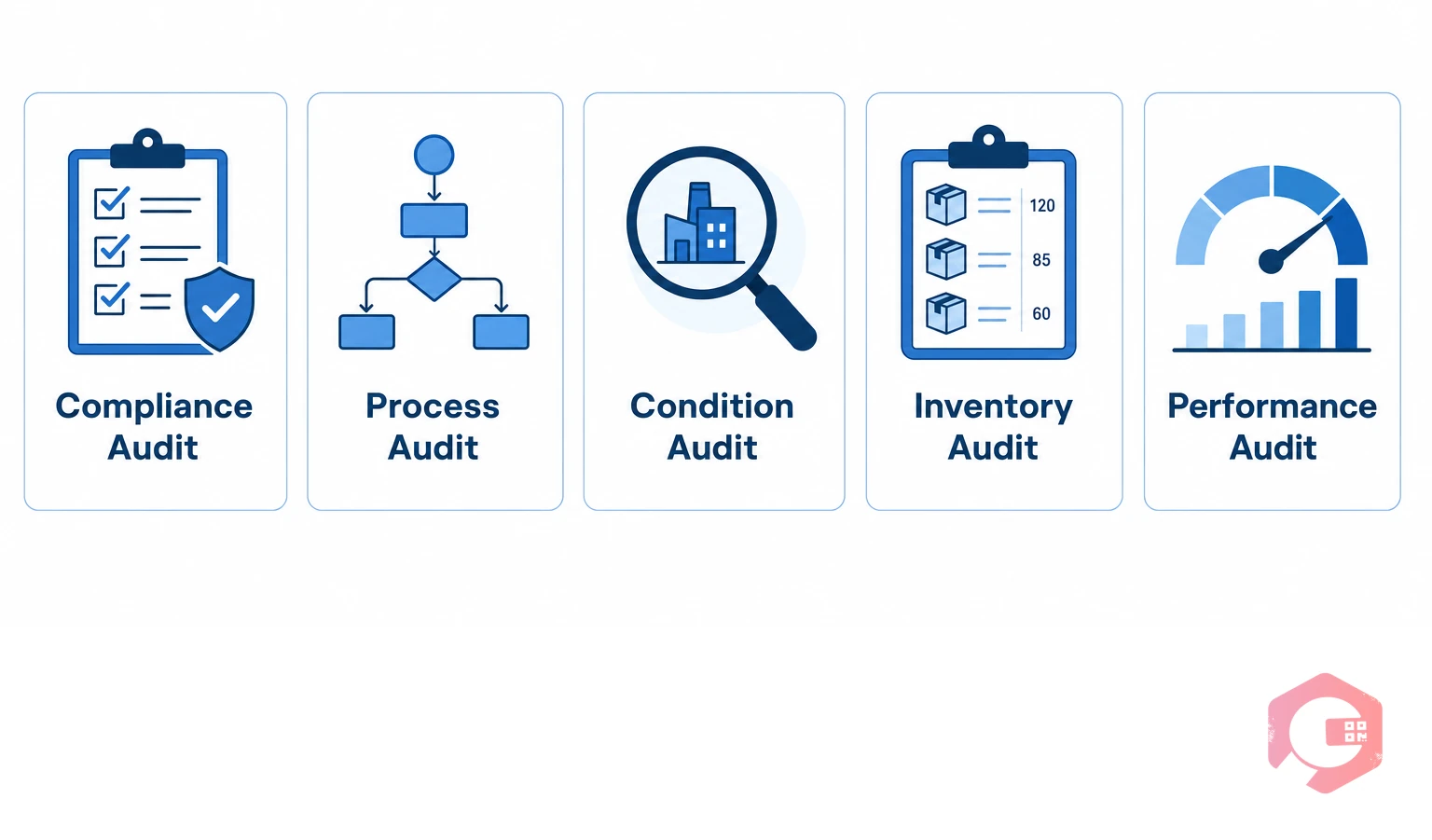
Not every audit covers the same ground. Matching the audit type to your objective prevents scope creep and keeps the process efficient.
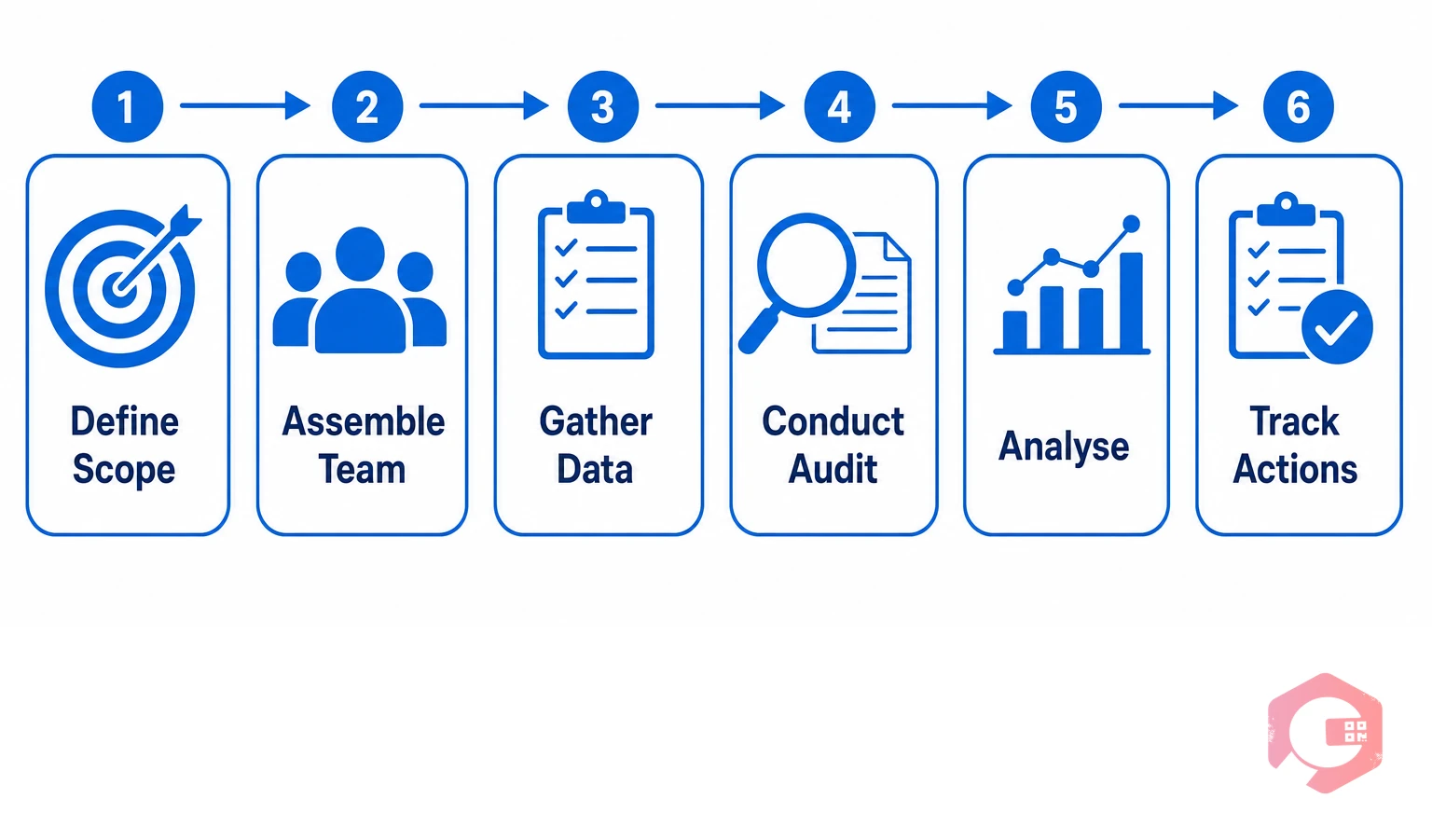
A well-organized audit follows a consistent structure regardless of type or scope. These six steps apply whether you are auditing a single production line or a multi-site facility portfolio.
Before anything else, answer three questions: What are you auditing? Why are you auditing it now? What does a successful outcome look like? Vague scope is the most common reason audits run over time and deliver unclear results. A well-scoped audit specifies the asset classes, departments, or processes in scope, the regulatory or operational standard you are auditing against, and the specific questions the audit must answer — for example, "Are all Tier 1 assets receiving PM on schedule?" or "Do our permit-to-work records meet ISO 45001 requirements?"
Internal audits are most effective when they include someone with authority to act on findings. A typical audit team consists of a lead auditor (often the maintenance manager or reliability engineer), a subject-matter expert from operations, and a representative from safety or compliance when regulatory topics are in scope. For equipment-specific condition audits, include the technician most familiar with that asset class — they notice what's unusual faster than anyone else. Avoid auditing teams where the people being audited and the people running the audit are the same individuals without independent oversight.
Data collection before the physical audit saves significant time on-site. Pull the following from your CMMS or maintenance records: PM completion rates for the audit period, work order backlog by age and priority, downtime history by asset and cause code, spare parts consumption and current stock levels, and any open corrective actions from the previous audit cycle. If your records are in spreadsheets or paper logbooks, allow extra time for this step — the gaps in those records are often the most significant finding of the audit. A digital maintenance checklist system makes this step dramatically faster by centralizing all records in one searchable platform.
The physical audit combines observation, interview, and document review. Walk the facility with your checklist and cross-reference what you observe against your records. Ask technicians open-ended questions about their daily workflow — the gap between documented procedures and actual practice often reveals itself in conversation before it shows up in data. Photograph anything that deviates from expected condition or documented procedure. Check that physical asset condition matches the maintenance history in your records — a machine with no recorded faults but visible wear is a data quality problem as much as a maintenance problem.
Not all audit findings carry equal weight. A useful prioritization framework applies two criteria: consequence of inaction (safety risk, production impact, regulatory exposure) and ease of correction (immediate fix, planned work order, capital investment). Findings in the high-consequence, easy-to-fix quadrant should be corrected before the audit report is even finalized. Findings that require capital planning or process redesign need a clear owner, deadline, and tracking mechanism. According to a McKinsey analysis on maintenance excellence, facilities that close audit findings within 30 days reduce repeat findings by 60% compared to those that allow action items to remain open indefinitely.
An audit that produces a report but no verified corrective action is an audit that didn't work. Every finding should generate a documented action item with a named owner, a completion deadline, and a verification step confirming the fix was implemented. Work order management software is the most reliable way to track corrective actions — each action item becomes a work order with a priority level, assigned technician, and due date, making it impossible to close the audit without confirming every item is resolved. The follow-up audit, typically 30 to 90 days after the main event, confirms that corrective actions were completed and effective.
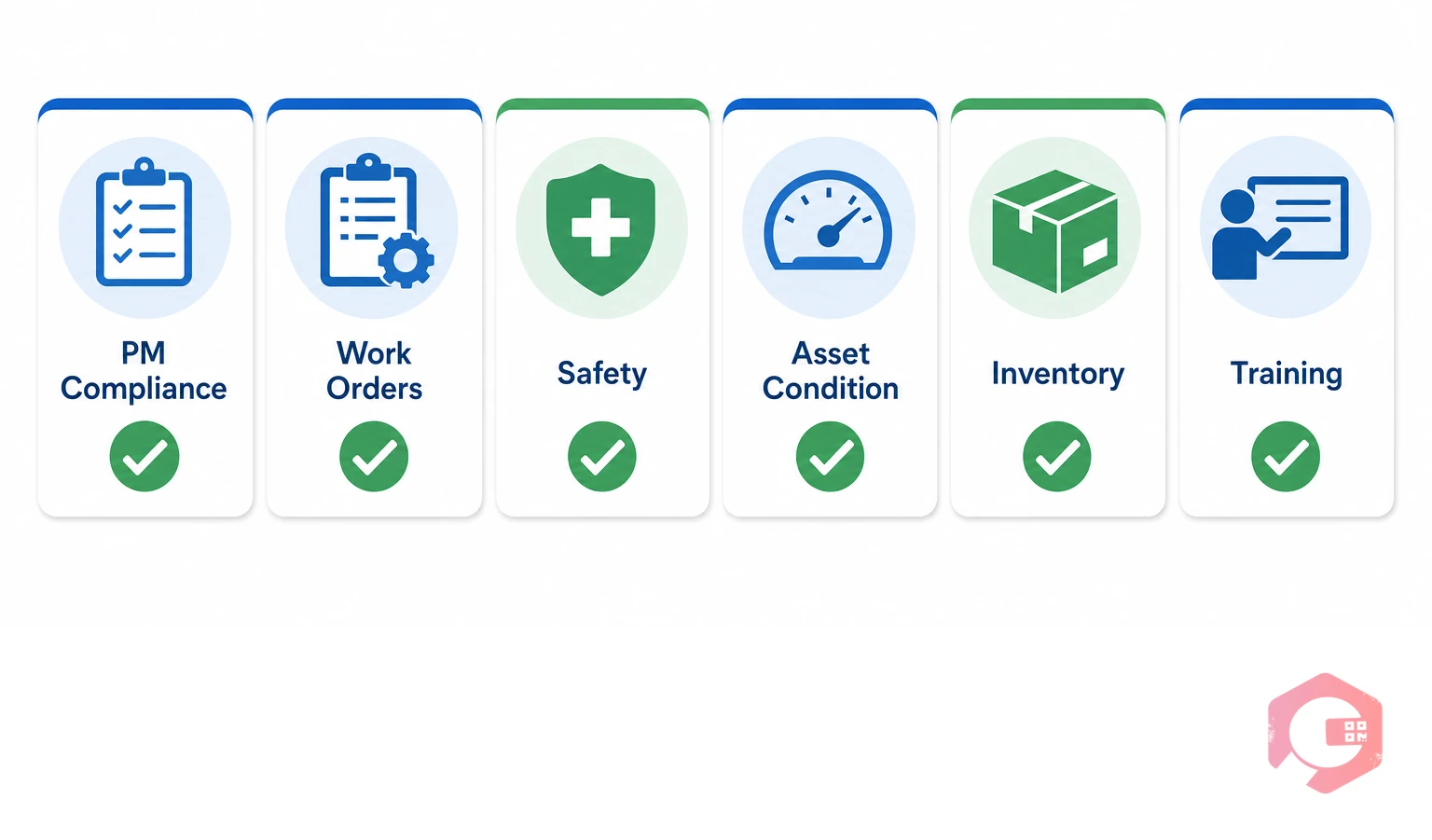
A maintenance audit checklist should cover six core areas. Customize the specific items to your asset types and applicable regulations, but these categories apply across nearly every industrial and commercial maintenance environment.
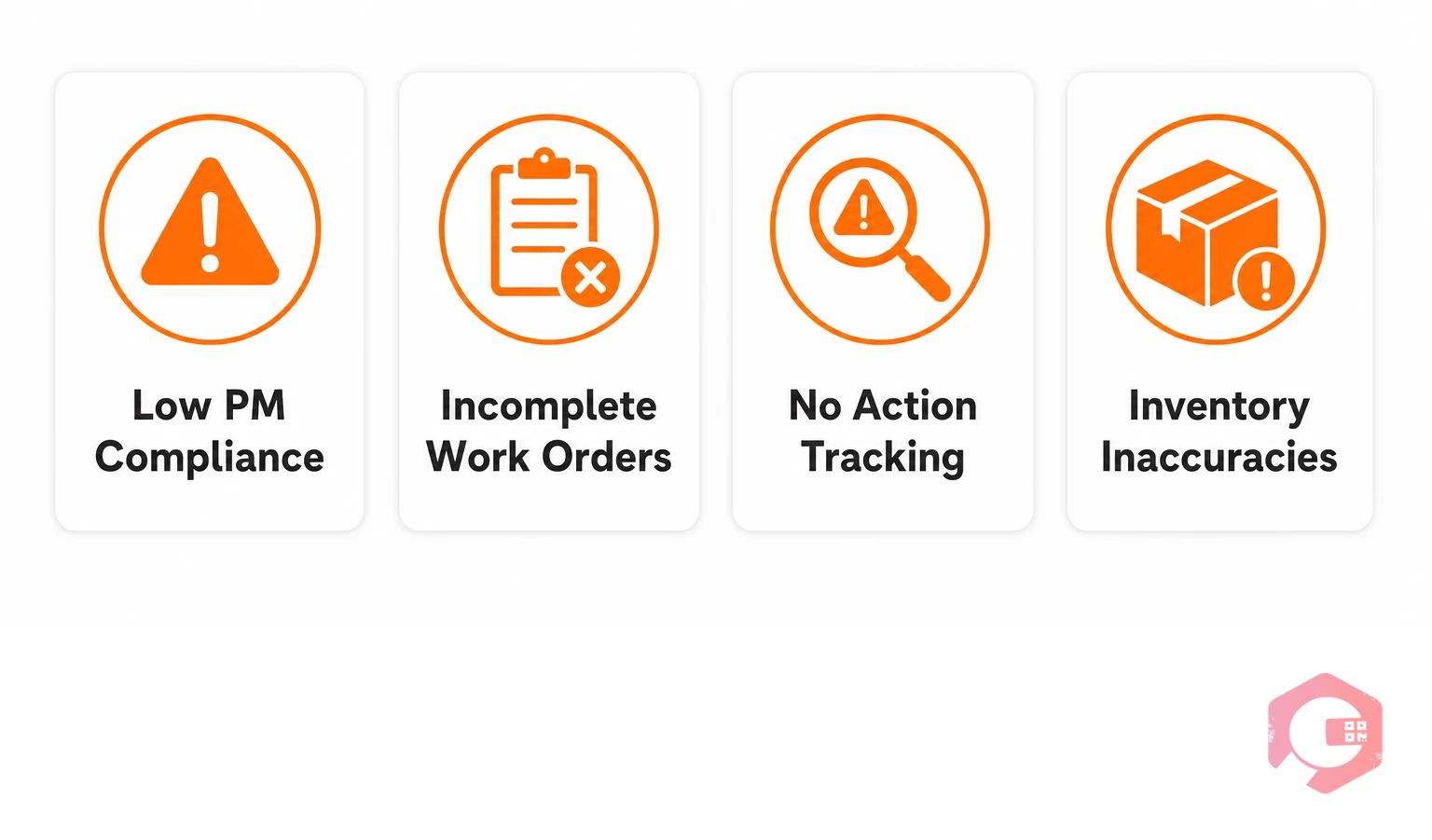
Certain findings appear consistently across facility types and industries. Recognizing them in advance helps your audit team ask the right questions and your management team understand what the remediation actually involves.
A CMMS transforms maintenance audits from labor-intensive, stressful events into a continuous, low-friction process. When your maintenance data lives in a structured digital system, the three most time-consuming parts of any audit — data collection, findings tracking, and corrective action management — happen in minutes rather than days.
Before the audit, a CMMS gives you instant access to PM completion rates, work order histories, downtime logs, and inventory records for any asset, time period, or department. The data that takes days to gather from paper files or disconnected spreadsheets is a filtered report in a well-configured CMMS. Cryotos's BI Dashboard surfaces OEE, MTBF, MTTR, and PM compliance trends across every level of the organization, so audit preparation becomes a matter of reviewing current-state metrics rather than assembling them from scratch.
During the audit, technicians using the Cryotos mobile app can log observations, photograph equipment conditions, and create corrective work orders directly from the shop floor. Every entry is timestamped and attached to the relevant asset record, creating an immutable audit trail that satisfies ISO 55001, OSHA, and insurance audit requirements without additional documentation work.
After the audit, corrective action items become work orders with priority levels, assigned technicians, and due dates. Managers see open action items on their dashboard, and automated reminders notify owners before deadlines pass. The next audit cycle pulls historical work order data to verify that previous findings were resolved — closing the continuous improvement loop that distinguishes high-performing maintenance programs from ones that run the same audit and find the same problems every year.
Cryotos customers using the platform's audit-ready documentation and PM compliance tracking report a 30% reduction in unplanned downtime and a 25% improvement in repair turnaround times. More significantly, they report that regulatory audits and insurance inspections that previously required weeks of preparation now take hours — because the documentation was being continuously captured throughout the year, not assembled in a scramble the week before.
A maintenance inspection checks the condition of individual assets — looking for wear, fluid levels, operating parameters, or physical damage. A maintenance audit is broader: it reviews the entire maintenance program, including whether inspections are being scheduled and completed, whether findings are being acted on, and whether documentation meets internal and regulatory standards. Inspections are a source of data for audits, not a substitute for them.
The duration depends on scope. A single-department process audit focused on PM compliance might take one day of preparation and half a day on-site. A full facility audit covering equipment condition, documentation compliance, inventory, and safety records can take one to two weeks from planning to final report. Using a CMMS significantly reduces both preparation and reporting time — teams typically cut audit preparation time by 50% to 70% compared to paper-based processes.
For internal audits, a combination of the maintenance manager, a reliability or process engineer, and an operations representative gives the broadest perspective. For compliance audits with significant regulatory stakes, engaging an independent third-party auditor adds credibility and catches blind spots that internal teams sometimes normalize. The auditors should have authority to access records, observe operations, and interview personnel without restriction.
A complete audit report includes the scope and objectives of the audit, the methodology and dates, a summary of findings organized by priority, specific corrective actions with named owners and deadlines, a comparison against the previous audit's action items, and an overall program health score or rating. The report should be concise enough to be read by senior leadership in under 15 minutes while providing enough detail for the maintenance team to act on every finding.
The most reliable method is to convert every corrective action into a work order in your CMMS, with a named owner, priority level, and due date. This keeps corrective actions visible in the same system your team uses daily, integrates them into the maintenance backlog workflow, and gives you a documented audit trail showing completion. Tracking action items in a separate spreadsheet almost always results in items being forgotten or delayed without accountability.
Effective maintenance audits are not compliance exercises — they are the mechanism through which maintenance programs improve. The six-step process in this guide gives you a repeatable structure for organizing and conducting audits that find real problems, drive real corrective action, and build a maintenance program that gets better with every cycle. The difference between facilities that consistently achieve high equipment availability and those that fight recurring failures is almost always the quality and consistency of their audit and improvement process.
If your team is ready to take maintenance audits from a once-a-year scramble to a continuous improvement engine, Cryotos CMMS gives you the asset history, PM tracking, corrective action management, and compliance reporting to make every audit faster, more thorough, and more impactful. Book a free demo today and see how leading maintenance teams use Cryotos to stay audit-ready every day of the year.


Cryotos AI predicts failures, automates work orders, and simplifies maintenance—before problems slow you down.