

IIoT and predictive maintenance work together to shift your maintenance operations from reactive firefighting to data-driven decision-making. The Industrial Internet of Things (IIoT) connects sensors, machines, and software so your team can monitor equipment health in real time — and predictive maintenance uses that data to flag failures before they happen. According to a McKinsey report, predictive maintenance can reduce maintenance costs by 10–25%, cut unplanned downtime by 50%, and extend asset life by up to 40%.
If your team is still scheduling maintenance by the calendar or responding to breakdowns after they occur, you're leaving significant cost savings and uptime gains on the table. This guide walks you through exactly how IIoT-powered predictive maintenance works, what it delivers, and how to put it into practice.

Predictive maintenance is a condition-based strategy that uses real-time equipment data to predict when a failure is likely to occur — so you can schedule a repair before it turns into a breakdown. IIoT is the infrastructure that makes this possible at scale.
Traditional time-based maintenance sends a technician to service equipment every 30, 60, or 90 days regardless of its actual condition. That approach wastes labour on equipment that's fine and misses failures that develop between cycles. Predictive maintenance solves both problems by monitoring the actual health of each asset continuously.
IIoT sensors measure temperature, vibration, pressure, current draw, oil particle count, and dozens of other parameters that signal wear or stress. This data feeds into your maintenance management software, which applies threshold rules or machine learning models to determine when intervention is warranted. The result: maintenance work is triggered by real equipment condition, not a fixed schedule.
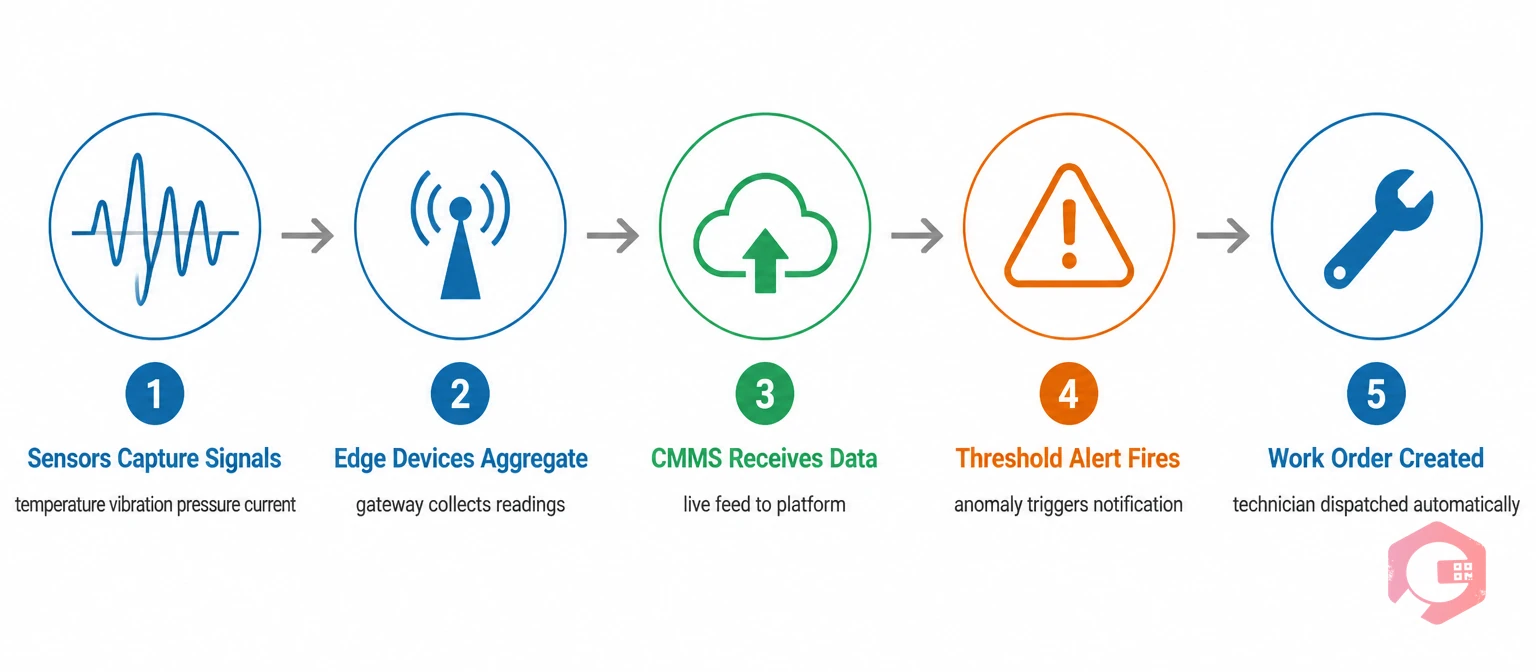
The sensor layer is the foundation. Without reliable, continuous data from the field, predictive maintenance is just a theory. Here's how the data chain works in practice:
Different failure modes require different sensors. A motor bearing about to fail shows up in vibration data. A heat exchanger losing efficiency shows up in temperature differentials. A pump developing a leak shows up in pressure readings. Matching the right sensor to the right failure mode is what makes predictive maintenance accurate rather than generic.
Sensors connect to edge devices or gateways that aggregate readings and push them to your CMMS via SCADA, PLC, or direct API integration. Cryotos's IoT meter reading feature connects directly to these data streams, displaying live readings against configurable alert thresholds. When a value crosses a threshold, the system automatically triggers a work order — no human has to spot the anomaly first.
This automation closes the gap that manual monitoring leaves open. A technician checking readings once per shift can miss a vibration spike that develops at 2 a.m. A sensor connected to a CMMS catches it immediately and routes a work order to the on-call team before the next shift starts.

When IIoT sensors feed directly into a maintenance platform, the operational gains are specific and measurable. Here are the most significant ones your team can expect:
Abstract benefits become concrete when you look at what organisations have actually achieved after deploying IIoT-based predictive maintenance programs.
A global automotive supplier reduced unexpected downtime by 37% in the first 12 months after deploying vibration and temperature sensors on critical press lines and routing alerts to their CMMS. The same program cut their parts consumption by 22% because components were replaced based on actual wear rather than fixed intervals.
A food processing plant using continuous monitoring on refrigeration compressors avoided three major compressor failures in a single year — each of which would have caused product loss exceeding $80,000 in addition to repair costs. The monitoring system paid for itself in the first avoided failure.
Cryotos customer BorgWarner used Cryotos's platform to gain visibility into asset health across production lines, reducing reactive maintenance work and improving maintenance team accountability. Their team shifted from a predominantly reactive posture to a planned one — a transition that consistently produces 15–30% reductions in total maintenance cost according to industry benchmarks.
These results align with findings from Deloitte's analysis of predictive maintenance programs, which found that organisations with mature programs achieve mean time between failures (MTBF) improvements of 25–30% compared to preventive-only programs.
Moving from reactive or time-based maintenance to a predictive program doesn't happen overnight. But you don't need to retrofit every asset on day one. A phased approach delivers value quickly while managing implementation risk.
Start with the equipment whose failure would cause the most disruption — highest production impact, longest lead time for parts, or greatest safety risk. Run a criticality ranking against your asset register. These are the machines where the ROI of predictive monitoring is highest, and where a single avoided failure justifies the sensor investment.
Work backward from failure modes. For each critical asset, identify the two or three most likely failure modes and choose sensors that detect those specific conditions early. Wireless sensors reduce installation cost and disruption significantly. Validate sensor placement with your equipment OEM data or a reliability engineer before committing to a full deployment.
This is where the data becomes actionable. Your CMMS needs to receive live readings, apply threshold logic, and generate work orders automatically when conditions indicate a problem. Cryotos connects directly to SCADA, PLC, and edge device outputs via its IoT meter reading integration. Configure alert thresholds for each asset, define who gets notified, and set the work order priority rules so the right technician responds at the right time.
When sensors first go live, you need a period of normal-operating data to establish what healthy looks like for each asset. Run three to six weeks of baseline collection before setting tight alert thresholds. This prevents false positives that erode team trust in the system. Refine thresholds as your understanding of each machine's behaviour deepens.
Measure the results from your pilot assets: work orders generated by sensor alerts, failures prevented, downtime avoided, and cost per repair compared to pre-program averages. Use Cryotos's BI dashboard to track MTBF, MTTR, and overall equipment effectiveness (OEE) trends over time. When the data supports expansion, roll the program out to the next tier of assets.
Most IIoT predictive maintenance programs hit similar obstacles. Knowing them in advance keeps small friction points from derailing the initiative.
IIoT is the network of connected sensors and devices that continuously collects equipment data. Predictive maintenance is the maintenance strategy that uses that data to anticipate failures before they happen. IIoT provides the real-time visibility that predictive maintenance requires — without sensor data, you're predicting based on assumptions rather than actual equipment condition.
Costs vary widely depending on equipment complexity and the number of assets monitored. Wireless sensor kits for a single machine typically range from $500 to $3,000. The CMMS platform, connectivity infrastructure, and setup labour add to the initial investment. Most organisations recover costs within 12–18 months through avoided failures and labour savings.
No. Retrofit sensors can be added to most existing equipment without replacing the machine or modifying its internals. Magnetic-mount vibration sensors, clamp-on temperature probes, and wireless current sensors attach to equipment non-invasively and start transmitting data immediately.
The metrics that show the clearest improvement are MTBF (mean time between failures), MTTR (mean time to repair), OEE, and the ratio of planned to unplanned work orders. Teams with mature predictive programs typically achieve 80%+ planned work — a significant shift from the reactive posture most facilities start with.
A CMMS acts as the action layer for the sensor data IIoT generates. It receives alerts, converts them into work orders, assigns them to the right technician, and tracks the repair to closure. Without a CMMS, sensor data sits in a monitoring dashboard without generating action. With one, every alert becomes a tracked, documented maintenance event.
IIoT and predictive maintenance together represent the clearest path from reactive firefighting to proactive, data-driven operations. The technology is mature, the ROI is well-documented, and the implementation path is clear: start with your most critical assets, connect them to a CMMS that acts on sensor data automatically, and measure the outcomes.
If your team is ready to move beyond fixed schedules and emergency callouts, Cryotos CMMS gives you the IoT integration, automated work order generation, and downtime tracking tools to run a predictive maintenance program from day one. Book a free demo today to see how it works with your assets.




Cryotos AI predicts failures, automates work orders, and simplifies maintenance—before problems slow you down.



