

Industrial IoT for maintenance connects sensors on your equipment to a Computerized Maintenance Management System, so machines report their own condition in real time. Instead of waiting for a scheduled inspection, your team gets an alert the moment something looks wrong. That single shift turns maintenance from a fixed calendar task into a data-driven one. The savings show up in downtime hours, energy bills, and parts spend. This guide breaks down how industrial IoT for maintenance pays off across eight different industries.
Key Takeaways
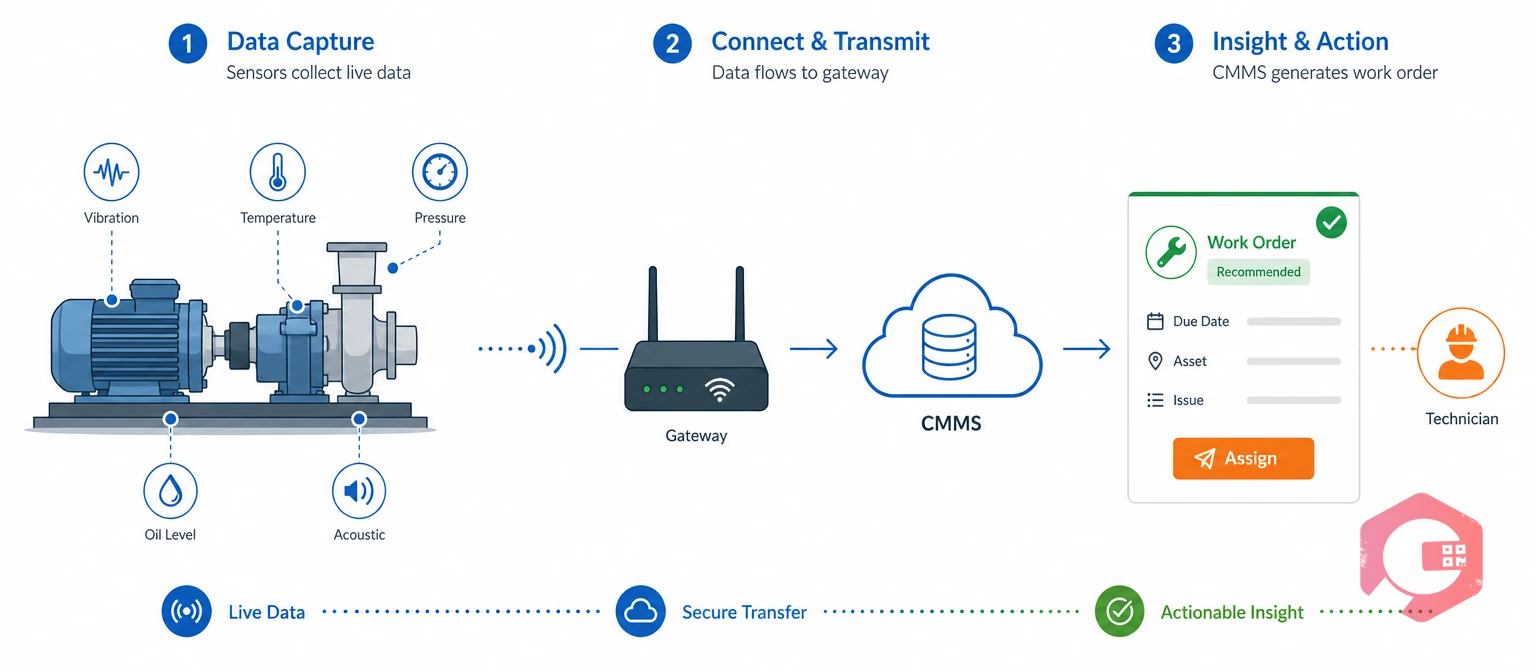
Industrial IoT for maintenance is the use of networked sensors on equipment to send live condition data into a maintenance system. A vibration sensor on a pump sends readings around the clock. So does a temperature probe on a compressor, or a current sensor on a motor. No one has to wait for a monthly walk-through to catch a problem.
That data only helps once it triggers action. Most plants pair IoT meter reading with automated thresholds. A reading outside the normal range creates a work order on its own. This is narrower than broader Industry 4.0 initiatives, which cover the whole digital factory. Industrial IoT for maintenance is the smaller, ROI-focused slice that most facilities tackle first.
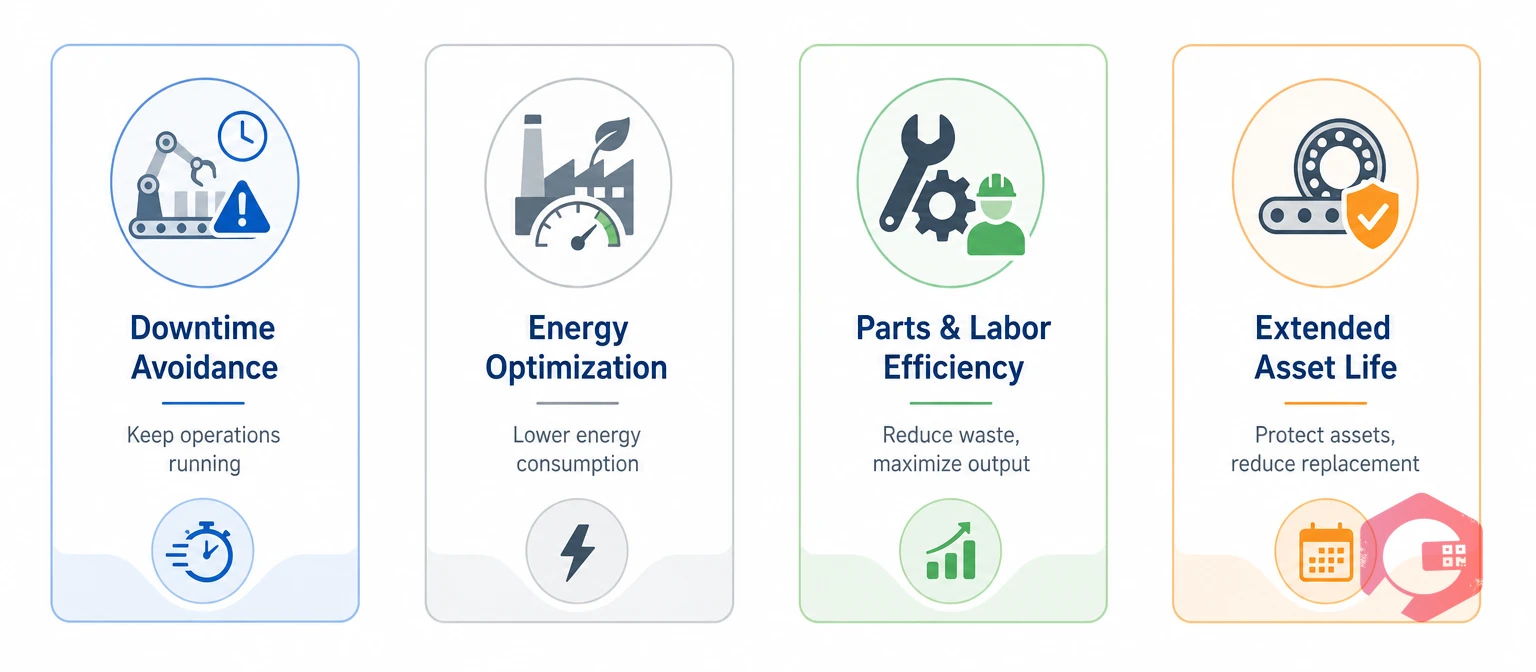
Industrial IoT for maintenance drives cost savings through four separate mechanisms. Knowing which lever applies to your equipment tells you whether the payback lands in months or years.
The Four-Pillar IIoT Savings Framework:
Downtime avoidance is the single largest source of savings in most industrial settings. A pump flagged three weeks before it seizes costs far less than the same pump failing mid-shift and stopping everything downstream.
Maintenance teams that track these four categories separately see clearly where their industrial IoT for maintenance program is paying off. A single blended number hides that detail. This approach lines up with the ISO 55000 asset management standard, which treats maintenance spend as a long-term investment. Cryotos customers running IoT-triggered work orders have reported up to 30% reduction in unplanned downtime. They also report 25% faster repair turnaround compared to calendar-based PM alone.
Curious what unplanned downtime already costs your operation? Try the unplanned downtime calculator before reading on.
These plants lose more money per hour of downtime than almost any sector here, since one stopped line can halt the entire schedule. IIoT sensors on CNC spindles, conveyor motors, and hydraulic systems catch bearing wear days before a breakdown. Most plants say their biggest saving is avoided changeover disruption, not the repair bill itself. A line that keeps running keeps output on track.
In oil and gas, IIoT centers on safety, not just cost per hour. Pressure and corrosion sensors on pipelines and wellhead equipment flag failures long before they turn into a safety incident. Predictive maintenance in this sector is less about efficiency and more about preventing costly regulatory shutdowns. Savings add up through avoided fines, lower insurance impact, and less unplanned rig downtime.
Food and beverage plants use IIoT to protect compliance and product quality first, and uptime second. Temperature and humidity sensors on refrigeration and processing lines catch drift before it spoils a batch. Most plants find their biggest win isn't the maintenance cost saved. It's the product that never has to get thrown out.
Commercial buildings apply IIoT to HVAC, elevators, and building automation, where energy waste often costs more than repairs do. One misconfigured air handler running outside its efficient range can waste thousands in energy a year, unnoticed without sensor data. Facility teams that pair IoT monitoring with downtime tracking usually find HVAC drives the largest share of avoidable spend.
Utilities and power generation lean on IIoT for transformer, turbine, and grid-asset monitoring. One failure here can hit thousands of customers at once. Vibration and thermal sensors catch insulation breakdown and bearing wear early enough to plan an outage instead of scrambling for one. The gap in cost between a planned outage and an emergency one is often the biggest line item IIoT affects here.
These plants run on tight just-in-time schedules. IIoT sensors on robotic welders, stamping presses, and paint lines focus on stopping small hiccups before they cascade into missed shipments. Condition-based maintenance in automotive plants is measured in minutes, not hours, since stops ripple through sequenced lines. A five-minute sensor-flagged fix beats a two-hour emergency stop every time.
Healthcare and pharma facilities apply IIoT to sterilizers, cold-chain storage, and cleanroom HVAC. A failure here risks patient safety or an entire batch of product. Sensor alerts on refrigeration units protect vaccine and medication stock that would otherwise be a total loss after a quiet temperature excursion. Automated, timestamped sensor logs also help with audit and compliance work on their own.
Logistics and warehousing teams use IIoT on conveyor systems, forklifts, and automated storage. One jam here can back up an entire fulfillment schedule. Most warehouses see their savings concentrated in avoided rush parts and overtime labor. An unplanned stop during a peak shipping window costs far more than the same failure on a slow day.
The table below shows where each sector's IIoT savings concentrate, based on the drivers covered above.
| Sector | Primary Savings Driver | Where the Value Shows Up |
|---|---|---|
| Manufacturing | Avoided line stoppage | Production schedule adherence |
| Oil & Gas | Safety and compliance | Avoided fines, incidents, rig downtime |
| Food & Beverage | Spoilage and quality | Reduced scrapped product |
| Facilities & Real Estate | Energy efficiency | Lower HVAC and utility spend |
| Utilities & Power | Planned vs. emergency outages | Avoided outage cost and customer impact |
| Automotive | Micro-stoppage prevention | Shipment schedule protection |
| Healthcare & Pharma | Inventory and compliance protection | Avoided product loss, audit readiness |
| Logistics & Warehousing | Peak-period uptime | Avoided rush parts and overtime labor |
Every sector above traces back to the same four savings pillars. The mix simply shifts based on what a stoppage actually costs in that setting.
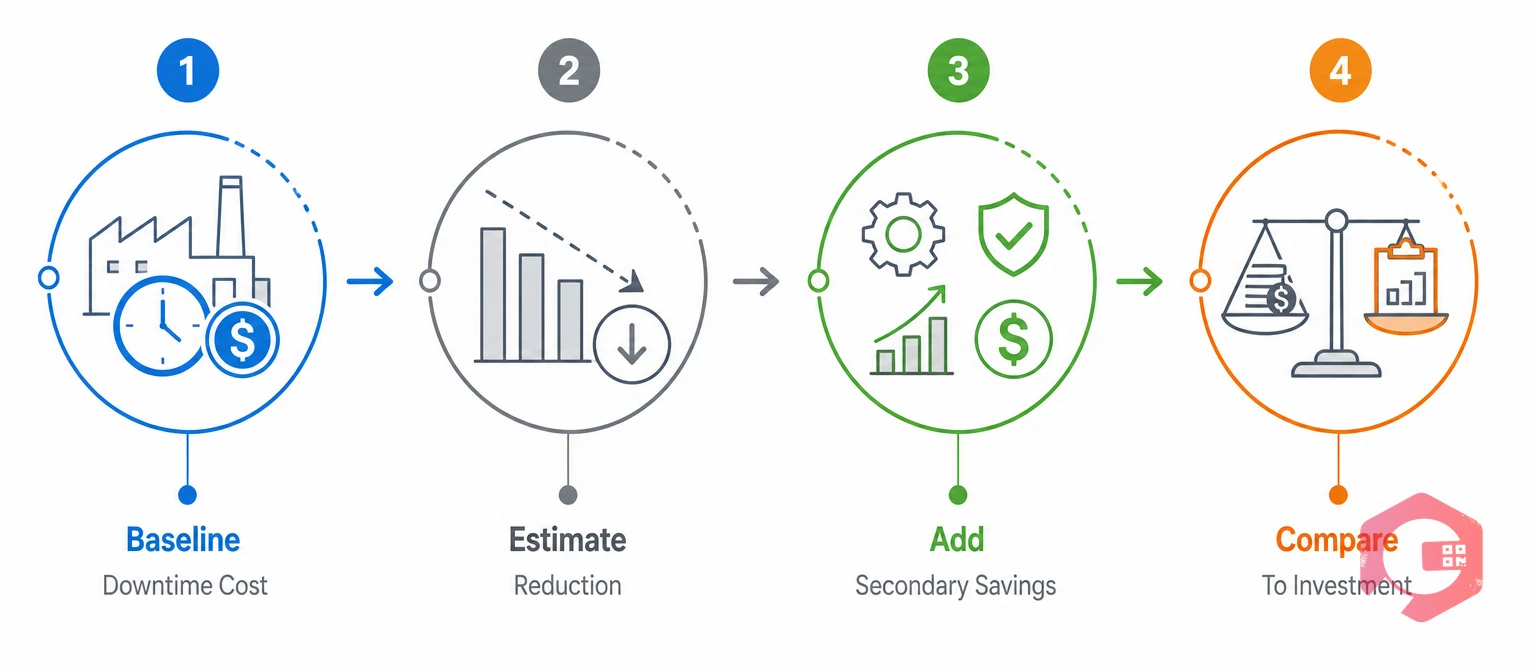
Calculating industrial IoT for maintenance ROI starts with your current downtime cost. It does not start with the price of the sensors. Multiply your average downtime hours per month by your cost per hour of downtime. Then estimate the percent reduction a sensor-triggered PM program could realistically achieve.
Most facilities that follow this process see payback inside 6-18 months. Safety-critical sectors like oil and gas and utilities often see faster returns, since the avoided-incident cost runs so high.
A sensor network only creates savings once its data reaches the team that acts on it. That's where the CMMS layer matters. Cryotos connects to SCADA, PLC, and edge devices. A threshold breach on any connected asset creates a work order on its own, instead of sitting in a dashboard nobody checks.
Maintenance teams get the alert on mobile, with the sensor reading, asset history, and checklist already attached. That cuts the time technicians usually spend figuring out what triggered the call. Combined with real-time downtime tracking, this closes the loop from sensor reading to finished repair inside one system. This is what makes industrial IoT for maintenance work in practice, not just on paper.
Most facilities report a 20-30% cut in unplanned downtime within the first year of a sensor-triggered maintenance program. Safety-critical sectors like oil and gas and utilities often see faster, larger gains, since the cost of any single incident runs so high.
No. Most facilities start with their 10-20 highest-cost or highest-risk assets, since that small group usually drives most of the downtime cost. You can expand sensor coverage gradually from there.
IIoT goes further than SCADA's plant-floor visibility. It feeds sensor data straight into maintenance workflows and creates work orders on its own, instead of just showing readings on a control-room screen.
Most industrial deployments reach payback within 6-18 months, based on downtime cost avoided versus sensor and integration spend. That figure comes from SMRP reliability benchmarks.
Yes. Most modern CMMS platforms, including Cryotos, connect to existing SCADA, PLC, and edge devices without a full sensor network replacement. Facilities can add IoT-based meter reading to what they already have in place.
Real savings from industrial IoT for maintenance come from matching the right sensors to the failure modes that cost your sector the most. You don't need sensors on everything at once. Schedule a free demo to see how Cryotos turns sensor data into automated work orders across your facilities.



Cryotos AI predicts failures, automates work orders, and simplifies maintenance—before problems slow you down.



