
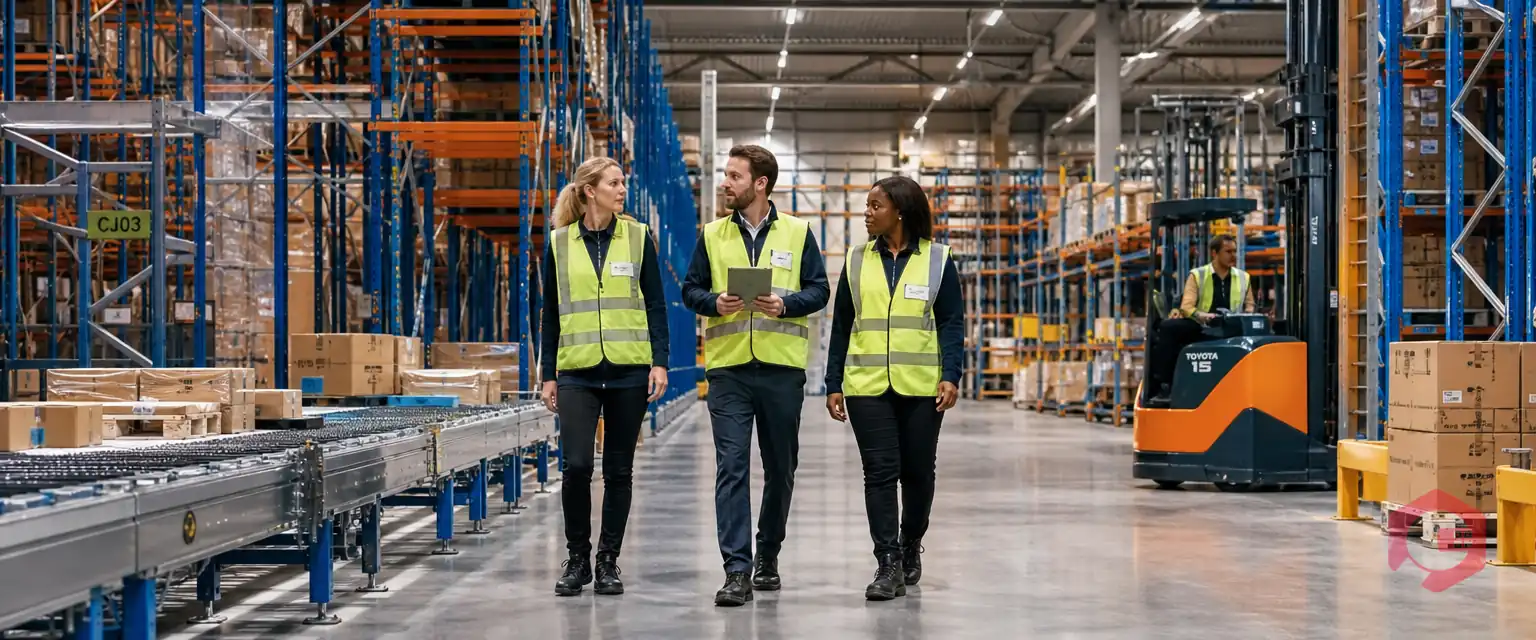
Lean logistics is a way of running warehouses, transport, and distribution that removes waste and moves goods only when customers pull for them. It replaces large buffer stocks with small, frequent, steady flows of material. Equipment reliability supports lean logistics because those thin, fast flows only work when forklifts, conveyors, and docks run without surprise breakdowns.
Lean logistics borrows its ideas from the Toyota Production System and applies them to the movement of goods instead of their production. The pay-off is lower inventory, shorter lead times, and steadier on-time delivery. The catch is that lean removes the safety stock that used to hide equipment failures, so reliability stops being a maintenance issue and becomes a delivery issue.
Key Takeaways
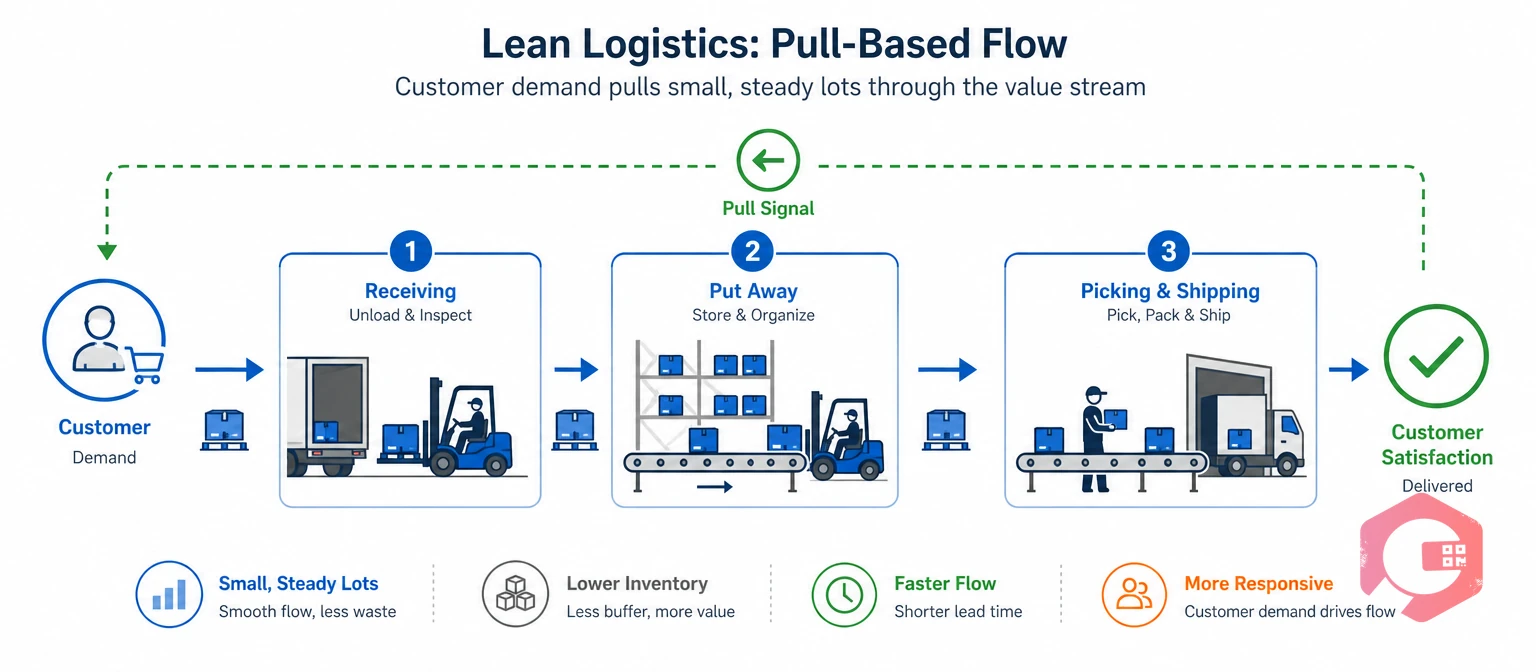
Lean logistics is the use of lean thinking across receiving, storage, picking, shipping, and transport. The Lean Enterprise Institute describes it as a pull system with frequent, small-lot replenishment between each firm and facility along a value stream. In plain terms, nothing moves until the next step needs it.
The ideas come from the Toyota Production System, which paired just-in-time flow with a maintenance discipline called Total Productive Maintenance (TPM). Asset management standards such as ISO 55000 take the same view: the value of a system depends on how well its physical assets perform over time.
The short version: lean logistics trades the comfort of big buffers for the speed and lower cost of steady, demand-driven flow.

Lean logistics follows the same five principles that Womack and Jones set out for lean thinking. Each one has a direct meaning on a warehouse floor or a delivery route.
A pull system is a replenishment method in which actual consumption, not a forecast, triggers the next movement of material. It is the principle that makes lean logistics lean, and it is also the principle most exposed to equipment failure.
Flow and pull both assume that the equipment carrying the goods works when called on. That assumption is where equipment reliability enters the picture.

Lean logistics targets eight kinds of waste, often remembered as TIMWOODS. Each waste shows up in a specific way in warehouses and transport, and several of them trace straight back to unreliable equipment.
Most logistics teams spot the obvious wastes first, like walking distance and excess stock. The hidden ones are often equipment-driven: waiting caused by a jammed sorter, or defects caused by a forklift with worn forks damaging pallets.
Any waste-reduction plan that ignores the condition of material handling equipment leaves a large share of waste untouched.
Want to know how often your critical conveyors or forklifts actually fail? Work it out with the MTBF calculator.
Equipment reliability is the foundation of lean logistics because lean removes the buffers that used to absorb breakdowns. In a push operation, a broken conveyor might delay put-away while shipments continue from deep stock. In a lean operation with two days of stock or less, the same breakdown can halt outbound orders the same shift.
Equipment reliability is the probability that a machine performs its required function without failure for a stated period under stated conditions. In logistics, the machines that matter most are the ones every order passes through.
Picture a distribution center that ships 4,000 order lines a day. Under a push model it held five days of stock in reserve racking. After a lean program, it holds one day.
Now a reach truck that feeds the fast-moving pick faces breaks down at 9 a.m. With five days of stock, pickers pull from nearby reserve and barely notice. With one day of stock, the busiest pick faces run dry by early afternoon, and the evening wave misses its carrier cut-off.
This is why Toyota paired just-in-time with TPM. Total Productive Maintenance aims for zero breakdowns, zero defects, and zero accidents by involving operators and maintenance teams in keeping equipment in top condition. A lean supply chain without that discipline tends to drift back toward big inventories.
The rule is simple: the thinner your buffers, the more reliable your equipment must be.
The same lean logistics design produces very different results depending on how reliable the equipment is. The table shows how key outcomes change across a typical warehouse.
| Lean Logistics Area | With Reliable Equipment | Without Reliable Equipment |
|---|---|---|
| Pull replenishment | Kanban triggers refill pick faces on time | Pick faces run empty while forklifts wait for repair |
| Inventory levels | Safety stock stays low and stable | Managers rebuild buffers to cover breakdowns |
| Dock scheduling | Trucks load and leave in planned slots | Faulty dock levelers cause idle trucks and detention fees |
| Order flow | Conveyors and sorters keep a steady pace | Jams create surges, overtime, and missed cut-offs |
| Labor use | Staff follow standard work | Staff wait, then rush, and errors rise |
| Continuous improvement | Teams improve the process | Teams spend their time firefighting |
The direct repair bill is usually the smallest part of the cost. The bigger costs are idle labor, overtime to catch up, truck detention fees, expedited freight, and orders that ship late or short.
The pattern is clear. Reliable equipment lets lean logistics deliver its promise, while unreliable equipment turns lean into a fragile system that teams no longer trust.
Not every asset deserves the same attention. In lean logistics, the critical assets are the ones that sit on the main flow path, have no backup, or would stop several processes at once if they failed.
Score each asset on three questions: does it sit on the main flow path, is there a backup, and how long does a typical repair take? Assets with high scores on all three get the tightest maintenance plans.
Most facilities find that a handful of assets, often a main sorter and a few replenishment trucks, carry most of the flow risk. Focus there first.
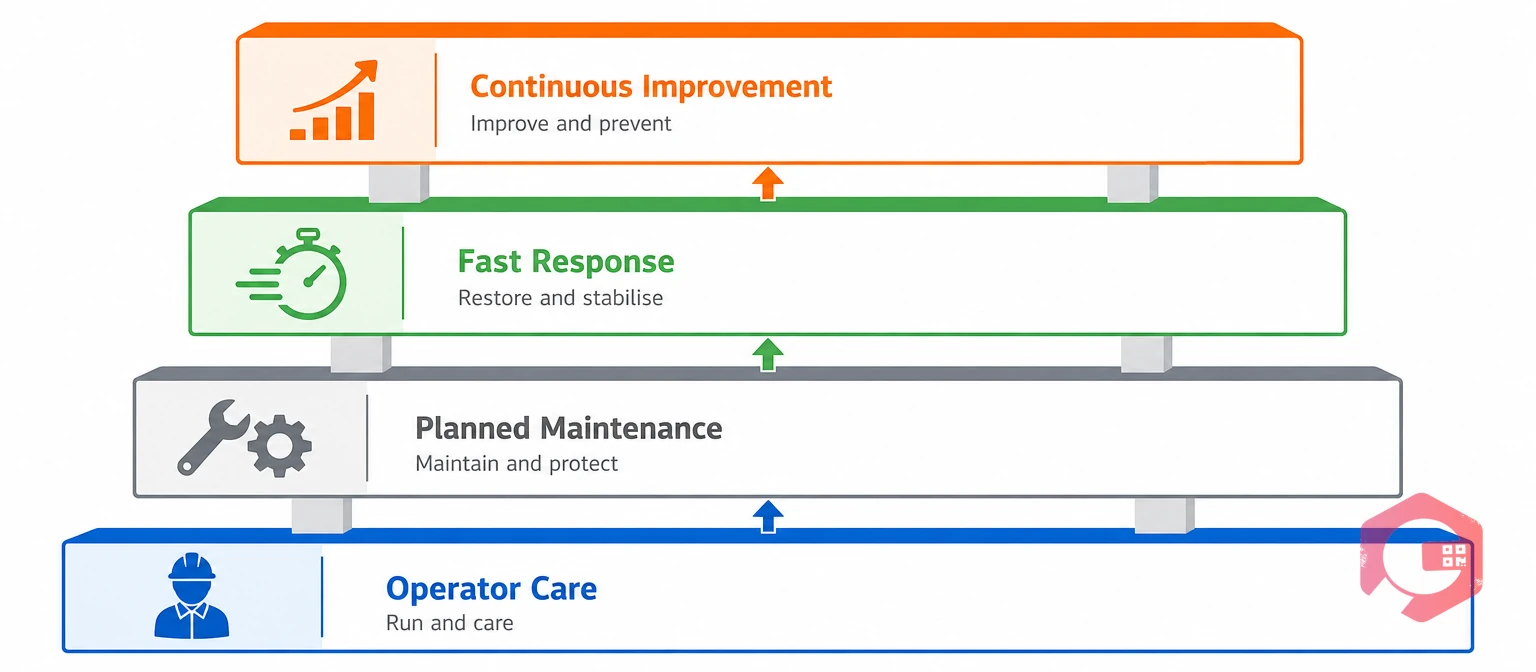
A lean logistics operation needs a simple model for building reliability into its flow. The framework below stacks four layers, from daily care to data-driven improvement. Each layer depends on the one beneath it.
The Four-Layer Lean Reliability Stack:
Operators wipe photo-eyes and clear debris at each shift start. Maintenance teams replace belts and check motor bearings every 500 run hours. When a jam does occur, a work request goes in from the floor with a photo.
Each month, the team reviews jam causes and adjusts the plan. Over time, the sorter moves from frequent surprises to predictable, planned stops.
Climb all four layers for your critical assets, and reliability stops being a constraint on lean logistics and becomes one of its strengths.
Building reliability into lean logistics is a practical, step-by-step effort. It works best when logistics and maintenance plan together instead of in separate meetings.
A Computerized Maintenance Management System ties these steps together. It schedules preventive tasks, turns floor reports into work orders, and builds the failure history that kaizen teams need. Maintenance teams using Cryotos have reported up to 30% reduction in unplanned downtime and 25% faster repair turnaround.
The lesson is that reliability work and lean logistics work should share one plan, one meeting rhythm, and one set of data.
Lean logistics teams usually track flow metrics, while maintenance teams track asset metrics. Putting both sets side by side shows how equipment problems turn into delivery problems.
Mean time between failures is the average operating time between one breakdown of an asset and the next. When MTBF for a key sorter falls, watch for rising order cycle time a few weeks later.
Reviewing both KPI sets together makes the link between reliability and lean flow visible to everyone.
Many lean logistics programs stall for the same few reasons. Most of them come from treating lean as an inventory project rather than a whole-system change.
Pairing lean logistics with lean maintenance avoids most of these traps. Both approaches share the same goal: remove waste and keep value flowing.
Lean logistics means moving goods only when they are needed, in small and steady amounts, while removing any step that does not add value for the customer. It cuts inventory, waiting, and wasted movement across warehouses and transport.
The five principles are: define value, map the value stream, create flow, establish pull, and pursue perfection. Together they help logistics teams remove waste and match the movement of goods to real customer demand.
In warehousing, lean means designing layouts, storage, and picking routes so goods flow with as little handling, walking, and waiting as possible. It also means keeping stock low and replenishing pick faces based on real consumption.
Lean logistics holds little safety stock, so a breakdown in a forklift, conveyor, or dock leveler quickly stops orders from moving. Reliable equipment keeps pull signals working and lets teams keep inventory low without risking missed deliveries.
No. Lean logistics focuses on removing waste and running steady, predictable flows, while agile logistics focuses on reacting fast to unpredictable demand. Many companies use lean methods for stable product lines and agile methods for volatile ones.
Yes. Small warehouses can start with simple steps like a basic value stream map, 5S in the pick area, kanban cards for replenishment, and a preventive maintenance plan for their few critical assets. The principles scale down well.
A CMMS schedules preventive maintenance, logs every breakdown, and tracks repair times for material handling equipment. That data shows which assets threaten flow, so teams can fix root causes instead of rebuilding inventory buffers.
Lean logistics only delivers when the equipment behind it is as dependable as the process on paper. Schedule a free demo to see how Cryotos keeps your forklifts, conveyors, and docks running so your lean flow stays lean.



Cryotos AI predicts failures, automates work orders, and simplifies maintenance—before problems slow you down.



