

Loom machine maintenance in textile manufacturing is the structured process of inspecting, servicing, and repairing weaving machines, spinning frames, and ancillary equipment to prevent breakdowns and keep production lines running at peak output. A McKinsey smart factory study found that manufacturers shifting from reactive to planned maintenance reduce unplanned downtime by up to 50% and cut maintenance costs by 10–25%. For textile plants running 24/7 across multiple loom types, a structured maintenance programme is not a cost centre — it's a competitive advantage.
Key Takeaways

A poorly maintained loom doesn't just break down — it silently degrades fabric quality long before a technician notices. Worn heddle frames cause warp thread misalignment. Dirty shuttle mechanisms create skip weaves. Inadequate lubrication raises operating temperatures and accelerates wear on bearings and cams.
A single defect batch in a 1,000-metre run can mean a full lot rejection from a garment buyer. The financial impact compounds fast: reactive repair costs, idle labour, delayed shipments, and potential buyer penalties. Shifting to planned maintenance typically cuts reactive incidents by 40–60% within the first year of implementation.
Beyond machine reliability, maintenance directly affects product quality metrics. Reed damage from undetected shuttle impact causes streaky weft patterns. Inconsistent warp tension from beam drive wear produces uneven fabric density — a defect invisible to the operator until the cutting stage. Quality-led maintenance programmes tie maintenance KPIs directly to defect rate reduction targets.
Reactive maintenance in a textile plant carries costs well beyond repair parts. A single rapier loom stoppage on a 120-loom floor affects downstream processes — warping, sizing, and finishing lines all queue up or halt. Average unplanned downtime per textile machine incident runs 4–8 hours when accounting for diagnosis, parts sourcing, and recommissioning. Across a shift, that's 15–25% lost production capacity per event.
Plants using a CMMS to track breakdown history consistently identify the same 20% of machines generating 80% of reactive incidents — the classic Pareto distribution. Targeting that 20% with redesigned PM intervals alone generates most of the reliability improvement without overhauling the entire maintenance programme.
Different loom technologies have distinct failure modes and maintenance frequencies. A one-size-fits-all maintenance schedule applied across a mixed weaving floor leads to over-maintaining low-risk machines and under-maintaining high-speed critical ones.
Shuttle looms — though older technology — remain widely used for heavy industrial and furnishing fabrics. Key maintenance focus areas: shuttle box timing and picking mechanism adjustment, picker and slay buffer replacement, reed cleaning and crack inspection, and cam and tappet wear checks. Rapier looms add rapier tape and head inspection to the weekly schedule, along with grippers and selvedge tuckers. Both types respond well to time-based preventive schedules tied to production metres rather than calendar days.
High-speed air-jet looms run at 600–1,200 rpm and generate significant heat and vibration. Nozzle wear and pressure consistency are critical — a 0.1 bar deviation in main nozzle pressure causes weft insertion failures that show as broken picks. Maintenance priorities include nozzle inspection and replacement cycles, reed profile cleaning, electronic stop motion calibration, and air filter and compressor maintenance. Water-jet looms add pump seal and filter system management to the schedule.
Both loom types benefit from autonomous maintenance practices — training operators to perform daily nozzle checks, tension monitoring, and cleaning tasks — freeing technicians for higher-skill work.
Projectile looms use a metal projectile to carry weft across the shed and are common in heavy fabric and technical textile applications. Key maintenance areas: projectile selector and braking mechanism, picking spring tension calibration, torsion bar inspection, and guide eye wear. Projectiles themselves are wearing parts — inspect for chips and dimension changes every 500 operating hours.
Cryotos's preventive maintenance software supports metre-based and hour-based PM triggers, so schedules automatically fire at the right operating threshold rather than relying on calendar reminders.
Use the MTBF calculator to establish baseline failure intervals for each loom type before setting PM frequencies.
Four maintenance strategies serve different asset types and criticality levels in a textile plant. Choosing the right strategy for each machine type is the single most impactful step in building a reliability programme.
| Strategy | Trigger | Best For | Typical Interval | Key Limitation |
|---|---|---|---|---|
| Preventive (Time-Based) | Calendar / metre count | Beater mechanisms, shuttle boxes, rapier tapes | Weekly / 500 hrs | May over-maintain low-risk parts |
| Predictive (Condition-Based) | Sensor alert (vibration, temp) | High-speed air-jet bearings, main drive motors | Continuous monitoring | Requires IoT sensor investment |
| Reliability-Centred Maintenance (RCM) | Failure mode analysis | Mixed fleets; critical path machines | Programme-level (annual review) | High upfront analysis effort |
| Corrective / Run-to-Failure | Breakdown | Low-criticality: bobbin transport trolleys, waste conveyors | As needed | Unacceptable for production-critical assets |
Most textile plants operate a hybrid model: preventive schedules for the majority of machines, predictive monitoring for high-speed critical looms, and deliberate run-to-failure for non-production assets. The key is documenting the rationale for each asset's assigned strategy in your CMMS so that decision is not lost when staff turn over.
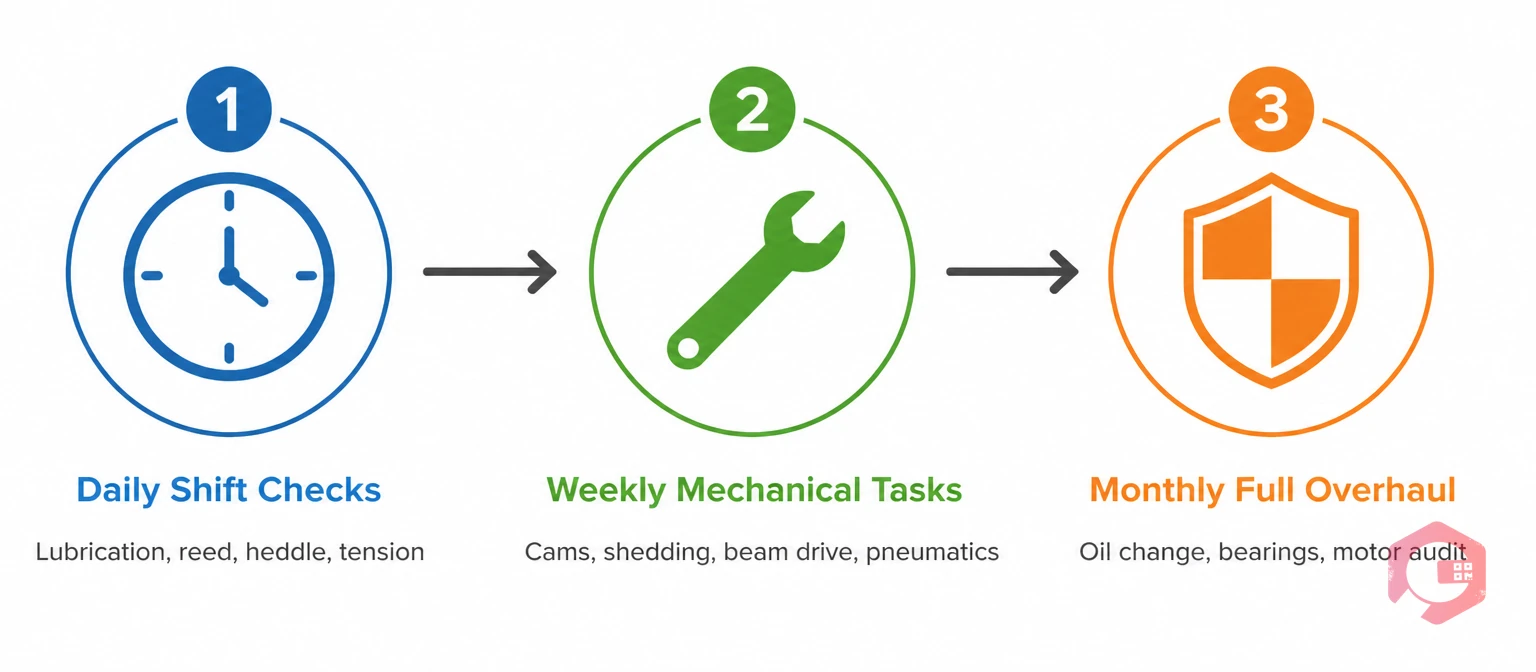
A structured multi-tier checklist is the foundation of any loom maintenance programme. Each tier serves a different purpose: daily checks catch emerging problems before they cause stoppages; weekly tasks address wear items; monthly overhauls reset the machine to baseline condition.
Daily checks (per shift):
Weekly tasks:
Monthly and quarterly:
Download a structured template from Cryotos's asset and equipment inspections checklist to digitise this workflow and assign tasks to specific technicians.
Understanding failure modes at the component level is the difference between treating symptoms and eliminating root causes. The following matrix covers the most common failure modes across rapier, air-jet, and shuttle looms in production environments.
| Component | Failure Mode | Effect on Production | Root Cause | Preventive Action |
|---|---|---|---|---|
| Reed | Bent or cracked dents | Streaky weft, warp breakage | Shuttle impact, excessive beat-up force | Inspect every shift; replace per metre count |
| Heddle frames | Frame wear / wire breakage | Warp misalignment, end breaks | Lint accumulation, worn guide rails | Weekly clean; guide rail check monthly |
| Main crank bearing | Seizure / elevated temperature | Loom stoppage, shaft damage | Inadequate lubrication, oil grade mismatch | ISO VG 46 oil; monthly vibration check |
| Air nozzle (air-jet) | Wear / pressure drop | Weft insertion failure, broken picks | Abrasive yarn, extended running hours | Replace at 2,000 hrs; pressure log daily |
| Dobby / Jacquard mechanism | Linkage failure / jam | Pattern defect, full loom stop | Lint accumulation, insufficient lubrication | Weekly clean; lubricate pivot points |
| Rapier tape / head | Tape fraying / gripper wear | Weft drop, weft insertion failure | High cycle fatigue, running beyond service life | Inspect weekly; replace per manufacturer schedule |
| Let-off / take-up drive | Backlash / speed variation | Uneven pick density, fabric bar defect | Gear wear, encoder drift | Monthly drive audit; check encoder calibration |
Recording these failure modes in your CMMS against each asset creates a failure history that powers future maintenance decisions. Repeat failures on the same component in under 90 days signal an inadequate PM interval or an unresolved root cause — not just bad luck.
Lubrication errors account for 40–50% of premature bearing failures in textile plants, according to Reliable Plant's bearing failure analysis research. The errors are rarely about forgetting to lubricate — they're about incorrect oil grade, wrong quantity, cross-contamination, or relubrication intervals that don't match actual operating conditions.
Follow these lubrication management fundamentals:
Cryotos's manufacturing maintenance software supports lubrication route scheduling, automatic job assignment per shift, and lubricant consumption tracking — so nothing falls through the cracks across a large loom floor.
Spare parts availability directly determines how long a loom stoppage lasts. A bearing in stock means a 2-hour repair. A bearing on order means a 2-day stoppage. Strategic parts classification is the key to controlling both inventory cost and machine availability.
Classify your textile spare parts into three categories:
Cryotos's inventory management module provides real-time stock visibility across all warehouses, auto-triggers purchase requests at minimum thresholds, and links parts consumption directly to work orders — giving you full visibility on cost per machine.
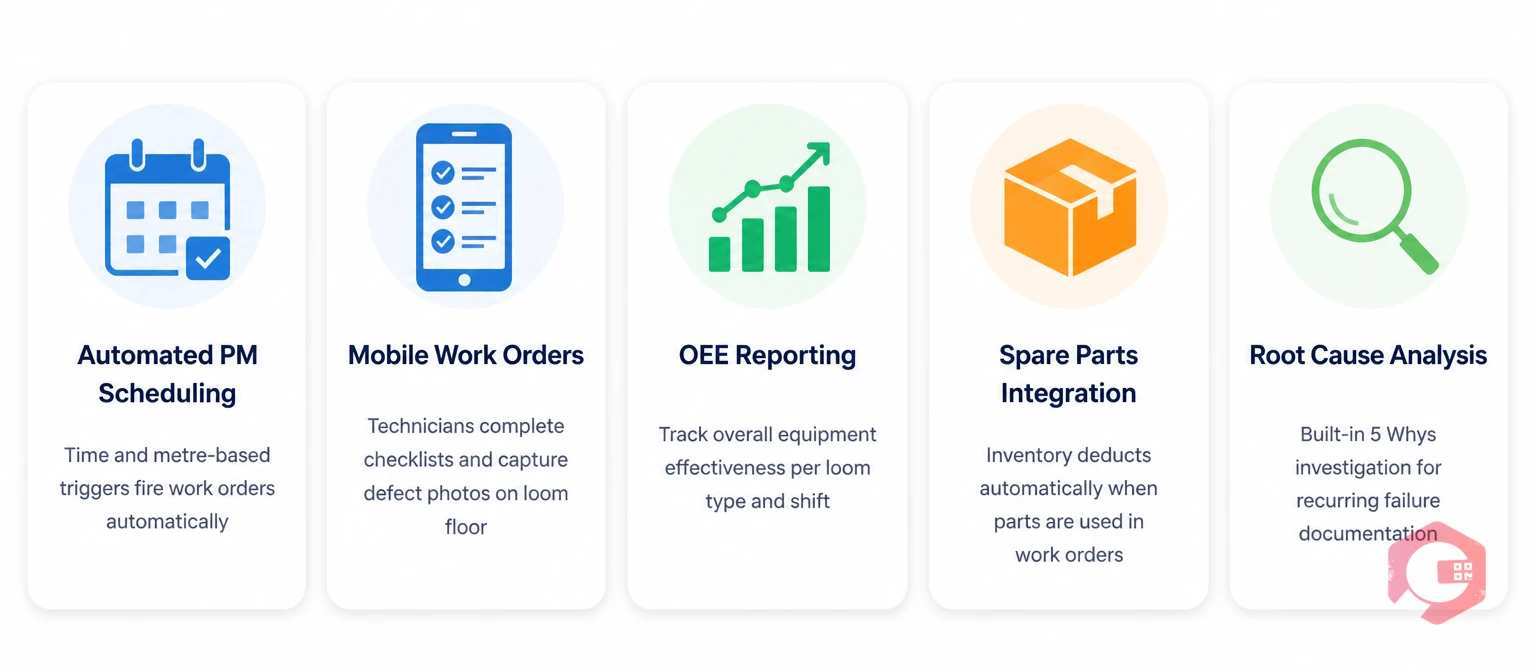
Managing maintenance across a 50–500 loom floor with spreadsheets and WhatsApp messages is where most textile plants hit their reliability ceiling. A textile manufacturing maintenance software purpose-built for this scale addresses the core challenges: scheduling, execution, tracking, and learning from failures.
Key capabilities that directly improve loom reliability:
Textile plants implementing Cryotos CMMS typically see 30% reduction in unplanned downtime and 25% faster repair times within six months of deployment.
A reliability programme moves maintenance from a reactive fire-fighting function to a proactive system that measurably improves OEE. SMRP Best Practices recommend a five-step approach that applies directly to textile manufacturing environments:
According to Plant Engineering's manufacturing reliability report, plants that formally document and review their maintenance strategies achieve 15–20% better OEE than plants operating informally — regardless of machinery age.
Daily visual checks and lubrication inspections per shift, weekly mechanical checks on shedding and drive mechanisms, and a full service every 500–1,000 operating hours or quarterly — whichever comes first. High-speed air-jet looms running 24/7 warrant monthly full overhauls.
Lubrication failure is the leading cause, responsible for 40–50% of premature bearing failures. The second most common cause is lint and dust accumulation in shedding mechanisms and dobby linkages, which causes jams and overheating in looms that aren't cleaned on a regular schedule.
Total Productive Maintenance (TPM) in textile manufacturing is a strategy where machine operators take ownership of daily cleaning, inspection, and minor maintenance tasks — known as autonomous maintenance. This frees maintenance technicians for higher-skill work and reduces the time between defect occurrence and detection, preventing minor issues from escalating into full stoppages.
A CMMS automates PM scheduling so no maintenance task is missed, provides mobile work orders for faster field execution, tracks spare parts in real time to eliminate "waiting for parts" delays, and records all failure history so repeat breakdowns can be identified and eliminated through root cause analysis.
Your textile plant's looms are the revenue engine — every unplanned stoppage costs production, quality, and buyer confidence. Schedule a free demo to see how Cryotos helps textile manufacturers cut loom downtime, standardise maintenance checklists, and build a reliability programme that scales across every machine on the floor.




Cryotos AI predicts failures, automates work orders, and simplifies maintenance—before problems slow you down.



