
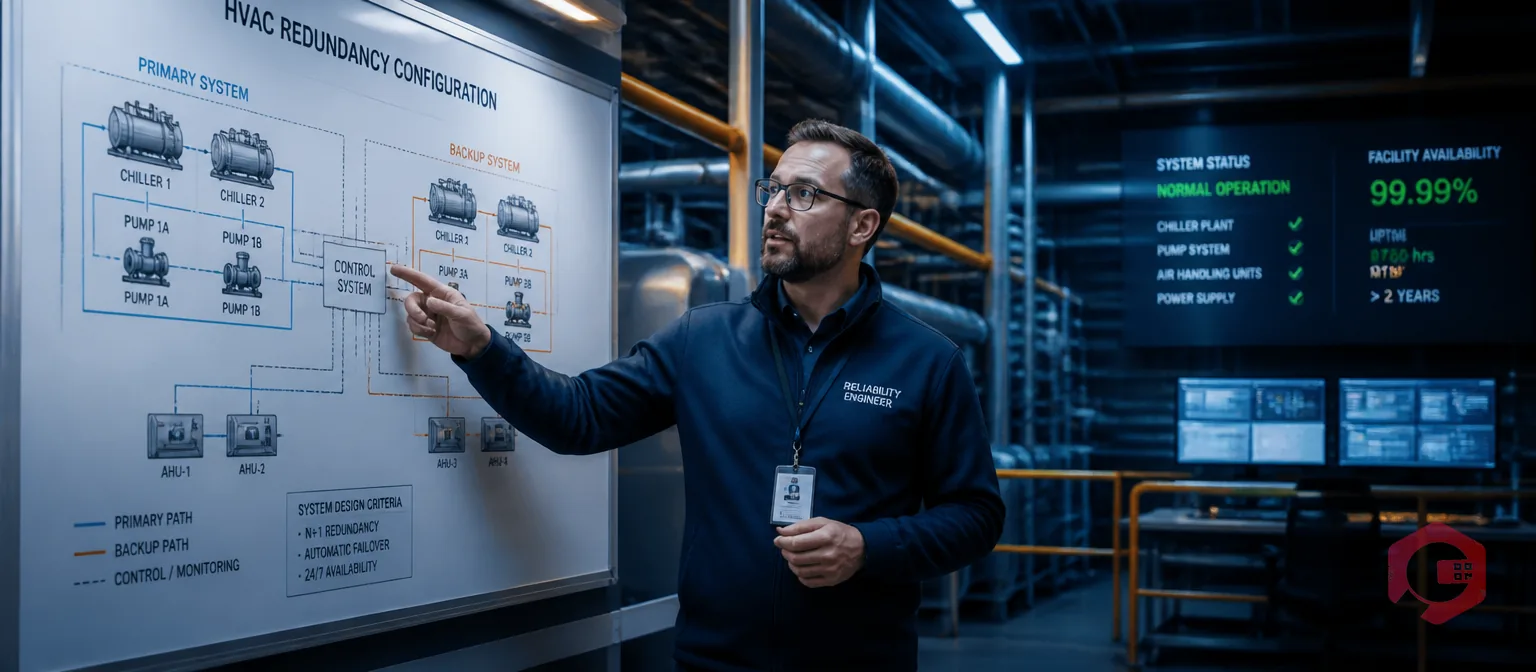
N+1 redundancy in maintenance is a reliability strategy where one extra unit of backup capacity — beyond the minimum required (N) — is kept available to take over if a primary component fails. In critical operations, a single point of failure can trigger cascading downtime and costly repairs. By deploying at least one standby unit for every group of active components, maintenance teams ensure that equipment continues running even when something breaks. According to the IDC, unplanned downtime costs industrial companies an average of $250,000 per hour. N+1 redundancy directly targets that exposure. This guide covers what N+1 means in practice, how it compares to other redundancy levels, which industries use it most, and how a CMMS built for asset maintenance management helps you plan, schedule, and track backup capacity at scale.
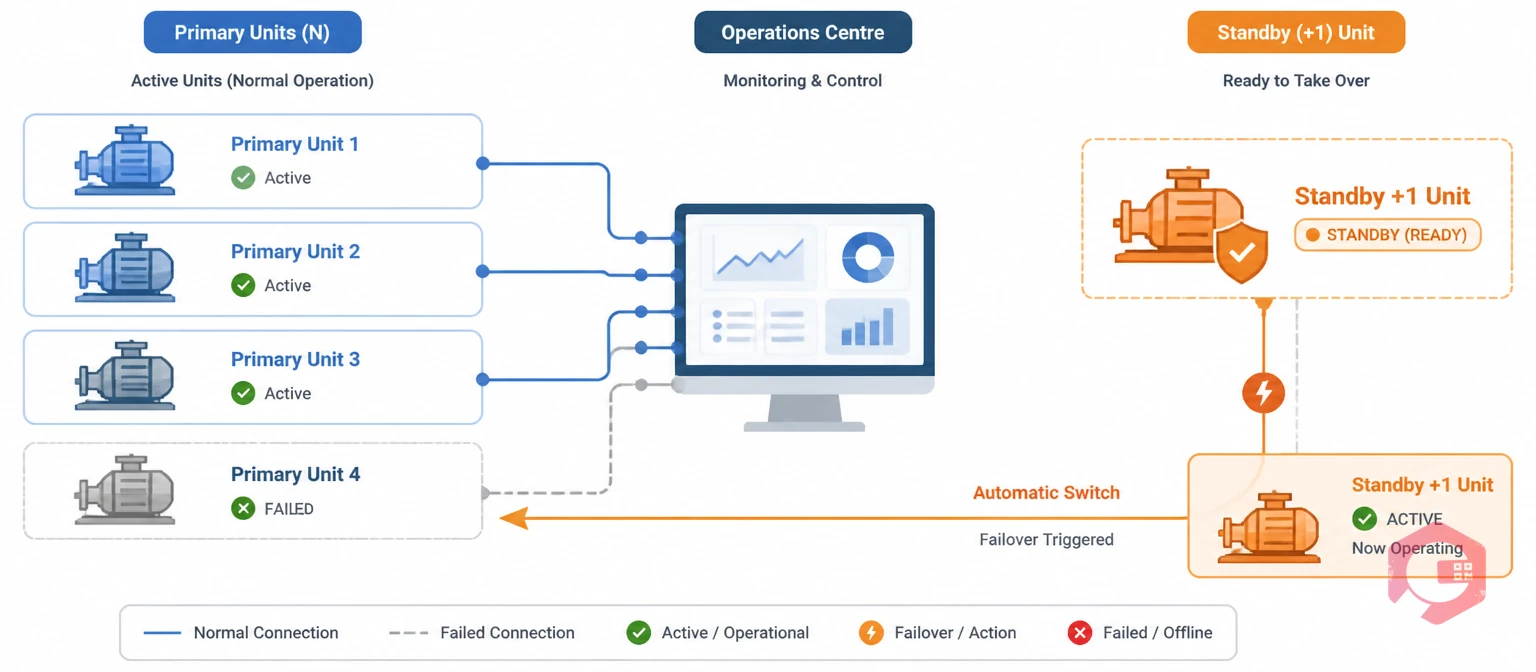
The "N" in N+1 redundancy stands for the number of components required to run your operation at full capacity. The "+1" is an additional standby component that can take over instantly if any one of the N units fails. So if your facility needs 4 cooling units to operate at full load, an N+1 design requires 5. If one unit fails, the remaining 4 handle the full load without any service interruption.
This concept applies across virtually every type of equipment in maintenance-intensive industries: power supplies, pumps, fans, generators, servers, conveyors, and HVAC units. The key requirement is that the +1 unit must be ready to carry the load of any single failing component — not just available in a warehouse. That distinction matters. A spare part sitting in storage is not redundancy; it is inventory. N+1 redundancy means the backup unit is installed, configured, and ready to operate the moment it is needed.
The principle is deeply rooted in reliability-centered maintenance, which prioritizes keeping critical assets available over simply reacting to failures. Think of it as insurance for your production floor: you hope you never need it, but when you do, it is already in place.
The practical mechanics of N+1 redundancy depend on how the backup unit connects to the system. Most designs fall into one of two configurations.
In an active-standby setup, the primary units carry all the load while the backup unit sits idle but ready. Automated failover switches detect the failure of a primary unit and bring the standby online within seconds. This is the most common configuration for generators and cooling equipment in facilities.
In an active-active setup, all N+1 units share the load simultaneously. Each unit operates below full capacity, so when one fails, the others absorb the extra load without any switching required. This design is common in power distribution and server infrastructure where seamless performance matters more than pure efficiency.
Both configurations require regular testing to confirm the backup unit will actually perform when called upon. A backup generator that has never been load-tested is a false sense of security. Preventive maintenance scheduling for backup units is therefore not optional — it is a core part of any N+1 strategy. Without it, the "+1" degrades into an untested liability rather than a reliable safety net.
Redundancy comes in multiple tiers. Understanding where N+1 sits relative to other configurations helps maintenance managers make the right investment decisions for each asset class.
| Redundancy Level | Configuration | Tolerance | Cost | Best For |
|---|---|---|---|---|
| N (No Redundancy) | Exactly the components needed to run at full capacity | Zero — any failure causes downtime | Lowest | Non-critical, easily replaced equipment |
| N+1 | One backup unit beyond the required number | One simultaneous failure | Moderate | Most industrial and commercial critical systems |
| N+2 | Two backup units beyond the required number | Two simultaneous failures | High | High-risk operations with extended repair windows |
| 2N | Full duplication — two complete independent systems | Full loss of one system | Very High | Tier 4 data centers, mission-critical infrastructure |
| 2N+1 | Two full systems plus one additional backup | Maximum — exceeds full system loss | Highest | Military, aerospace, life-safety systems |
For most industrial facilities, N+1 hits the sweet spot between cost and protection. It guards against the most common failure scenario — a single component outage — without doubling capital expenditure the way a 2N design does. Choosing the right tier depends on your asset's criticality, your mean time between failures, and the cost of a single hour of downtime in your operation.
N+1 redundancy is not a niche concern. It shows up wherever the cost of failure — financial, operational, or human — is too high to accept.
Data centers and IT infrastructure were among the earliest adopters. Cooling systems, uninterruptible power supplies, and network equipment all follow N+1 or higher standards. The Uptime Institute's Tier II standard requires N+1 redundancy at minimum for any facility claiming high availability.
Healthcare facilities use N+1 redundancy for medical gas systems, HVAC units serving operating rooms, emergency power, and sterilization equipment. The healthcare maintenance environment demands that no single system failure interrupts patient care, making N+1 not just a best practice but often a regulatory requirement under Joint Commission standards.
Manufacturing plants apply N+1 to conveyors, cooling towers, compressed air systems, and critical pumps. A single pump failure on a high-volume assembly line can halt an entire production run. With N+1, the standby pump engages automatically while the maintenance team schedules a repair — no emergency shutdown required.
Oil and gas facilities rely on N+1 for wellhead control systems, gas compression, and fire suppression. The oil and gas maintenance context adds an explosion and environmental risk layer, making redundancy both an operational and safety mandate.
Power generation plants design cooling water pumps, feed water systems, and emergency diesel generators to N+1 specifications. A turbine cooling failure at full load is catastrophic; one extra pump prevents it. According to the U.S. Department of Energy, redundancy design is one of the primary strategies for maintaining grid reliability in power infrastructure.

The core value of N+1 redundancy is obvious — it prevents unplanned downtime. But the downstream benefits extend well beyond that single outcome.
N+1 redundancy is not a set-it-and-forget-it solution. Several real-world challenges can erode its effectiveness if left unmanaged.
The backup must be maintained. The most common failure mode in N+1 systems is not the primary failing — it is discovering that the backup also does not work when you need it most. This happens when standby units skip preventive maintenance because "they are not in use." Every backup unit needs its own maintenance schedule, regular testing under load, and documented inspection records.
Capital cost. Installing an extra 20–25% of capacity costs real money. For large-scale industrial systems, N+1 can represent significant capital expenditure. The business case requires clear data on downtime costs, repair costs, and asset criticality — which is where downtime tracking tools become essential for building that justification.
Space and integration complexity. Physical space for an additional unit is not always available in older facilities. Retrofitting N+1 into an existing plant layout can require significant infrastructure changes.
N+1 only covers single failures. If two components fail simultaneously — during a maintenance window when one is already offline, for example — N+1 offers no protection. Understanding this limit helps maintenance managers plan maintenance windows carefully and decide when N+2 or 2N is warranted.
False confidence without testing. A backup unit that has never been tested under full load may fail when called upon. Load testing backup equipment regularly is a non-negotiable part of any honest N+1 program.
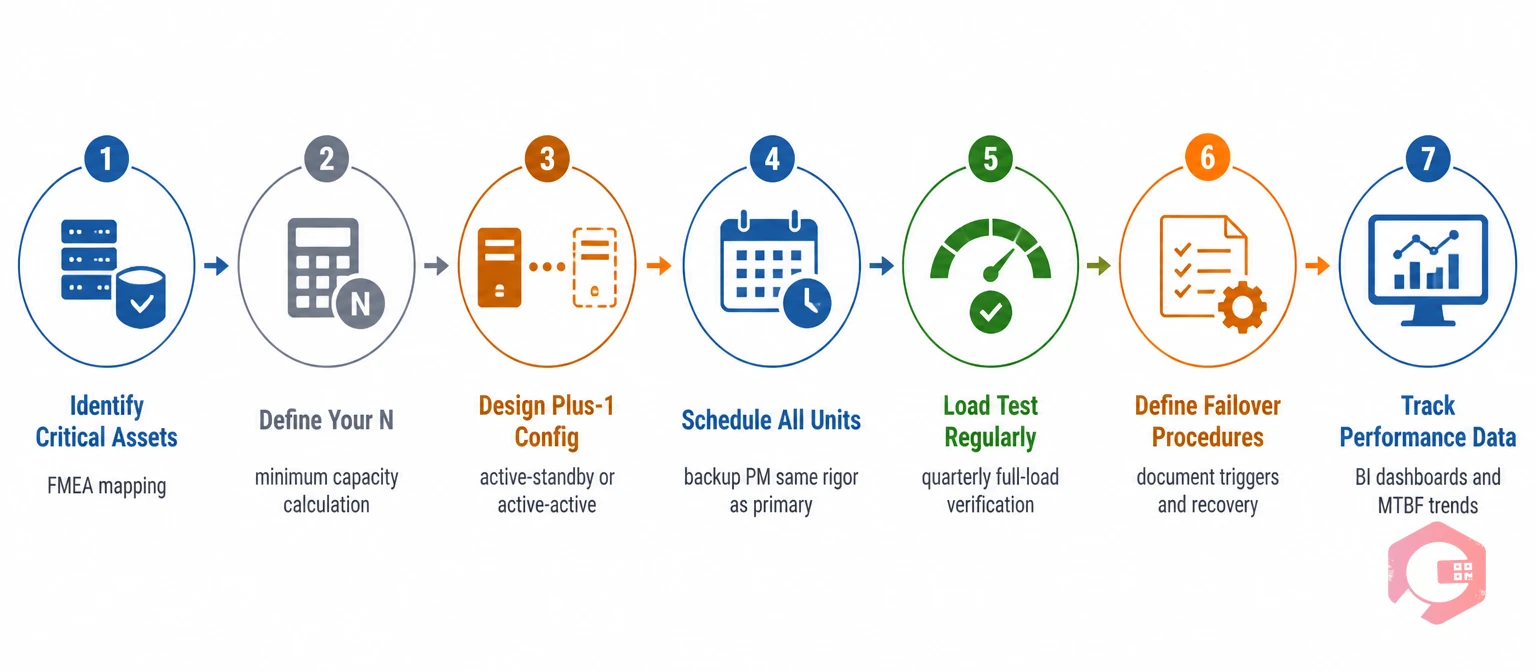
Implementing N+1 effectively requires more than purchasing an extra unit. Here is a practical framework for getting it right.
Managing N+1 redundancy manually — across dozens of critical asset systems — creates exactly the kind of gap that lets backup units degrade without anyone noticing. A CMMS like Cryotos closes that gap by building redundancy management directly into your maintenance workflows.
With Cryotos, you can assign every backup unit its own asset profile, PM schedule, and work order queue alongside its primary counterparts. The system treats the "+1" as a full citizen of your asset register — not an afterthought. When a PM is due on a standby pump or cooling unit, Cryotos generates the work order automatically and routes it to the right technician, ensuring the backup never silently falls behind on maintenance.
Real-time downtime tracking lets you see exactly when a failover occurs — which backup activated, how long it ran, and what triggered the switch. This data feeds directly into MTBF calculations and reliability reports, helping you demonstrate the value of your N+1 investment to leadership and flag any backup units showing declining performance before they fail under load.
Cryotos also supports load test workflows through its maintenance checklist builder, so your quarterly backup load tests follow a consistent, auditable procedure every time. When a regulator or auditor asks for proof that your backup systems are tested and maintained, you have the records to show them.
Teams using Cryotos report up to a 30% reduction in unplanned downtime and 25% faster mean time to repair — results that are directly tied to having reliable backup capacity and organized maintenance workflows behind it.
N+1 means you have one more unit than the minimum required to run your operation. If you need 3 pumps to keep a process running, N+1 requires 4. If any one of the 3 active pumps fails, the fourth takes over immediately without any operational interruption.
Not exactly. Failover is the process of switching from a failed component to a backup. N+1 redundancy is the design that makes reliable failover possible. You can have a failover plan without N+1 redundancy, but without an available backup unit, failover has nothing to activate.
Industry best practice recommends load-testing backup units at least quarterly. For life-safety or mission-critical systems such as emergency generators in hospitals, monthly testing is common and often required by code. Every test result should be documented in your CMMS for audit purposes.
Yes. N+1 is widely used in server clusters, network switches, storage arrays, and power supply units within IT infrastructure. The principle is identical: one extra unit stands ready to absorb the load if any active component fails. The Uptime Institute's data center tier standards use N+1 as the baseline for Tier II facilities.
High availability (HA) is the broader goal — keeping systems operational for a high percentage of time. N+1 redundancy is one of the primary technical strategies used to achieve HA. Other HA strategies include clustering, geographic replication, and automated self-healing systems. N+1 is the most common and cost-effective entry point into high-availability design for physical maintenance systems.
If your operation depends on critical systems running 24/7, N+1 redundancy is one of the most practical investments in reliability you can make — but only if the backup capacity is properly maintained. Cryotos CMMS gives maintenance teams the tools to schedule, track, and verify every backup unit alongside their primary assets, so your "+1" is always ready when it counts. Book a free demo to see how Cryotos supports redundancy management in facilities like yours.



Cryotos AI predicts failures, automates work orders, and simplifies maintenance—before problems slow you down.



