

A root cause culture in maintenance is an organizational mindset where every equipment failure is treated as a learning opportunity, not just a task to close. Teams with a strong root cause culture don't just fix breakdowns — they investigate why failures happen, document findings, assign corrective actions, and verify that the underlying condition has actually changed. Research from Reliable Plant and Plant Engineering both confirm that repeat failures account for nearly half of all unplanned downtime events in facilities that lack structured RCA programs. Building a root cause culture is what breaks that cycle.
Key Takeaways
A root cause culture is not a tool or a process — it's a habit built into how your team responds to every failure event. It means technicians and supervisors ask "why did this happen?" before asking "what do we replace?" That shift in question changes everything about how failure data gets used.
Most organizations have RCA procedures written in a binder somewhere. Very few have the culture where those procedures actually get followed on a Tuesday night at 10 PM when the line is down and everyone just wants to get things running again. The difference between those two organizations isn't the procedure — it's the culture around the procedure.
A genuine root cause culture has three defining traits: every significant failure triggers a structured investigation, every investigation produces at least one corrective action with a named owner, and leadership visibly acts on what technicians surface. When all three are present, repeat failures drop — and your team's confidence in the maintenance system grows.

Pillar 1 — Psychological Safety After a Breakdown. Before introducing any RCA tool, establish one clear norm: breakdowns are systems failures, not personal failures. When technicians fear blame, they provide surface-level answers to RCA questions. When they feel safe, they surface the real problems — staffing gaps, missing spare parts, unclear procedures — that actually drive repeat failures.
Pillar 2 — Structured RCA as Standard Practice. Define a clear failure threshold that automatically triggers a structured investigation. A production stoppage over two hours, a safety-related event, or any failure that has occurred more than twice in 90 days should be non-negotiable triggers. Consistency matters more than comprehensiveness in the early stages.
Pillar 3 — Closing the Loop: Acting on Findings. Every RCA must produce at least one corrective action with a named owner and a due date. If RCA findings disappear into a report nobody reads, technicians learn quickly that the process is theater — and they stop participating genuinely. Use your work order management software to convert every corrective action into a trackable work order with a due date and an assigned technician.
Pillar 4 — Tracking Repeat Failures as a KPI. Add a repeat failure rate to your maintenance dashboard. Define it clearly — for example, any failure on the same asset using the same failure code within 90 days of a previous repair counts as a repeat. When repeat failure rate becomes a visible metric, it becomes a priority.
Pillar 5 — Leadership Visibility and Accountability. When a maintenance manager reviews RCA findings in monthly team meetings and acts on what technicians surface, the feedback loop closes and the culture deepens. Leaders who only see production numbers — and never see failure pattern data — inadvertently signal that RCA doesn't matter.
Use the root cause analysis investigation checklist to standardize how your team captures failure data at each step of the process.
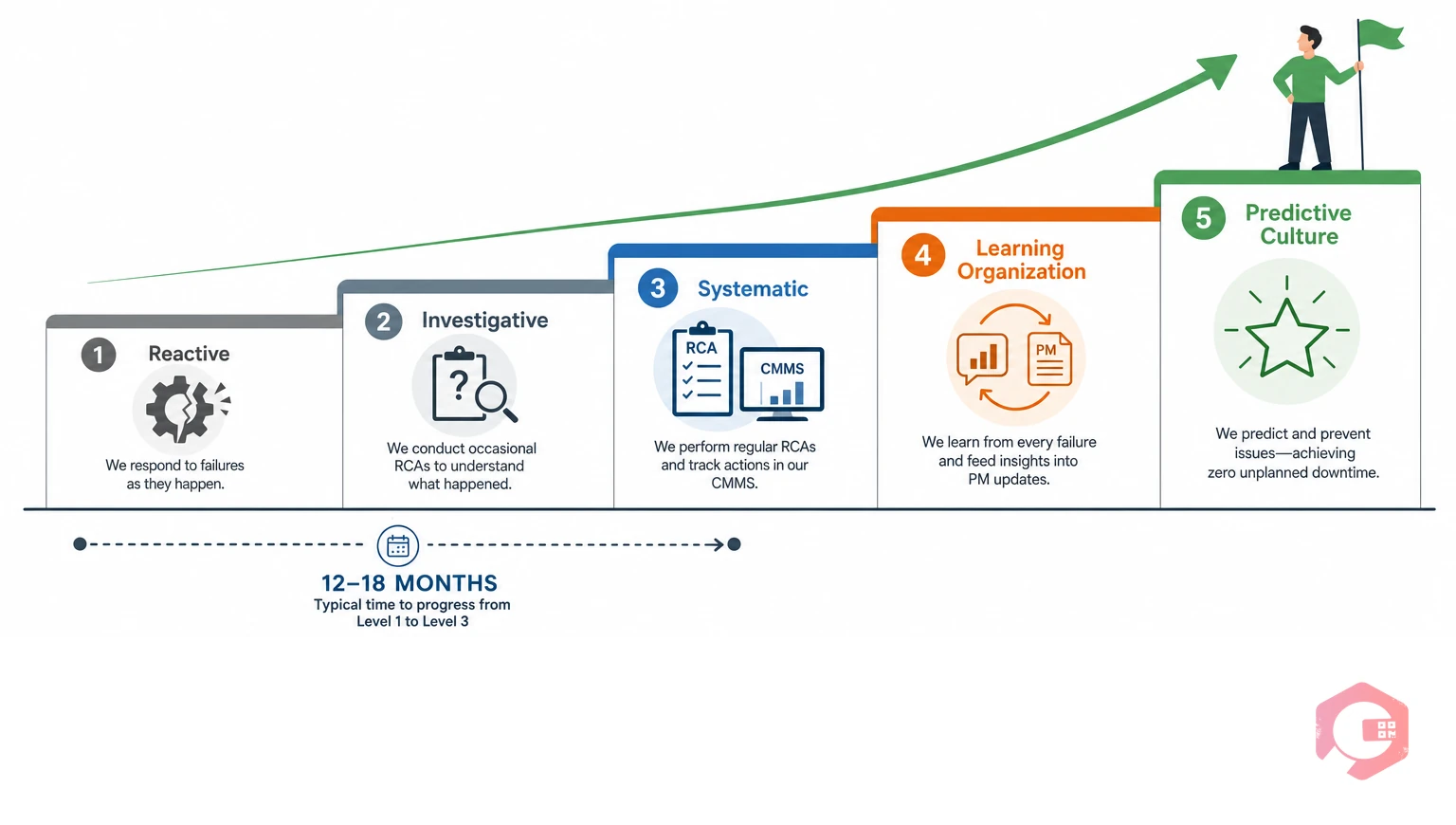
Understanding your current maturity level gives you a realistic starting point and a clear direction for improvement. Most teams discover they're somewhere between Level 1 and Level 2 when they first assess honestly.
Most teams move from Level 1 to Level 3 within 12–18 months of a deliberate program. The jump from Level 3 to Level 5 requires CMMS data maturity and consistent leadership investment, but the reliability gains are exponential once you get there.
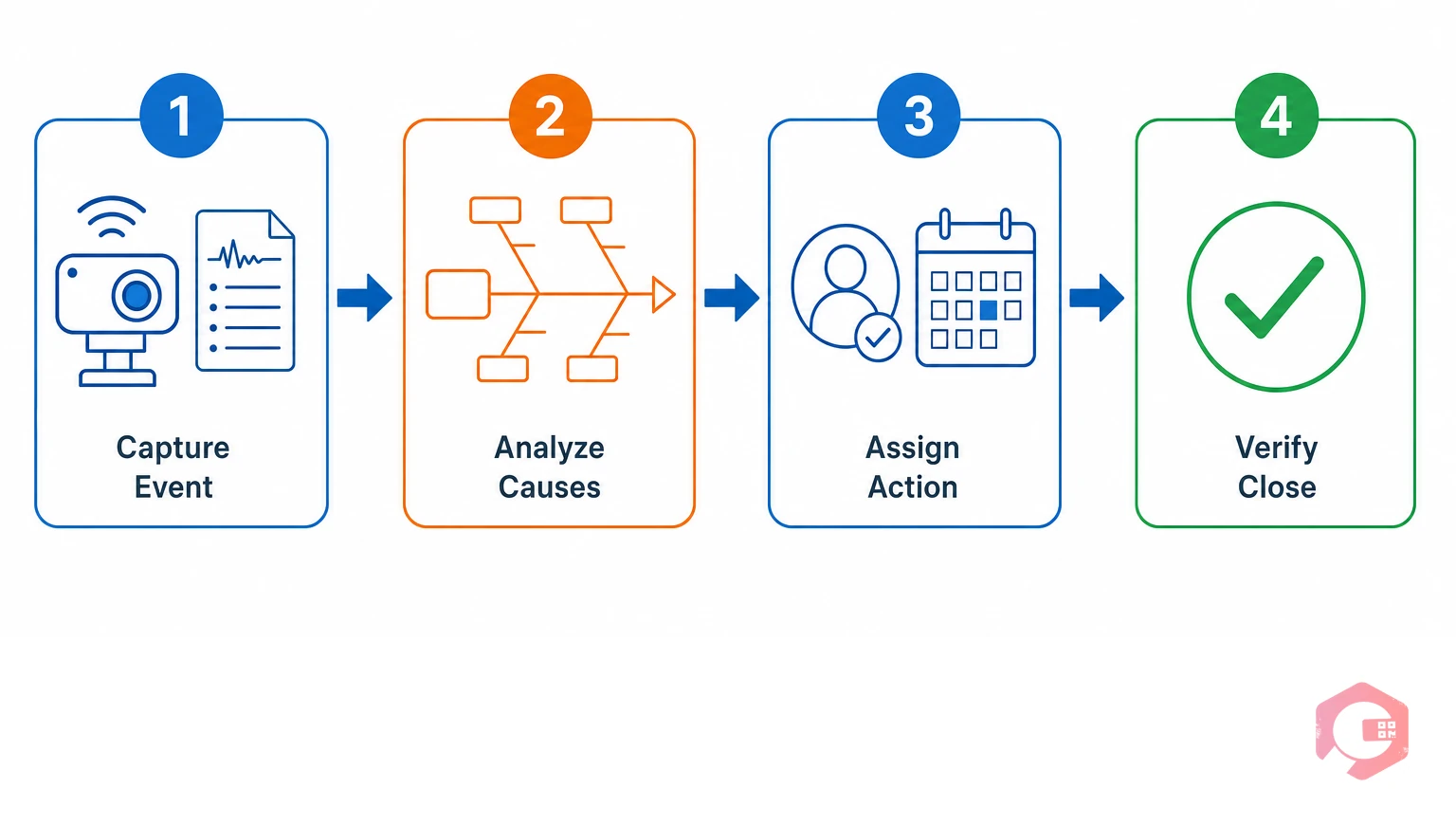
A structured RCA session doesn't need to take three hours. When you have the right data available and the right people in the room, most failure investigations can be completed in 30–60 minutes. Here's the four-step process that keeps sessions focused and productive.
Step 1 — Capture the event within 24 hours. Memories fade, conditions change, and parts get swapped out. The sooner you gather the raw facts — what failed, when, what was happening at the time, what the technician first observed — the more accurate your investigation will be. Document everything into the work order before closing it.
Step 2 — Use 5 Whys or Fishbone Diagram to dig deeper. Ask "why did this happen?" until you reach a systemic cause rather than an individual action. A bearing failed because it overheated. Why did it overheat? Because lubrication intervals were missed. Why were they missed? Because the PM schedule didn't account for the new production cycle. Now you have a root cause worth acting on — not just a bearing to replace.
Step 3 — Assign corrective actions with named owners and specific deadlines. Vague actions get ignored. "Someone should look at the PM schedule" accomplishes nothing. "Maria to revise bearing PM interval from 90 to 45 days by Friday" is an action that gets done. Log every corrective action directly into your CMMS as a tracked work order.
Step 4 — Verify and close out. Confirm that the corrective action was completed and that the underlying condition has actually changed. This is where most programs fail — they generate corrective actions but never verify them. Verification closes the loop and proves to your team that the process is real.
A CMMS turns root cause culture from a good intention into a repeatable system. Without it, RCA findings live in spreadsheets, email chains, and notebooks that nobody reads six months later. With it, every finding becomes searchable, trackable, and actionable data that prevents future failures across your entire asset fleet.
Cryotos CMMS supports root cause culture through several tightly integrated features. Built-in 5 Whys on every work order means technicians capture root cause data at the point of repair — not in a separate meeting later. Standardized failure codes make it possible to identify patterns across hundreds of work orders that would be invisible in a manual system. Corrective action workflows convert RCA findings directly into tracked work orders with assigned owners and automatic reminders. The downtime tracking module surfaces repeat failure rates by asset, department, and failure mode — making your KPIs visible in real time. And the AI-powered knowledge base turns individual RCA findings into organizational knowledge, so a technician on night shift benefits from what a colleague discovered three months ago.
According to McKinsey's Operations research, companies that apply systematic RCA practices reduce maintenance costs by 15–25% and cut unplanned downtime by up to 30%. The technology exists — the limiting factor is almost always culture, not capability.
Even well-designed RCA programs stall. The obstacles are almost always cultural or organizational, not technical. Here's what teams commonly hit and how to move past them.
According to SMRP Best Practices, organizations that sustain RCA programs for more than 24 months see failure rates decline by an average of 35–45% on high-criticality assets. The first six months are the hardest — but they're also where the habit gets built.
Root cause analysis (RCA) in maintenance is a structured method for identifying the underlying cause of an equipment failure — not just the visible symptom. Common techniques include 5 Whys, Fishbone Diagrams, and FMEA (Failure Mode and Effects Analysis). The goal is to identify and address the condition that allowed the failure to occur, not just restore the asset to service.
For most equipment failures, a focused RCA session takes 30–60 minutes when the right people are in the room and the data is already collected in the work order. The key is to hold the session within 24–48 hours of the failure, before the evidence is cleaned up and the details are forgotten.
The fastest way to build technician buy-in is to act on what they surface. When a technician identifies that a bearing failed because a specific spare part was chronically out of stock — and management restocks that part within a week — that technician completes every future RCA with genuine care. Nothing kills buy-in faster than watching RCA findings go nowhere.
A practical starting threshold for most teams: any unplanned downtime event over two hours, any safety-related event regardless of duration, and any failure on an asset that has experienced two or more events in the past 90 days. As your program matures, you can refine the threshold based on asset criticality and cost impact.
If you're ready to give your team the tools to make root cause analysis a natural part of every work order, Schedule a free demo to see how Cryotos CMMS embeds 5 Whys, failure code tracking, corrective action workflows, and repeat failure reporting directly into your maintenance operations.



Cryotos AI predicts failures, automates work orders, and simplifies maintenance—before problems slow you down.



