
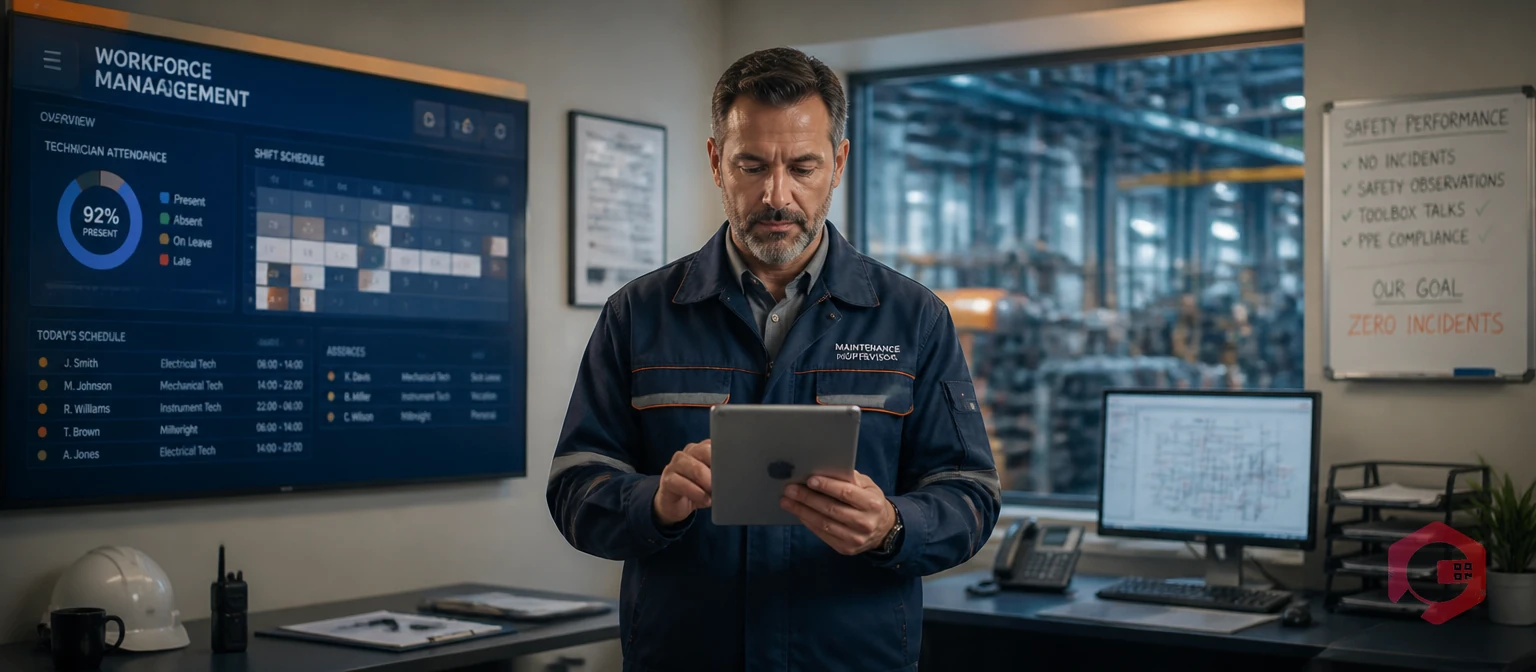
Technician attendance tracking in a CMMS gives maintenance managers real-time visibility into who is on-site, who is available for assignments, and how attendance patterns affect work order completion rates. When attendance data lives inside the same platform as your work orders, preventive maintenance schedules, and asset records, you eliminate the guesswork that comes from juggling separate HR and maintenance systems. According to a McKinsey operations study, organisations that integrate workforce data with maintenance workflows reduce unplanned downtime by up to 23%. This guide explains what technician attendance tracking inside a CMMS actually looks like, why separation from your HR tool creates costly blind spots, and how Cryotos connects attendance to every layer of your maintenance operation.

Technician attendance tracking in a CMMS is the practice of recording technician clock-in and clock-out times, shift availability, and on-site presence directly within the maintenance management platform — not in a separate HR or payroll tool. The system uses this data to drive scheduling decisions, resource allocation, and productivity analysis inside the same environment where work orders and assets are managed.
This is different from a basic time-and-attendance app. When attendance is captured inside a CMMS, the data is immediately available for:
The result is a single source of truth for both asset health and workforce availability — something no standalone attendance tool can provide.
Most maintenance teams track attendance in a separate system — a basic time-clock app, a spreadsheet, or an HR platform. The problem is not that these tools are poor at tracking hours. The problem is that the data never reaches the people and systems that need it most: the maintenance manager assigning a critical work order at 6 AM, or the CMMS scheduling a preventive maintenance task that requires a certified technician.
When attendance lives in one system and work orders live in another, managers rely on manual checks and memory to bridge the gap. A work order gets assigned to a technician who called in sick an hour ago. A PM task is scheduled for a technician on annual leave. These errors generate reactive scrambles, delayed repairs, and extended asset downtime — all traced back to a scheduling decision made without current attendance data. A research report by Aberdeen Group found that maintenance teams using integrated scheduling and workforce tools resolved unplanned breakdowns 31% faster than those relying on disconnected systems.
In industries governed by safety regulations — manufacturing, oil and gas, pharmaceuticals — technician presence is a compliance matter, not just a scheduling one. Permit-to-work systems require documented confirmation that qualified, present technicians performed specific tasks. When attendance is logged in an HR tool and work execution is logged in a CMMS, assembling a complete audit trail during an inspection means pulling reports from two systems, reconciling timestamps, and hoping neither has gaps. Integrated attendance tracking solves this by storing the full record — who showed up, when they clocked in, which work orders they executed, and what they signed off on — in a single audit-ready environment.
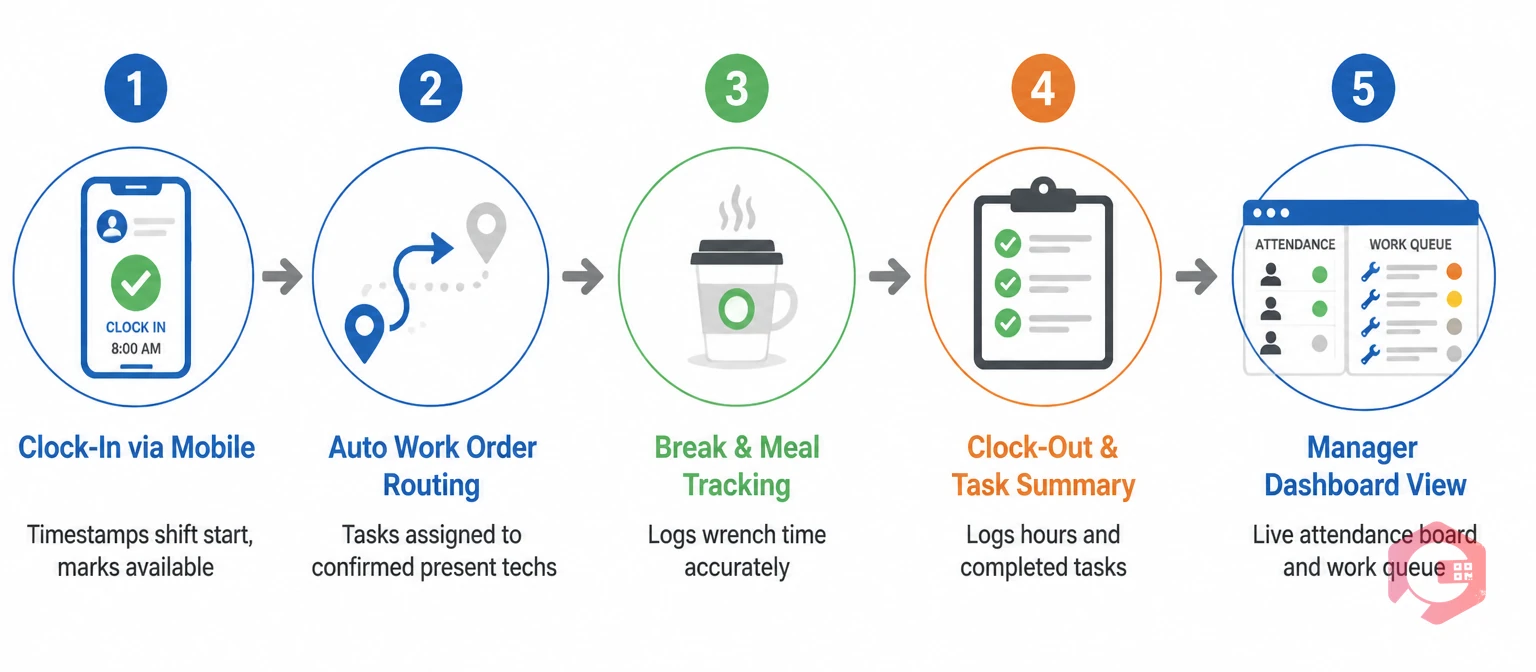
In a modern CMMS like Cryotos, attendance tracking is built into the same mobile app technicians use to receive and complete work orders. There is no second app to open, no separate time clock to punch. Here is what a typical shift looks like:
This flow means attendance is not an administrative afterthought. It is a live operational input that shapes every scheduling and assignment decision the system makes throughout the day.
Here is a direct comparison of what you get when attendance tracking is inside your CMMS versus managed in a separate HR or time-tracking tool:
| Capability | Attendance Inside CMMS | Standalone HR / Time Tool |
|---|---|---|
| Real-time work order routing | Automatic — system checks attendance before assigning | Manual — manager must cross-reference two systems |
| PM schedule adaptation | Adjusts automatically when a technician is absent | Requires manual rescheduling by the maintenance planner |
| Downtime linkage | Absence records linked directly to downtime events | No connection — downtime and attendance stored separately |
| Permit-to-work compliance | Single audit trail covering presence and task execution | Fragmented across HR system and CMMS — manual reconciliation needed |
| Productivity analysis | Attendance correlated with MTTR, task completion rate in one report | Requires data export and manual merging of two datasets |
| Mobile offline support | Clock-in works without connectivity; syncs when reconnected | Depends on the tool — many require constant internet access |

The real value of technician attendance tracking inside a CMMS is not the attendance record itself — it is the performance data that becomes visible when attendance is linked to every other operational variable.
Consider what a maintenance manager can now see in a single BI dashboard report:
This level of analysis is impossible when attendance data and maintenance data live in separate systems. Merging them manually is slow, error-prone, and rarely done with enough frequency to drive real decisions. When both data sets are inside the CMMS, every report is current and the correlations are automatic. You can use the MTTR calculator to baseline your current repair times before and after integrating attendance data to measure the improvement.
Field maintenance teams present a specific challenge: they often work in environments with poor or no internet connectivity — inside large manufacturing plants, underground facilities, or remote industrial sites. A CMMS that requires a live internet connection to record attendance creates gaps that undermine the entire tracking system.
Cryotos handles this with a full offline mobile CMMS mode. Technicians can clock in, log attendance, receive work orders, and complete task records without any connectivity. When the device reconnects, all data syncs automatically with no action required from the technician or the manager.
This matters for compliance as much as convenience. An OSHA regulation 1910.147 on the control of hazardous energy (lockout/tagout) requires documented records of who performed specific maintenance tasks and when. If a technician cannot log attendance because of a connectivity issue, that creates a compliance gap. Offline-first design eliminates that risk entirely.
For teams managing field service operations across multiple sites, the mobile attendance feature also gives dispatch managers a live view of who has clocked in at each location — without phone calls or manual check-ins. The system surfaces this data automatically as part of the normal work order management workflow.
No — a CMMS is not designed to replace payroll or HR platforms. Its role is to capture attendance data as an operational input that drives maintenance scheduling and work order management. Many organisations run both: HR software handles payroll and leave management, while the CMMS captures shift presence for maintenance workflow purposes. Some CMMS platforms support ERP integration to sync data between both systems and eliminate duplicate entry.
Yes. Most CMMS platforms, including Cryotos, support role-based access and user role management that allows you to create accounts for contract technicians with limited permissions. Contract workers can clock in, receive assigned work orders, and log task completion without accessing sensitive asset data or maintenance records beyond their scope of work.
ISO 55000, the international standard for asset management, requires documented evidence of competent and authorised personnel performing maintenance tasks. Attendance records tied directly to work order execution inside a CMMS provide exactly the kind of traceable, timestamped documentation that auditors look for. This is far more reliable than reconciling attendance logs from an HR system with execution records from a separate maintenance platform. You can check your current compliance readiness against the maintenance audit checklist.
Most CMMS platforms handle this through automated shift-end rules or manager overrides. Cryotos allows managers to manually correct attendance entries and add notes explaining the adjustment — maintaining a clean audit trail even when human error occurs. Supervisors receive alerts for incomplete clock-out events so gaps are resolved the same day rather than accumulating into larger discrepancies.
Yes. CMMS mobile apps use encrypted data transmission and role-based authentication, meaning attendance data is protected both in transit and at rest. For high-security environments, device-level controls such as PIN or biometric authentication add another layer. The ISO 27001 information security standard provides the framework most industrial CMMS vendors use to govern data security practices.
Technician attendance tracking belongs inside your CMMS because maintenance execution and workforce availability are not two separate problems — they are one operational challenge that demands one connected solution. When you can see who is on-site, what they are working on, and how their presence patterns affect your maintenance KPIs in a single platform, you make better scheduling decisions, close work orders faster, and build the audit trail that compliance requires. Cryotos CMMS connects technician attendance to every layer of your maintenance operation — from work order assignment through to downtime reporting — so your maintenance team always works from current, accurate data. Book a demo to see how integrated attendance tracking can reduce your scheduling delays and improve first-time fix rates.


Cryotos AI predicts failures, automates work orders, and simplifies maintenance—before problems slow you down.



