Choosing between time-based and meter-based maintenance is one of the most practical decisions a maintenance manager makes. Time-based maintenance schedules service at fixed calendar intervals — monthly, quarterly, annually. Meter-based maintenance triggers service when equipment hits a usage threshold — every 5,000 operating hours, 50,000 cycles, or 10,000 miles. Neither is universally better. The right choice depends on your asset type, failure patterns, and how accurately you can measure usage. This guide explains both approaches, compares them directly, and shows you exactly when to use each — or both at once.
Key Takeaways
Time-Based Suits Age-Related Degradation: Use calendar intervals for assets where failure risk rises with elapsed time regardless of usage — HVAC filters, fire safety equipment, and compliance-mandated inspections.
Meter-Based Matches Maintenance to Actual Wear: Tie service to operating hours, cycles, or mileage when equipment stress directly correlates to how much it runs, preventing both over-maintenance and under-maintenance.
Hybrid Scheduling Covers Both Risks: Setting "whichever comes first" conditions on critical assets captures time-based degradation and usage-based wear simultaneously — the gold standard for high-value equipment.
A CMMS Automates All Three: Modern platforms like Cryotos handle calendar triggers, IoT meter readings, and either/or hybrid conditions without manual tracking across your entire asset base.
What is Time-Based Maintenance?
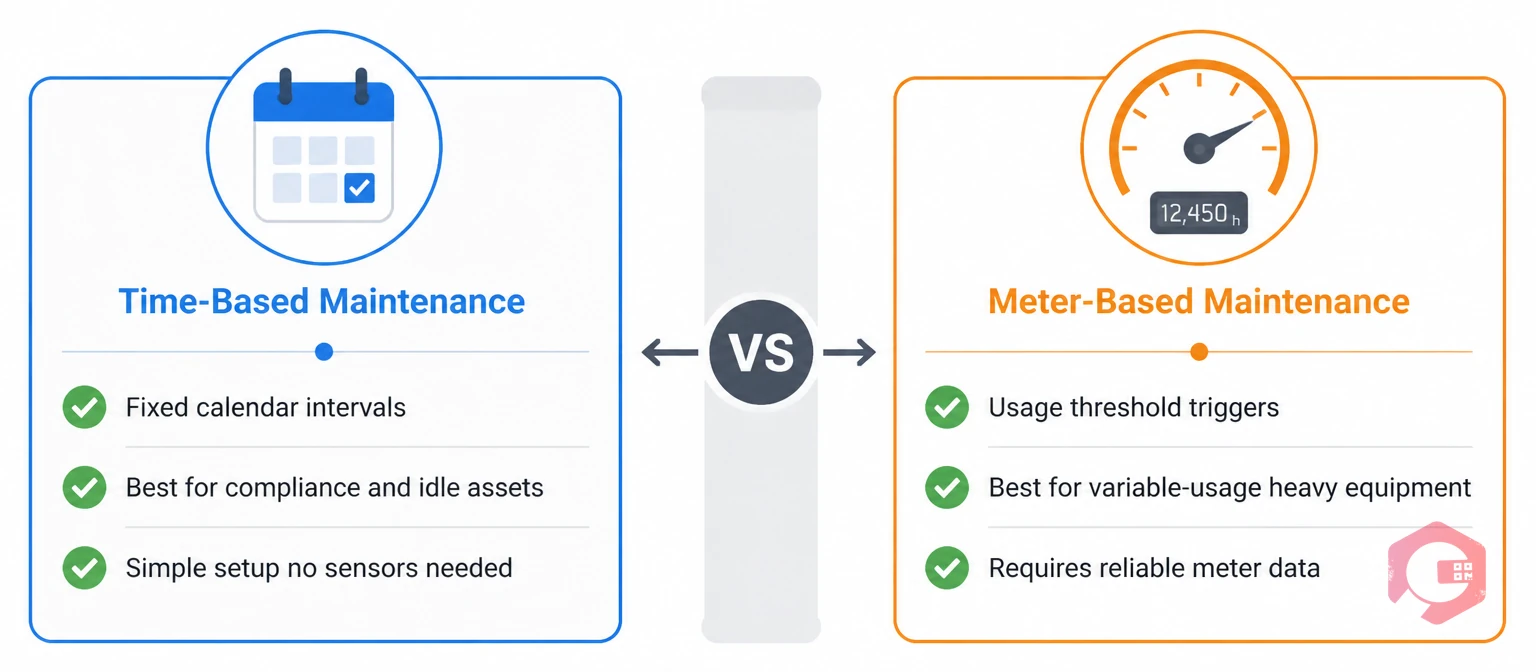
Time-based maintenance schedules service at fixed calendar intervals regardless of how much the equipment has actually run. A facility might replace HVAC filters every 30 days, calibrate pressure sensors every quarter, and conduct full equipment overhauls every 12 months — the calendar triggers the work order, not the asset's usage counter.
This approach works well for assets where failure risk increases predictably with elapsed time. Seals, gaskets, lubricants, and belts degrade through oxidation, temperature cycling, and material fatigue even when equipment sits idle. For these assets, time-based intervals align maintenance with the actual degradation mechanism.
Time-based maintenance is also the default for compliance-driven tasks. Many regulatory bodies — in healthcare, pharmaceuticals, and food processing — mandate service at fixed calendar intervals regardless of usage. A fire suppression system must be inspected annually whether it's been activated once or never.
Advantages of Time-Based Maintenance
Simple to Plan and Communicate: Once intervals are set, maintenance schedules itself. Every technician knows when work is due without checking asset meters.
Supports Compliance: Regulatory bodies specify calendar intervals. Time-based scheduling makes documentation straightforward and audit-ready.
Works Without Meter Infrastructure: No sensors, counters, or IoT devices required. A spreadsheet or basic CMMS handles the scheduling.
Protects Against Non-Usage Degradation: Catches corrosion, oxidation, material fatigue, and seal degradation that accumulates with time regardless of how much the asset runs.
Disadvantages of Time-Based Maintenance
Can Cause Over-Maintenance on Idle Assets: Equipment that runs rarely still hits its calendar interval. You end up servicing assets that haven't actually worn enough to need it — wasting parts and labor.
Ignores Actual Usage Intensity: A compressor running 16 hours a day accumulates wear far faster than one running 4 hours a day. Same calendar interval, very different maintenance needs.
May Miss High-Usage Assets: If a heavily-used machine hits its wear threshold well before the next calendar trigger, time-based scheduling leaves it unserviced when it actually needs attention.
What is Meter-Based Maintenance?
Meter-based maintenance — also called usage-based or runtime maintenance — triggers service when equipment reaches a measured threshold rather than a date. A generator gets serviced every 500 operating hours. A conveyor belt trigger fires at 200,000 cycles. A fleet vehicle is serviced every 10,000 kilometers. The asset's actual workload determines when maintenance happens.
This approach ties service directly to wear and tear. A piece of equipment that runs two shifts a day reaches its 1,000-hour service threshold roughly twice as fast as the same model running one shift. Meter-based scheduling captures this difference — which time-based maintenance simply ignores.
The prerequisite is reliable meter data. Hour counters, odometers, cycle counters, or IoT meter readings feed the CMMS with usage data. When a reading crosses the threshold, a work order fires automatically. If meters are unreliable, missing, or manually logged with gaps, meter-based scheduling produces errors that can lead to missed maintenance.
Advantages of Meter-Based Maintenance
Matches Service to Actual Wear: Lightly-used assets get fewer interventions; heavily-used assets get more. Maintenance frequency reflects real operational stress.
Reduces Unnecessary Work Orders: Assets that run infrequently don't trigger maintenance until they've actually accumulated enough usage to justify it — saving parts, labor, and downtime.
Extends Asset Lifespan Through Precision: Over-maintenance causes its own damage — introducing human error, disturbing seals, and consuming parts prematurely. Meter-based scheduling eliminates that waste.
Ideal for Variable-Usage Environments: Seasonal equipment, standby generators, backup pumps, and fleet vehicles all benefit because their usage patterns vary significantly from week to week.
Disadvantages of Meter-Based Maintenance
Requires Reliable Meter Infrastructure: Faulty counters, missing sensors, or inconsistent manual readings undermine the entire approach. Data quality directly determines scheduling accuracy.
Misses Non-Usage Degradation: Equipment sitting idle still corrodes, seals still harden, lubricants still oxidize. Meter-based scheduling alone won't catch degradation that accumulates with time regardless of use.
More Complex to Set Up: Defining thresholds requires manufacturer data, historical failure analysis, or engineering judgment. Setting intervals too wide risks failure; setting them too narrow re-introduces over-maintenance.
Reliable meter readings (IoT, counters, manual logs)
Risk of Over-Maintenance
High — idle assets still hit intervals
Low — service only when usage justifies it
Risk of Under-Maintenance
Low for idle assets; high for heavily-used ones
Low if meters are accurate; high if data quality is poor
Compliance Fit
Excellent — most regulations specify calendar intervals
Good where regulations permit usage-based intervals
Setup Complexity
Simple — set interval, schedule fires automatically
Moderate — requires meter infrastructure and threshold-setting
Non-Usage Degradation
Fully captured
Missed — needs time-based overlay to cover
The right choice usually comes down to one question: does this asset degrade primarily with time, or primarily with use?
When to Use Time-Based Maintenance
Time-based maintenance makes the most sense when an asset's failure risk depends more on elapsed time than on active use. Several scenarios strongly favor this approach:
Age-Sensitive Components: Seals, O-rings, drive belts, and gaskets harden and crack with time regardless of runtime. A rubber seal in a dormant valve degrades on the same schedule as one in constant use. Set calendar intervals based on manufacturer data for these components.
Compliance-Mandated Inspections: Fire extinguishers, safety valves, electrical panels, and medical devices often carry regulatory inspection requirements expressed as calendar intervals. Time-based scheduling ensures these tasks never slip and documentation is always audit-ready.
Seasonal Equipment: HVAC systems, cooling towers, and seasonal machinery are serviced before the season they're needed — not based on how many hours they ran the previous season. Pre-season and post-season service windows are inherently time-driven.
Low-Usage or Standby Assets: A backup generator that runs only during power outages accumulates very few hours per year but still needs annual inspection. Batteries lose charge, fuel degrades, and coolant needs flushing on a time schedule — not a usage schedule.
Lubrication and Fluid Changes: Oil oxidizes and loses viscosity over time, even in equipment that runs infrequently. Calendar-based oil changes protect against contamination that builds regardless of runtime.
Meter-based maintenance delivers the most value when you have reliable usage data and when wear tracks directly to how hard and how long the asset runs:
High-Runtime Production Equipment: CNC machines, conveyor systems, compressors, and pumps accumulate wear proportional to runtime. A compressor running two shifts a day wears twice as fast as one running a single shift. Service it at 2,000 hours regardless of whether that takes 3 months or 8 months.
Fleet and Mobile Equipment: Vehicles and heavy equipment degrade primarily through use — engine hours, mileage, and load cycles. Manufacturer service intervals are almost always expressed in kilometers or hours for this reason. Applying a calendar override wastes resources on low-mileage assets.
Variable-Shift Environments: Facilities with production peaks and quiet periods see wildly inconsistent usage patterns. Meter-based maintenance automatically adjusts — heavy production months trigger more service; quiet months generate fewer work orders.
Assets With Clear Wear Thresholds: Any equipment with a measurable wear indicator — brake pad thickness, bearing vibration levels, filtration efficiency — maps naturally to meter-based triggers. The threshold is grounded in data, not estimation.
Equipment Supported by IoT: When condition-based monitoring sensors feed real-time data into your CMMS, meter-based scheduling becomes highly precise. You service on actual usage readings, not approximations.
The Best of Both: Hybrid Maintenance Scheduling
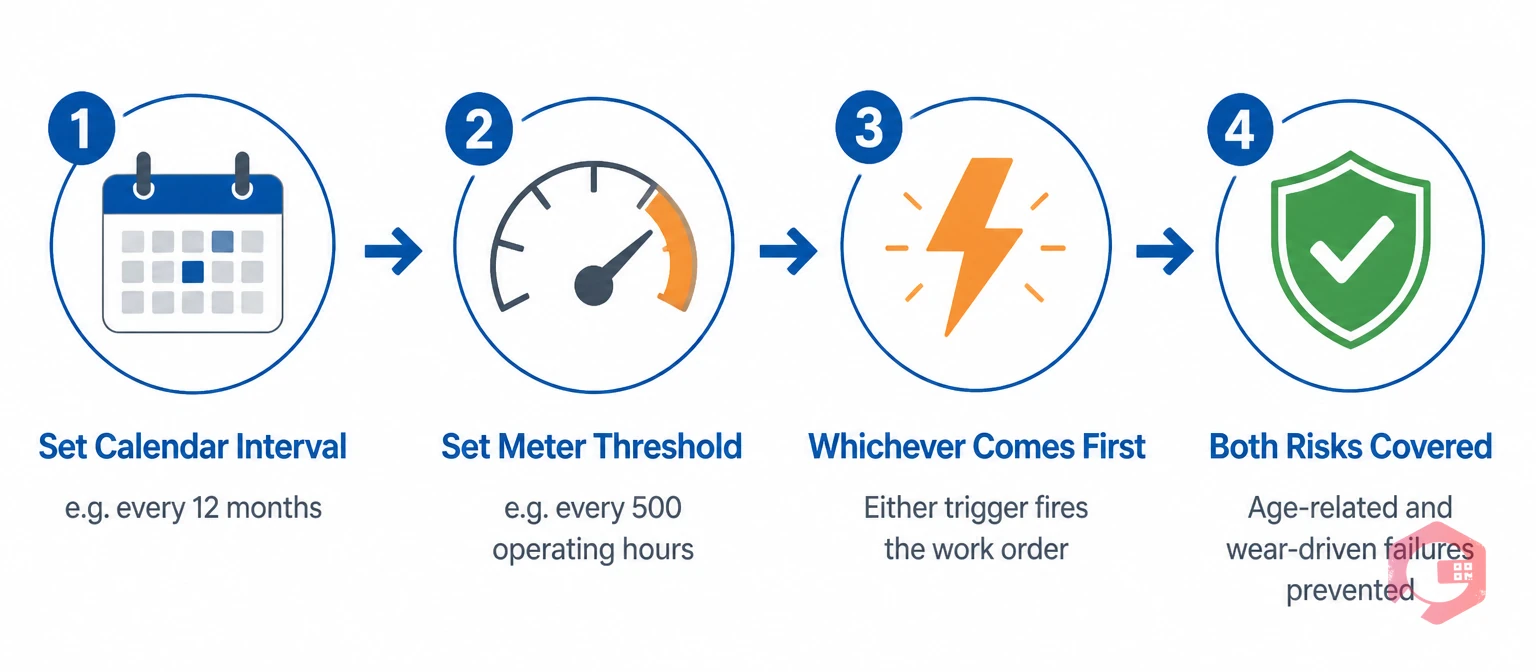
In practice, most well-run maintenance programs use both approaches simultaneously on the same assets. This hybrid strategy sets an either/or condition: service the asset when the calendar interval arrives or when the meter threshold is reached — whichever comes first.
A practical example: "Service the standby generator every 12 months or every 500 operating hours, whichever comes first." A generator running 40 hours per month hits 500 hours in just over 12 months — so the meter triggers first in a typical year. A generator running only 10 hours per month never reaches 500 hours in a year, so the 12-month calendar fires first instead. Both failure pathways are covered.
Hybrid scheduling delivers four key benefits:
Covers both degradation pathways: Time-based coverage catches age-related failure; meter-based coverage catches wear-driven failure. No gap is left open.
Protects high-value assets fully: For critical equipment where an unplanned failure is expensive or dangerous, "whichever comes first" is the conservative, defensible choice.
Adapts automatically to usage changes: If production ramps up, the meter threshold fires before the calendar does. If equipment sits idle, the calendar catches it before wear accumulates. No manual schedule adjustment needed.
Simplifies compliance documentation: Regulated assets can carry both a calendar interval (for auditors) and a meter threshold (for technical accuracy). Neither requirement is sacrificed.
Track your asset's baseline reliability before adjusting intervals — use the MTBF calculator to calculate mean time between failures and set evidence-based thresholds.
Common Implementation Challenges
Both approaches come with execution risks. Knowing them in advance prevents the most common scheduling failures:
Meter Data Reliability: Faulty hour counters, broken odometers, or inconsistent manual logging corrupt meter-based schedules. Implement meter validation checks in your CMMS and set alerts for counter anomalies or missing readings.
Multiple Failure Modes on a Single Asset: A motor might fail from bearing wear (usage-driven) and from seal corrosion (time-driven). A single-method approach leaves one failure pathway unprotected. Hybrid scheduling resolves this, though it adds a layer of configuration.
Legacy Equipment Without Meters: Older machinery often lacks integrated hour counters. Retrofit IoT sensors cover critical assets; for lower-priority equipment, manual meter logging is an acceptable fallback — but requires discipline to maintain.
Interval Creep Under Budget Pressure: Cost-cutting environments create pressure to extend maintenance intervals. Document the risk-benefit analysis for any change, tie intervals explicitly to manufacturer guidelines, and track failure rates after any adjustment to catch problems early.
Threshold-Setting Without Data: Starting meter intervals from scratch without historical failure data means your first thresholds are estimates. Begin conservatively (tighter than needed), track outcomes, and widen intervals only when actual failure data supports it.
Run through this process for each major asset class in your facility:
Identify the primary failure mode: Does this asset fail because of age (time-based) or because of use (meter-based)? Review manufacturer service manuals, historical work orders, and failure records. Most assets will show a dominant pattern.
Check if reliable meter data exists: If the asset has an accurate hour counter, odometer, or IoT sensor, meter-based scheduling is viable. If readings are manual, inconsistent, or unavailable, default to time-based until infrastructure improves.
Review compliance requirements: Regulated assets may have no choice — the standard specifies a calendar interval. Apply time-based scheduling as a floor, then add a meter overlay if usage justifies earlier service.
Assess usage variability: Does this asset run consistently, or does its runtime vary significantly by season, shift, or production volume? High variability strongly favors meter-based or hybrid scheduling over fixed calendar intervals.
Apply the hybrid rule to critical assets: For any asset where failure causes significant production loss, safety risk, or regulatory exposure, default to "whichever comes first" hybrid scheduling. The added complexity pays for itself on the first avoided unplanned failure.
Once you've assigned a method to each asset, a preventive maintenance software platform automates the trigger logic — no manual tracking required. You set the rules once and the system fires work orders automatically when thresholds are met.
Frequently Asked Questions
Can I use meter-based maintenance if my equipment doesn't have built-in hour counters?
Yes, but you'll need an alternative data source. Retrofit IoT sensors or digital hour meters work for critical assets — the investment typically pays back through smarter scheduling within a year. For non-critical equipment, manual meter logging is a viable fallback, though it requires consistent discipline. If neither is practical, default to time-based scheduling until infrastructure catches up.
Does time-based maintenance ever prevent failures better than meter-based?
Yes — specifically for failures caused by age, environmental exposure, and non-usage degradation. Rubber seals harden, batteries self-discharge, lubricants oxidize, and corrosion forms regardless of whether equipment runs. Meters don't capture any of this. For assets with these failure modes, time-based maintenance is more protective than meter-based, and a hybrid approach covers both simultaneously.
Which approach costs more?
Time-based maintenance typically inflates costs over time through unnecessary service on low-usage assets. Meter-based has higher setup costs (sensors, threshold-setting, data infrastructure) but delivers lower ongoing maintenance spend for variable-usage environments. Hybrid scheduling is the most cost-effective for critical assets because it eliminates both unnecessary early service and missed service on high-usage equipment.
Is meter-based maintenance used in regulated industries?
Yes. Aviation is the clearest example — engines follow hour-based and cycle-based overhaul schedules, while structural inspections follow combined calendar and flight-hour requirements. In pharmaceuticals and medical devices, calendar-based intervals typically form the regulatory floor, but many standards also permit earlier service when usage data justifies it. Always verify with your specific regulatory framework before replacing calendar intervals with meter-only triggers.
Getting the scheduling strategy right reduces planned downtime and prevents far more expensive unplanned failures. Schedule a free demo to see how Cryotos handles time-based, meter-based, and hybrid scheduling across your entire asset base — automatically.